Economic Observer Follow
2026-07-22 22:24


On July 22, the Ministry of Finance held a press conference to introduce the financial revenue and expenditure situation for the first half of 2026.
According to data from the Ministry of Finance, in the first half of the year, the national general public budget revenue was 1.21047 trillion yuan, a year-on-year increase of 4.7%; Expenditure was 1.43329 trillion yuan, a year-on-year increase of 1.5%.
Wang Zhenyu, Dean of the Institute of Local Finance at Liaoning University, analyzed that from the data, the general public budget revenue is experiencing a recovery growth, while the growth of main tax revenue tends to be positive. However, the tax revenue related to real estate is not as expected. He believes that in the second half of the year, we should continue to implement an active fiscal expenditure policy, ensure the necessary expenditure intensity, and play a countercyclical regulatory role.
In the government fund budget, the revenue from the transfer of state-owned land use rights was 977.8 billion yuan, a year-on-year decrease of 31.5% in the first half of the year, setting a new historical high for the same period in nearly a decade.
Yan Yuejin, Vice President of Shanghai E-house Real Estate Research Institute, told the Economic Observer that the decline in land transfer revenue this year is significant, and the reasons need to be comprehensively examined. Firstly, the real estate market is still in the process of stabilizing, and the land market is facing significant pressure; Secondly, there are also active regulatory factors contributing to the decline in land transfer revenue; Thirdly, there are also structural positive changes in the land market. When evaluating land transfer work, we should not only look at the total scale, but also re-examine it from the perspective of land supply quality and structural optimization.
Income
The Chinese government has "four accounts" for revenue, namely general public budget, state-owned capital operation budget, government fund budget, and social security budget.
The data released by the Ministry of Finance on a daily basis usually only involves general public budgets and government fund budgets. The general public budget is divided into tax revenue and non tax revenue.
According to Ma Hongbing, Deputy Director of the Treasury Department of the Ministry of Finance, in terms of tax categories, the domestic value-added tax increased by 6%, mainly driven by the sustained growth of the industrial and service industries, as well as the upward trend of factory prices for industrial producers; The value-added tax and consumption tax on imported goods increased by 11.8%, mainly due to the rapid growth of foreign trade imports; Corporate income tax increased by 3.9%, mainly due to the growth of corporate profits; The stamp duty on securities trading increased by 97.3%, mainly due to the increase in stock market transaction volume.
The growth rate of land value-added tax and farmland occupation tax related to the land and real estate markets is still declining. Among them, the land value-added tax was 214.6 billion yuan, a year-on-year decrease of 15.3%, and the farmland occupation tax was 83 billion yuan, a year-on-year decrease of 3.5%. The decline in land value-added tax usually means that the sales of commercial housing are under pressure, real estate companies have weak willingness to acquire land and start new construction, and the prosperity of the new housing development chain is declining; The decrease in farmland occupation tax means that real estate companies are unwilling to acquire new residential land.
Wang Zhenyu believes that there is a possibility of further decline in land transfer revenue (land finance) in the future period, and rational expectations need to be prepared.
According to data from the Ministry of Finance, in the first half of this year, the revenue from the transfer of state-owned land use rights was 977.8 billion yuan, a year-on-year decrease of 31.5%.
This is also the year with the largest year-on-year decline in the growth rate of land transfer revenue in the first half of the past decade. Compared with the peak of 3443.6 billion yuan in the first half of 2021, it is only 28.4% at that time, which is less than 30%.
Yan Yuejin believes that this year, the supply of real estate development land has generally slowed down in various regions, which is an active action in line with the policy orientation of "strictly controlling increment and optimizing stock", rather than a passive contraction. Especially with a clear reduction in the supply of land for bidding, auction, and listing purposes, most cities have lowered their land supply plans by about 20% compared to last year, which is a process of reducing quantity and improving quality. Therefore, the current decline in land transfer fees is largely the result of the government's proactive management.
Expenditure
In the first half of the year, the national general public budget expenditure was 1.43329 trillion yuan, a year-on-year increase of 1.5%. From the perspective of both the central and local governments, the expenditure of the central general public budget at this level was 2121.8 billion yuan, a year-on-year increase of 6.5%; The local general public budget expenditure was 1.22111 trillion yuan, a year-on-year increase of 0.6%.
The expenditure on "investing in people" has increased rapidly, with social security and employment expenditure accounting for 2.4504 trillion yuan, the highest year-on-year growth rate, with a year-on-year increase of 9.2%; Education expenditure was 2148.3 billion yuan, a year-on-year increase of 5.9%; Health expenditure reached 1100.4 billion yuan, a year-on-year increase of 4.3%.
Wang Zhenyu analyzed that the livelihood characteristics of the expenditure side are distinct, with social security and employment expenditures accounting for 18.4% in the first half of this year, after becoming the top expenditure in January 2025. At the same time, debt interest payments increased by 4.5% year-on-year, ranking third among all expenditure items in terms of growth rate, and this trend will continue to increase month by month in the future, which urgently needs to be taken seriously.
He said that at the local government level, most of them have entered a peak period of borrowing and repaying principal and interest this year. The "original" part can be resolved through refinancing bonds, borrowing new to repay old debts; And the part of "interest" is included in the general public budget, reflected as a rigid fiscal expenditure of real money and silver.
In the first half of this year, debt interest payments amounted to 668.9 billion yuan, a year-on-year increase of 6.1%. A county-level finance department official told reporters that local government bonds are divided into general bonds and special bonds. The interest payment for general bonds is usually at the provincial level, and cities and counties mainly pay interest for special bonds. There is a distribution issue here, as the restrictions on the use of general bonds are relatively small, and the willingness of provinces to allocate quotas downwards is relatively small.
Our annual special bond interest payment pressure is very high, accounting for more than 10% of the total expenditure plate. According to regulations, the principal of the special bond can be solved by issuing refinancing bonds (borrowing new to repay old), but the interest must be repaid by the project's own income or government fund income. With the decline in land income, we can only rely on the money raised from newly issued special bonds to circulate and pay interest, "said the county-level finance department official.


Volkswagen and Horizon officially announce L3 and L4 cooperation, L3 level self driving plan to be delivered in the second half of 2027, Robotaxi plan to be promoted synchronously
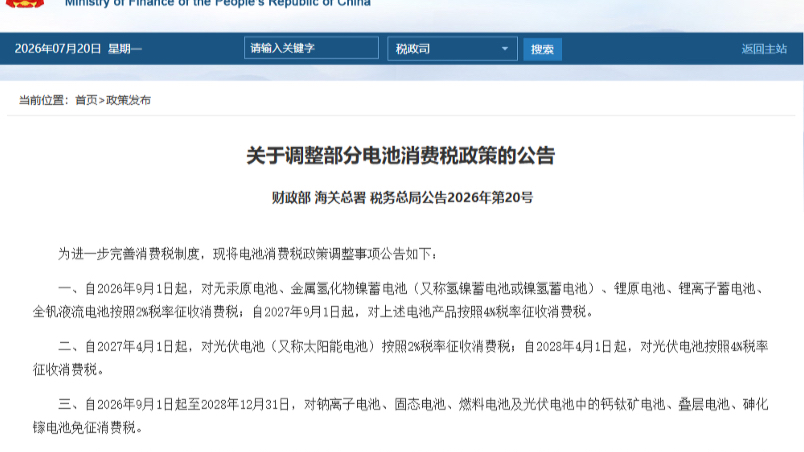
Is the 27 month tax-free window for solid-state batteries an expansion opportunity or a countdown to cost reduction?

Sinian Intelligent Driving has completed a 300 million yuan Series C financing, and the popularity of the autonomous driving heavy-duty truck track is rising. Unmanned truck collection in ports and mining areas has already made profits


 WeChat registration or login


 Subscribe