2026-07-22 17:12



Li Xiaodan Intern Cai Siwen/Wen Production is gradually stabilizing, and domestic demand is still bottoming out. In the first half of 2026, the Chinese economy will strive for progress while maintaining stability. The economic structural adjustment will continue in the second half of the year, and while policies continue to be implemented, more attention should be paid to practical results and kept in sync with the economic structural adjustment.
Economic data for June 2026 shows that CPI increased by 1.0% year-on-year, a decrease of 0.2 percentage points from the previous month. Despite the mild price performance in the first half of the year, consumer power still needs to continue to recover; PPI increased by 4.1% year-on-year, and the scissors gap between PPI and CPI is still widening; The manufacturing PMI was 50.3%, with a month on month increase of 0.3 percentage points; In the first half of the year, fixed assets investment decreased by 5.7% year on year, and real estate was still the main drag factor; In June, new RMB loans amounted to 1.61 trillion yuan, with a year-on-year decrease of 333 billion yuan in loans to the residential sector; The year-on-year growth rate of M2 has decreased to 8%, and the difference between the year-on-year growth rates of M2 and M1 has widened to 4%, indicating a weakened level of financial activity.
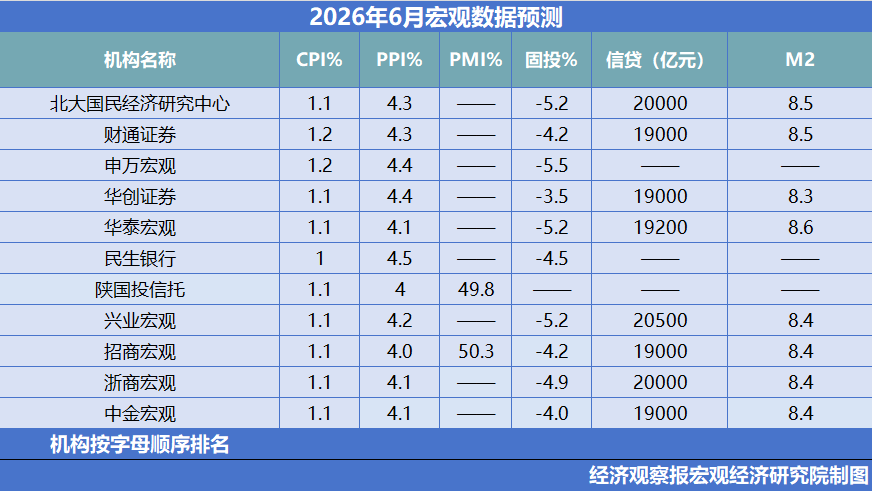
The "Economic Observer Monthly Observation" initiated by the Economic Observer is released once a month. A total of 11 institutions participated in the monthly macro data forecast.
CPI: Moderate increase in the first half of the year, domestic demand still remains constrained
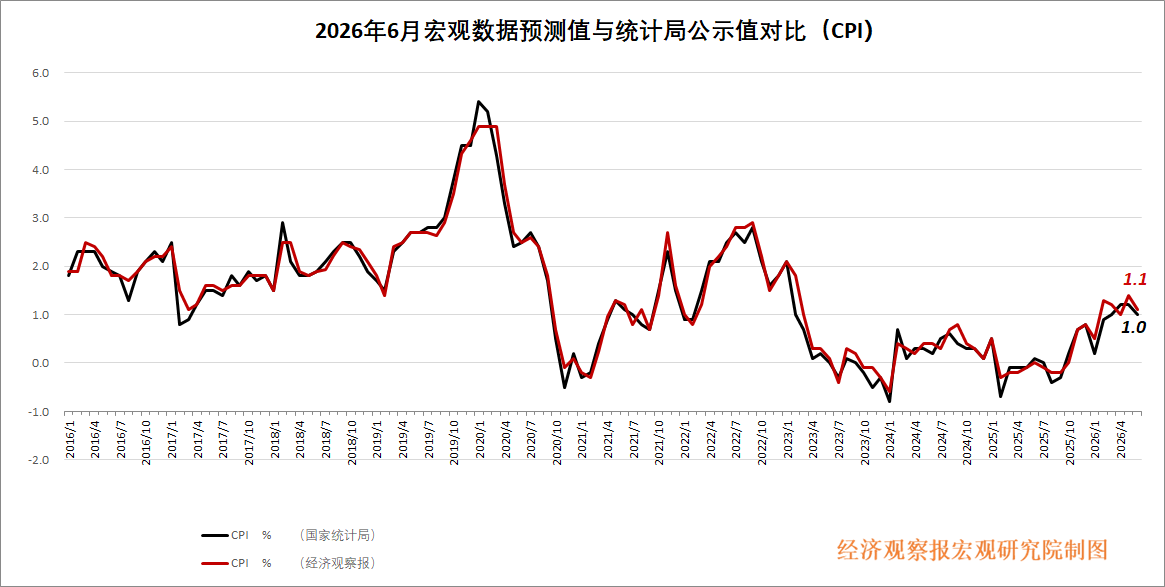
CPI published value: 1.0%
Previous value: 1.2%
CPI forecast: 1.1%
Professor Su Jian from the School of Economics at Peking University and Director of the National Economic Research Center commented:In June, the CPI increased by 1.0% year-on-year, a decrease of 0.2 percentage points from the previous month, and the growth rate of consumer prices remained stable. The suspension of the US Israel Iran war in June and the decline in international crude oil prices are the main factors leading to the downward trend in CPI growth this month. In the first half of the year, CPI increased by 1.0% year-on-year, 1.1 percentage points higher than the same period last year, and consumer prices for residents rose moderately. On the one hand, factors such as low base effect, in-depth rectification of "anti involution" competition, and fluctuations in international crude oil prices have all driven up consumer prices in the first half of the year; On the other hand, the growth rate of residents' income is still relatively low, which suppresses the increase in CPI growth rate.
PPI: Year on year increase hits a new high in nearly four years
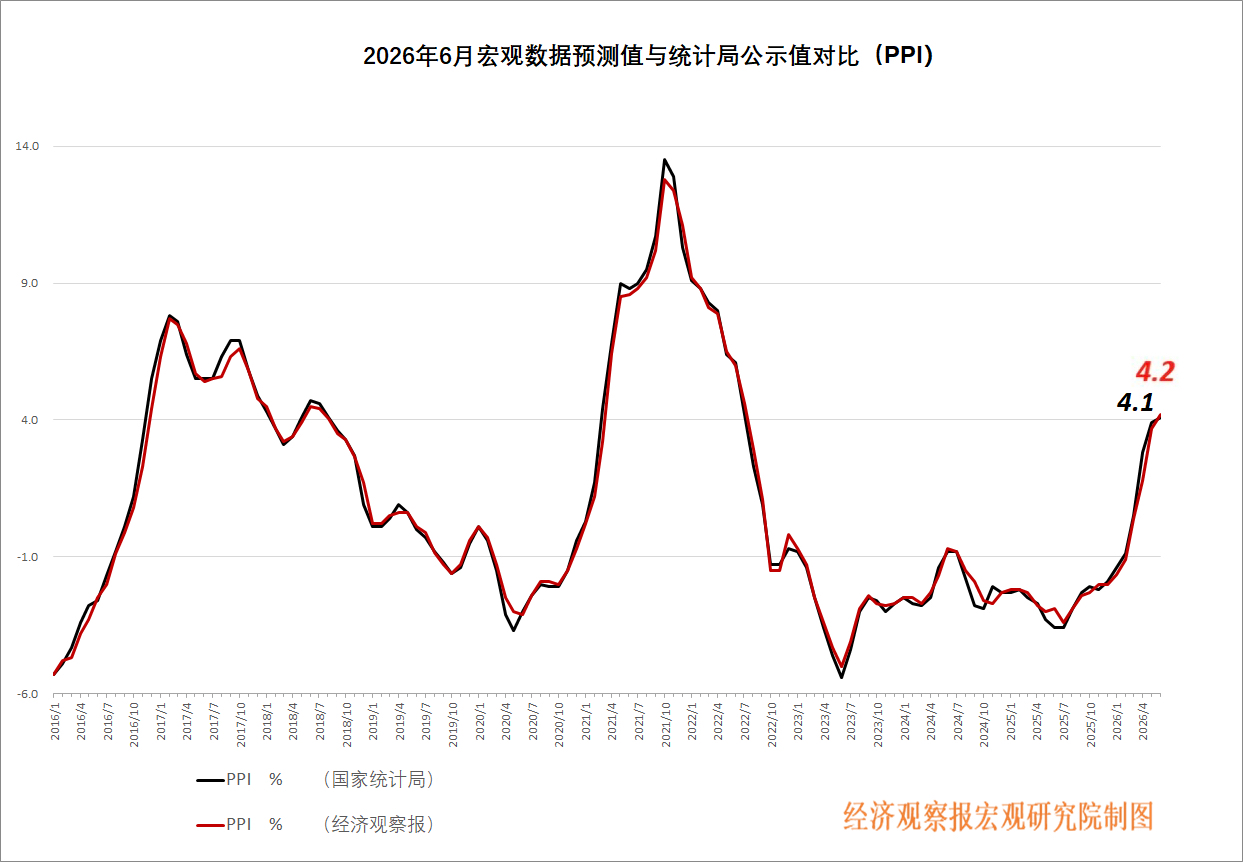
PPI published value (year-on-year): 4.1%
Previous value: 3.9%
PPI forecast (year-on-year): 4.2%
AVIC Securities analyst Guo Xin commented:PPI rose by 4.1% year-on-year in June, up 0.2 percentage points from the previous month, reaching a new high since August 2022; PPIRM increased by 6.4% year-on-year, up 0.6 percentage points from the previous month. Specifically, in June, PPI production materials increased by 5.5% year-on-year, up 0.3 percentage points from the previous month, while PPI living materials decreased by 0.9% year-on-year, down 0.1 percentage points from the previous month. The scissors gap between production materials and daily necessities has been widening for three consecutive months, indicating that the transmission of prices from upstream to midstream and downstream remains sluggish.
From the perspective of upstream and downstream price transmission, the current scissors gap between PPI and CPI is still widening, and the upward trend of upstream raw material prices has not effectively transmitted to terminal consumer prices, further expanding the structural differentiation characteristics. The PPI trend is facing a game of high-level decline and structural support. From the perspective of input factors, with the signing of the memorandum of understanding between the United States and Iran, the overall geopolitical risks in the Middle East have eased, and the upward space for oil prices is limited. It may be difficult to form a sustained upward momentum in the second half of the year. In addition, from the perspective of industry chain structure, the trend of price increase in the AI industry chain is expected to continue, and it is expected to continue to support PPI year-on-year in the future.
PMI: Marginal recovery of manufacturing industry prosperity
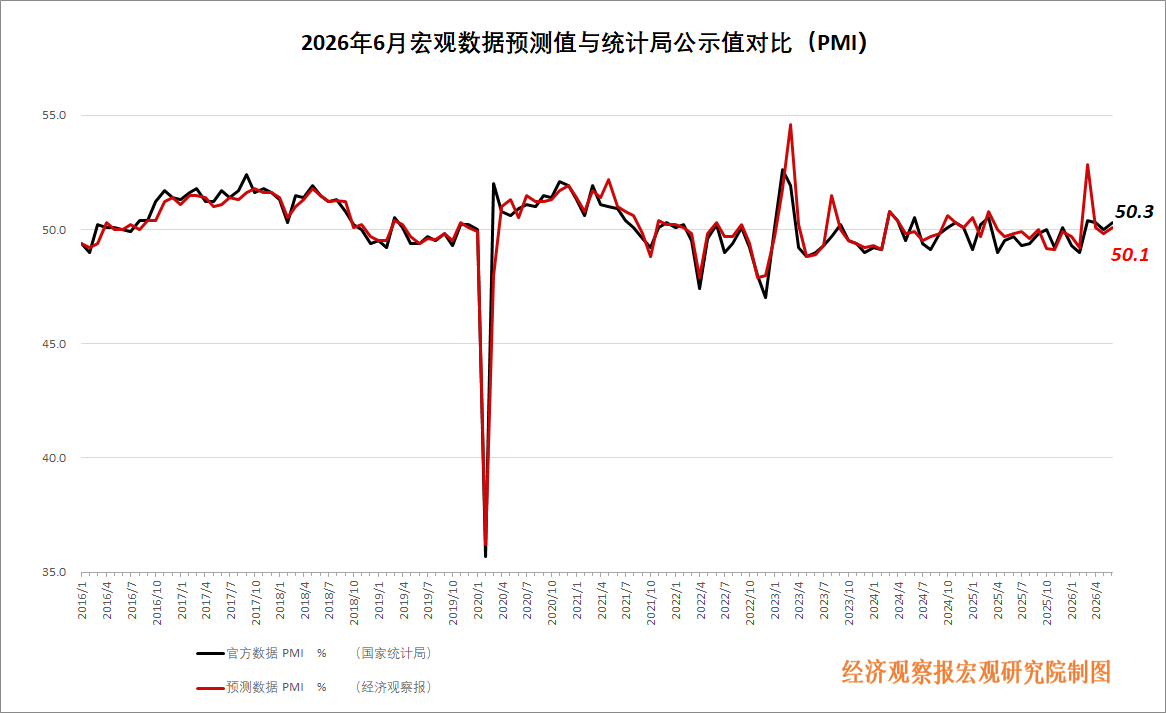
PMI release value (MoM): 50.3%
Previous value: 50.0%
PMI forecast (MoM): 50.1%
Sun Suyu, Chief Analyst of Macroeconomics Group at Huayuan Securities Research Institute, commented:The manufacturing PMI for June was 50.3%, up 0.3 percentage points from the previous month. On the production side, PMI production rebounded by 0.2 percentage points month on month to 51.4%, still maintaining an expansion trend; Both internal and external demand have rebounded, with a slight improvement in external demand. PMI new orders, PMI new export orders, and PMI imports have increased by 1.3, 1.5, and 0.8 percentage points month on month to 51.2%, 50.1%, and 49.6%, respectively. Looking at different industries, industries such as agricultural and sideline food processing, specialized equipment, computer communication and electronic equipment have a relatively high level of production and demand, while industries such as chemical fiber and rubber plastic products, and black metal smelting continue to fall below the critical point.
Recently, all ministries and commissions have steadily promoted the established policies, including accelerating the construction of policy based financial instruments and "six networks", speeding up the issuance and use of ultra long term special treasury bond, special bonds, etc., printing and issuing the Action Plan for Utilizing Foreign Capital to Stabilize Stability and Promote Excellence and other measures, and required to increase pre research reserves and launch incremental policies in a timely manner to stabilize the endogenous momentum of the economy. Follow up will focus on the setting of economic work in the second half of the year at the Political Bureau meeting in July and the potential incremental policies.
Fixed investment: Real estate remains the main drag factor
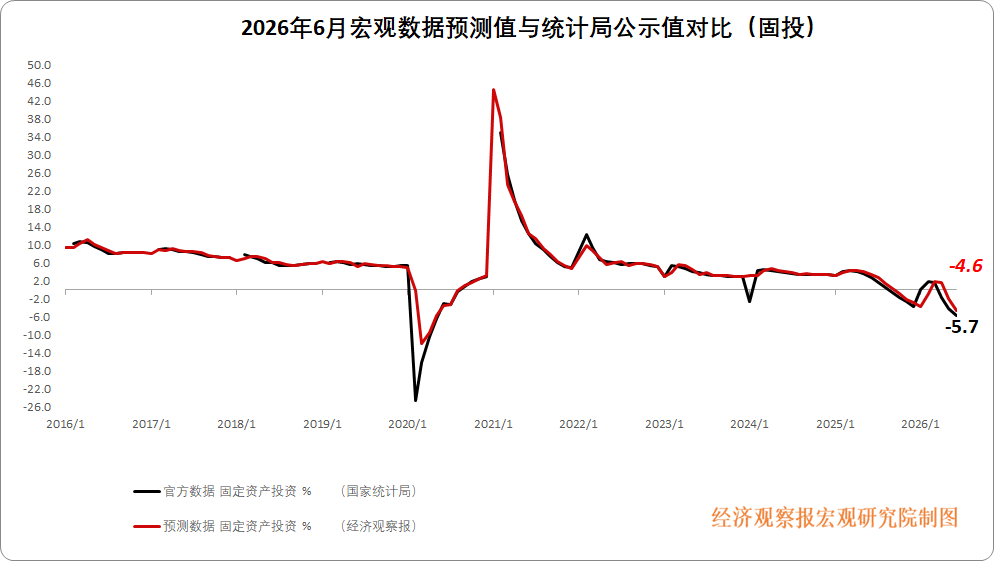
Fixed investment announcement value (cumulative year-on-year): -5.7%
Previous value: -4.1%
Fixed investment forecast value (cumulative year-on-year): -4.6%
Southwest Securities Chief Economist Ye Fan commented:In the first half of the year, fixed assets investment decreased by 5.7% year on year, and real estate was still the main drag factor. With the promotion of the construction of "Six Networks" and the accelerated issuance of ultra long term special treasury bond, financial funds are expected to support investment in infrastructure and related industries. In terms of real estate investment, real estate development investment decreased by 18% year-on-year in the first half of the year, and the market is still in the adjustment stage.The policy continues to focus on reducing home purchase costs, unleashing demand for improvement, and revitalizing existing housing, but sales recovery and investment willingness of real estate companies are still weak, and real estate investment is still under pressure in the short term.
In terms of manufacturing investment, it decreased by 1.2% year-on-year in the first half of the year, but the advanced manufacturing sector remained resilient. With the implementation of the "two new" policies, the release of equipment update demand, and the landing of 800 billion yuan of new policy based financial instruments, manufacturing investment is expected to continue its structural improvement.
Credit: Residents deleverage, with a focus on structural easing of currency
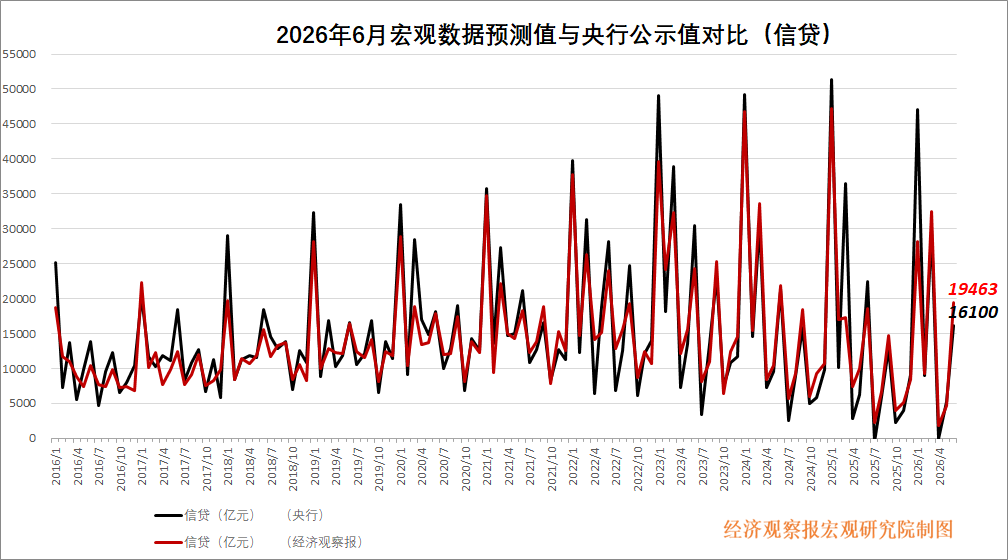
Newly added credit announcement value (year-on-year): 1.61 trillion yuan
Previous value: 520 billion yuan
New credit forecast value (year-on-year): 1946.3 billion yuan
Xiong Yuan, Chief Economist of Guosheng Securities, commented:In June, new RMB loans amounted to 1.61 trillion yuan, with a previous value of 520 billion yuan, compared to 2.24 trillion yuan in the same period last year. Among them, loans from residential departments increased by 264.6 billion yuan, a year-on-year decrease of 333 billion yuan; Enterprise loans increased by 1.5 trillion yuan, a year-on-year decrease of 270 billion yuan; Non bank loans decreased by 142.6 billion yuan, a year-on-year decrease of 40 billion yuan. Overall, the newly added credit is lower than expected and below seasonal levels, with no improvement in structure.
On the residential end, short-term loans have turned from negative to positive, but significantly lower than seasonal ones; Continuous medium and long-term loans9The month on month decrease in year-on-year growth indicates that there has been no significant improvement in consumption and real estate, and the internal driving force of the economy is still weak. On the enterprise side, short-term loans increased slightly compared to the same period last year, while bills increased significantly with obvious impulse characteristics. Medium - and long-term loans continued to grow4The month on month decrease is mainly due to the weak investment willingness of physical enterprises and the lack of significant acceleration in fiscal efforts.
From the perspective of monetary policy, easing is still the general direction, but under constraints such as bank interest rate differentials, the central bank's interest rate cuts will be more cautious, mainly focusing on structural easing. Comprehensive interest rate cuts need to be driven by weak fundamentals or financial risks.
M2: Decreased growth rate, differentiated deposit structure
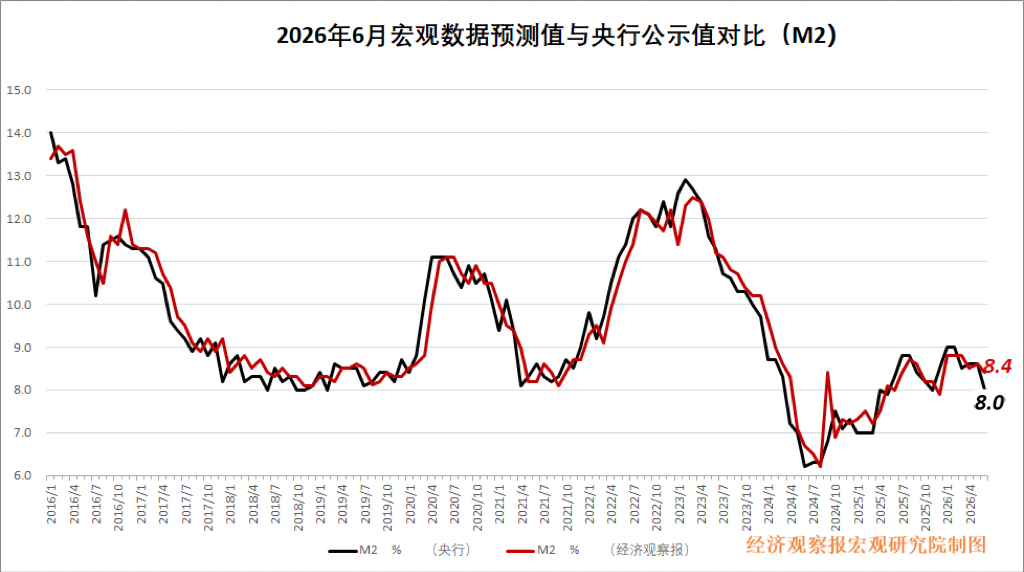
M2 published value (year-on-year): 8.0%
Previous value: 8.6%
M2 forecast value (year-on-year): 8.4%
Chen Xing, Chief Macro Analyst at Huafu Securities, commented:The year-on-year growth rate of M2 in June fell to 8%, a decrease of 0.6 percentage points from the previous month. In June, fiscal deposits decreased by 938.5 billion yuan, with a year-on-year decrease of 118.5 billion yuan from a decrease to an increase; Resident sector deposits increased by 1.95 trillion yuan, with a year-on-year decrease of 520 billion yuan compared to the previous year; Corporate sector deposits increased by 1.94 trillion yuan, from a decrease to an increase of 162.7 billion yuan year-on-year. In June, the growth rate of M1 fell back to 4%, a significant decrease of 1.5 percentage points from the previous month. The difference in year-on-year growth rate between M2 and M1 widened to 4%, indicating a weakening of the level of capital activity.
At the end of June, the growth rate of social financing stock continued to decline to 7.4%, and the growth rate after excluding government bonds also decreased. Firstly, due to insufficient effective financing demand, credit continued to show a trend of low year-on-year growth; The second reason is that the pace of government bond issuance has slowed down, resulting in a much smaller net financing scale compared to the same period last year. Overall, there were two major changes in the financing structure in the first half of the year: on the one hand, the proportion of direct financing increased significantly, with corporate bond and stock financing accounting for 11.3% of the social financing increment in the first half of the year, 5.5 percentage points higher than the same period last year, forming a certain substitution effect on loans; On the other hand, credit resources are shifting from the residential end to the enterprise end, and from traditional heavy assets such as real estate and infrastructure to emerging fields. In the first half of the year, there was a net decrease in residential loans, so "slowing down and improving quality" of loans will still be one of the new normal in the future. Although the central bank suggests combining loans and bonds for observation, in reality, the sum of newly added credit and newly added corporate bonds in the first half of the year continued to increase slightly year-on-year, and the financing demand of the real sector was weak.

Director Lu Peihua of Ludaopei Hospital: Leukemia diagnosis and treatment have entered the "molecular age", with gene determined treatment plans

Volkswagen and Horizon officially announce L3 and L4 cooperation, L3 level self driving plan to be delivered in the second half of 2027, Robotaxi plan to be promoted synchronously
Is the 27 month tax-free window for solid-state batteries an expansion opportunity or a countdown to cost reduction?


 WeChat registration or login


 Subscribe