Economic Observer Follow
2026-05-24 11:51


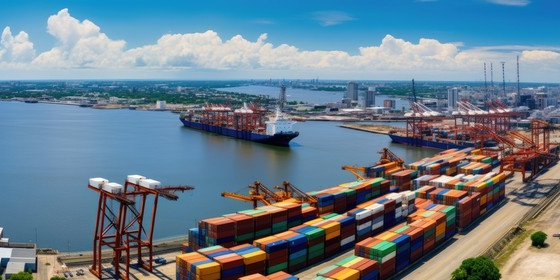
After the May Day holiday, Yan Qin often drove to multiple bulk commodity warehousing and logistics centers in Shanghai to inquire with staff about the latest situation of the transfer of warehouse receipts and cargo rights for copper and aluminum metal for corporate customers.
Yan Qin works as a corporate customer manager at a city commercial bank in Shanghai, with over 5 years of experience in bulk commodity credit.
He said, "If the strict matching of contract flow, invoice flow, fund flow, and goods flow in terms of time and business logic cannot be confirmed (i.e. the integration of the four flows), the bank's risk control department will not approve credit applications." Since the second half of April, he has had multiple bulk commodity trade financing applications "stuck" and needs to supplement relevant information to meet the "integration of the four flows" requirements, proving the authenticity of the relevant bulk commodity trade background and reasonable commercial purposes.
Yan Qin said that these changes stem from the continuous strengthening of the rectification efforts of relevant departments on the "invoicing economy" (referring to behaviors that deviate from real business activities and use invoicing as the main purpose or means of profit) since the beginning of this year.
In late April, the State Administration of Taxation released the "Positive and Negative List of Taxpayers' Compliance in Issuing Invoices" (hereinafter referred to as the "List"), which clearly listed 28 negative list situations of illegal invoicing, including large invoicing amounts, abnormal tax burdens, extremely few employees, lack of external vouchers for goods receiving, shipping, warehousing, testing, acceptance and other links that match business activities, or business entities engaged in financing trade or false trade; Invoices with no reasonable commercial purpose, such as "opposite opening and ring opening", without reasonable basis, such as "flat input and output, inverted sales and purchases", and fictitious transaction links such as "idle order processing".
The trade of bulk commodities has the characteristics of large invoicing volume, high single transaction amount, and fast circulation of warehouse receipts, which can easily lead to phenomena such as "bill of lading without goods" and "idle bill of lading". It is a major area of the barbaric development of the "invoicing economy" in recent years. Especially in the trade of bulk commodities such as copper, aluminum, coal, and iron ore, there are some fraudulent loan behaviors such as repeated pledging and falsified warehouse receipts.
As the risk control director of a joint-stock bank's East China branch, Luo Qiang received the latest notice from the head office at the end of April on "strengthening risk control of bulk commodity pledge financing and trade financing".
In the past two weeks, he has taken multiple risk control measures - significantly reducing credit or suspending lending to bulk commodity trading companies suspected of violating "invoicing economy" regulations; All bulk commodity pledge financing and trade financing must first meet the "four in one" requirement, otherwise the risk control department will not accept relevant loan applications. This has resulted in the actual credit allocation for bulk commodities by this branch in the past two weeks being less than 500 million yuan, a decrease of over 30% compared to the same period last year.
According to Luo Qiang's rough estimate, his branch has a total of about 260 bulk commodity trading enterprise customers, of which about 40% of the enterprises are affected by tax inspections and upstream and downstream trade chain invoicing limits, making it difficult to submit value-added tax special invoices as trade vouchers in a timely manner, resulting in a slowdown in bank lending; In addition, about 10% of enterprises have situations such as "taking orders without goods" and "idling orders", which have been included in the "risk enterprise category" by the risk control department, significantly reducing credit and suspending lending.
Although this has an impact on banking business, Luo Qiang hopes that relevant departments can thoroughly rectify the "invoicing economy" this time. In the long run, this move will "clear the mines" for banks' commodity credit business and reduce the risk of loan fraud caused by enterprises repeatedly pledging the same batch of commodities and falsifying warehouse receipts.
Data shows that since the beginning of this year, various regions have achieved initial results in rectifying "circular invoicing" and "mutual invoicing". The wholesale industry, which is a high-risk area for illegal invoicing, saw a year-on-year decrease of 2.5% in invoicing amounts. Among them, the coal and product wholesale industry and the metal and metal ore wholesale industry, which are most closely related to bulk trade, experienced significant declines, with invoicing amounts decreasing by 7.1% and 5.7% respectively.
Tightening Credit Approval
In the first three months of this year, Yan Qin only needed to request trade contracts, invoices, relevant warehouse receipts, inbound and outbound information, and transfer documents from regular customers of bulk commodity trading enterprises to generate application materials for bulk commodity pledge financing or trade financing and submit them to the risk control department. In most cases, the risk control department will approve the loan smoothly.
But after the release of the "List", the risk control department of Yan Qin's bank began to rigorously investigate the authenticity of the trade background and reasonable commercial purposes of commodity credit. He started going to the warehousing and logistics center every day to ensure that each bulk commodity credit meets the "four in one" requirements.
During this period, Yan Qin often received calls from the risk control department, either requesting to submit relevant materials such as warehouse records, inbound and outbound documents, transportation vouchers, etc., or requesting him to conduct on-site inspections to ensure that the transfer of cargo rights on the warehouse receipt is consistent with the inbound and outbound documents.
The risk control department also reminded him that if a customer manager colludes with a bulk commodity trading enterprise and fabricates "four streams in one" information, once the bank verifies it, the customer manager will be severely punished.
In order to make customer managers aware of the credit risks arising from the "invoicing economy" of bulk commodities, on the first working day after the May Day holiday, Yan Qin's bank also issued various false trading practices for bulk commodities, requiring customer managers to be vigilant.
For example, if Company A seeks a loan from Company B, Company B will contact its affiliated commodity trader C, who will sell the commodity goods to Company B and issue a VAT special invoice. Company A promises to repurchase the goods. In this way, Company B uses invoices as trade vouchers to apply for bulk commodity trade financing from the bank and hands over the loan funds to A. In this business chain, bulk commodities did not undergo "real" trade, but credit funds were obtained through fictitious trade and issuing special invoices between Company B and its affiliated enterprise C.
For example, a bulk commodity enterprise, without a real trade background, uses the same batch of bulk commodity goods to conduct multiple transactions with affiliated enterprises in order to inflate performance or obtain more credit funds from banks. It artificially fabricates multiple bulk commodity trade invoices, warehouse receipts, and transportation vouchers. Once the bank issues pledged loans to each warehouse receipt, it faces a high risk of loan fraud.
In order to avoid the above-mentioned credit risks, Yan Qin not only conducted on-site inspections of the "four streams in one", but also became extra careful in generating credit application materials, fearing that key information would be missed.
Previously, these bulk commodity credit application materials could be completed at 8 pm, but now they are still being revised in the early morning. This is because there are too many additional materials to be added, such as warehouse records, inbound and outbound documents, transportation vouchers, etc., and each bulk commodity trade needs to be proven to have a reasonable commercial purpose first, and it is not an idle order, "he said.
Luo Qiang is also well aware of the hard work of customer managers, but recently the approval rate for bulk commodity credit in his branch has decreased by about 25 percentage points. Several banks in the East China region are also tightening the approval of commodity credit, "he said bluntly. Colleagues from the risk control departments of two banks' Shanghai branches told him that their approval rates for commodity credit have recently decreased by at least 20 percentage points from around 85%.
Behind this is the recent rectification of the "invoicing economy", which has caused bulk commodity trading enterprises to more or less encounter situations such as ticket suspension and restriction, reduced invoice amounts, etc., making it impossible to submit invoices as trade vouchers to banks, and making it difficult for bank risk control departments to approve credit applications; Secondly, banks take the initiative to strengthen risk control of commodity credit. Once it is discovered that corporate customers are being inspected by tax departments, credit limits will be quickly reduced and lending will be suspended, resulting in related credit applications being "stuck".
Some commodity trading companies are "complaining" - they are not aware that upstream traders engage in false trade, "non delivery", "idle delivery" and other behaviors. Obtaining relevant trade invoices is considered a good faith acquisition, and they hope that banks can be lenient and complete credit application approval and disbursement as soon as possible. However, in order to prevent potential risks of duplicate pledge or warehouse receipt fraud, banks will suspend credit applications and wait for the tax department to complete inspections and prove that these enterprises are operating in compliance before resuming credit limits and credit approvals.
Recently, the head of the corporate business department at the branch where Luo Qiang works has repeatedly approached him, stating that if the risk control department continues to strictly tighten credit, they will definitely not be able to achieve their goal of increasing commodity credit business by 30% this year. We are also helpless. The risk control department of the head office believes that the top priority is to strengthen the risk control of commodity credit and avoid the rectification of the 'invoicing economy' in the commodity field from affecting our own credit security, "said Luo Qiang.
Enterprise credit encounters obstacles
Jiang Bo is the business director of a commodity trading enterprise in East China. In the past two weeks, the company has had three bulk commodity trade financing transactions stuck in the bank risk control link. This situation has never happened before, "he said. All along, the company has strictly followed relevant regulations to ensure that each bulk commodity trade has a real background and reasonable commercial purpose, and strictly achieved the "four flows in one". In the process of rectifying the "invoicing economy" of bulk commodities, the local tax department did not take measures such as reducing the invoice credit limit or monitoring the invoicing amount on a daily basis. However, our credit business has still been mistakenly damaged, "he said. He has submitted storage documents, logistics records, fund transfer vouchers, bulk commodity goods inbound and outbound vouchers and other information twice, but there is still no sign of approval progress.
In his opinion, this kind of accidental injury may be difficult to avoid. After all, in order to reduce operating costs, bulk commodity traders have adopted a light asset operation model, which means that bulk commodity goods are directly initiated by upstream logistics transportation, downstream enterprises pick them up, and traders do not have their own warehousing and logistics bases.
In this mode, Jiang Bo's company only has more than 20 employees, but its annual trade volume exceeds 1 billion yuan, and the invoicing amount often approaches 1 billion yuan. Due to fierce competition in the commodity market, the company's single trade profit margin is less than 0.6%, and it can only rely on volume to increase its profit margin.
However, this characteristic of "large invoicing volume, high single transaction amount, fast warehouse receipt circulation, few employees, and low profit margin" is easily confused with behaviors such as "idling orders", "orders without goods", and "financing trade".
Jiang Bo discovered that the company's business financing was being blocked, triggering a domino effect. On May 14th, a bank that had been cooperating for many years suddenly told him that it was difficult to accept the company's bulk commodity trade financing business in the near future because other banks seemed to have suspended the company's credit lending. On the same day, another cooperating bank notified him for the same reason that it would reduce the company's credit limit by about 50%.
What also troubles him is that the credit approval bottleneck is causing the inventory of warehouse receipts in the company to continue to accumulate. This means that companies need to pay a hefty storage fee every day. In the long run, the previously meager profits of the enterprise will also be depleted.
Jiang Bo noticed that in mid May, the State Administration of Taxation required tax departments in various regions to classify and handle the risks of enterprise operation and invoicing based on their level of risk. Without actual verification, a "one size fits all" approach should not be applied, and measures such as suspending or limiting invoices or reducing invoice amounts should not be taken to effectively ensure the normal invoicing needs of enterprises.
Jiang Bo is particularly happy because this means that the relevant departments support the normal operation of compliant bulk commodity enterprises, which will help them persuade banks to resume credit cooperation as soon as possible.
Finding a compliant path
Equally anxious as Jiang Bo is Yan Qin. He calculates every day how to meet the assessment target of 60 million yuan for commodity credit allocation.
After inquiring from various sources, he found that the Shanghai Futures Exchange's standard warehouse receipt pledge financing and trade financing for bulk commodities are almost not "stuck" by the risk control department, because the ownership of these standard warehouse receipts is clear and can effectively prevent duplicate pledges and false warehouse receipts.
In addition, some non-ferrous metal trading platforms with local government backgrounds have cooperated with local tax departments to establish a "trusted tax invoice chain" and incorporate commodity trade transaction data into tax supervision. As long as the trade data is true and traceable, relevant enterprises can enjoy invoice authorization, material exemption, and verification. The risk control department of the bank also believes that this type of commodity trade has high compliance and will smoothly approve credit applications.
On May 18th, as soon as Yan Qin stepped into a large non-ferrous metal trading platform in Shanghai, he was informed that there were as many as five or six banks seeking commodity credit cooperation with the platform in recent days. He realized that it would be quite difficult for him to get a share of the pie.
Luo Qiang is also considering how to improve the approval rate of bulk commodity credit for compliant enterprises in the current context of enhancing credit approval risk control.
He found that an important reason for the extreme "prudence" of bank risk control is that in the past, banks relied too much on the credit level and financing guarantee ability of core enterprises in the commodity trade chain for such approvals - as long as the financing guarantee ability of core enterprises is strong enough, even if the "four flows in one" are not achieved, the risk control department will still lend money. Nowadays, this approach is no longer feasible.
On May 18th, Luo Qiang requested the bank's technical department to improve the risk control system for bulk commodity credit, first enhancing data collection and analysis capabilities through artificial intelligence technology, so that the bank's risk control department can quickly understand the logistics traces, storage records, and latest trends of bulk commodities for enterprise customers, and improve the "four in one" audit mechanism; By comparing the past commodity trade records of relevant enterprises through big data analysis technology, it is confirmed whether the end buyers are downstream commodity processing factories, thereby preventing illegal behaviors such as false trade and financing trade.
As regulatory authorities continue to rectify the 'invoicing economy' of commodities, in order for commodity trading enterprises to win bank credit support in the future, they cannot become arbitrageurs dependent on the 'invoicing economy', but rather risk managers of the commodity trading chain. This is also a necessary path for the commodity trading industry to move from barbaric development to standardized and mature development, "he said bluntly.
(At the request of the interviewee, Luo Qiang uses a pseudonym)


 WeChat registration or login

 Subscribe