2026-01-30 17:07



As a leading enterprise in the field of high-end general computing in China, Haiguang Information has always adhered to an open and compatible development strategy, accumulated profound technical expertise in security and stability, and has long been committed to providing core technical support for the domestic computing industry. The company focuses on the research and development of high-end computing chips and related technologies, closely follows the upgrading demand for computing power from emerging applications such as artificial intelligence, actively explores breakthroughs in the bottleneck of interconnection under heterogeneous computing systems, and deeply aligns its business layout with the development direction of independent controllability and efficient collaboration of the domestic computing power industry, laying a solid foundation for the improvement and upgrading of the domestic computing ecosystem.
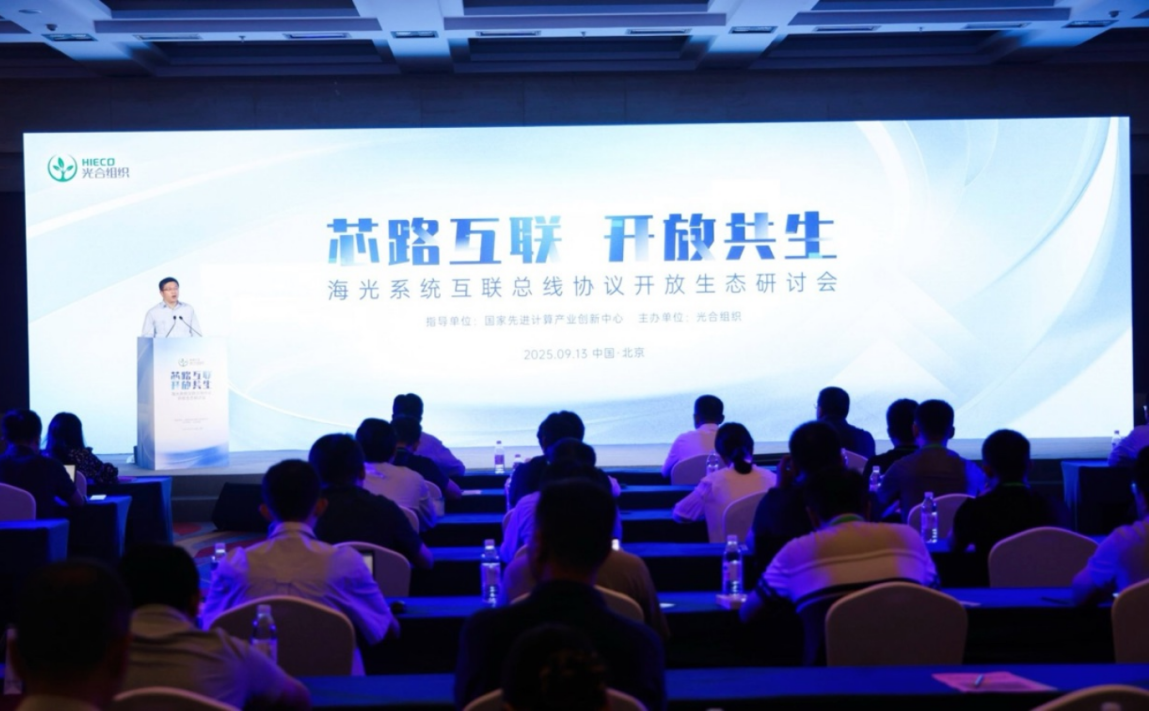
With the exponential growth of computing power demand for applications such as artificial intelligence big models, traditional single form processor architectures are no longer able to meet the performance requirements of diverse scenarios. Heterogeneous computing systems composed of various chips such as CPUs, GPUs, NPUs, etc. have become the mainstream in the industry. However, the efficient collaboration of different components in heterogeneous systems has always been a pain point in the industry. Zheng Weimin, academician of the CAE Member, pointed out that, CPU?GPU? The collaborative efficiency between accelerated card storage and network modules directly determines the overall performance release of heterogeneous systems, and a unified and efficient interconnect bus protocol is the key to solving this problem. In this context, Haiguang Information independently developed the System Bus Interconnection Protocol (HSL) and officially opened the protocol to the full stack of GPU, IO, OS, OEM and other industries at a seminar held in Beijing in September 2025. The HSL protocol has five core characteristics: high bandwidth, low latency, global address space consistency, full stack openness, and flexible scalability. Compared with traditional PCIe interfaces, it achieves multi-dimensional breakthroughs: in terms of performance, it significantly reduces data transmission latency, improves bandwidth, supports high-speed direct connections between chips, and allows the GPU within the AI supernode to fully utilize CPU memory space, significantly improving the efficiency of AI model operation; In terms of development expansion, it simplifies programming complexity and can flexibly support elastic expansion from single machine multi card to large-scale intelligent computing clusters. It also supports heterogeneous interconnection of computing acceleration cards at or above the 10000 card level; In terms of ecological collaboration, we open up the complete bus protocol, provide IP reference design and open instruction set, fully support mainstream domestic AI chips, help upstream and downstream partners connect efficiently, break down technical barriers, and unleash the collaborative efficiency of domestic computing power.
At present, the HSL agreement has achieved clear phased results, and the HSL 1.0 specification has been officially released in the fourth quarter of 2025, providing a standardized technical foundation for ecological partners. Haiguang Information has established deep cooperation with multiple core ecological partners in China, covering GPU research and development, server systems, operating systems, and other fields, forming a complete industrial ecosystem.
For Haiguang Information, the development and opening up of the HSL protocol is not only a concentrated reflection of the company's technological strength, but also an important measure to fulfill the mission of independent and controllable domestic computing power. In the future, the company will continue to invest in protocol iteration and upgrading, optimize performance, improve the ecosystem, promote deep collaboration of core components such as domestic CPUs, GPUs, and NPUs, and break the monopoly of foreign technology. From an industrial perspective, the promotion and application of the HSL protocol will promote the standardized and large-scale development of domestic AI computing power ecology, provide strong computing power support for the high-quality development of the digital economy, and inject lasting momentum into China's technological self-reliance and industrial structure optimization and upgrading.
Zhang Xin/Wen


 WeChat registration or login