2026-11-23 19:16


On November 17th, at a conference titled "What are the real challenges for China's AI from catching up to originality? 》In the podcast, Lin Dahua, co-founder, executive director, and chief scientist of SenseTime, presented his observations:AI competition is not a 100 meter sprint, but a compound interest game。
In the field of AI in China, Lin Dahua is one of the most qualified individuals to discuss the topic of AI competition. He is one of the few people in the Chinese AI community who has personally run through all four lines of "academic source - open source infrastructure - commercial companies - national standards". He reorganized SenseTime from "selling CV APIs" to "selling large models+spatial intelligence". This kind of real experience from the front line is not possessed by most big model entrepreneurs, scholars, and investors.
Lin Dahua sees the AI competition as a long-distance race.The process towards General Artificial Intelligence (AGI) is a long run, not an overnight sprint. ”On August 12, 2025, he wrote this sentence in his lengthy article "Towards Multimodal Universal Intelligence: Reflections on SenseTime".
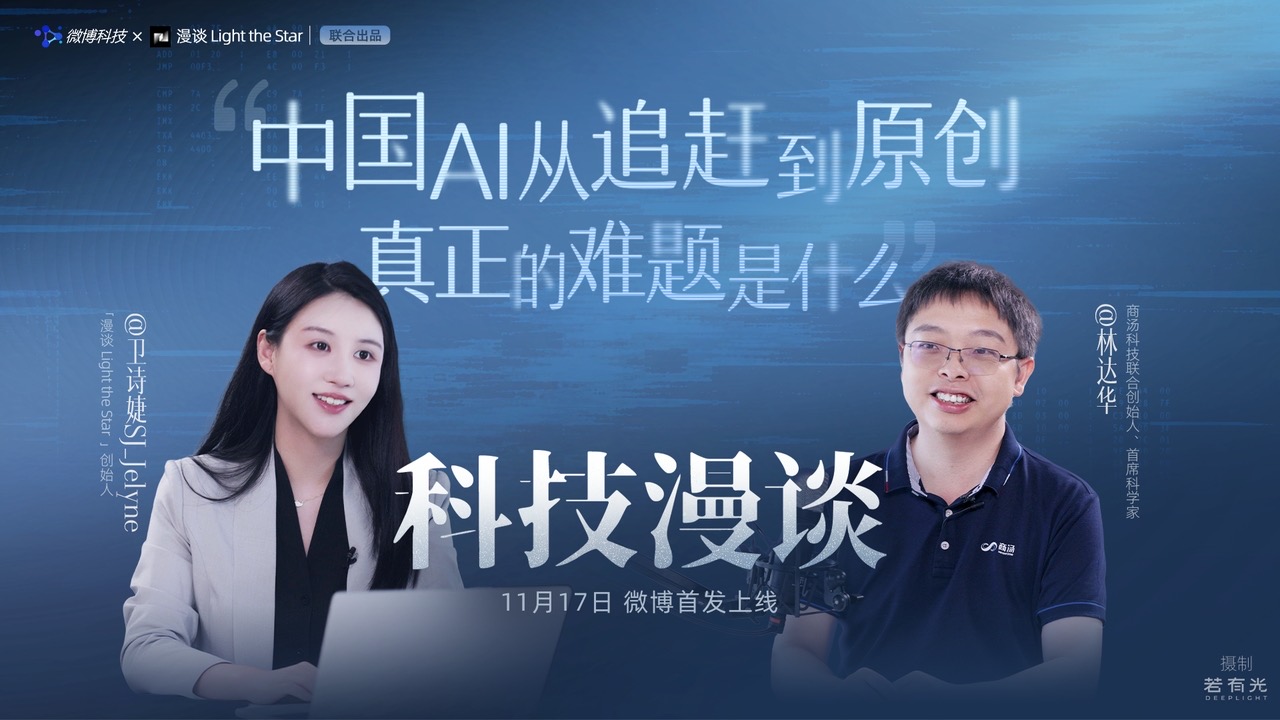
More than half a year later, he changed his wording to a more vivid one - "fast" and "slow" need to be viewed dialectically. Only by investing in infrastructure and building a closed-loop iterative chain in the early stage can we talk about true speed; Fast never means changing places with just one shot, otherwise it cannot form a long-term compound interest flywheel.
In the podcast on November 17th, from the dilemma of chart topping and the paradox of training costs, to how Chinese AI can move from catching up to originality, and to the ideals and confidence left by Tang Xiaoou for several generations of AI people, Lin Dahua's answers almost all fall on the same word: compound interest.
Shang Tang himself also chose the technology route in this way. From the arms race of SOTA ranking, to the expansion of parameter scale, and then to building the supercomputing center eight years ahead of schedule and focusing on embodied intelligence and spatial intelligence. The choice of soup is almost entirely based on "compound interest".
The performance of SenseTime proves the value of this choice. In the third quarter of 2026, SenseTime's generative AI revenue for a single quarter increased by more than double year-on-year. In the first three quarters, SenseTime's total revenue was 3.792 billion yuan, with a gross profit margin of 1.647 billion yuan. The gross profit growth rate (45%) was significantly higher than the revenue growth rate (30%). This means that SenseTime has smoothed out the unit economic model of "selling AI", which is rare for AI companies, as most companies are still in the stage of revenue growth and gross profit decline.
Fight for speed and walk long distances
Will we always have to keep up with the United States step by step? "Podcast host Wei Shijie asked on the show.
She described a scenario that almost all Chinese AI practitioners are familiar with: whether in the embodied field or the big model field, several American companies define the SOTA ceiling. Once the model is released, it is like pointing out a path for Chinese entrepreneurs, resources quickly flow in, and a batch of lower cost, implementable applications are born.
But in her opinion, if we keep investing all our attention resources in such a path, it seems difficult to grow truly bottom-up, original innovation.
Lin Dahua called this strategy "Pinshou Speed". "If the United States produces something, we can see who can produce something similar to China in the fastest time, and then we can seize an ecological niche. This is something that many companies are practicing. ”
He thinks that fighting with speed is tiring because if you fight, others will also fight. In China, a batch of things claiming to be made with the same plan often emerge within two or three months. "If only one company seizes it, then it may be given to them, and as a result, 10 companies are doing it.
For the competition of large model companies,He has his own attitude: the long-term competitiveness of a company does not rely on constantly following the trend, but on the ability to have sustained compound interest.When you walk long enough and tie deep enough on a road, it's difficult for others to reach your height on that road.
As Tang Xiaoou left to the team at an annual meeting, 'You must take every step of the way well, and in the end, you will reach a better place than where you are now.'.
Lin Dahua gave an example that to this day, 20% of SenseTime's resources are still invested in some pre research and prospective research work that does not have any products for export.
This mechanism explains why SenseTime still adheres to the unity of spatial intelligence and understanding generation despite having far fewer resources than OpenAI. This is also what we have been persisting in, reserving certain resources to do what we believe should be done from a first principles perspective, "Lin Dahua said." The accumulation of continuously doing these things for the past year or two, I think we will soon see that we have something different from other teams in the industry
12 year technology tree
Compound interest takes time. Fortunately, as one of the earliest AI companies in China, SenseTime has accumulated sufficient experience and strength in the field of AI.
SenseTime was founded in 2014. Lin Dahua reviewed the losses during the AI 1.0 era: every project had to go from collecting data, specialized training and tuning, repeated testing, to being able to be put into production. The chain was deep and the cycle was long, and the application scope was narrow after being made. If a new customer changed, they had to start over from scratch.
In its 2021 prospectus, SenseTime wrote a number stating that the model factory produces 40000 models annually, but the problem lies in its limited versatility and inability to generate diminishing marginal costs.
The big model has shortened this chain. The products that SenseTime truly emerged in the era of big models were products such as Little Raccoon and Seko. Seko creates short dramas and comics, and at one point, the release of Seedance left the team confused. Later on, they realized that downstream creators were not looking for 30 second movie level clips, but rather 100 episode short dramas with a complete creative process of script, storyboards, character prototypes, and actions behind them. Seko has maintained strong vitality, with a seven to eight fold increase in users and starting to make money.
Lin Dahua also regards these products as living beings. He said that he will not judge whether to invest heavily in A or B. When a product can really do well, there will be very good natural growth, and then he may increase investment.
Another compound interest from time in SenseTime is computing power. In 2018, SenseTime invested in the construction of the Lingang Supercomputing Center; In 2019, an intelligent computing center was established in Shanghai, which became the foundation of the later "big device". In the same year, it was the first in the industry to launch a visual model with billions of parameters, breaking multiple performance records in visual recognition, and began exploring the law of scale in visual models, which was more than three years earlier than ChatGPT. This forward-looking technological observation is also an important reason for SenseTime to invest in large-scale AI computing power earlier. ”Lin Dahua wrote in a lengthy article of ten thousand characters.
It is reported that SenseTime achieved kilocalorie parallel connection around 2019, and now can achieve ten thousand calorie parallel connection, ensuring a linear acceleration ratio of 90%. In the era of AI 2.0, when generative AI exploded and everyone was accumulating this ability, SenseTime already had it.
The embodied intelligence and spatial intelligence, which are in a hot period this year, have already been discontinued by SenseTime. On the model side, SenseNova SI series, an open-source space intelligence model developed by SenseTang Research Institute, will surpass GPT-5 on benchmarks such as VSI in November 2025; On the embodied end, SenseTime established DaXiao Robotics in July 2025, bringing in hundreds of millions of dollars in financing from institutions such as Ant, Geely, and Qiming. At the same time, incubator Tang Shanhui (launching SenseMart OS and a convenience store for burning and buying robots) and consumer grade brand Yuan Luobo were incubated; On the landing end, Shao Mai Gou has landed in more than 20 stores across the country, completing one order in as fast as 15 seconds and launching the "Thousand Cities, Ten Thousand Stores" plan. Spatial intelligence is integrated with Shanghai Quantum City flood control dispatch, linking more than 50000 video points.
In the narrative of SenseTime, multimodality is not the end, it leads to the physical world. Lin Dahua calls this path "from digital space to physical space", which requires three-dimensional understanding of time and space, grasp of physical laws, and self-control of one's own actions. "This is not just a 'brain', but an agile and efficient collaboration of 'brain cerebellum sensory limbs'." We hope to achieve AGI in a broader physical space through the joint emergence of language and vision. ”Lin Dahua said that his understanding of AGI is not limited to models that can only process text or write code. Once visual perception and language semantics are deeply integrated on the base, it will usher in the "GPT moment" of robots.
The value of compound interest
Since the beginning of this year, the attitude of the capital market towards SenseTime has been changing. The core judgment given by multiple institutions is that SenseTime is "transforming from a company that proves technology to a company that verifies value".
In February, SenseTime was officially included in the global core investment benchmark MSCI China Index, further expanding the allocation channels for international long-term and passive funds. On October 23rd, the Hong Kong Stock Exchange officially launched its first AI themed index——Hong Kong Stock Exchange Artificial Intelligence Index, SenseTime ranks fourth in the market with a weight of 6.46% and first among AI model component stocks。
During the same period, multiple securities firms successively released their first coverage reports. The commercialization and long-term growth potential of SenseTime have also attracted close attention from more and more top international investment banks. This year, several major international banks, including J.P. Morgan and UBS, have strengthened their in-depth research and real-time coverage of SenseTime.
The signals from the product and capital sides are pointing towards the same judgment, and SenseTime is moving from technological leadership to value realization.
From the specific performance perspective, SenseTime has maintained a high-quality growth rate and gross profit margin level. In the semi annual report, SenseTime's gross profit margin was 41.4%, an increase of 2.9 percentage points year-on-year. From the progress of business in the third quarter report, this trend has continued: the gross profit margin in the first nine months increased to 43.4%, a year-on-year increase of 4.3 percentage points, with a gross profit of 1.65 billion yuan, a year-on-year increase of 45%; The group's revenue was 3.79 billion yuan, a year-on-year increase of 30.4%, and the growth rate further accelerated compared to 23.4% in the first half of the year.
More noteworthy is that SenseTime is transforming models, computing power, and intelligent agents into systems that customers are willing to continuously pay for. In the third quarter, generative AI continued to be the core of growth, with revenue more than doubling year-on-year. This was achieved on a high base where generative AI revenue accounted for nearly 80%. In other words, this revenue is not a rebound from a low base, but a real increase in user demand.
Analysts from Zhongtai Securities believe that SenseTime's generative AI business has become a core source of revenue, with rapid growth in recurring revenue, synchronous improvement in gross profit margin, expense ratio, and adjusted profit indicators. "One model, one token factory, and one intelligent agent control system" are forming a large-scale commercial closed loop. They also believe that as the demand for inference grows, intelligent agents penetrate enterprise workflows, and overseas markets continue to expand, SenseTime's system level AI capabilities are expected to accelerate their conversion into revenue and profits, further opening up long-term growth opportunities.
On November 19th, Shenwan Hongyuan released a research report maintaining the "buy" rating of SenseTime. Shenwan Hongyuan also stated that considering the accelerated growth of SenseTime's generative AI revenue, the improvement of inference efficiency driving gross profit improvement, and the significant improvement in personnel costs and R&D expense ratio, SenseTime has raised its net profit forecast for 2026-2027.
The first batch of active ETFs have officially gone public, ushering in a new stage of "daily listing" for active investment

Silver Companion Tea Fragrance Home Warm Longwu

The first batch of nuclear drugs with a price of 250000 US dollars, known as the "first stock of nuclear drugs," went public and broke through