2026-11-12 21:19

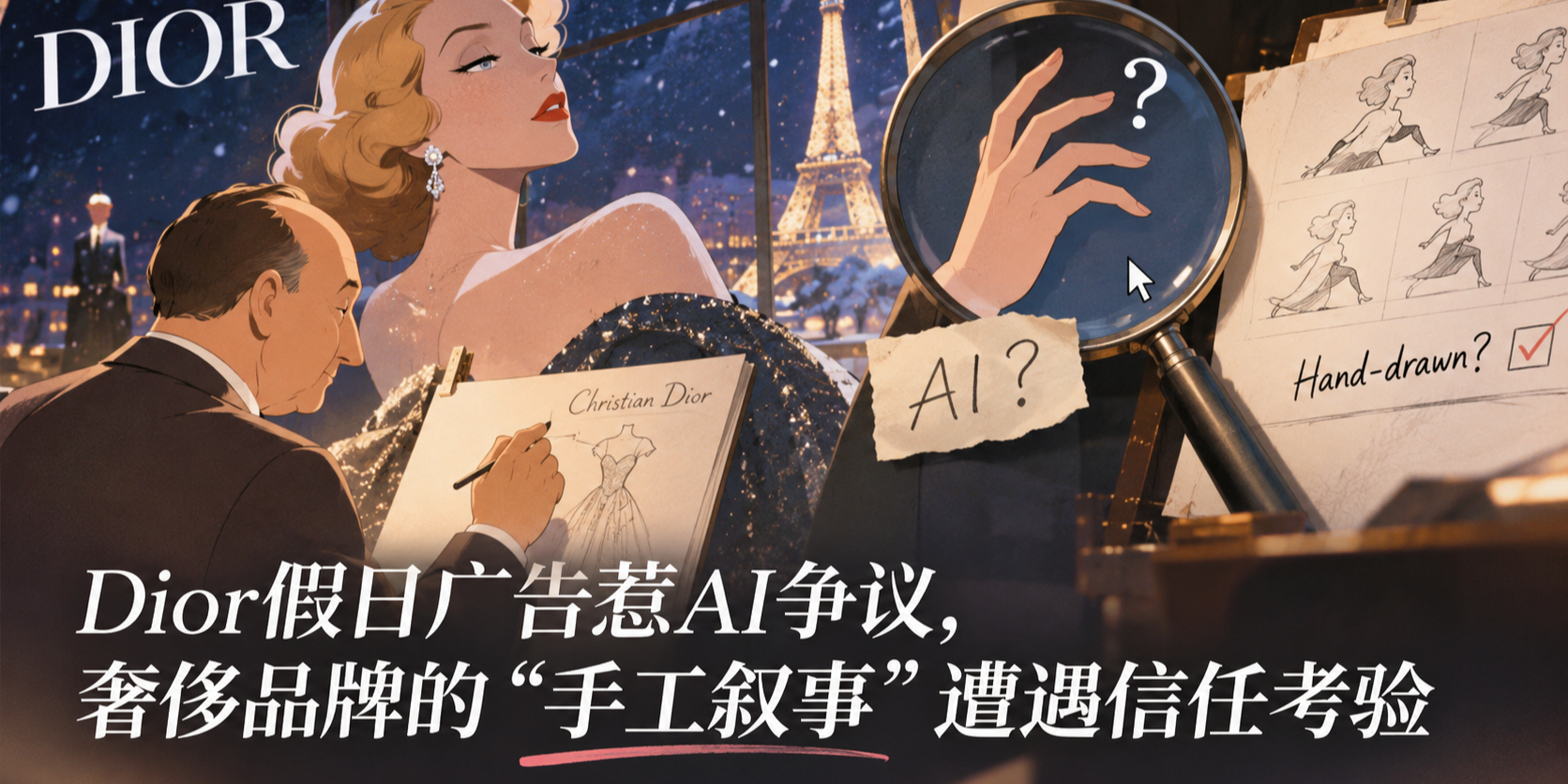
A holiday advertisement originally intended to pay tribute to traditional handicrafts has become embroiled in AI controversy due to a few "not quite right" fingers.
On November 4th, French luxury brand Dior released the 2026 holiday animated short film "Christian Dior's Night in Color". The film is set in Paris in 1949 and tells the fantastic story of brand founder Christian Dior designing dresses for Hollywood star Marlene Dietrich on a winter night.
This retro inspired animated short film is directed by renowned French animation director Sylvain Chomet and voiced by celebrities such as Robert Pattinson and Rihanna. Whether it's the dreamy storyline, exquisite visuals, or weighty creative lineup, they all fit the luxury brand's imagination for holiday marketing.
More importantly, Dior emphasizes the handmade nature of the film. The brand introduces in its promotion that the animation adopts traditional production techniques that can be traced back to the 1940s, and the creative process requires a large amount of manual drawing, which echoes the patience, skill, and craftsmanship emphasized in haute couture.
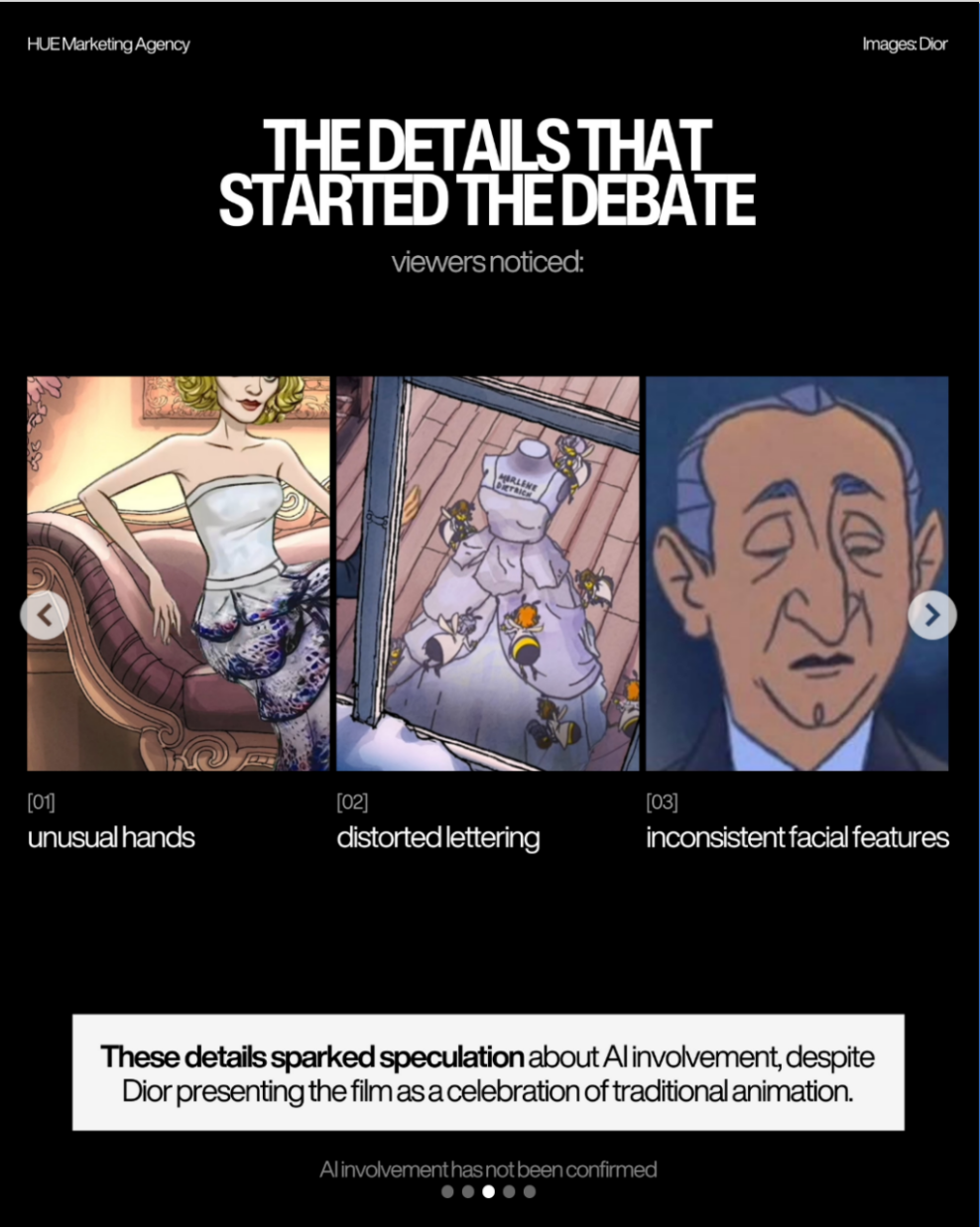
However, after the advertisement was launched, some netizens found suspected AI generated traces in the screen: abnormal number of fingers, distorted text, and unnatural character movements. Some animation practitioners and netizens have raised doubts about this:Is this so-called hand drawn advertisement actually using generative AI?
The controversy quickly extended from social media to industry media. The Business of Fashion, Fast Company, and others have successively reported on this incident.
An advertisement aimed at showcasing the charm of handmade creation ultimately made consumers doubt whether it was truly handmade. For Dior, which has long relied on craftsmanship, history, and creator values to establish brand identity, this is clearly not an ordinary advertising controversy.
From manual tribute to AI questioning, Where does the controversy come from?
Dior's choice of Sylvain Chomet to direct this film already has a clear brand intention.
Chomet has directed animated films such as "Crazy Date Beautiful City" and "Magician", and is known for his unique hand drawn style and expressive character designs. His joining has made this holiday advertisement not only a holiday marketing campaign, but also a collaboration between the brand and animation art.
Dior Creative Director Jonathan Anderson emphasized in his introduction of the film that it utilizes hand drawn animation techniques from the 1940s. The brand also released behind the scenes production images, showcasing the process of artists sketching and designing characters, attempting to show the audience the creative labor behind the works.
This has precisely become the crux of the controversy.
When a brand takes the initiative to make hand drawn craftsmanship a key focus of communication, the audience's scrutiny of the image is no longer limited to whether it looks good or not, but begins to pay attention to how it is made.
Some netizens pointed out that the details such as abnormal fingers of characters and changes in dog tag text in the film are similar to common visual problems in generative AI videos. Some animation practitioners further suspect that the film may use automated technology to generate intermediate images instead of being completed frame by frame by animators.
However, these abnormal images do not directly prove the use of generative AI. Traditional animation may also experience styling changes, exaggerated movements, or production errors.
On November 7th, Chomet and producer Aton Soumache responded to the controversy in an interview with Variety.
The production team stated that the film took seven months to complete and involved around 20 artists, including six animators. The characters, backgrounds, and key actions were all drawn by the artist, and no generative AI was used to create the visuals during the production process.
But they also acknowledge that the film used automatic frame insertion technology in a small number of segments, which utilizes software to generate transition frames between key images, making character movements smoother.
This explanation provides new information for the controversy, but does not completely eliminate external doubts. Automatic frame insertion is not necessarily equivalent to generative AI, and there are significant differences between different technologies. But for ordinary consumers, there is still room for explanation between the brand's previous emphasis on "completely hand-painted" and its current recognition of automated processing.
So far, there is insufficient evidence to prove that Dior used generative AI to create this advertisement. The production team has also explicitly denied the allegations.
But the incident has evolved from an initial technical doubt to another issue:How to accurately describe the degree of involvement of technology in the creative process when a brand emphasizes the handmade nature of its work?
Why did Prada receive different responses when choosing hand drawn animation?
Dramatically, just before and after Dior became embroiled in controversy, another luxury brand Prada also launched a holiday advertisement centered around handmade animation.
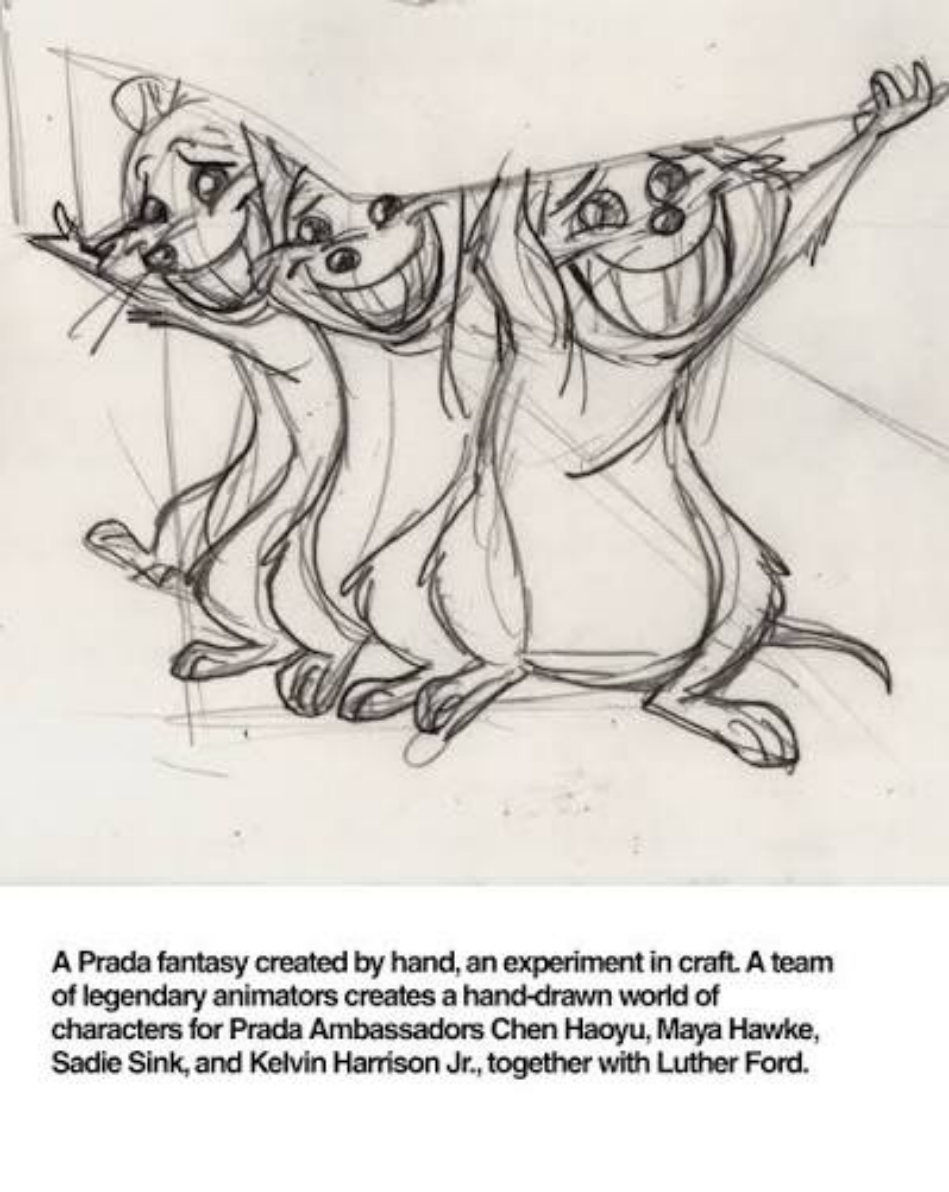
At the end of October, Prada released its 2026 holiday marketing plan "Drawing Prada: Animated by Hand", inviting veteran animator John Pomeroy to participate in the creation, combining live action images with traditional hand drawn animation.
In the film, actors Sadie Sink, Maya Hawke, and others are immersed in a winter scene full of fairy tale colors. Foxes, mice, and other hand drawn animals shuttle through and interact with real actors.
Prada did not deliberately pursue completely realistic visual effects. On the contrary, animated characters retain distinct lines, exaggerated movements, and hand drawn textures, allowing viewers to intuitively feel the artist's creative style.
The brand also showcases through behind the scenes footage how animators design characters, draw actions, and combine animation with live action filming.
John Pomeroy emphasized that the value of hand drawn animation lies in allowing people to see the traces of human creativity when it comes to creation.
This display of the creative process echoes Prada's long-standing emphasis on art, design, and cultural expression, making handmade animation itself a part of the brand's story.
Dior and Prada have both chosen retro animation and attempted to convey brand value through traditional craftsmanship, but the market discussions sparked by the two have taken different directions.
This does not necessarily mean that Prada's production methods are superior to Dior's, nor does it negate the labor invested by its creative team just because Dior has visual abnormalities.
What is truly noteworthy is a change emphasized by both advertisements in their dissemination:The creative process is moving from the production stage behind the advertisement to the forefront of brand communication.
In the past, consumers saw a completed advertisement, and brands mainly relied on the final product to convey aesthetics, emotions, and values.
Nowadays, when AI is able to generate a large number of exquisite images in a short period of time, how the works are created is also beginning to affect consumers' judgment of their value.
Especially for luxury brands, handmade production is never just a technical issue.
The value of a high-end custom dress comes not only from the final appearance presented, but also from the creativity of the designer, the experience of the craftsman, and the numerous production processes that cannot be easily replicated.
Similarly,When brands choose to tell their stories through hand drawn animation, consumers expect not only a retro visual style, but also the real creative labor behind this style.
From this perspective, Prada fully incorporates the production process into its communication content, which actually allows consumers to have a more intuitive understanding of the value of handmade creations.
The controversy surrounding Dior serves as a reminder to the brand: whenThe production process itself becomes a marketing selling point, and the brand's description of the creative process also needs to withstand public scrutiny.
In the era of AI, brands need to rethink Understand the value of 'truth'
The entry of AI into advertising creation is no longer a new phenomenon. From script conception, visual design to video production, more and more brands are using AI to improve efficiency and reduce costs, making some previously difficult to achieve ideas possible.
But the efficiency brought by technology does not mean that consumers will unconditionally accept AI creations.
Previously, Coca Cola's AI generated Christmas ads sparked discussions about visual texture, emotional expression, and creative value. Unlike this, the uniqueness of Dior's controversy lies in the fact that the brand did not highlight AI as a promotional tool, but instead placed traditional craftsmanship at its core.
Therefore,Consumers are not only questioning whether AI is used in advertising, but also whether the creative stories told by brands are true.
For luxury brands that emphasize historical heritage, artistic value, and craftsmanship, the creative process itself is a part of the brand value. Consumers are willing to pay a premium for high-end customization not only because the product is exquisite, but also because of the design creativity, craftsmanship, and time investment behind it.
Similarly, when brands choose to pay tribute to traditional craftsmanship with hand drawn animation, audiences expect not only a retro visual effect, but also the real creative labor behind this effect.
This does not mean that luxury brands should reject AI. Technology can undertake repetitive tasks, allowing creators to devote more energy to creative ideas and artistic expression. What really needs to be wary of is that when brands use "pure handmade" and "completely artificially drawn" as their selling points, there is a gap between the actual production methods and the public's understanding.
Of course, automation technology is not equivalent to generative AI, and defects in the image cannot be used as a basis for judging the use of AI. It is not necessary for brands to disclose every production technique, but when the creative process becomes an important component of the brand story, it becomes particularly necessary to provide accurate and clear explanations.
From a longer-term perspective, AI is also changing the value judgment of advertising creativity. As the threshold for creating exquisite visuals continues to decrease, simple visual impact is no longer sufficient to form a lasting differentiation advantage. The cultural insights, aesthetic judgments, and unique connections between works and brands behind creativity have become even more important.
AI can help brands complete an advertisement, but cannot answer for the brand:Why is this story being told, and what is the relationship between this story and the brand.
Returning to the controversy surrounding Dior, the key issue is not necessarily finding traces of AI in a single frame of the image, but rather that when the brand emphasizes craftsmanship as its core value, consumers have reason to expect this expression to be authentic and credible enough.
As AI becomes increasingly capable of replicating handcrafted visual effects, what is truly scarce may no longer be the exquisite visuals, but the genuine creativity behind them. For a brand, what needs to be held is not a certain production tool, but the trust of consumers in the brand story.
The first batch of active ETFs have officially gone public, ushering in a new stage of "daily listing" for active investment

Silver Companion Tea Fragrance Home Warm Longwu

The first batch of nuclear drugs with a price of 250000 US dollars, known as the "first stock of nuclear drugs," went public and broke through