Economic Observer Follow
2026-11-11 10:33


Since the beginning of this year, the private equity market has delivered a stunning performance on the issuance side.
According to data from Private Equity Ranking Network, since the beginning of the year, the enthusiasm for private equity filing products has been high. As of October 31, 2026, a total of 12673 private equity securities products have been filed, with a year-on-year increase of 27.20%, exceeding the total number of filings for the whole year of last year. In the list of filing quantities, the top ten are all occupied by quantitative private equity institutions.
However, on the performance side, a picture of winter approaching is slowly unfolding, with a large number of newly issued quantitative long position products experiencing a decline in net asset value this year.
There is a strong contrast between selling well and doing poorly in the new quantitative private equity products.
Record Filing Frenzy
According to data from Private Equity Ranking Network, 12673 private equity securities products completed filing in the first ten months of this year. Among them, in terms of strategy distribution, stock strategy remains the absolute mainstay of the market. The number of stock strategy private equity products registered within the year reached 8399, accounting for a high proportion of 66.27%, an increase of 28.44% compared to the same period last year.
It is worth noting that the multi asset strategy is highly sought after by the market, with 1927 units filed within the year, accounting for 15.21%, and a year-on-year increase of 33.26% in quantity.
In this issuance feast, billion dollar private equity firms demonstrated strong fundraising capabilities. As of October 31st, among the 2664 private equity securities managers who have filed products since the beginning of this year, 125 billion dollar private equity firms have filed a total of 4404 products, accounting for 34.75% of the total market volume. These 125 giants have filed an average of 35.23 products per company, significantly ahead of the industry average of 4.76.
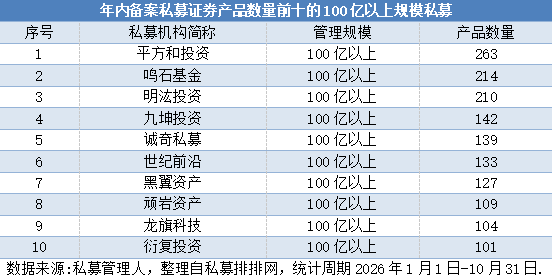
From the ranking of the number of registrations, the names of quantitative big companies occupy the top ten of the list. Square He Investment ranks first with 263 registered units; Mingshi Fund followed closely behind with 214 registered funds; Mingyi Investment also exceeded 200, reaching 210; Jiukun Investment recorded 142 units within the year.
Performance Failure
However, in sharp contrast to the booming distribution end, the performance of newly released quantitative products within the year. After the influx of funds into these products, not only did they fail to achieve the expected returns, but they also experienced a significant net asset value drawdown.
According to data from the Haomai Fund Research Center, as of October 30th, the quantitative long index products have fallen 11.41% this year, 13.93% in the past month, and a return rate of -9.58% in the past year. It is worth mentioning that the index had a cumulative return of 16.95% in the past year in early May, but the subsequent continuous adjustment of the stock market caused the early returns of such products to be swallowed.
Moreover, according to Wind data analysis by Economic Observer reporters, as of November 6th, out of 314 newly established quantitative long funds in 2026 with disclosed data, 234 products have had negative returns and a loss ratio of 74.52% since their establishment. The average return rate of these new products is -8.11%, with a median return rate of -6.93%.
Among them, the worst performing products are the six series of products enhanced by the CSI 500 Index in the evolution theory of Industrial Trust. This series of products was established from April 15 to June 8, 2026, and the annual yield decline exceeded 34%. For example, as of October 30th, the yield of the Industrial Trust Evolution Theory CSI 500 Index Enhanced 3 has been -36.79% since its establishment.
Even the top 10 billion dollar quantitative giants in terms of filing volume have not been completely spared. According to third-party data, since its establishment in April this year, the 126A phase of the Square Harmony Dingsheng CSI 1000 Index has experienced a pullback of 27.84%; Since its establishment in March this year, the share of Longqi Technology's Dividend Technology Wheel Balancing No.2 Class C has fallen by 27.92%; Century Frontier Quantitative Selection No. 36 Phase A also experienced a 27.48% decline.
This net worth pain has to some extent translated into anxiety among some customers. A top quantitative private equity market insider in Shanghai admitted to reporters that the net value of quantitative products has fluctuated significantly recently, and customers' attention to the drawdown of excess returns has significantly increased. Previously, customers were more concerned about how much the product could earn, but now the most common questions are why it was withdrawn and whether it can be repaired in the future. The channel side not only needs to do a good job in explaining and maintaining existing customers, but also needs to be more cautious in screening new products.
Disappearing Alpha
Why did quantitative long positions suffer a widespread Waterloo in this year's issuance year?
Guangfa Securities pointed out that this round of excess return drawdown is not caused by a single factor, but by the combination of three factors: the expansion of private equity product scale, the reversal of market style, and the reduction of trading volume.
The expansion of quantitative private equity scale will to some extent erode the excess returns of strategies. Funds will flow into similar strategy tracks, with highly overlapping factor libraries and similar pace of portfolio adjustments. The increase in trading congestion directly dilutes the alpha returns of unit funds (excess returns exceeding market benchmarks). ”Guangfa Securities believes that.
Secondly, the extreme reversal of market style has led to a multi factor resonance decline.
Guangfa Securities believes that the essence of this round of excess drawdown is the short-term failure of quantitative strategy single factor risk control methods in extreme situations where the market style is highly crowded and some factors resonate with the same frequency to decline. From the performance of Barra style factors (a common feature used to explain differences in stock returns), the strong beta and momentum factors in the first half of the year reversed and fell in July, with a single month drop of 6.4%. At the same time, the linkage between style factors improved, resulting in a resonant decline. The correlation coefficient between beta, momentum, liquidity, and residual volatility factors increased to around 0.4.
Most managers use single factor exposure limits for style risk control, with the implicit assumption that there is a certain degree of independence between factors and that risks can be hedged through diversification. However, when multiple factors fall in the same direction, the constraints of the single factor dimension cannot identify the common exposure at the portfolio level, and risk control measures may fail in stages, "Guangfa Securities further analyzed.
In addition, market trading volume is the "fuel" for the operation of quantitative models. The average daily trading volume of A-shares in the first half of the year remained at a high level of 2.5 trillion to 3 trillion yuan for a long time, but quickly fell below 2 trillion yuan after entering July.
Guangfa Securities believes that in a reduced volume environment, the spread between buying and selling widens, the order book becomes thinner, and the same position adjustment and turnover require higher trading costs. At the same time, it also has an impact on the T0 (same day reverse trading) trading strategy. The return of the T0 strategy depends on the effective capture of intraday fluctuations and sufficient trading volume support. When the trading volume significantly shrinks and the intraday volatility converges, the available spread space is also compressed.
It should be noted that the contraction in July was mainly due to passive contraction caused by chip accumulation and insufficient absorption during the rapid decline of the market. Its depth exceeded the conventional fluctuation range, and quantitative strategies were difficult to cope with through regular trading rhythm adjustments.
Searching for a new steady state
In fact, China's private equity industry is moving towards a new stage dominated by quantitative institutions. According to data from Private Equity Ranking Network, as of the end of September 2026, the number of billion dollar private equity firms in China has increased to 159, with 75 quantitative private equity firms occupying the main position. But after the frenzy of scale, how to repair performance and adapt to the new market ecology has become the sword of Damocles hanging over every quantitative institution.
A senior practitioner at a quantitative private equity firm in Beijing stated that based on historical experience, the repair of quantitative excess returns highly depends on specific market environments; Firstly, market volatility needs to return to the normal range; Secondly, the market transaction activity should remain stable at a level that can support the operation of the existing management scale; Thirdly, the funding aspect needs to return to structural balance.
In the first half of this year, the artificial intelligence technology sector's siphon effect on market funds led to a narrowing of market width and a decrease in stock selection effectiveness. However, when the unipolar clustering dissipates and the market transitions to a style rebalancing, returning to a multi-point blooming market, the advantages of quantitative bulls relying on factors and data to capture individual stock alpha can be more effectively utilized, "said a senior quantitative private equity firm.
Wang Yamin, founder of Hainan Turing Fund, stated that in the future, the focus should be on market trading volume and whether the market breadth can be expanded. If the trading volume remains low and market rotation accelerates, the previously crowded growth, momentum, and other factors may reverse, amplifying the portfolio's risk in terms of market value exposure and liquidity. In this regard, quantitative strategies should strictly control style exposure, not bet on exposure of small and micro sized stocks, and enhance the ability to avoid liquidity depletion and extreme drawdown risks.
Wang Yamin reminded that "quantitative investment should adhere to risk control discipline, strive to obtain excess returns, rather than actively exposing risks


Changan Automobile listed for transfer of 10% equity of Avita Technology, with a minimum price of approximately 3.2 billion yuan

The "golden nine and silver ten" in the car market have faded domestically, but exports have surged

Post Friendship Period "has become a hot search and hit the screen, becoming a dark horse in variety shows in 2026


 Subscribe