

2026-10-12 18:54

On October 12th, the Royal Swedish Academy of Sciences announced that the 2026 Nobel Prize in Economics will be awarded to Professor Robert E. Hall at Stanford University and Professor Michael Woodford at Columbia University, in recognition of their microeconomic foundations for macroeconomic stability policies.
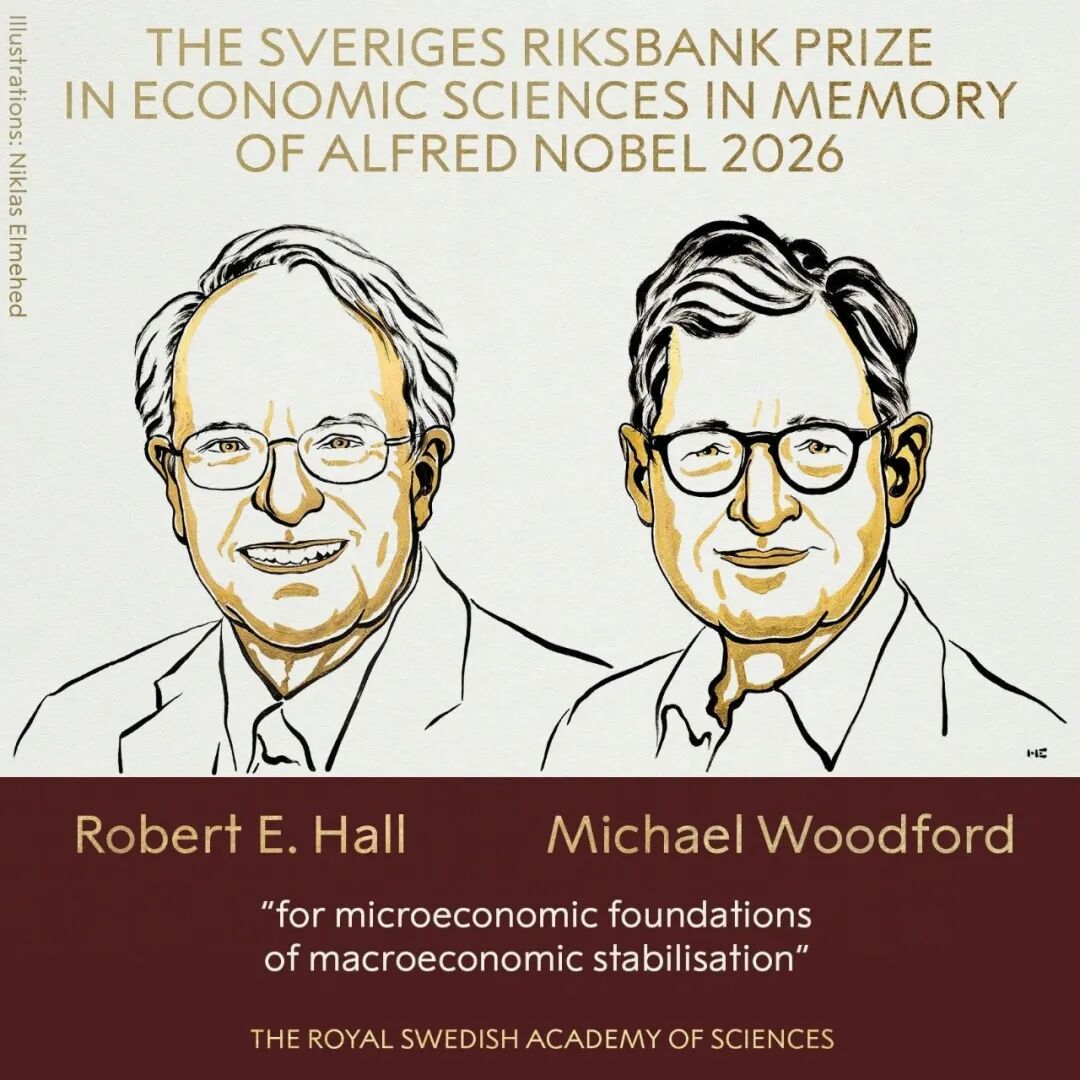
Robert E. Hall and Michael Woodford were awarded this year's Economic Science Prize for demonstrating how to reconstruct economic models to revitalize stability policies. They did not construct models based on statistical connections between macroeconomic variables such as inflation, production, and consumption, but chose to build them on a microeconomic basis. This includes understanding how the overall number of households and businesses affects the economy through their behavior.
A core component of these models is that households and businesses have foresight when making savings or product price decisions. When the government and central bank communicate their economic policy plans, they can influence this view of the future and drive the economy in the right direction. Since the introduction of these new models, they have been extremely useful in addressing the economic recession that has impacted us.
Robert E. Hall was born in Palo Alto, California, USA in 1943. In 1967, he obtained his doctoral degree from the Massachusetts Institute of Technology Cambridge campus in the United States. Professor at Stanford University in California, USA.
Michael Woodford was born in Chicopi, Massachusetts, USA in 1955. In 1983, he obtained his doctoral degree from the Massachusetts Institute of Technology Cambridge campus in the United States. Professor at Columbia University in New York, USA. Michael Woodford is also an important scholar in modern macroeconomics and monetary policy theory. He has made contributions to the theory and practice of monetary policy. He advocates for the central bank to use "forward guidance" to manage public expectations and inflation dynamics, and to incorporate rational expectations, price adjustments, and monetary policy into a more systematic macroeconomic analysis framework, explaining how the central bank's policy actions and communication affect the decisions of economic entities. He systematically demonstrated the superiority of rule-based monetary policy, and his theoretical framework has had a profound impact on global macroeconomic regulation.
Who were the Nobel laureates in economics in the past few years?
On October 13, 2025, the Royal Swedish Academy of Sciences announced that the 2025 Nobel Prize in Economics would be awarded to economists Joel Mokil, Philip Agion, and Peter Hoyt, in recognition of their contributions to the theory of innovation driven economic growth. Mokil was awarded half of the Nobel Prize in Economics for "revealing the prerequisites for achieving sustained growth through technological progress"; The other half of the prize money was jointly awarded to Agion and Hoyt, who proposed the theory of achieving sustained growth through creative destruction.
On October 14, 2024, the Royal Swedish Academy of Sciences announced that the 2024 Nobel Prize in Economics would be awarded to three economists from American universities, Daron Ajammolu, Simon Johnson, and James Robinson, in recognition of their outstanding contributions to the study of how institutions are formed and affect economic prosperity.
On October 9, 2023, the Royal Swedish Academy of Sciences announced that the 2023 Nobel Prize in Economics would be awarded to American economist Claudia Golding in recognition of her outstanding contributions in the field of women's labor force research. The Royal Swedish Academy of Sciences stated that Golding has identified key drivers of gender differences in the labor market, and her research findings have "enhanced our understanding of the outcomes of the female labor market.
The 2022 Nobel Prize in Economics is awarded to former Federal Reserve Chairman Bernanke and Professor Douglas W. Booth School of Business at the University of Chicago Diamond and Professor Philip H. from Washington University in St. Louis Three American economists, including Dybvig, were commended for their research on banking and financial crises. The research findings of the award winners have deepened our understanding of the role of banks in the economy, especially during financial crises, and one important finding is why avoiding bank failures is crucial.
The 2021 Nobel Prize in Economics was awarded to three economists, David Card, Joshua D. Angeliste, and Guido W. Ingens, in recognition of their outstanding contributions in the field of labor economics and empirical methods research.
The full name of the Nobel Prize in Economics is the "Swedish Central Bank Memorial Alfred Nobel Prize in Economics", aimed at rewarding scholars who have made outstanding contributions in the field of economics. The earliest can be traced back to 1968, when the Sveriges Riksbank established the Nobel Prize in Economics in honor of Alfred Nobel, the founder of the Nobel Prize.
Among them, the youngest Nobel laureate in economics is Esther Duflo from the Massachusetts Institute of Technology, who was 46 years old when she won the award in 2019. At that time, Esther Duflo, her husband Abhijit Banerjee, and Harvard professor Michael Kramer jointly received the Nobel Prize in recognition of their "experimental practices in reducing global poverty".
The oldest winner is Leonid Hevich, who was 90 years old when he won the award in 2007. At that time, he, along with Eric Maskin and Roger Myerson, was awarded the prize in recognition of his work in laying the theoretical foundation for mechanism design.
As of now, three female economists have won the Nobel Prize in Economics, including the youngest Nobel laureate Esther Duflo, as well as Eleanor Ostrom and Claudia Golding.
Proofreading: Lv Jiubiao

Following American Express and Mastercard, Visa China has been approved to prepare for the establishment of a bank card clearing institution

Zheng Qinwen wins the championship, which brand is taking advantage of this?

Home Appliance Chapter of the "Shandong Artificial Intelligence Vertical Domain Large Model" Series Short Films: Home Appliance Production Line "Evolution", Master's Skill, AI Learned


