

Economic Observer Follow
2026-10-12 18:47

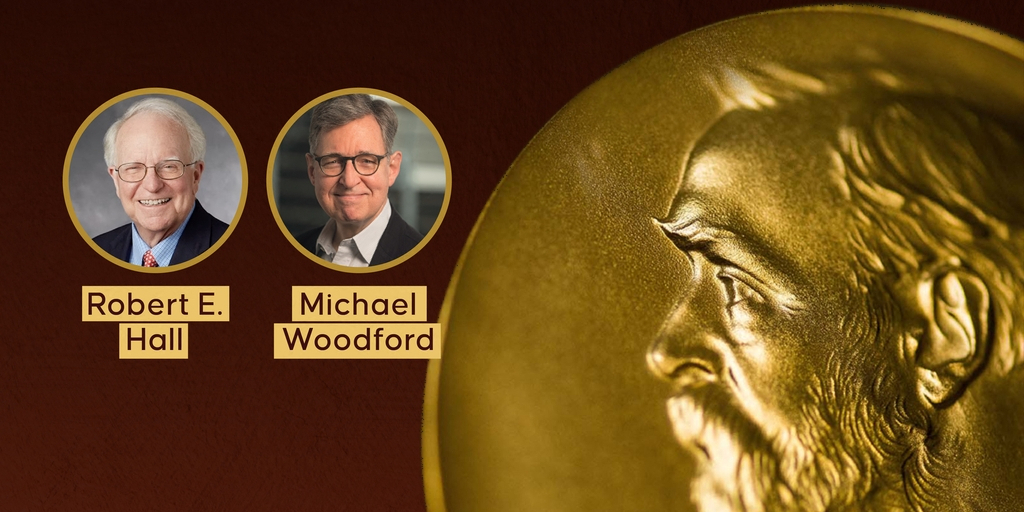
Wen/Chen Yongwei
On October 12, 2026, the Royal Swedish Academy of Sciences announced that it would award this year's Nobel Prize in Economics to Robert E. Hall from Stanford University and Michael Woodford from Columbia University, in recognition of their contributions to macroeconomic stability and microeconomic foundations. This is a combination that can quite summarize the evolution of macroeconomics over the past half century. Hall studies why households consume and why businesses hire, while Woodford studies why businesses cannot adjust prices at any time and how central banks influence the economy through interest rates and expectations. Their work ultimately flows into the same river: to understand why the entire economy prospers and declines, and how the government stabilizes it, it is necessary to first understand how families and businesses make choices when facing the future.
This is precisely the most important transformation in macroeconomics since the 1970s. The traditional Keynesian model excels at describing the aggregate relationship between consumption, investment, inflation, and unemployment, but often fails to further explain why these relationships hold true. When the oil crisis, stagflation, and Lucas criticism followed one after another, this approach was seriously challenged. If families and businesses know how the government will act, they will change their consumption, savings, pricing, and wage requirements in advance; The relationships observed in past data may not necessarily continue to hold true under new policies. To regain a firm foothold in stabilizing policies, macroeconomics must move down from "aggregate relations" to individual choices, and then rebuild the entire macroeconomic system from individual choices.
Hall and Woodford respectively completed extremely important parts of this project.
1、 Hall: From Consumption to Unemployment
Robert Hall was born in Palo Alto, California in 1943, a city that later became the center of Silicon Valley and almost the geographic center of his academic career. He studied at the University of California, Berkeley for his undergraduate degree and then entered the Massachusetts Institute of Technology to pursue a PhD under the guidance of Robert Solow. He obtained a PhD in Economics in 1967. Afterwards, he taught at MIT and Berkeley, and entered Stanford University and the Hoover Institution in 1978.
Hall rarely refers to himself as a macroeconomist of a particular school of thought. His introduction on his personal homepage even consists of a simple sentence: 'I am an applied economist', with interests including employment, inflation, technology, competition, and economic policy. This sentence can quite summarize his research style. He did not establish a grand system named after himself, but constantly proposed new research methods on many key issues such as consumption, labor market, enterprise pricing, productivity, tax system, and economic cycle.
He even left a name for the famous "freshwater saltwater" debate in modern macroeconomics. Hall himself recalled that in a 1976 paper, he was the first to use the "freshwater school" and "saltwater school" to distinguish between different macroeconomic traditions near the Great Lakes and the east and west coasts of the United States. Later on, these two slightly joking words became common labels in the debate between neoclassical macroeconomics and neo Keynesianism. What's even more interesting is that this year's Nobel Prize placed this economist, who once gave names to both factions, alongside Woodford, one of the most important theorists of New Keynesianism.
Hall's most classic work was published in 1978, titled 'Stochastic Implications of the Life Cycle Permanent Income Hypothesis: Theory and Evidence'.
Friedman had previously proposed the permanent income hypothesis: people will not immediately spend all 1000 yuan just because they suddenly earn an extra 1000 yuan this month. What truly determines consumption is the judgment of long-term income. Hall took a step forward: if consumers are rational and able to use existing information to predict the future, what statistical properties should consumption changes have?
The answer seems somewhat astonishing. If a family has already incorporated all the information they can know today into their lifetime income expectations, then the predicted news today should theoretically have been reflected in today's consumption long ago. Therefore, tomorrow's consumption only needs to be adjusted when new, unpredictable information emerges tomorrow. If there is no new news, consumers have no reason to suddenly change their consumption. Therefore, under specific assumptions, consumption approximates a random walk process, and its changes should be difficult to predict with existing information.
This result was very unexpected, thus arousing suspicion from many people. According to Romer's "Advanced Macroeconomics," when Hall first reported on this paper, a renowned macroeconomist told him that he "must have been on drugs" when he wrote it.
However, it is precisely this unconventional conclusion that has changed the way macroeconomics studies consumption. Afterwards, researchers can no longer be satisfied with simply writing an empirical equation that states' consumption increases as much as income increases', but need to derive consumer behavior from the perspective of intertemporal optimization of consumers. The Euler equation, which can be seen everywhere in macroscopic models later, is the fundamental tool for this traditional research. Hall's 1978 paper thus became one of the landmark works in Lucas' critique of establishing the "micro foundation" of macroeconomics.
Later research naturally found that consumption in the real world does not fully follow the law of random walks. Families may be constrained by liquidity, have precautionary savings, and may also face issues such as habit formation and bounded rationality. But this does not diminish the importance of the Hall method. On the contrary, subsequent consumption theories often first ask: why does reality deviate from Hall's theoretical benchmark? This research approach of "deriving benchmarks from optimization first, and then explaining deviations" has become a standard routine in modern macroeconomics.
Hall later advanced similar methods to the labor market. This is particularly important for understanding the "macro stability" mentioned by this year's Nobel Prize.
There is a long-standing perplexing fact about economic cycles: during economic downturns, employment and job vacancies can sharply decrease, unemployment rates rise significantly, but wages often do not decrease by a corresponding amount. If the labor market operates like a simple supply-demand model, an increase in unemployment should drive wages down rapidly, businesses should be willing to hire again, and unemployment should not last that long.
The Diamond Mortensen Pissarides search matching theory explains that workers and businesses need to spend time searching for each other, but the Standard Model still struggled to generate the same level of unemployment volatility as in reality. One of Hall's research focuses is to explain why wages do not easily absorb this impact.
In 2008, he proposed a new wage negotiation mechanism with Paul Milgrom. Once the enterprise and the worker have found each other, the cost of searching for another partner is usually high, so the real threat in the negotiation process is not necessarily "I will leave immediately if the deal cannot be reached", but more importantly, the cost of delaying the negotiation itself. In this way, the impact of external unemployment rate changes on negotiated wages will be much smaller than the standard model. Wages are relatively stable, making corporate profits and recruitment intentions more sensitive to economic shocks. Even small productivity changes may result in significant job vacancies and employment changes.
On the surface, consumer research and labor market research belong to two different fields, but they share a common logic: consumption, employment, and unemployment in macroeconomics cannot be written as just a few historical statistical relationships. It is necessary to ask why households consume like this, why companies recruit like this, and why workers accept such wages. Macro fluctuations ultimately grow from micro selection.
This kind of research also makes Hall one of the few people who are active in both macro theory and real cycle judgment. From 1978 to 2013, he led the Economic Volatility and Growth Research Program of the National Bureau of Economic Research (NBER) for a long time and served as the chairman of the NBER Business Cycle Dates Committee. The semi official judgment of when the United States will enter and exit recession, which has been repeatedly cited by the media, has long been made by a committee led by Hall. In 2010, he also served as the President of the American Economic Association.
2、 Woodford: Not giving up on Keynes
Compared to Hall, Michael Woodford's academic path is more unusual. He was born in Chicopi, Massachusetts in 1955 and graduated with a bachelor's degree from the University of Chicago. He did not immediately pursue a PhD in economics, but instead entered Yale Law School to obtain a Juris Doctor (J.D.). Later, he transferred to the Massachusetts Institute of Technology and obtained a PhD in economics in 1983. In 1984, he first joined Columbia University to teach, and then worked at the University of Chicago and Princeton University before returning to Columbia in 2004.
Woodford later became one of the most systematic theorists of modern monetary economics. His research truly answers a seemingly simple question: why can a central bank change a very short-term interest rate to affect trillions of dollars in consumption, investment, employment, and prices?
Traditional monetarism likes to answer this question from the quantity of currency. But in the 1990s, the core of many central banks' actual operations gradually shifted from controlling money supply indicators such as M1 and M2 to adjusting short-term policy interest rates. Monetary economics requires a new theory that matches the operational methods of central banks in reality.
What Woodford did was to establish this theory.
The most important thing to understand Woodford is that he did not attempt to go back to the old Keynesianism of the 1960s.
Lucas criticized that if the government changes policy rules, households and businesses will also change their expectations and behaviors, so the effects of new policies cannot be mechanically predicted based on past statistical correlations. Woodford fully accepted this. His model also starts from rational and forward-looking households and businesses, allowing consumers to conduct cross period optimization and allowing businesses to determine prices based on future profits. The difference is that he also retains an extremely important friction in the real world: prices cannot be readjusted without cost at all times.In this way, rational expectations and price stickiness enter the same model.
In the 1990s, Woodford and Julio Rottenberg further developed a monetary policy model based on optimal behavior. The Rottenberg Woodford framework of 1997 was already very close to the new Keynesian DSGE model, which later became a standard tool for central banks: households optimize consumption and savings, while firms price under monopolistic competition but can only adjust prices from time to time; The central bank influences aggregate demand and inflation through short-term interest rates.
This is equivalent to completing a macroeconomic 'reconciliation'. Lucas is right: expectations cannot be ignored, and new policies cannot be evaluated using historical relationships that lack behavioral foundations. But Keynes also captured a real phenomenon: there is adjustment friction between prices and wages, so changes in demand can indeed affect production and employment in the short term.
Modern new Keynesianism is no longer a simple revival of old Keynesianism, but a re established Keynesianism after absorbing the rational expectations revolution.
3、 How Central Banks Manage the Future
In 2003, Woodford published nearly 800 pages of "Interest and Prices: Foundations of a Theory of Monetary Policy". The title directly pays tribute to Swedish economist Knut Wicksell's Interest and Prices. This book later became one of the most important works in modern monetary policy theory, and Columbia University also referred to it as Woodford's most important work.
The most important idea of this theory is to shift monetary policy from "controlling today's interest rates" to managing people's expectations for future interest rates. Whether a company invests in a factory does not depend on today's overnight interest rate, but on the financing costs for many years to come; Whether a family buys a house or not will not only consider the current interest rate. Therefore, the true power of the central bank in influencing the economy largely comes from its ability to change the public's judgment on future policy paths.
That's why a statement from the central bank can sometimes push market interest rates down before they actually cut rates. As long as businesses and households believe that the central bank will maintain low interest rates in the future, they will change their consumption, investment, and pricing today. So, communication itself became monetary policy.
The later popular "forward guidance" is the practical expression of this idea. The Royal Swedish Academy of Sciences emphasized in this year's statement that Hall and Woodford's model places forward thinking behavior of households and businesses at the center, and that governments and central banks can change this expectation by explaining future policies, thereby affecting today's economic activity.
Woodford also drove another important shift in modern monetary theory: monetary policy does not necessarily need to be explained by controlling the quantity of money.
In his "cashless economy" framework, even if the monetary balance itself has little effect, the central bank can still influence real interest rates by setting short-term nominal interest rates, thereby changing consumption and investment. The key variable thus shifted from 'how much money there is' to the gap between the market's real interest rate and the natural interest rate.
This reintroduced the concept of natural interest rates proposed by Wicksell a hundred years ago into modern macroeconomics. If the real interest rate in the market is lower than the natural interest rate that maintains potential output and stable inflation in the economy, demand will expand; Otherwise, it will contract. The task of the central bank is to systematically adjust interest rates based on changes in inflation and economic activity.
The Taylor rule provides such a simple rule in practice, and Woodford further illustrates why this rule can stabilize the economy. One of the important conditions later became known as the Taylor principle: when inflation rises by 1 percentage point, the central bank should raise the nominal interest rate by more than 1 percentage point to truly raise the real interest rate. Otherwise, rising inflation may actually lower real interest rates, further stimulating demand, and the economy may lose its stability anchor.
Therefore, Woodford's work integrates natural interest rates, interest rate rules, rational expectations, price stickiness, and central bank credibility into a unified framework.
4、 Finding micro foundations for macro stability
At first glance, this year's combination seems somewhat unexpected. Hall is most famous for his theories on consumption and the labor market, while Woodford is most famous for his work on monetary policy. The two are not a long-term cooperative pair of economists.
But from the history of macroeconomic thought, this combination is actually very complete. Hall's answer is: How do families and workers act in the face of the future? Woodford's answer is: How do companies price and how does the central bank influence these actions by changing future conditions?
The former establishes the micro foundation of consumption and labor markets for macro models, while the latter links these forward-looking behaviors with nominal price frictions and monetary policy. The two routes ultimately changed the meaning of stability policy together.
Traditional stability policies have a bit of a "pull lever" meaning: high unemployment increases demand; When inflation is high, demand decreases. Modern macroeconomics tells policy makers that people in the economy are not passive pawns waiting for government manipulation. Families predict future taxes and income, businesses predict future demand and interest rates, workers consider future employment opportunities, and everyone guesses what the government will do next. Policies change behavior, and people's expectations of policies will change behavior in advance. This is the true meaning of 'micro foundation'.
From the 1970s onwards, the rational expectations revolution seemed to signify the end of Keynesian stability policies. If households and businesses can foresee policies, then the government's ability to simply manipulate aggregate demand will greatly decrease. Macroeconomics has undergone decades of reconstruction as a result.
Hall was an early participant in this reconstruction. He truly brought rational expectations into consumption theory and constantly sought micro foundations for consumption, labor markets, and economic cycles. Woodford belongs to the generation that completed synthesis later on. He did not abandon rational expectations, but put price stickiness and monetary policy back into a strict general equilibrium system.
Therefore, the 2026 Nobel Prize is not simply a reward for "Keynesianism", nor is it a reward for a specific interest rate cut or fiscal stimulus policy. It rewards a new macroeconomic approach: starting from purposeful and expected households and businesses, re establishing theories about how the entire economy fluctuates and how policies stabilize it.
The Royal Swedish Academy of Sciences has made it clear in its just released statement that Hall and Woodford's research provides a stable theoretical basis for the models used by central banks and governments around the world today, enabling policy makers to better respond to economic shocks such as energy crises and sudden changes in consumption.
If Keynes' question nearly a hundred years ago was' What can the government do when the entire economy falls into recession, 'then the task of economists of Hall and Woodford's generation is to re answer this question after experiencing the rational expectations revolution.
Their answer is: to stabilize the macroeconomy, the first step is to understand the people who make up the macroeconomy.

Following American Express and Mastercard, Visa China has been approved to prepare for the establishment of a bank card clearing institution

Zheng Qinwen wins the championship, which brand is taking advantage of this?

Home Appliance Chapter of the "Shandong Artificial Intelligence Vertical Domain Large Model" Series Short Films: Home Appliance Production Line "Evolution", Master's Skill, AI Learned


