

Economic Observer Follow
2026-10-12 14:53

With the release of September sales figures, the first three quarters of the 2026 Chinese automotive market report card has been released. According to data from the China Passenger Car Association, as of September 27th, the cumulative retail sales of passenger cars in China reached 12.973 million units, a year-on-year decrease of 22%. Supported by exports, manufacturers wholesale a total of 18.657 million units, a year-on-year decrease of only 7%. Against the backdrop of a downturn in the overall environment, the top seats of automobile companies are stuck, and the progress of achieving annual goals is generally lagging behind.
Among traditional car companies, SAIC Group held the top spot with 3.147 million vehicles, followed closely by BYD with 3.132 million vehicles; But looking at the third quarter alone, BYD surpassed SAIC's 1.1021 million vehicles with 1.3226 million vehicles, leaving the suspense of the annual sales champion in the fourth quarter. The third place race between Geely Automobile and Chery Group is also very fierce. In the first three quarters, Geely led Chery by less than 30000 vehicles, and Chery's single quarter sales in the third quarter have also surpassed Geely. Among the new forces, Zero Run leads with 666500 vehicles, while NIO, Ideal, Jike, Xiaopeng, Xiaomi and others are all squeezed into the 280000 to 300000 vehicle range, breaking through the pressure.
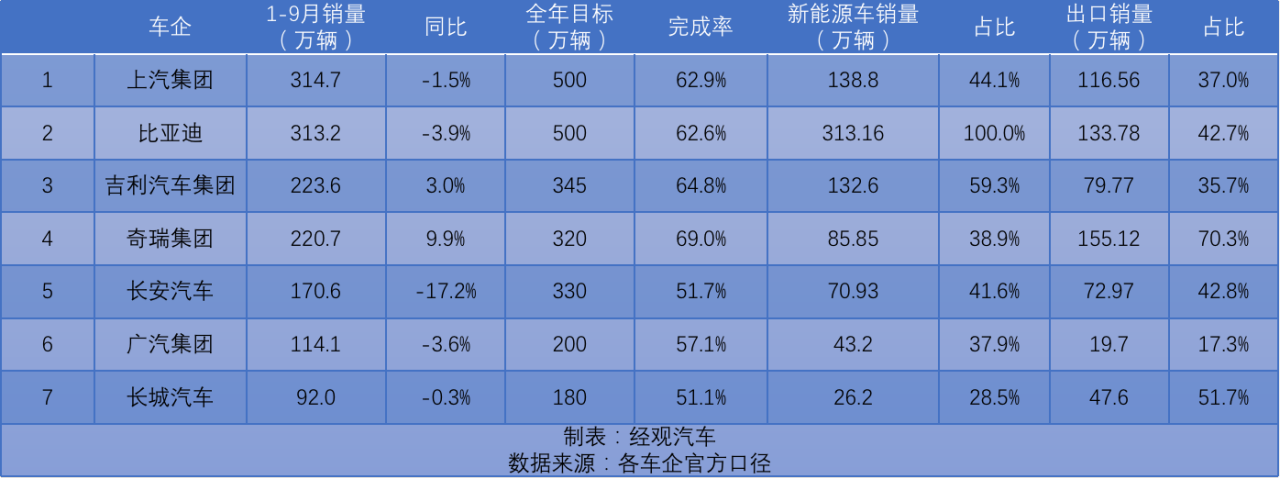
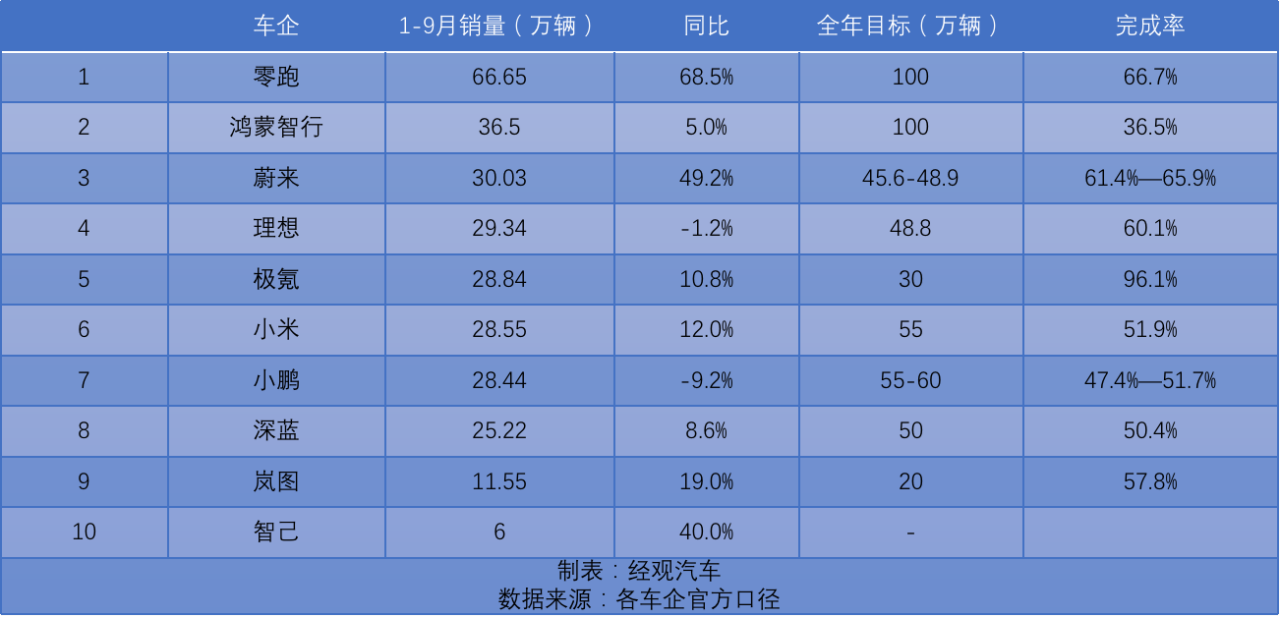
From the perspective of annual target completion rate, the situation remains severe. Among the 17 car companies that announced their annual targets according to the Economic Observer, only Jike crossed the qualification line, reaching 96.1%. Next are Chery (69.0%) and Zero Run (66.7%). In addition, Geely, SAIC, BYD, NIO, and Ideal all have over 60%; Chang'an, Great Wall, Xiaopeng, Xiaomi, Sailis, and Shenlan are around 50%; Hongmeng Zhixing has the lowest, only about 36.5%.
In terms of electrification, except for BYD's comprehensive electrification, Geely's new energy accounts for the highest proportion, reaching 59.3%, SAIC 44.1%, Changan 41.6%, Chery 38.9%, and Great Wall 28.5%. Export is the most consistent highlight, with all seven traditional car companies experiencing positive overseas sales growth. Chery has the highest proportion of 70.3%, while Great Wall Motors, Changan, BYD, SAIC, and Geely have sales between 35% and 52%. Guangzhou Automobile Group has the lowest proportion at 17.3%.
Traditional car company: BYD outperforms in a single season, with annual seat numbers stuck
After losing the top spot to BYD for two consecutive years, SAIC Motor returned to the top spot in the first three quarters of this year, but the lead was very weak. SAIC Group sold a total of 3.1471 million vehicles in the first three quarters, a year-on-year decrease of 1.45%, only leading BYD by 15000 vehicles, with an annual target completion rate of 62.9% for 5 million vehicles. Among them, SAIC Group's domestic brand had 2.303 million vehicles, a year-on-year increase of 12.6%, accounting for 73.2% of the total; 1.388 million new energy vehicles, an increase of 28.2%; Overseas 1165600 vehicles, an increase of 52.36%. But the joint venture sector continues to lose blood, with SAIC Volkswagen and SAIC General Motors falling by 34.52% and 10.44% respectively.
And it is worth noting that in September, BYD achieved a monthly sales volume of 463600 vehicles, surpassing SAIC Group (406100 vehicles) by 57500 vehicles, and has been growing year-on-year for five consecutive months; In the first three quarters, BYD accumulated 3.1316 million vehicles, a year-on-year decrease of 3.94%, with a completion rate of 62.6% calculated based on the target of 5 million vehicles. This indicates that with the increasing volume of megawatt flash charging models and the ramp up of overseas factory production capacity, BYD is returning to the growth channel. This also means that after entering the fourth quarter, its championship battle with SAIC Group will be more exciting.
The third place race between Geely and Chery is also a major suspense in the fourth quarter. Data shows that Geely sold 2.2355 million vehicles in the first three quarters, a year-on-year increase of 3.0%, with an annual target completion rate of 64.8% for 3.45 million vehicles; Exported 797700 vehicles, a year-on-year increase of 169%. By brand, Jike delivered 288400 vehicles, a year-on-year increase of 101%, Geely brand delivered 1.751 million vehicles, a slight decrease of about 2%, and Lynk&Co delivered 196100 vehicles, a decrease of about 19%.
Chery Group has the highest growth rate among traditional car companies, with cumulative sales of 2.2068 million vehicles, a year-on-year increase of 9.9%, and an annual target completion rate of 69.0% for 3.2 million vehicles. Almost all of the growth was contributed by exports: 1.5512 million vehicles were exported, a year-on-year increase of 65.6%, exceeding the total export volume for the whole year of 2025; 858500 new energy vehicles, an increase of 46.1%. But domestic sales were about 655600 units, a year-on-year decline of nearly 40%. Currently, Chery Automobile is undergoing intensive management adjustments.
Changan Automobile's decline is still expanding, with a cumulative delivery of 1.7061 million vehicles in the first three quarters, a year-on-year decrease of about 17%, and an annual target completion rate of 51.7% for 3.3 million vehicles. The overseas market performance is the only bright spot, delivering 729700 vehicles, a year-on-year increase of 56.8%, and achieving 97% of the annual overseas target of 750000 vehicles; However, domestic sales have also declined by nearly 40%, with a slight decrease of 2.07% compared to the same period last year for 709300 new energy vehicles, which is significantly lower than the annual target of 1.4 million new energy vehicles.
The progress of the Great Wall is similar to that of Chang'an. Great Wall sold 920300 vehicles in the first three quarters, a year-on-year decrease of 0.33%, with an annual target completion rate of 51.1% for 1.8 million vehicles; Overseas 476000 vehicles account for 51.7%, and new energy 262000 vehicles account for 28.5%. The performance of brands under Great Wall Motors shows significant differentiation, with Euler growing by 100.19% in the first three quarters, Tank decreasing by 13.53%, and Haval decreasing by 2.54%.
Guangzhou Automobile Group sold a total of 1.14 million vehicles in the first three quarters, a year-on-year decrease of 3.6%, achieving 57.1% of the target of 2 million vehicles. Among them, the cumulative sales of new energy vehicles from January to September were 432000 units, a year-on-year increase of 61.13%. According to official data, the sales volume of GAC Haobo Ai'an BU in September was 35000 units, showing a seven month upward trend against the trend.
As of press time, Dongfeng and FAW have not yet released group caliber data.
New energy car companies: leading the way with zero running faults, engaging in hand to hand combat in the densely populated areas of central China
In the first three quarters, the differentiation of new forces was more severe than in the first half of the year: the head was completely isolated, the middle was squeezed into a ball, and the tail was clearly lagging behind.
Zero Run Motors continues to hold the top spot in sales among new forces, delivering 666500 vehicles in the first three quarters, a year-on-year increase of 68.5%. It is the only enterprise to break through 500000 vehicles, delivering over 100000 vehicles for three consecutive months from July to September; Overseas delivery exceeded 150000 units, completing the annual overseas mission ahead of schedule. The completion rate of the annual target of 1 million vehicles is 66.7%, and there is a high hope of reaching the standard. Since the beginning of this year, Zero Run has launched multiple cost-effective products such as Zero Run A10, helping to boost sales growth.
Hongmeng Zhixing ranks second, with a cumulative delivery of about 365000 vehicles, a year-on-year increase of less than 5%. The annual target completion rate of one million vehicles is only about 36.5%. In September, it delivered 37500 vehicles, a year-on-year decline of about 29%, and has been declining month on month for three consecutive months.
NIO delivered 300300 vehicles in the first three quarters, a year-on-year increase of 49.2%, making it the fastest-growing new force in the 300000 vehicle class. In September, a total of 37400 vehicles were delivered, including 21000 vehicles delivered by NIO brand, 8763 vehicles delivered by Ledao brand, and 7327 vehicles delivered by Firefly brand. Based on the target of 456000 to 489000 vehicles, the completion rate is 61.4% to 65.9%. It is worth noting that on September 28th, it reached a capital cooperation agreement with Geely Holding for charging and swapping, with cross shareholding and two-way network opening, making it possible for the swapping ecosystem to be monetized for the first time. This may help it advance its goal of achieving profitability by 2026.
Ideal Automobile delivered 293400 vehicles, a year-on-year decrease of 1.2%, with a completion rate of 60.1% calculated based on the target of 488000 vehicles. The direct reason for its fall behind is that the L series has entered a period of replacement vacuum and the pure electric i series has not yet reached scale; With the launch of the new generation MEGA and pure electric i9, as well as the launch of the all-new L9 in the Middle East, it is attempting to restart growth with globalization and pure electric technology.
Extreme Krypton has the highest completion rate, delivering 288400 vehicles, a year-on-year increase of 101%. The annual target of 300000 vehicles has been achieved by 96.1%, and the goal has been basically locked in. It is worth noting that Jike's overseas sales in August and September both exceeded 10000 units, becoming a sample for Chinese luxury brands going global. According to official sources, Jike has deployed in over 60 countries and regions, delivering over 930000 vehicles worldwide.
Xiaomi Motors and Xiaopeng Motors meet head-on in the 280000 vehicle class. Xiaomi delivered over 285500 vehicles, a year-on-year increase of about 12%. In September, it broke the brand record of 40000 vehicles for the first time in a single month. The extended range series "Pengcheng" delivered over 10000 vehicles in the first month, with a target completion rate of about 52% for 550000 vehicles. Xiaopeng Motors delivered 284400 vehicles, a year-on-year decrease of 9.2%, with a completion rate of 47.4% -51.7% calculated based on the target of 550000-600000 vehicles. At present, its new car MOMA L03 is being delivered in bulk, and the all-new flagship G9L has been launched in China and will complete its European debut.
Deep Blue Motors has sold a total of 252200 vehicles, a year-on-year increase of 8.59%, but a year-on-year decrease of 10.2% in September alone; As the core carrier of Chang'an's overseas expansion, it is accelerating its layout in Southeast Asia and Australia. Avita delivered 8183 vehicles in September, a year-on-year decrease of 25.8%. Recently, Changan Automobile established the AD Collaborative Development Department to promote the strategic collaborative development of the two major brands, Avita and Deep Blue.
Lantu and Zhiji continue to rank lower in overall sales among new forces. Lantu delivered 115500 vehicles in the first three quarters, a year-on-year increase of 19.1%, with an annual target completion rate of 57.7% for 200000 vehicles. Zhiji has sold a total of 60000 vehicles, a year-on-year increase of 40.1%, but its volume has not yet reached the standard.

Following American Express and Mastercard, Visa China has been approved to prepare for the establishment of a bank card clearing institution
Zheng Qinwen wins the championship, which brand is taking advantage of this?

Home Appliance Chapter of the "Shandong Artificial Intelligence Vertical Domain Large Model" Series Short Films: Home Appliance Production Line "Evolution", Master's Skill, AI Learned


 Subscribe
