2026-06-27 14:56



In the past 7 years, the mobile phone industry has continuously improved the lightweight and reliability of foldable screens, and the shipment volume of foldable screens in China will increase by more than 40% year-on-year in 2025. However, an awkward reality is that the usage rate of the internal screen for most users is still less than 30%, and a large number of users are unwilling to unfold the internal screen after buying a foldable screen phone for a few months due to the loss of novelty. The core usage still remains in the primitive stage of watching movies, stocks, and documents.
Therefore, foldable screen phones often face the question of: Apart from watching videos, documents, and socializing on split screens, where is your big screen productivity?
Fundamentally, folding screens in the past were always like "small tablets forced into phones", with screens only achieving physical "enlargement" without any significant changes in usage efficiency.
The era of extensive use of large screens and content is over. The first round of competition for foldable screens revolves around the question of whether hardware can be made thin and lightweight. However, standing at the watershed of the industry in 2026, the second round of competition has shifted to the question of whether it is effective after being made thin and lightweight.
For content creators in the workplace and high-frequency overloaded business users, a perfect mobile phone is not only expected to have the slimness, thinness, and top-notch imaging of a straight board machine, but also to work like a computer with multiple threads and windows, while providing seamless productivity support in the AI era.
Until the vivo X Fold 6 brought the all-new OriginOS 6 Fold to the stage, it used an extremely hardcore interactive refactoring and native AI landing, giving a firm answer: you can't have both for your phone unless it's the vivo X Fold 6.
Not just a bigger screen
Traditional foldable screens often fall into the misconception of "splitting screens for the sake of splitting" when handling multitasking. The vast majority of systems simply mechanically place the interfaces of two straight phones side by side, or divide the same app into left and right columns. This type of split screen, which lacks underlying logic connectivity, brings pain points such as limited freedom of window proportion, inability to adjust the proportion of three split screens, and mutual occlusion of information.
In the end, users are often forced to frequently switch between apps to cut them off.
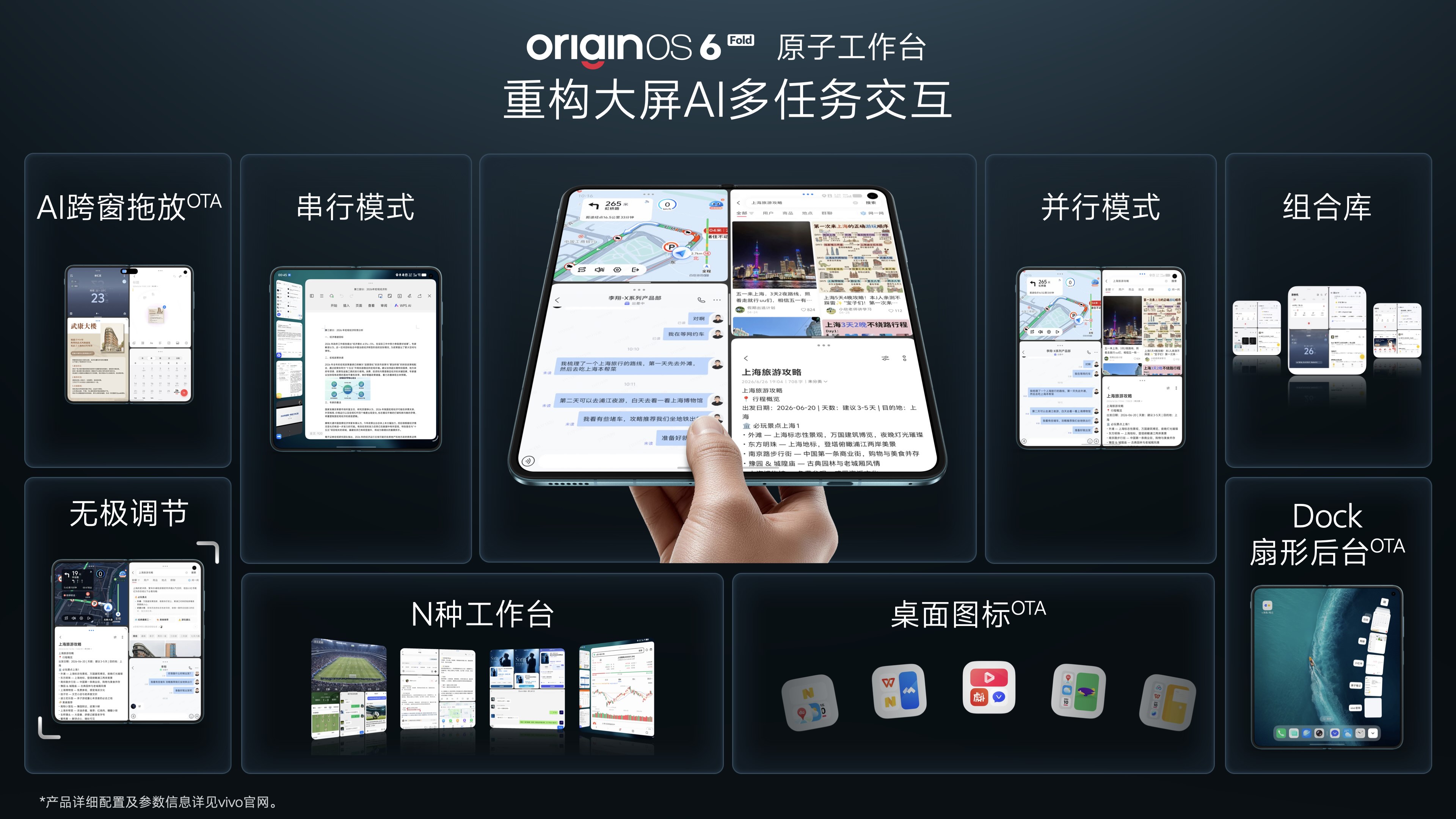
The vivo X Fold 6 has completely broken the shackles of traditional split screen technology and launched an atomic workbench centered around large tasks. For high-frequency overloaded workflows, vivo has innovatively developed two multitasking modes, serial and parallel, using a single workbench:
Serial mode (one main and multiple auxiliary), the upgraded display area has increased by 15%, and the utilization rate of split screen layout is higher. It is extremely suitable for scenarios where a single core event is the main focus and multiple applications assist in coordination.
When you are reading a big model industry data report or financial candlestick chart, you can hang WeChat next to it for easy communication at any time, hang an AI assistant at the bottom to assist in deduction, and then open a browser to search for external information. The four windows do not obstruct each other, the main screen focuses on pushing forward, and the side is always on standby. This is also a must-have for a journalist, and if necessary, you can read four articles at the same time.
Parallel mode (multi line concurrency) is a new form of interaction introduced by OriginOS 6 Fold. It can divide the 8.02-inch inner screen into four equally important independent areas, allowing all four windows to operate normally without switching. Its biggest trump card lies in the window's infinite adjustment ability - holding down the intersection of the four windows in the middle allows you to freely drag and drop the size of each window. You can make the core analysis document occupy 2/3 of the area, and WeChat and Atomic Notes each occupy 1/6. This freely adjustable proportion function completely solves the pain point of traditional folding screens being rigid.
The productivity of foldable screens is not just about how many application windows can be opened, but about whether there can be less interruption, less switching, and less disconnection when searching for work status between window jumps.
Let four AI machines work for you at the same time
In an ordinary straight phone, there are various apps that operate independently, with each grid representing an application, and each application carrying a pile of small red dots, but none of them truly care about what users want to do at the moment.
This is not just about users having higher demands.
Three years ago, AI was just a simple entry point for answering questions, and users had little demand for multi window parallel work. But now, different AI agents have become practical partners who can work and help humans solve problems. Therefore, our requirement for mobile phones has also become a carrier that can enable multiple AI and multiple apps to complete a long-term complex task together.
For example, the inspiration and thoughts of a writer are cut off due to switching programs. To write a material, we need to read reference documents, search for background information, continuously ask questions and discuss with AI, and wait for another specialized AI tool to help sort out and organize viewpoints. On traditional smartphones, you have to frequently switch between several apps.
How to roll up multiple AI simultaneously on a mobile phone?
X Fold 6 can solve this problem. It supports four AI machines running and working simultaneously on a foldable large screen.
Workers are no longer limited to the limitations of a single model when doing industry research, competitive product analysis or creative planning. You can have four large models run and work on the same screen at the same time, which one has clearer ideas, more complete summaries, and more outstanding creativity, at a glance.
AI work may make mistakes, act on its own, and misunderstand intentions. The large screen of X Fold6 can become a monitor for you to monitor AI multi line operations. You can always see what these four AI are doing and what information they are retrieving at every step, maximizing your personal productivity leverage.
The use of a regular mobile phone is like a book that keeps flipping pages, with work links scattered across dozens of pages, making it extremely easy to get lost flipping around; After unfolding X Fold 6, it looks more like a living painting of "Along the River during Qingming Festival", where people can walk from one shop to another and the cargo on the ship can be directly transported to the carriage on the shore. This kind of 'painting circulation' has evolved into a magical experience in the AI era.
Real AI Infrastructure
When it comes to deep processing individual tasks, vivo X Fold6 also offers two core features that should have appeared long ago and directly hit the pain points of business: AI file manager and AI meeting assistant.
Despite the development of smartphones for twenty years, file management on mobile devices often feels like a decoration when faced with massive amounts of files received and downloaded through WeChat. Most users simply don't give proper names to files, searching for a historical file is like looking for a needle in a haystack. The AI file manager of X Fold 6 can automatically cluster files based on end-to-end AI algorithms: according to the actual content, source, and time nodes of the files, they are automatically classified into different topics.
All relevant PDFs, PPTs, on-site recordings, and photos from last week's important conference will be automatically categorized under the same topic. In conjunction with AI themed Q&A, all you need to do is say "Where are the photos from June 26th?" and it will accurately extract them from the topic, truly achieving a closed-loop of "save find use" in file management.
In the context of offline business meetings, X Fold6 has implemented AI character transcription and summarization functions that were first introduced on foldable screens. In a complex conference room with multiple discussions and background noise, it not only has extremely high accuracy in transcription, but more importantly, it can automatically recognize and segment the roles of different speakers, and provide periodic summaries, speculate on the relaxed or intense atmosphere of the conversation, insight into the progress and potential risks of the meeting, and effectively help users understand the "implied meaning" of the speakers. Due to the adoption of end-to-end privacy and security mechanisms, all sensitive content does not need to be uploaded to the cloud, maximizing the protection of enterprise users' asset security.
Even more outrageous is that the X Fold 6 can directly serve as a mini host. Connect the monitor through a Type-C cable or wireless screen mirroring, select "Computer Mode" in the phone pop-up window, and a complete desktop environment will immediately appear on the large screen.
It's not just about screen mirroring and zooming in. The front-end can independently display up to 5 application windows at the same time, while other applications can be minimized to the Dock bar for quick switching. In this mode, the built-in WPS is a PC level full blooded version, not a castrated version on straight phones. The experience of large screen editing, table formulas, and layout alignment is completely consistent with that of a PC.
At this point, the phone itself can be transformed into a precise touchpad. If you connect a Bluetooth keyboard and mouse, and need to change an emergency PPT while on a business trip, you don't even need to turn on your laptop. Simply connect to the hotel's TV and you can instantly enter work mode.
Can handle the endurance and imaging of the main aircraft
Multi tasking on a large screen is a severe test of battery life, and if the main aircraft wants to be "fuel-efficient", there can be no talk of efficiency.
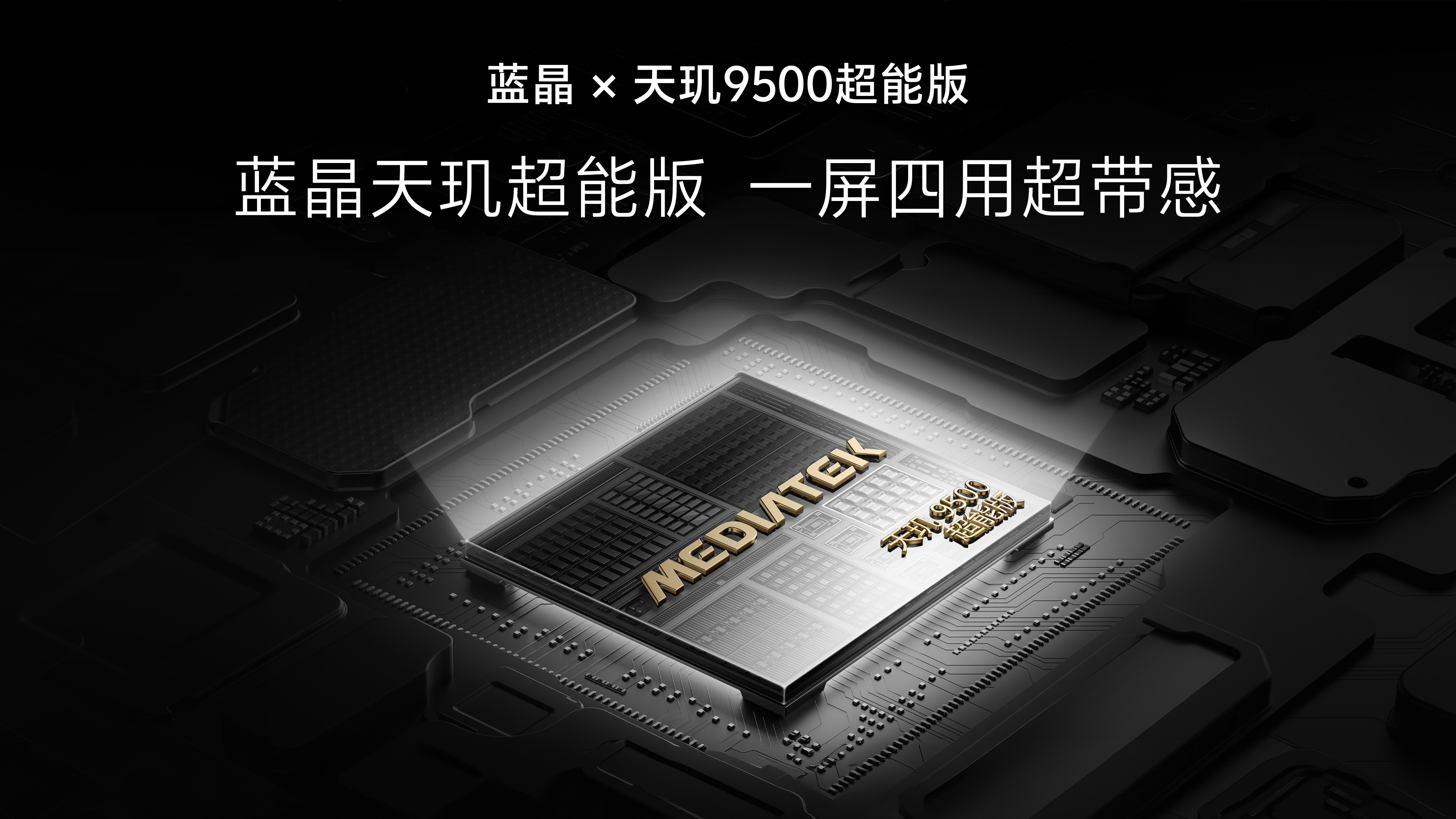
The X Fold 6 comes standard with a 7000mAh blue ocean battery in all versions, featuring the first fifth generation silicon anode and exclusive third generation semi-solid technology, capable of withstanding temperatures as low as minus 20 degrees Celsius. Paired with the jointly tuned Blue Crystal x Dimensity 9500 Super Edition flagship chip, it is equipped with a super energy-efficient concurrent engine at the bottom layer. Even if four apps run video conferencing, documents, WeChat, and notes in real-time on the same screen, it can still achieve an amazing front-end battery life of up to 9.86 hours, eliminating battery anxiety.
For a long time in the past, foldable phones were rarely praised as "flagship imaging devices". Folding screen users often needed to bring an extra straight Ultra phone in order to pursue ultimate imaging.
The default unspoken rule in the industry is that in order to achieve a foldable physical structure and lightweight, it is necessary to sacrifice the storage space of the image. The main camera should be able to capture, the telephoto lens should be sufficient, and the night scene should not be too cramped. But the vivo X Fold 6 clearly has no intention of making any compromise on the core imaging dimension of the main aircraft.
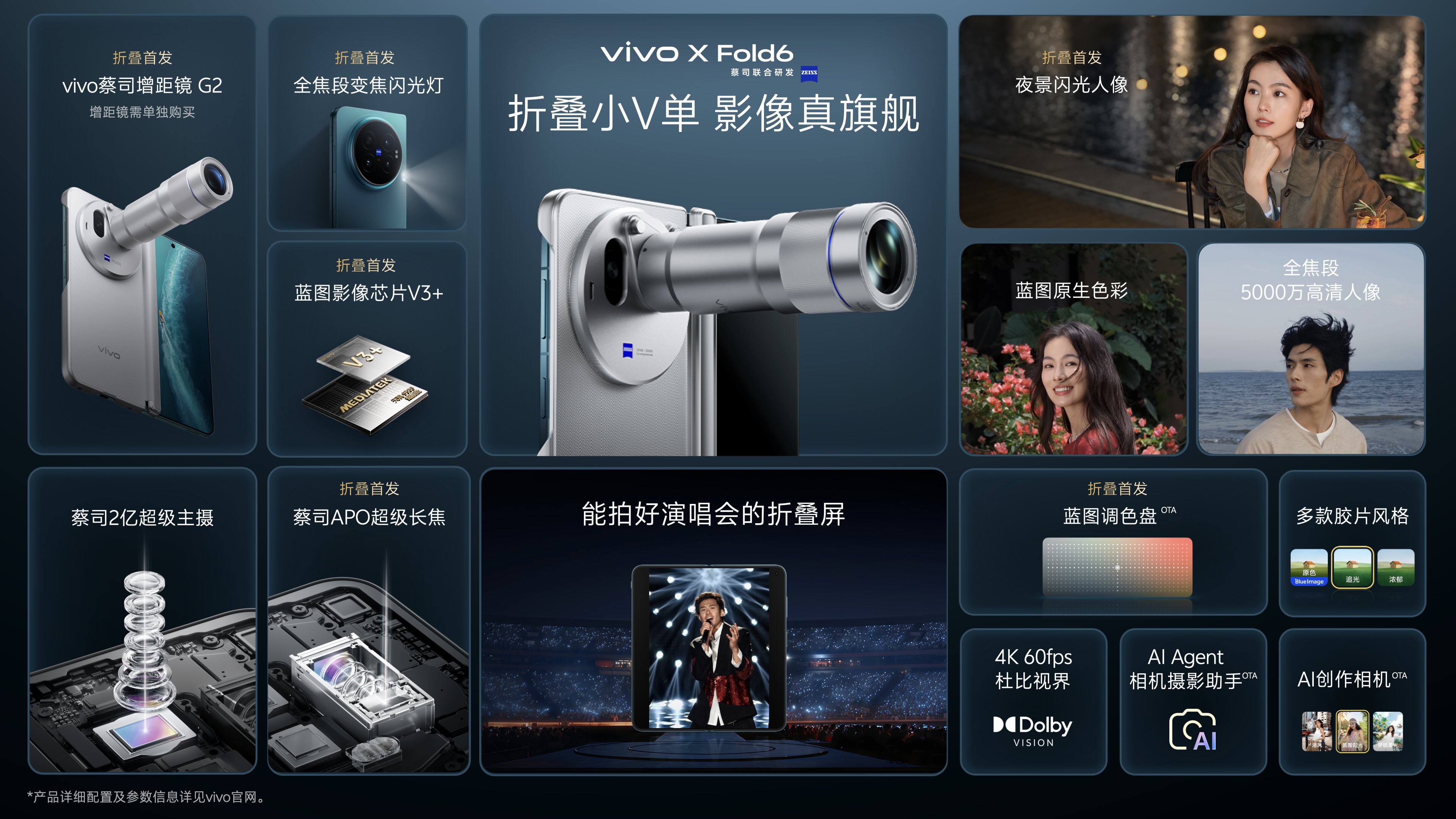
The X Fold 6 has launched a super telephoto lens that can pass the Zeiss APO standard, equipped with a Zeiss 200 million super main camera (1/1.4 inch large bottom, F1.68 large aperture), and built-in a more powerful self-developed blueprint imaging chip V3+. The huge original film captured with 200 million pixels is repeatedly enlarged on the ultra clear screen, and even the highlights in the eyes are vividly displayed. Combined with the intuitive and wearable "blueprint color palette", it has become a true Pro level folding mirrorless camera.
When time passes to 2026, with the comprehensive sinking of large models to the end side, the complete maturity of multimodal interaction, and the opening of the Agent era, the logic of device value has undergone a fundamental reversal.
In terms of absolute computing power and absolute processing ability, the laptop in the bag is certainly the strongest. But when you are on the high-speed train, on the way to the conference venue, at every golden fragment moment that requires spiritual inspiration or crisis handling, the computer often lies in your bag or is offline.
Mobile phones may not be the strongest, but they are always online, like the little assistant you carry with you. The vivo X Fold6 uses hardcore hardware to defend the dignity of the main machine without compromise. With a brand new atomic workbench and native AI, it breaks through the wall and reorganizes multitasking flow, successfully making multitasking smoother rather than more complex. This is an all-around flagship that may not be needed by everyone at first glance, but as long as it deeply penetrates into your production and life, it will make people increasingly dependent on it.
You really can't have both of these foldable phones on the market, unless it's the vivo X Fold6.


 WeChat registration or login