

Economic Observer Follow
2026-06-05 19:39



Economic Observer reporter Liu Xiaonuo
On the evening of May 31st Beijing time, the latest data from Kangfang Biotechnology (09926. HK) flooded the social media of medical professionals. The data shows that PD-1/VEGF dual antibody (Ivosi) combined chemotherapy has defeated PD-1 combined chemotherapy.
An investment industry insider excitedly said, "Not only did we win the World Cup final this time, but we also defeated Brazil, Argentina, and Spain by a large margin
At this moment, Kangfang Biotechnology is attracting widespread attention in Chicago. This research data, called HARMONI-6, became the first Chinese original new drug research achievement to be presented at the annual meeting of the American Society of Clinical Oncology (ASCO).
ASCO is the top medical conference in the global oncology field. The Chinese innovative drug industry broke multiple industry records at the ASCO in 2026, with the number of Chinese innovative drug projects selected for the latest breakthrough summary (LBA) increasing from 2 in 2023 to 13, and the number of oral presentations for over 90 projects also reaching a historical high.
However, the market did not buy it. On June 1st, Kangfang Biotechnology rose by over 12% after opening, but opened high and fell low. After three consecutive days of decline, as of the close on June 5th, Kangfang Biotechnology's total market value was HKD 86.2 billion, with a market value drop of over HKD 10 billion within a few days.
During the same period, almost all Chinese companies participating in ASCO experienced a decline in stock prices, with about 12 companies falling more than 10% within 3 days. On June 1st alone, Cornerstone Pharmaceutical (02616. HK) fell 32.42%.
Despite the continuous market adjustment of innovative drugs for several months, many investors still feel greatly surprised. They once thought that the excellent data published by ASCO could boost stock prices.
Multiple interviewees pointed out that the decline in the stock market may be directly affected by the funding situation. In addition, there is still controversy over to what extent the above clinical data constitutes favorable news. Positions obtained in academia may not necessarily translate directly into commercial value. If the industry wants to develop in a healthy way, more innovative drugs need to truly go global and prove their global value.
The other side of honor is scrutiny
The last time I was so nervous was on the eve of the college entrance examination. "On the evening of May 31st, an industry researcher said on social media that he had experienced tachycardia because he had been waiting for the latest data from the HARMONI-6 clinical trial of Kangfang Biotechnology all day.
This is a phase III clinical trial in China, comparing the combination therapy of Ecovacil and Trastuzumab (a domestically produced PD-1 drug) with first-line treatment for advanced squamous non-small cell lung cancer.
HARMONI-6 data shows that the median overall survival (mOS) of the treatment group is 27.9 months, while that of the control group is 23.7 months; The hazard ratio (HR) is 0.66, which means that the treatment group can reduce the risk of patient mortality by 34%.
In the narrative of Kangfang Biotechnology, the clinical data presented at the ASCO plenary meeting can be considered a historic breakthrough. This data has been forwarded thousands of times within a few hours, and there is a popular saying: Kangfang is the king of the world!
Tang Dajie, founding partner and chairman of Qinzhi Capital, was also excited beyond control. As an investor, he contributed to the financing of Kangfang Biotechnology from Series A to Series D, accompanying Kangfang Biotechnology to grow from a small company with more than ten people to a company with a market value of 50 billion Hong Kong dollars, and successfully exiting. On the evening of May 31st, he also forwarded this data with the caption "Believe in Kangfang".
However, Chen Feng, a professor of pharmacy at a certain university present at ASCO, did not feel the "explosion" effect.
According to the schedule, Kangfang Biotechnology's report was ranked fourth in the plenary session, and the speaker was Lu Shun, Director of Shanghai Pulmonary Tumor Clinical Medical Center. In the subsequent discussion session, Julie Brahmer, a professor at Johns Hopkins University, made sharp comments. Afterwards, the highlight moment of Kangfang Biology quietly ended.
Then, the American pharmaceutical company Revolution made the final report of pancreatic cancer. The mOS lasted 13.2 months, which was about double that of the control chemotherapy group. Chen Feng remembers, 'This is the kind of research that requires everyone to stand up and clap their hands.'.
Chen Feng stated that HARMONI-6 achieved a 34% OS improvement, which has exceeded the expectations of many industry observers who typically consider a 30% improvement as a big win. However, some experts have higher expectations, expecting to see an "amazing" OS result with an HR below 0.5.
This matter itself carries great weight. However, the other side of honor is scrutiny. Analyst Dr. Daina Graybosch's words were straightforward: 'It will definitely be chopped up,' which is the risk of entering the plenary meeting. ”Chen Feng said.
It is undeniable that HARMONI-6 from Kangfang Biotechnology has reached all expected endpoints and achieved significant positivity. However, there are still significant differences in the interpretation of the data.
Chen Feng said that after the report was completed, domestic doctors and investors showed positive emotions; However, some senior experts in the field of breast cancer in Europe and America have responded relatively restrained. Their focus is mostly on the same thing, that is, this is a pure Chinese population dataset completed in China, and there are doubts about the transferability of extrapolating to the Chinese population.
HARMONI-6 is a clinical trial in China, and its control group uses trastuzumab instead of K-drug - K-drug+chemotherapy is the benchmark for first-line squamous cell carcinoma treatment worldwide. The truly head to head global multicenter clinical trial comparing "Ivosi+chemotherapy" and "K-drug+chemotherapy" is HARMONI-3, led by Summit, an overseas partner of Kangfang Biotechnology.
Chen Feng mentioned that in May 2026, Summit tactfully stated that the mid-term analysis of progression free survival (PFS) in the leading HARMONI-3 squamous cell carcinoma cohort did not reach the statistical threshold. The final PFS analysis is expected to be conducted in the second half of 2026.
This result once shattered the market's optimistic expectations for the smooth expansion of Eversion's overseas market, making the real difficulty of China's innovative drug globalization clear. Chen Feng believes that the most practical concern is global extrapolation: the better Kangyi does in China, the greater the pressure on HARMONI-3 global data replication. Once data attenuation occurs, it will be a hard constraint on valuation.
Tang Dajie believes that the HARMONI-6 released now is not the final data, but at least it reflects a very good trend.
At the conference, the challenge faced by Ewosi was not only about whether Chinese data could be applicable to the American population.
According to Apexonco's report, Julie Brahmer questioned whether selecting relatively young patients for inclusion may help improve data quality, as there are many deletions in the survival curve, insufficient follow-up time, limited survival benefits for elderly patients, and exclusion of patients with severe vascular invasion.
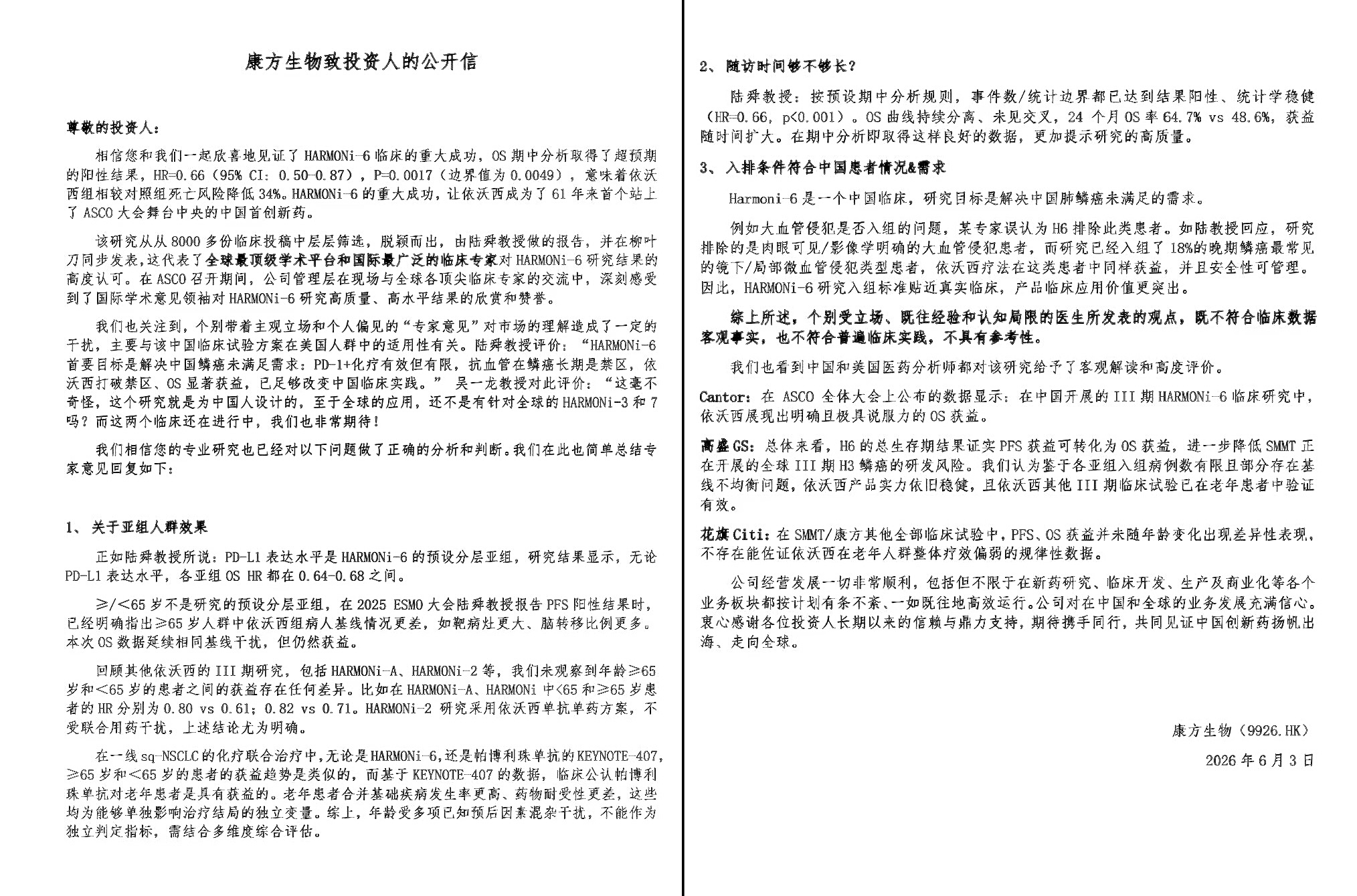
On June 3rd, Kangfang Biotechnology sent an open letter to investors: "We have noticed that individual 'expert opinions' with subjective positions and personal biases have caused certain interference in market understanding," and explained three major controversies in the letter, including subgroup effects, follow-up time, and inclusion and exclusion conditions.
China can produce several top-level works, but has not yet formed a stable system for producing top-level works. Therefore, the evidence threshold set by overseas for Chinese data is more systematic, which is reasonable in itself, not biased, "Chen Feng said.
He believes that objectively evaluating the quality of data can consider four dimensions. 1. Judging from the intensity of the control group, defeating contemporary standard treatment head to head is better than defeating placebo or chemotherapy alone; 2. Looking at the hierarchy of endpoints, OS is closer to ultimate value than PFS; 3. The extrapolation of the population, pure Chinese queue data may have the risk of attenuation from China to the world; 4. Expectations are always relative to expectations, whether the data is good enough or not.
Why has the stock price fallen
Three days after the data was released, the market value of Kangfang Biotechnology fell by over HKD 10 billion, and as of press time, the total market value is less than HKD 100 billion. Other companies participating in ASCO have also experienced significant declines.
Tang Dajie was not surprised by the decline in stock prices. In recent years, every time (Kangfang) releases data, the secondary market has fluctuated violently. We realized from the beginning that this may still be the case. The market may have differences in understanding the company and the data
He pointed out that compared to the primary market that focuses more on industry trends, the secondary market is more concerned with certainty and more averse to risk. After companies release data, there is often a phenomenon known as "seeing the light and dying". Once the good news is realized, funds tend to avoid risks at relatively high levels before returning in. In addition, there have been some market rumors recently, including the US House of Representatives' proposal to restrict the use of Chinese clinical data and China's proposed restrictions on BD, which, although their authenticity cannot be confirmed, amplify market risks.
Ping An Medical Health Fund Manager Zhou Sicong believes that the fundamentals of China's innovative pharmaceutical industry are developing positively, and the short-term stock price trend is primarily related to the funding aspect. Zhou Sicong saw a huge short selling from June 1st to June 2nd, with a short order of 20 million shares on June 1st, which he had never seen before.
In addition, Zhou Sicong believes that medicine itself also has countercyclical properties and belongs to the defensive sector. When the market is good, it is less likely to be favored by funds.
Multiple interviewees also pointed out that while the technology sector is thriving, funds from other industries, including innovative drugs, are constantly being extracted, which also affects the stock price trend of innovative drugs.
It is difficult for capital to invest in healthcare or technology without considering returns. At this stage, which one has a higher possibility of achieving returns, and funds will inevitably flow in those directions first, "said Wang Li, a member of the investment banking committee of Guotai Haitong.
She believes that holding medical assets for the long term still requires determination. Current investments are mostly based on short-term stimulus information, where good news flows out and naturally declines, without taking data and other favorable signals as long-term holding signals.
Short term funds are mainly traded based on some data nodes. However, the value of innovative drug companies requires more patient tracking, such as how many billions of potential profits may be formed in the future, and thus form a long-term holding value. Long term value still needs a long-term profitable target, at least holding it in hand is a 'ballast stone', "said Wang Li.
What you see is that the stock price is falling, but I see that its trading volume has been increasing in recent days. It means that if someone sells, someone will buy. "Tang Dajie believes that effective investment is countercyclical in both the secondary and primary markets. In recent years, as investment institutions, they have been increasing their investment efforts.
Academic seats and commercial value
After reaching a high of 3691.39 in September 2025, the Hang Seng Innovative Medicines Index (HSIDI. HK) has entered a long period of adjustment. Since 2026, in addition to a significant increase in mid to late March, the Hang Seng Innovation Drug Index has entered a downward trend for several consecutive days. As of press time, the Hang Seng Innovation Drug Index is 2227.34 points, equivalent to the level in May 2025.
Will the innovative pharmaceutical industry still enter a capital winter? The respondents generally believe that it will not happen.
The industry will slowly spiral upwards. Policy, supply, and payment aspects are all being optimized. After the previous cycle, this wave of investors is also more mature and rational, "said Wang Li.
Chen Feng believes that the current situation is closer to the second half of 2021, where the previous high point has just been surpassed, the first wave of clearing has begun, but most participants still hold the critical point of "this time is different" narrative. But now there is a relatively certain variable added to the fundamentals, which is BD transactions mainly based on external authorization.
A severe pullback will occur, but the probability of a complete winter like the one from 2022 to 2023, where there is widespread inability to raise funds and bulk liquidation, will decrease. This round is supported by external authorization cash flow, policies, and the actual performance of some companies, "said Chen Feng.
Zhou Sicong believes that there will be three moments of value leap for innovative drugs in China, the first being BD, the second being generic drugs, and the third being commercialization. ASCO has also released a lot of Phase III data, and by 2026, it has entered the validation phase for commercial drugs. This may be the most intense period of financial competition, but only after this verification stage can companies commercialize and cash in their achievements on financial reports.
She expects that by the second half of 2027 or after 2028, the market may break free from the speculative state catalyzed by a single event. At that time, innovative pharmaceutical companies will not only be able to collect down payments, but there will gradually be more cases of collecting commercial dividends. Innovative drugs will be more like stable growth consumer stocks, submitting better reports every quarter.
The divergence between industry and stock prices after ASCO in 2026 also indicates that academic representation and commercial value are two separate evaluation systems.
Treating a venue seat as a judgment of clinical value is a typical way to find reasons for holding positions, "Chen Feng said." The plenary session report reflects the recognition of the importance of scientific issues by the academic community, rather than the endorsement of commercial returns by the capital market.
He believes that in order for the industry to achieve more sustainable development, it needs a truly effective mechanism for clearing outdated production capacity, as well as cultivating long-term capital that tolerates high failure rates, and transforming individual cases from isolated cases to replicable paths.
The sign of a virtuous cycle in the industry is not just a few more seats for the entire conference, but a group of companies that have the willingness and ability to become global multi centers and prove their global value in a positive way, even if they suffer setbacks like HARMONI-3- this precisely shows that the industry is doing real innovation, rather than continuing to compete in crowded tracks. ”Chen Feng said.
(At the request of the interviewee, Chen Feng is using a pseudonym)
Commercial aerospace companies collectively sprint for IPO
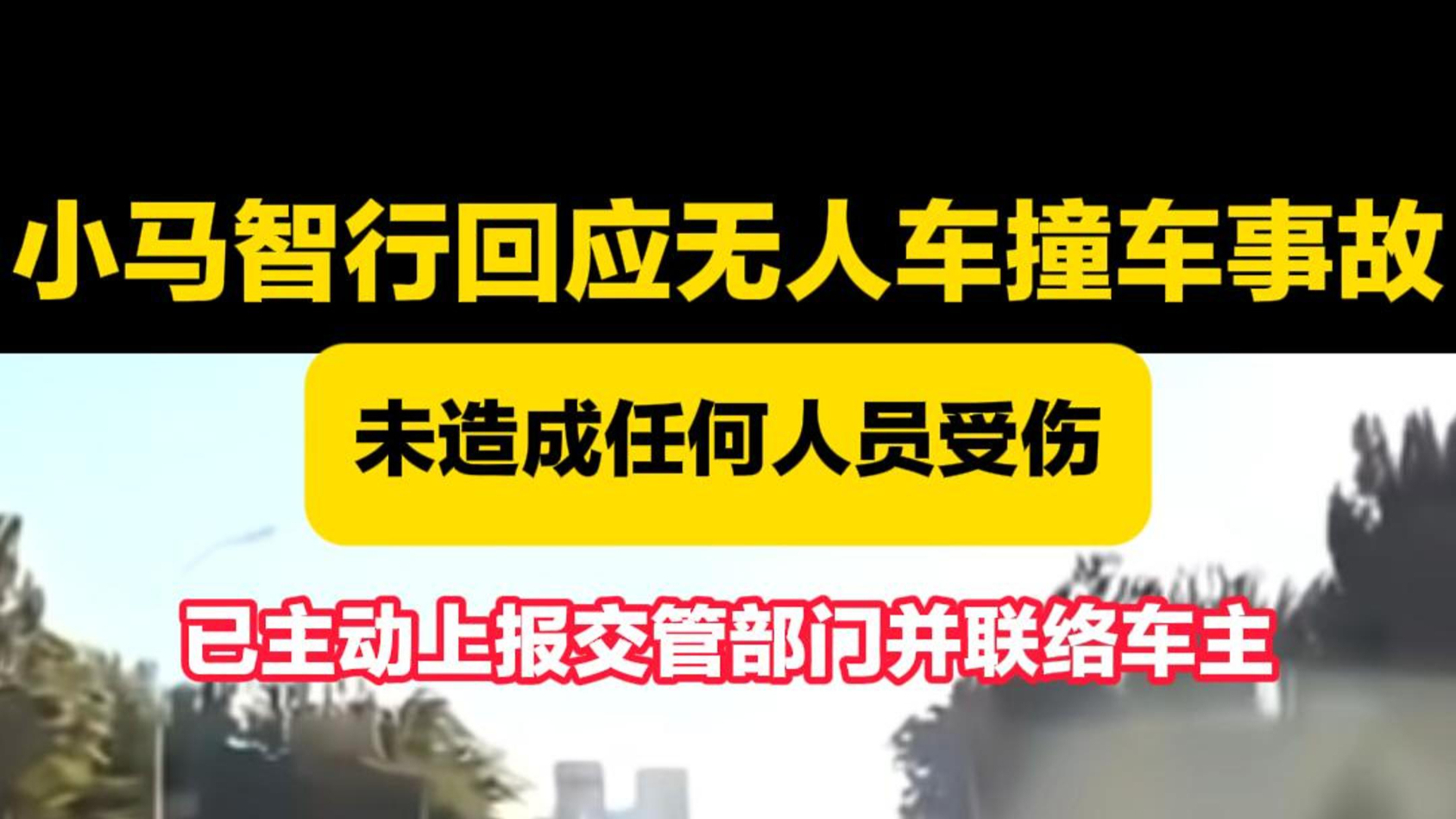
Xiaoma Zhixing responds to the unmanned car collision accident: no injuries were caused, and has proactively reported to the traffic management department and contacted the car owner

Tide Point Research Institute | The World Cup has not yet started, and the "war" among brands has already heated up


 WeChat registration or login


 Subscribe
