2026-10-20 10:54

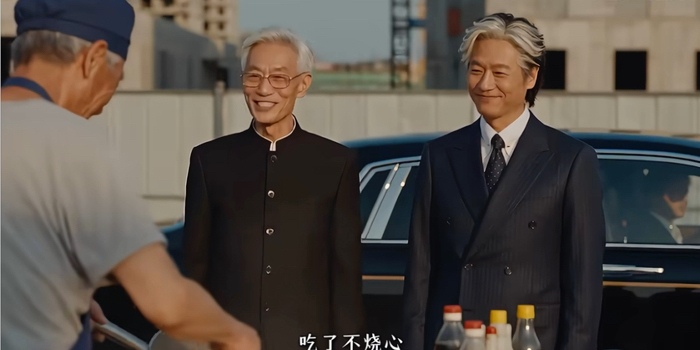
Expensive is a bit expensive, but eating it won't burn your heart. It's better to earn less than to break the rules ..... These lines, which have appeared in multiple AI short dramas and catering vendors, are becoming popular internet memes.
'Heartburn' originally referred to the sensation of stomach acid reflux caused by consuming stimulating food, resulting in a burning sensation in the esophagus that can be mistaken for heart pain. This meme comes from an AI short drama template of a "conscientious merchant". The plot of such short dramas is highly similar, telling the story of a conscientious boss who adheres to principles and uses high-quality materials, but is robbed of business by a unscrupulous boss who uses inferior materials to save money. Although customers are attracted by low prices, the conscientious boss would rather earn less money than adhere to his own rules and standards, and ultimately "defeat" the unscrupulous boss's chicken soup story. From baozi shops to noodle stalls, and then to tea shops, the plot of "not burning the heart" swept through various industries in the short drama.
However, the reason why "expensive is a bit expensive, but eating it doesn't burn the heart" has become popular is because the audience can easily recognize these repeatedly replicated plot routines at a glance. When 'not burning the heart' becomes a new assembly line template, the audience's patience and trust in AI content are gradually being consumed. Today, AI tools have lowered the threshold for content production, but businesses and creators should not lower their creative standards as a result.
A thousand faces at once, the assembly line faces "pinched" by algorithms
In these AI short dramas, the uncle who sells buns and the boss who sells tea have the same "righteous face", while the unscrupulous merchants who compete for business are all villainous templates with "triangular eyes and sharp chin". Many viewers have noticed that characters in different TV series seem to share the same set of faces.
Some low-cost production teams repeatedly use the same or similar facial models, prompt words, and character templates in order to compress the cycle. The characters generated from this often have uniformly high skulls, big eyes, narrow noses, and cold white skin. Even the curved corners of the mouth when smiling and the trajectory of tears when sad seem to be copied from the same template. This kind of "perfect but soulless" face weakens the authenticity and recognition of the characters, making the audience feel uneasy.
The homogenization of characters is not only limited to appearance, but also permeates into their behavior and personality. In many short dramas with the theme of "not burning the heart", the protagonist is always a tolerant and kind grassroots entrepreneur, and the opponent is always a speculator who cuts corners. There are no complex human wrinkles, no real flaws in life, and the characters are more like "tool people" who convey values.
Film art master Hitchcock once said, "Casting is about shaping characters." In the era of AI, character creation in short dramas is also like a "casting". But in the production process of AI short dramas, some production processes simplify character design into "templates". When AI generated characters lose their recognizability, the character images that should have served the plot instead become the biggest obstacle for the audience to appear in the play.
Original content is scarce, AI becomes a copy and paste accelerator
By 2025, there will be approximately 46900 AI animated series released online, with views exceeding 70 billion; In the first half of 2026, only Tiktok's new dramas will reach 515.738 billion. The popularity of AI short dramas is rapidly increasing.
The significant decrease in production costs has spurred the explosion of AI short dramas. According to a research report released by Fangzheng Securities in May, the production cost for mid-range AI short dramas is only 800 to 1200 yuan per minute, and for low-end dramas, it can be reduced to 350 to 500 yuan per minute. Overall, its production cost is only one-fifth of that of live action short dramas and one twentieth of that of traditional anime, and the production cycle has been compressed to one-third or even shorter than before.
However, the reduction in production costs and shortened production cycles did not bring about a synchronous explosion in the quality of AI short drama content, but instead fell into a serious homogenization dilemma. Multiple industry insiders have stated that most AI short dramas rely on online articles and popular live action short dramas to train large models, and the logic of generating content is highly similar. The fixed routine loop of "Rebirth, Dominance, Revenge, Cultivation, Werewolf and Vampire" has become a rarity in terms of originality. In actual production, many creators use the method of "casting a wide net and betting on popular products" to generate and launch with one click, and the plot themes and tricks that have been verified by the market are constantly copied as a result.
The commentary on China National Radio is sharp, with the same template, the same reversal, and the same moral comfort, it can be remade with a different product name. "This is not an AI problem, it's people using AI as a copy and paste accelerator.
The homogenization of content is manifested in two types: one is the "non burning" style chicken soup plot; Another type is the absurd drama that is completely 'released'. The same template of "family ethics+identity reversal" can be pasted on anything you can think of: fungus is competing for family property, nail art is causing divorce, wooden chopsticks and stainless steel chopsticks are engaging in family marriage, and even holidays are coming up on weekends and weekends. There is also a thunderous and identical "Fruit AI Short Drama" that often receives nearly 100000 likes.
Hao Cheng, an innovation business expert at Mango TV Intelligent Research Center, bluntly stated: "Homogenization is unprofessional. I just leave a lot of blank spaces that I should fill in myself to AI, and what I fill out is definitely routine. ”
Ren Yiduo, a senior producer, producer, and director in the AI short drama industry, revealed that the platform even distributes a set of scripts to seven AI production companies to synchronously generate dramas, only replacing virtual faces and background images. The core plot and character conflicts are completely consistent, and homogenization has changed from a creative problem to a platform mass production problem. ”,
Behind this is a set of algorithmic logic. The platform algorithm prefers content that is "abundant, fast, and labeled", and creators can only rely on quantity to exchange traffic, resulting in increasingly poor quality.
When the audience walks away, it's not just a drama
The AI short drama produced on the assembly line attracted the audience's attention with its fast plot twists and sensory stimulation. But consuming the emotions of the audience does not mean triggering emotional resonance, and catching the eye does not mean winning people's hearts.
A survey conducted by the Social Survey Center of China Youth Daily in collaboration with Questionnaire Network, involving 1334 participants, showed that nearly 90% (89.2%) of respondents feel that there are "theatrical" or uncomfortable aspects to current AI performances. 49.4% of respondents believe that current AI performance expressions are hollow and lack genuine emotions. To tell the story deeply and bring the characters to life, one cannot do without the author's personal supervision.
Good examples also exist. The AI short drama "Whose Three Cup Chicken", which was launched in August 2026, tells a story of root searching across the Taiwan Strait and won the "Golden Camellia" Script Award in the 2026 Cross Strait Youth Short Drama Competition. The creative team used AI technology to restore the yellowed texture of family letters, broken details of recipes, vintage props such as old radios, and leveraged the collective memory of the audience, resonating with the fate of the characters' separation and reunion in the drama.
Associate Professor Li Yujian from the Communication University of China pointed out that the common feature of current popular works is not technological updates, but the ability to make audiences empathize widely.
If creativity is no longer valued, the industry may still face the problem of ecological degradation.
According to DataEye's "2026 First Half AI Drama Data Report", there were over 221900 newly launched AI short dramas on the internet in the first half of the year, of which only 1055 had over 100 million views, with a rate of only 0.47%; The AI comics that have entered the investment market account for less than one thousandth of the total profit.
Viewers can stay for three minutes because of the 'pleasure', but they won't pay for the 'emptiness' of the content. When the content cannot retain people, the project can only rely on investing money to buy traffic. Nowadays, the cost of investment has skyrocketed, and about 90% of projects in the entire industry are in a loss making state. Many practitioners are still making profits by losing money.
Similarly, if platform algorithms only promote homogeneous content and advertisers only focus on short-term conversions, differentiated works will be difficult to sustain, and the content ecosystem will fall into the dilemma of bad money driving out good money.
How to get out of the low-quality production "assembly line"?
To break free from fixed routines, AI short dramas need to break free from the aesthetic domestication of algorithms and dare to showcase the "imperfections" of characters.
Characters can have wrinkles at the corners of their eyes, accents with a hint of dialect, moments of hesitation, and choices that do not meet the 'standard answer'. In 2026, some short dramas with good reputations have begun to attempt this breakthrough, such as designing personality details for vendors that are "talkative but soft hearted", adding complex motivations for opponents that are "forced by life to cut corners", and allowing characters to break out of the black-and-white template.
In terms of plot, a large number of local AI short dramas are currently focused on three types of templates: aristocratic counterattacks, time travel rebirth, and fantasy cultivation. There is still a lack of humanistic content such as family, legal documentary, non heritage travel, and real rural areas.
These overlooked areas provide space for AI short dramas to break free from plot clich é s. The first domestic AI full process micro drama "Chinese Mythology" starts from classic mythological stories, uses AI technology to expand people's conventional imagination of myths, and presents the echoes of national spirit in the present through classic imagery. In addition, there are short drama creation teams that use AI to analyze emotional changes in audience comments, generate different versions of endings, and then have creators make choices based on data. In these practices, AI provides more creative possibilities.
The quality can only be gradually refined through reverence for creation, understanding of life, and respect for the audience, "pointed out by the CCTV program" Observing Dan "
The industry also needs to promote the establishment of new AI short drama content evaluation standards.
Evaluating a work should not only focus on the viewing rate and conversion rate, but also pay attention to whether the characters can stand firm, whether the emotions are real, whether the real issues are discussed, and whether the audio-visual language has artistic value. The admission rules of "filing first, then going online", the "Jianwang 2026" special action, and the implementation of the "Management Measures for the Development of Micro dramas" are also accelerating the elimination of the extensive production mode and illegal content of some AI short dramas.
Only by emphasizing "quality" becomes a consensus, can technology return to content oriented, allowing short dramas to transform from "heart burning" fast food consumption into memorable slices of the times.
(The author is a researcher at the Jingguan Research Institute)
The new photovoltaic regulations have not yet been implemented, and some components have already exited the competition for large orders
Towards the end of the year, grid connected energy storage encounters an 'invisible barrier'
The new regulations for innovative drugs do not limit BD, but it has become difficult to sell companies