

2026-10-14 17:53


First issue: Classic film 'Walking on Wall Street'
Starring: Burton Malkiel (Professor of Economics at Princeton University)
Type: Investment Insights/Market Rules/Index Investment
Release year: 1973 (a classic re release of over 50 years)
Is the market really random? How can investors navigate through the fog of cycles?
This classic work that spans half a century is re released today.
Pilot Episode
1-minute quick movie viewing
Director's note:
Time goes back to 1973.
At that time, the "Beautiful 50" foam in the United States had just burst, and countless investors who were chasing the top had suffered heavy losses. It was during this market winter that Princeton University economist Burton Malkiel wrote "Strolling on Wall Street," using extensive empirical evidence to tell the audience:The short-term trend of stock prices is almost random, and no one can continuously predict the market.
Over 50 years have passed, and this book has been reprinted 15 times. In today's information overload, its core idea of accepting unpredictable markets and instead sharing economic growth at low cost has become increasingly clear.
Exciting highlights:
Suspense 1: What does the metaphor of "monkey throwing darts" mean?
Malkiel proposed a well-known metaphor in his book: "A blindfolded monkey can throw darts at the stock price lists of different companies and select an investment portfolio that performs as well as the expert's selection in terms of returns
Is this a joke or a true reflection of market randomness?
Suspense 2: Why is it said that 'the biggest enemy of investors is themselves'?
Now we have encountered an enemy, and the enemy is ourselves. "This sentence was written in 1973, but today in 2026, it still accurately describes the investment behavior of most people.
Why do we always panic and leave in the midst of fluctuations, even though we know we should hold for the long term?
With these two suspense points in mind, let's focus on the two most central and subversive climax moments.
Slice Sharing
[Analysis of orgasmic scenes]
Highlight 1: Random Walk - Is the Market Really Unpredictable?
Classic lines:
The past trend of stock prices cannot be used in any meaningful way to predict future stock prices
Movie Guide:
Markier's "random walk" theory is often misunderstood as the "useless investment theory". But what he really wants to express is:Short term stock prices are influenced by countless unpredictable factors, and it is difficult to consistently outperform the market by attempting to choose stocks or timing.
So, where is the way out? Since the short-term trend is difficult to grasp, a logical inference is that instead of spending a lot of effort and paying high costs to chase elusive "winners", it is better to have a representative sample of the entire market at a lower cost. This is the profound logic of index investing.
This approach cleverly responds to the famous metaphor of "monkeys throwing darts" - if the complex strategies of professional players cannot consistently win, embracing an investment portfolio that simulates the overall, passive operation of the market may actually capture the long-term returns of the market itself.
Instead of predicting storms, it's better to build an ark. Index investment can be described as a "smart choice" tailored for ordinary investors after a deep understanding of market randomness.
Highlight 2: The Number One Villain - Investors' biggest enemy is themselves
Classic lines:
Now we have encountered an enemy, and the enemy is ourselves
Movie Guide:
The hardest part of investment is not learning knowledge, but managing emotions. Cognitive psychology research has confirmed that:When people make judgments in uncertain situations, there may be systematic deviations from rationality in some aspects.
The market is constantly changing, and in the midst of complex information, how should we be vigilant about our irrational decisions? Markier pointed out:“To deal with the negative impact of our bad behavior habits, the first step is to recognize these behavioral quirks and submit to the wisdom of the market.”He also summarized three misconceptions that investors are prone to fall into:
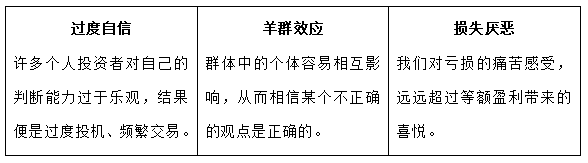
Establish investment discipline by first acknowledging your 'irrational self'. When you find that your buying and selling decisions are often influenced by emotions or others, why not stop and ask: Am I investing, or are emotions investing?
Risk Warning: Funds carry risks and investments should be made with caution.

ST Qingyue fined 172 million yuan for suspected fraudulent issuance and illegal letter disclosure

Focusing on "Artificial Intelligence Empowering New Industrialization", the 2026 Artificial Intelligence Industry Conference opens in Jinan

Can Traveler 7 take care of both commuting on weekdays and mountain trips on weekends? This time, the all-new Jetour Traveler 7 will focus on its "Keyo" # Smart Beauty Travel Champion Box # Kecheng Keyo Keyo Travel # 7 Series Square Box New Benchmark # New Traveler 7 Renewal Surprise Price Starting from 125900 yuan


