

2026-10-12 15:12

1、 The banking sector has reached a new peak, with several major banks hitting new highs on the same day
On October 12th, the A-share banking sector strengthened against the trend. The CSI Bank Index (399986) rose 2.07% on the same day, led by a nearly 5% increase in Chongqing Rural Commercial Bank, Chongqing Bank rose over 4.5%, China Merchants Bank rose nearly 3%, and Ningbo Bank rose over 2.5%. More notably, Industrial and Commercial Bank of China (ICBC), China Construction Bank (CCB), Bank of China (BOC), and China CITIC Bank (CITIC Bank) set new historical high prices since their listing on the same day - ICBC hit 8.42 yuan during trading, CCB hit 11.30 yuan, and Bank of China hit 6.95 yuan.
Looking at it for a longer period of time, the strengthening of bank stocks this round is not a short-term pulse. The CSI Bank Index has risen by 10.39% in the past three months and 5.43% in the past six months; Since the low point in July, the cumulative increase has been about 14.5%. The Sci Tech Innovation 50 Index has fallen by about 34% during the same period, highlighting the relative advantage of the banking sector as a "safe haven". Since 2026, 11 listed banks have successively hit historical highs, and the sector is undergoing a systematic reassessment.
2、 Four fold logical resonance: the core driving force for this strong round
(1) The fundamental turning point has been established, and the net interest margin has rebounded for the first time in nearly four years on a month on month basis.According to the semi annual report of listed banks in 2026, over 70% of the 42 listed banks achieved dual growth in revenue and net profit, and the overall net interest margin of the industry saw its first month on month rebound in nearly four years. Nearly half of the banks' net interest margins hit the bottom and rebounded. Revenue increased by 7.4% year-on-year, and net profit attributable to the parent company steadily climbed. The asset quality pressure that the market had been continuously concerned about has also been alleviated - the non-performing loan ratio has steadily declined, and the provision coverage ratio remains sufficient. The performance outlook for the third quarter is also positive. Guangfa Securities expects its revenue to continue to improve in the third quarter, and its profit growth rate to be basically the same as that of the second quarter. The fundamental shift from "bottoming out" to "improving" is the most solid anchor for sector valuation repair.
(2) The dividend has exceeded expectations and the dividend attribute has been strengthened.As of now, 21 A-share listed banks have disclosed their 2026 mid-term dividend plans, with a total planned dividend payout of over 260 billion yuan. The six major state-owned banks have raised their cash dividend ratio from 30% to 31%, exceeding market expectations, with a total planned dividend of over 220 billion yuan. In the low interest rate environment where the yield of 10-year treasury bond is only about 1.68%, the debt like nature and high dividend attraction of the banking sector are further highlighted, and long-term funds such as insurance continue to increase.
(3) Policy intensive catalysis leads to marginal improvement in the credit environment.A series of policy combinations, such as discount interest on house purchase loans, a 0.25 percentage point reduction in PSL interest rate, expansion of structural refinancing to 1.4 trillion yuan, and 150 billion yuan of capital injection by the Ministry of Finance into special treasury bond, have been put into effect, and the bank's operating environment has shifted from "yielding profits" to "stabilizing profits".Huachuang Securities pointed out that the policy environment has shifted from "suppressing profits" to "stabilizing profits", and the upward logic of the sector has extended from simple defense to the triple drive of "stabilizing mortgages+expanding credit+stabilizing investment".
(4) Rebalance of funds and preference for undervalued defense attributes.Since the third quarter, the high volatility of the technology growth sector has intensified, and funds continue to rebalance towards undervalued and high dividend assets. The PMI's return to the expansion range in September also eased concerns about the quality of bank assets. The average price to book ratio of the banking sector is still only about 0.6 times, and all 42 listed banks have broken through net worth, indicating considerable room for valuation recovery.
3、 Continuous assessment: dual support of win rate and odds
Guosen Securities proposed a dual framework of "win rate+odds" in its fourth quarter strategy: in terms of win rate, the net interest margin has stabilized with high certainty, profits have bottomed out and improved, consolidating the dividend foundation. The third quarter report is expected to further verify the improvement trend; In terms of odds, the important meetings in October and December are key observation windows for policy escalation. If policies push for profit correction, there is a possibility of a "Davis double click".
The mid-term dividend grabbing market usually starts about 2 months before the equity registration date and lasts for 30 to 45 trading days. October is still the window for layout; Insurance has a good start and early allocation at the end of the year will also provide incremental funds. In the short term, attention should be paid to the pace of recovery in the technology sector and the disturbance of overseas risk appetite, but the medium-term logic of "dividend base+profit recovery" in the banking sector is still clear.
Guangfa Securities also reminds that the post cyclical nature of banks means that in the fourth quarter, attention should be paid to the lagging impact of weak physical demand on asset quality, but the alpha of current stock selection is heavier than the beta of the sector.
4、 How to choose a bank ETF: Differences from the total return of the underlying index
Currently, the mainstream bank ETFs in the market track two types of indices: one isChina Securities Bank Index(covering 42 listed banks on the A-share market), the second isCSI Bank AH Price Optimization Index(Compare the A/H discount premium dynamically every month and choose the lower valuation side for allocation). Reinvestment with dividends includedTotal Return IndexDimensional comparison, the differences are clear at a glance:
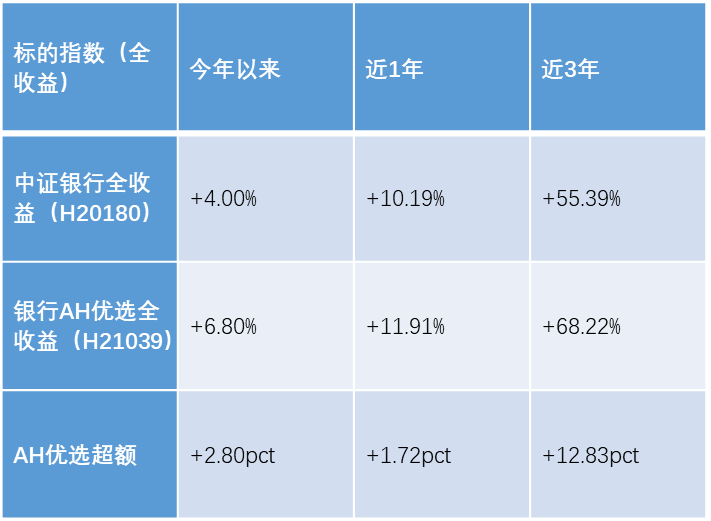
Data as of October 11, 2026. The total income index includes dividend reinvestment, which more accurately reflects the holding experience.
The difference between the two types of indices is essentially a difference in strategic logic: China Securities Bank's total return is pure A-share bank β, while bank AH's preferred total return is superimposed on bank β with AH's spread rotation α. In the past three years, the cumulative excess has reached 12.83 percentage points, and the excess in all time dimensions is positive, indicating that the AH rotation strategy is not accidental, but systematically captures the valuation difference between bank stocks in A/H cities.
In ETFs that track bank indices,Bank AH Preferred ETF Investment Promotion 517900 is the first product in the market to implement AH Bank's rotation strategy。
5、 Bank AH Optimal ETF Investment Promotion 'Rotation' Optimal Selection: AH Spread Strategy Creates Long term Excess
CSI Bank AH Price Optimization IndexThe core mechanism is to dynamically compare the A/H discount premiums of constituent stocks on a monthly basis, and select the side with lower valuation for allocation, which is equivalent to a systematic "rotation" between A-share banks and Hong Kong stock banks.
The source of excess returns is clear: Southbound funds continue to net buy Hong Kong bank stocks, while the valuation of Hong Kong bank stocks has been lower than that of A-shares for a long time, and the AH rotation strategy continues to capture this price difference. At present, the official dividend yield of the index is about 5.36%, which is about 3.7 percentage points higher than the yield of 10-year treasury bond bonds (about 1.68%). The dividend attraction is outstanding. The total return index has returned 68.22% in the past three years, which is nearly 13 percentage points higher than the total return of pure A-share banks, fully reflecting the compound interest effect of the "rotation" strategy.
Under the dual drive of "dividend defense+fundamental revaluation", the bank's AH rotation strategy combines the stability of A-share banks with the low valuation elasticity of Hong Kong stock banks, and the long-term source of excess returns is sustainable. For investors who are optimistic about the banking sector and hope to achieve returns beyond the pure A-share banking index, 517900 is a differentiation tool worth paying close attention to.
Risk Warning: Increased downward pressure on the economy, exposure to risks in urban and real estate investment, lower than expected credit allocation, and slower than expected convergence of AH price differentials may affect sector performance and strategic excess returns.

ST Qingyue fined 172 million yuan for suspected fraudulent issuance and illegal letter disclosure
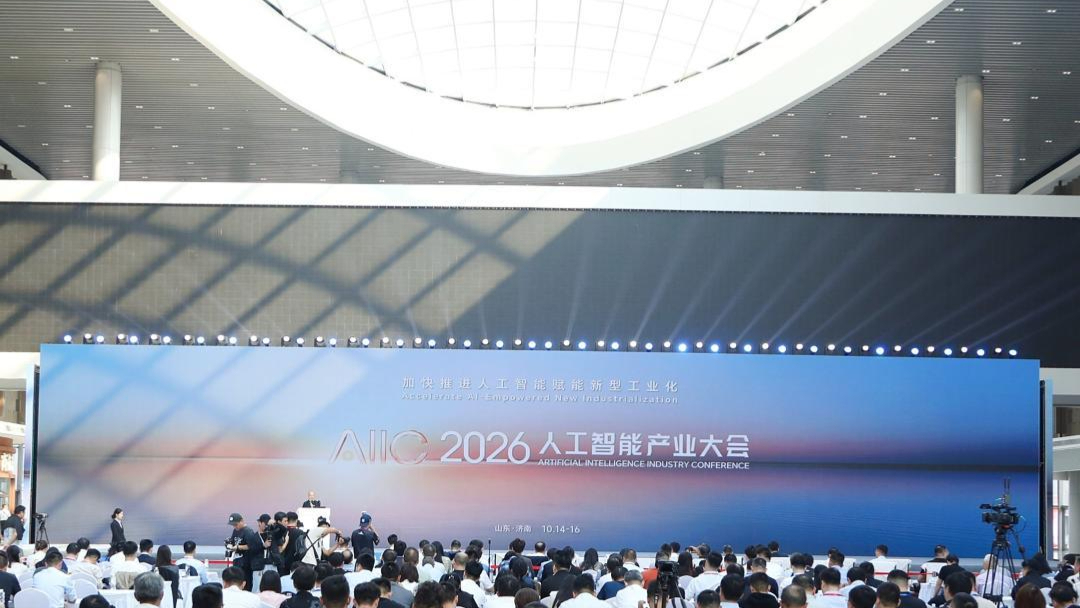
Focusing on "Artificial Intelligence Empowering New Industrialization", the 2026 Artificial Intelligence Industry Conference opens in Jinan

Can Traveler 7 take care of both commuting on weekdays and mountain trips on weekends? This time, the all-new Jetour Traveler 7 will focus on its "Keyo" # Smart Beauty Travel Champion Box # Kecheng Keyo Keyo Travel # 7 Series Square Box New Benchmark # New Traveler 7 Renewal Surprise Price Starting from 125900 yuan


