Economic Observer Follow
2026-10-10 08:23

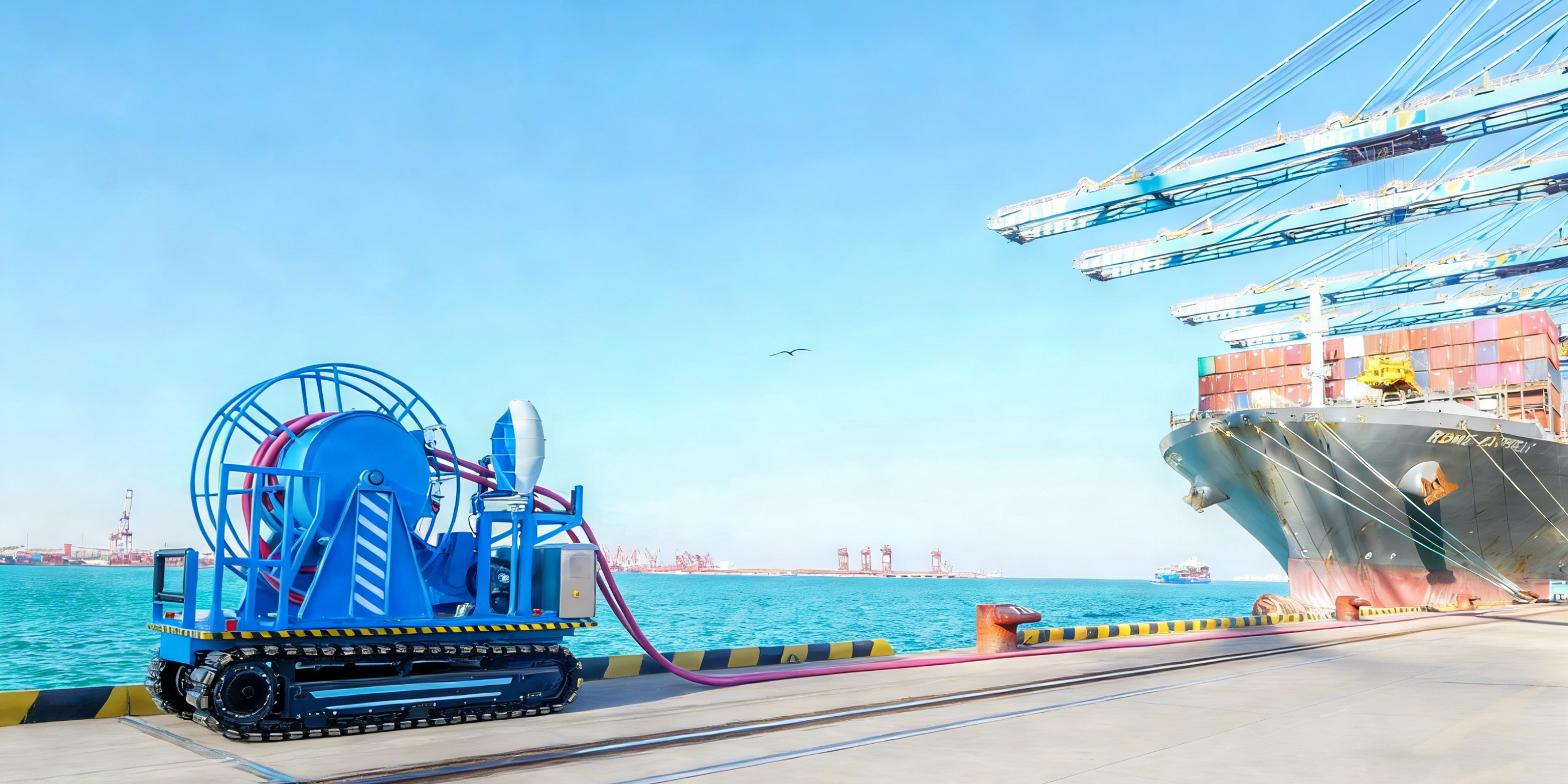
From training a planner for 8 to 10 years, to intelligent agents generating plans in 1.5 minutes; From the security officer breaking his leg and staring at someone's eyes, to establishing a 133 class violation recognition algorithm model. Behind these changes, the Star Harbor Big Model is transforming the experience of old masters into replicable and callable intelligent decision-making capabilities.
The Xinggang Large Model was developed by Qingdao Port (SH601298) and released on October 31, 2025. This is the first vertical large-scale model of the port industry in China, and has been listed as a typical case of vertical large-scale models in the field of transportation by the Ministry of Transport. This model can provide a "smart hub" for ports, fully empowering the intelligent transformation of ports.
Behind this is the trend of port intelligence. The port industry is transitioning from the first half of "equipment automation" to the second half of "decision intelligence". At present, 60 automated docks have been built nationwide, but core production decisions still rely on manual labor. The ability of artificial intelligence to take over mental processes such as scheduling and security is becoming a watershed in the next round of competition.
Why did the big model land first in Qingdao Port? According to Chang Jian, a first-class expert at Shandong Port and Qingdao Port, the answer lies in the scenario and data. Among domestic major ports, some focus on dry bulk cargo such as coal, while others specialize in container shipping; The upper limit of the capability of a large model largely depends on the breadth of the training scenario and the thickness of data accumulation. Qingdao Port has a complete range of cargo types and diverse scenarios, with cross nourishment of data from various sectors. As a result, the model can continue to iterate and deepen the understanding of port business.
In response to real pain points, Qingdao Port has launched the construction of the first batch of 26 demonstration scenarios based on the Star Harbor model, focusing on areas such as port safety, production, and port and shipping services. These scenarios are divided into five major sectors, including terminal production, port and shipping collaboration, global security, embodied intelligence, and operational control, and 19 intelligent agents have been developed, including full factor scheduling and container ship loading.
At present, the Star Harbor model has been implemented on a large scale within Shandong ports and is gradually being replicated and promoted to ports nationwide and overseas.
How to train a 'brain' that understands ports
Why does Qingdao Port need to develop its own large-scale model instead of using a universal large-scale model?
Changjian introduced that the general large model can cope with common scenarios such as daily Q&A among the public, but cannot adapt to high-precision, strong professional, and practical vertical business scenarios. To answer professional questions such as how rail cranes operate and how berth plans are arranged, what is needed is an industry model that understands ports.
To train a large-scale industry model that understands ports, the first step is to solve the problem of "what foundation to use". Chang Jian stated that the Star Harbor model chose a domestically produced base model because the port is a key national infrastructure, and autonomy and controllability are the bottom line requirements. Meanwhile, the current technological capabilities of domestically produced bases are capable of supporting the secondary development of port scenarios.
After the base is determined, data is the next key. After decades of production and operation, Qingdao Port has accumulated a massive amount of diversified professional data, which is the training foundation. However, the original data sources are complex and of varying quality, making it impossible to directly use them for model training.
In response to this, the Qingdao Port R&D team completed the knowledge transformation in several steps: based on data governance and desensitization, cleaning the historical data of the terminal, and structuring the analysis system regulations; Collaborate with frontline experts to make implicit experiences explicit and construct a port knowledge graph that covers ships, berths, equipment, personnel, and safety regulations; Based on the knowledge base and real cases, generate multi scenario question and answer pairs, divide the training/validation set, and combine pre training, domain fine-tuning, and RAG (Retrieval Enhanced Generation) to call the knowledge base in real time, reduce illusions, and ensure compliance.
The biggest challenge in the R&D process is to uncover the implicit experience of experts. These experiences are not standardized and only exist in the minds of senior practitioners, "said Chang Jian.
Taking the intelligent agent for dry bulk cargo terminal berthing as an example, the R&D team invested 3 to 4 months in conducting in-depth research, reviewing a large number of paper plan forms and historical operation records, and organizing the scheduling logic and disposal experience of the old master through interviews and case reviews. The entire intelligent agent polishing cycle lasts for six months.
'Understanding ports' means understanding knowledge,' being able to work 'means being able to participate in real production, and a series of optimizations are required in between. The Xinggang big model first conducts simulation environment deduction, then enters a small-scale pilot in an isolated environment, and finally forms an iterative loop based on real business feedback from the front line, continuously adjusts and optimizes, gradually embeds into business processes, and realizes intelligent operation empowerment.
The Xinggang Large Model is the first vertical domain large model in the national port industry, covering scenarios such as safety, production, and port and shipping services. It has core functions such as natural language, visual recognition, and multimodality, and adopts a "big small model collaboration" mode.
This mode is adopted because the big model is good at understanding complex intentions, processing unstructured information and organizing multi-step tasks, but in terms of real-time control, deterministic computing, cost control and security verification, small models and traditional optimization algorithms are often more effective. The two work together to balance efficiency and safety.
In terms of usage, the Star Harbor model can interact directly like a conversation or be called by other applications through API interfaces. Internally, this model provides intelligent Q&A and job assistants for port employees; Externally, the model relies on the Shandong Port Social Commerce Platform to provide intelligent services to 26000 enterprises and 570000 individual users on the platform, covering port customers such as shipping agents, freight forwarders, and drivers.
What is the relationship between the Star Port model and the first fully automated container terminal in Asia that has already been built in Qingdao Port? Changjian explained that automated docks solve the problem of how bridge cranes, automatic guided vehicles, and other equipment receive instructions and perform physical operations. The Xinggang big model targets human brain decision-making processes such as scheduling analysis, risk identification, and scheme deduction. The former is responsible for equipment execution, while the latter is responsible for decision-making and judgment, and the two complement each other.
Let the big model truly 'work on duty'
Whether the model can work or not ultimately depends on the landing scenario.
The daily production organization, processes, equipment, and interactions in ports are diverse, and what and how to manage safety have always been a difficult problem. Traditional container and dry bulk cargo terminals are the main battlefield for safety control, with a large number of personnel, foreign drivers, and mobile machinery operating every day.
Before the implementation of the large-scale model, port security control heavily relied on manpower. Chen Yiwei, IT administrator of Qingdao Port QQCTU (Qingdao Qianwan United Container Terminal Co., Ltd.) in Shandong Port, introduced that on the one hand, they rely on safety officers to conduct on-site patrols and identify hidden dangers at the terminal; On the other hand, arrange for duty personnel to monitor thousands of surveillance screens. The dock factory has a vast area and scattered operation points, making it difficult for manual inspections to achieve all-weather coverage without blind spots. Internal workers have the advantage of violating regulations in order to save time, and external truck drivers are also prone to on-site violations. Relying on a man to man model, hidden dangers are difficult to capture in a timely manner.
To this end, the Xinggang big model has derived a dynamic security control intelligent agent that can capture personnel's violations, such as illegal standing in the booth, non-standard climbing, and intrusion into dangerous areas; It can also identify the unsafe status of objects, such as monitoring equipment maintenance, multi machine cross operation, mechanical collision risk, and other equipment and work environment hazards.
This intelligent agent targets violations in four high-risk areas: equipment maintenance, human-computer interaction, high-altitude operations, and road traffic. It has implemented 50 business scenarios and established 133 algorithm models. The coverage rate of dock safety supervision has reached 95%, and the number of employee violations has decreased by 32%.
Another typical scenario is production scheduling. Zhao Weili, Director of the Automation and Intelligent Control Center of Qingdao Port Front Company in Shandong Port, introduced that when formulating production plans for dry bulk cargo terminals, manual coordination is required, with over 180 business rules to consider and 132 factors affecting the plan. Planners often spend most of their time manually preparing tables, and any change in one factor will affect the overall production plan adjustment. Nowadays, all factor scheduling intelligent agents can automatically complete calculations and scheme optimization, and can output the optimal berthing and berthing scheme in just one and a half minutes, with a stable adoption rate of over 90%.
The intelligent production decision-making of Qingdao Port's dry bulk terminal is not simply grafting AI scenarios, but adapting AI to the continuous iteration process of this 30-year old terminal. ”Changjian Introduction.
Products such as Xingzhou Safety Control Integrated Machine and Hooking Route Human Vehicle Recognition Intelligent Agent developed based on the Xinggang Big Model have been launched and applied in Rizhao Port and Yantai Port. Domestic ports such as Ningbo Zhoushan Port, Tianjin Port, and Dalian Port are currently negotiating cooperation.
The landing of the product is just the beginning. The biggest challenge in replicating from Qingdao Port to ports across the country is not the algorithm model itself, but the significant differences between ports, "said Chang Jian. The operational processes, management models, and rules and regulations of coastal and inland ports, as well as containers, dry bulk cargo, and general cargo, are not completely the same. In addition, the progress of informationization construction in various ports varies greatly, with different system vendors and inconsistent data standards. The implementation of large-scale models relies on high-quality business data, and some ports have data silos and insufficient standardization of data.
Qingdao Port adopts a "basic large model base+industry wide capabilities+port customization and adaptation" model for this. Reuse the base and universal capabilities, adapt and iterate business rules, data interfaces, and scenario configurations for each port, reduce replication costs, and respect the differentiation of each port.
Changjian believes that large models will become the core infrastructure of the next generation of smart ports. In the past, digitalization of ports focused more on data collection and online processes; The era of big models will move towards intelligent understanding, comprehensive decision-making, and human-machine collaborative operations.
In this round of transformation, Qingdao Port hopes to play two roles: one is a practitioner, continuously polishing the port's large-scale model technology and vertical products, and continuously landing in the direction of scheduling, safety, port services, and green ports; The second is industry co builders, who work together with port and industry chain partners to improve industry datasets and standards, and promote the true rooting of big model technology in the port real economy.
Starting from Qingdao Port, this exploration of port intelligence has just begun.

The Central Political and Legal Affairs Commission has released the list of brave warriors for the third quarter of 2026, with Meituan riders Guo Yabin, Yu Rongxian, and Cheng Jianfeng on the list
New "Three Piece Set" in Shopping Mall: Market, IP First Exhibition, First Store

Up to 4.35%! Which bank in mainland China or Hong Kong has a higher fixed deposit interest rate for US dollars?


 Subscribe