Economic Observer Follow
2026-10-09 11:21

Wen/Li Peishan
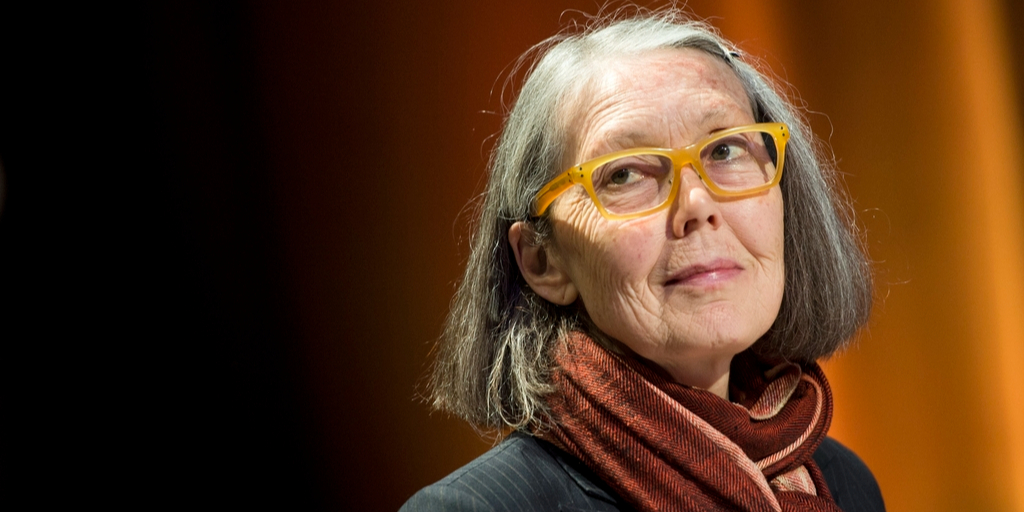
On October 8th, Anne Carson was awarded the 2026 Nobel Prize in Literature. The reason for the award given by the Swedish Academy is that it creates new forms of contemporary literature through bold and creative works that engage in playful dialogue with classical traditions. As a scholar who has devoted half of her life to classical literature, she is adept at using modern and even "postmodern" artistic techniques such as collage, photography, and installations to deconstruct and restructure ancient Greek traditions, creating new literary expressions.
For example, in her poetic novel "The Red Autobiography," the mythological monster Gr ü on, who was originally killed by the hero Hercules, transforms into a sensitive young man with red wings and a camera wandering in South America. She forcefully stuffed some ancient passion into a modern glass jar, giving birth to a strange chemical reaction - Carson did not let the myth become a parody, she used the heartbreak of a young man's heartbreak to make it regain the weight of tragedy.
If we want to truly infiltrate Carson's text, we must first retrieve her yardstick for measuring the world: the ancient Greek 'Eros'.
A sweet apple turns red on a tall branch. "In her first book, 1986 critical work" Eros the Bittersweet, "Carson carefully read this fragment of Saff's poem. Sappho then added, "On the highest branch." "The picker forgot about it," but the poet immediately changed his mind, "No, they didn't forget, they just couldn't reach it
Carson noticed that as Sappho's brushstrokes continued to rise, the reader's gaze became increasingly distant towards the apple. The poem seems to make desire reach out again and again, but in the end it still hangs in mid air. Saff begins with a sweet apple and ends with endless hunger, "Carson wrote.
In Carson's dictionary, desire is never the satisfaction after obtaining it, but a search for scarcity. The ultimate goal of desire is not to obtain, but to measure the distance between oneself and the unattainable. Desire is about boundaries, "she wrote. Carson quoted a metaphor from the ancient Greek tragic poet Sophocles: a child holds an ice cube, watching it melt in their palm, yet still desperately trying to preserve the initial coolness. To preserve the ice, you must freeze your desires. This is a cold paradox. You don't want this, but you can't help but hope for it.
This classical love desire, full of hunger, spans over two thousand years and hits the love and anger of urban men and women during the "economic upswing" period in Europe and America, triggering a huge echo at the turn of the century. Carson's poetic novel "Red's Autobiography," published in 1998, sold 25000 copies within two years; Love is Bitter and Sweet "has been selected as one of the top 100 non fiction books by readers of the Modern Library in the United States. As a classical scholar, Carson unexpectedly became a cultural idol admired by young people. In a popular American urban drama at the time, the protagonist discovers that her crush is also obsessed with Carson, and excitedly confesses that her two books "almost changed my life", igniting their desire for love.
That was an era where people were still willing to pay the price for crossing boundaries. People are happy to regard the reckless collisions of ancient Greeks as a fascinating emotional adventure. This kind of background belonging to the "cultural upswing period" is honesty about the desire itself: characters can acknowledge their desires without having to prove in advance that they will bring a correct or "big result". In Titanic, Ruth jumps back from the slowly descending lifeboat just to get back to Jack's side; In 'Sex and the City', Kelly repeatedly rushes towards' Mr. Big ', towards a relationship she knows may break her heart.
But Carson is not a reckless pure love singer. The reason why desire exists is because certain boundaries exist. "In Carson's view, boundaries are almost like fuel, igniting desire and revealing the loneliness that cannot be eliminated in intimacy. In "The Red Autobiography," the slaughter narrative of ancient Greek mythology is reversed. Ge L ü weng is no longer a monster waiting to be slaughtered, but a sentimental young man tormented by love; The sacred hero Hercules became his frivolous modern lover. As the relationship between the two began to crack, Ge Luweng's wings struggled on his shoulders, "tearing at each other like two ignorant little animals". He found wooden boards to make a back frame, tied his wings tightly, and put on a thick coat. My lover saw him coming up from the basement with a sharp tone and asked him why he was feeling down.
He likes to see the happy expression on Graham's face, "Carson added a cold statement here. This is precisely Carson's cruel diagnosis of modern lust: intimacy not only fails to bridge the gap between two people, but also makes the divide more visible. In order to maintain this precarious relationship, Ge Lv Weng must hide his huge wings, along with the loneliness and pain in his love desires.
The book 'The Beauty of Husband', published in 2001, analyzed the loneliness of love and desire to a more ruthless level. This book, labeled as "A Fictional Essays Composed of Twenty Nine Tango Dances," turns tango, a dance of temptation and rejection, into a dissecting rhythm of marriage. The husband in the book took his wife's reading notes and wrote the phrases she had excerpted from the Homeric epic, describing Andromache and Hector's frequent looks back after their separation, into a letter to his lover. The words of farewell between husband and wife in classical epics have become excellent rhetoric for modern men to embellish betrayal.
Faced with betrayal, the wife had ample reason to condemn her husband and make a clear judgment of right and wrong for this marriage. Her husband once said, "Doubling desires is love, doubling love is madness." She coldly mocked her husband, "Doubling madness is marriage." However, she immediately added that she "does not intend to give a golden rule. However, moral clarity cannot counteract the inertia of desire - she knows her husband is full of lies, yet she is still infatuated with his divine beauty. Carson allowed the ugliness of betrayal to coexist with her husband's beauty, refusing to provide readers with simple moral judgments.
The wound will emit its own light, "Carson wrote at the beginning of the book. Even if all the lights in the room are turned off, people can still use the light emitted by the wound to bandage it. The damage itself becomes the light source that illuminates the damage. However, this light did not free the wife from desire. The more she sees through her husband's lies, the more she has to face her own helplessness. The person who hurt her was precisely the one she couldn't stop longing for. The wound is so clear, but the desire still refuses to leave.
The disheveled nature of love lies in the fact that it is never a form of self-protection that can be carefully calculated, but rather a self exposure that involves handing over the possibility of being hurt to others with one's own hands. Roland Barthes once wrote about the more secretive hesitations of lovers in "Lover's Whispers", that is, how much should their infatuation be concealed, and how much should their desires and pains be exposed?
Praising hopeless affection is a luxury. However, in the overall upward social climate of the "economic upswing period", people seem to have a more affluent survival chassis, able to face the loneliness of love and desire calmly, and dare to squander emotions, treating a heartbreak as an adventure to establish oneself. In that cultural imagination, an experience that one knows will hurt is a brave self breakthrough. It is not a stain on life, but a proof of vitality.
But today, discussions about intimate relationships are increasingly centered around "defense" and "avoiding harm": how to cut losses in a timely manner, how to recognize manipulation, and how to protect one's emotional boundaries. The boundary is no longer a fuse for burning desires, but a set of survival guidelines aimed at avoiding harm. People are increasingly accustomed to using classification terms such as "toxic" or "red flag" to determine the direction of a relationship. This judgment even extends to the evaluation of popular culture products.Under this logic, Ge L ü weng's restrained and restrained behavior can easily be seen as a tragedy of a "pleasing personality"; And the wife who cannot escape from her husband's beauty will trigger a sudden moral anxiety among onlookers, 'Isn't this beautifying an unhealthy relationship?'
Carson refused to play the role of a mentor who gave life advice. In these works, she did not confine complex relationships into one sentence: 'This is the price of desire'. She allowed these unresolved experiences to maintain her own chaos. Once literature no longer allows characters to make mistakes and bear the inevitable harm, we may truly learn how to live more safely. But as a cost, people are also losing the ability to face complex experiences head-on.
This acceptance of complex and unresolved experiences also extends to her translation of ancient Greek texts.
When translating Sappho's poetry collection 'If Not, Winter', Carson retained the square brackets scattered on the pages to mark the words that were damaged and unrecognizable due to their age. She did not attempt to fill these gaps, nor did she mark all the deficiencies one by one, but rather made readers aware that the remaining poems in front of them were originally from damaged ancient literature. Those abruptly interrupted blanks became what she called 'a free space for imaginative adventure'. Just as love grows out of reach, poetry also gains new possibilities because it has not been fully expressed. More than two thousand years later, the remnants of Sappho still invite readers to return to that ruins with their own experiences and desires.
The ultimate attraction of ancient Greece to Carson may have been that it had already preserved this voice of opposition to its own authority. In the 16th fragment of 'If Not, Winter', Sappho explores the 'most beautiful things on earth'. After listing cavalry, infantry, warships, and other things that represent the glory of the city-state, Sappho raised his own objection, "But I say they are what you love." A person's personal desire dared to openly challenge the value ranking of the entire city-state.
Faced with a world increasingly cut by "correctness", this classical provocation has become a luxury. The highly anticipated Nolan film "The Odyssey" this year, as well as the coronation of Carson with the Nobel Prize in Literature, seem to jointly send a cultural signal: as modern people become increasingly accustomed to dividing life by right and wrong, safety and danger, the Western intellectual community is looking back at ancient Greece and seeking another possibility of understanding the world from those ancient conceptual origins. This is an almost instinctive cultural nostalgia.
What are people missing? Perhaps the desires of that era still carry the smell of dirt. In those epics and tragedies full of primitive vitality, the city-state has its rules, the gods have their prohibitions, but people still act within the limits of the rules - desires are allowed to burn, rather than being systematically extinguished.
Saff's objection is precisely the position that Carson reiterated throughout his life in the text. The Swedish Academy praised her in the award speech for "creating new forms for contemporary literature". But behind the reform of form, there is a cruel return to the ancient dilemma.
In this era of rushing to issue a diagnosis for intimate relationships, Carson stubbornly left behind those inconclusive desires, wounds, and blanks. She refuses to let literature become a clinic that provides emotional comfort, but instead uses these ancient fragments to bring modern people back to the most primitive dilemma of love and desire: love and fear.
As Faye Wong sang in her 1997 song "Undercover", "The more beautiful something is, the less I can touch it." We are so eager to get close, but also afraid of getting hurt; Knowing that one cannot have it forever, yet still unwilling to stop craving.


The Central Political and Legal Affairs Commission has released the list of brave warriors for the third quarter of 2026, with Meituan riders Guo Yabin, Yu Rongxian, and Cheng Jianfeng on the list

New "Three Piece Set" in Shopping Mall: Market, IP First Exhibition, First Store

Up to 4.35%! Which bank in mainland China or Hong Kong has a higher fixed deposit interest rate for US dollars?


 Subscribe