Economic Observer Follow
2026-09-18 21:41


On September 17th, Ke Rui International jointly received a report from the AI (Artificial Intelligence) Learning Circle titled "Where are job opportunities flowing in the AI era? ——The 2026 AI Talent Market Report (hereinafter referred to as the "Report") shows that from the first half of 2024 to the first half of 2026, AI related recruitment positions will grow by about 119%, and the proportion of all recruitment positions will increase from 0.72% to 2.01%, nearly three times that of three years ago.
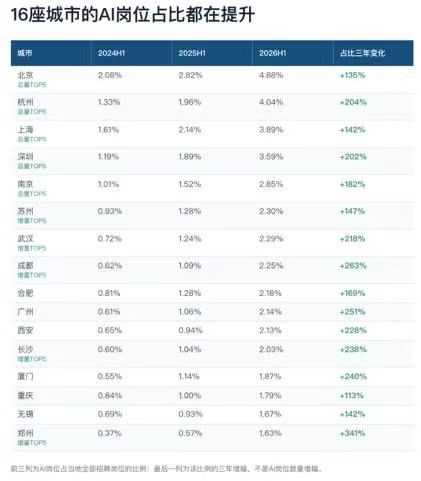
Geographically speaking, Beijing, Hangzhou, Shanghai, and Shenzhen are still the main gathering places for AI positions, with Shanghai having approximately 15000 AI positions in the first half of 2026. But the report also shows that in addition to first tier cities, some industrial cities have begun to rely on their own industrial foundations to form different AI job demands.
Among the 16 cities observed in the report, Zhengzhou has the fastest growth in the proportion of AI positions, with a three-year increase of 341%. The new opportunities mainly come from AI Infra and computing platform operations, as well as AI editing and AI animation creation in short dramas and content e-commerce. Among them, the number of AI application positions has increased by 7 times compared to three years ago, while the number of AI operation positions has increased by 6 times compared to three years ago. However, the total number of AI positions in Zhengzhou is still less than one seventh of that in Beijing.
The report concludes that the growth of content positions corresponds to the existing short drama industry in Zhengzhou. In recent years, Zhengzhou has made the micro drama industry a strategic focus for promoting the integrated development of culture, tourism, culture, and creativity. This city, known as the "vertical store" of the industry, has more than a thousand micro drama enterprises and is aiming for the "billion yuan goal" by 2027, moving towards becoming the "capital of micro drama creation". Some traditional live action filming companies have begun to use AI in some production processes, and positions such as AI editing and AI animation creation have also emerged.
Wuhan has embarked on another path. According to the report, the growth of AI jobs in Wuhan comes more from the automotive, optoelectronic information, robotics, and manufacturing industries. The number of algorithm research and development, agent development, and motion planning positions has also increased, with agent development positions reaching 11 times that of three years ago.
Suzhou is more concentrated in the manufacturing industry. The number of AI posts in the local manufacturing industry has exceeded that in the Internet industry, and the salary of AI posts has exceeded that in Guangzhou, close to the first tier cities; Changsha is more inclined towards manufacturing, electronic hardware, and media culture; Chengdu focuses more on Internet software and electronic hardware.
From the perspective of branch types, the report shows that AI opportunities do not only exist in large and pure AI companies. Among them, about 84% of AI positions come from companies where "AI positions account for less than 30% of all recruitment positions", and the growth rate of AI positions in state-owned enterprises is also higher than that of foreign-funded enterprises.
In terms of enterprise size, companies with less than 500 employees contribute 49.3% of AI recruitment needs, nearly half. Among enterprises with a scale of 0-500 employees, the number of AI application engineering positions has increased by 418% in three years, AI product management has increased by 358%, and algorithm research and development has increased by 43%.
The report shows that more and more traditional industries are also increasing AI related positions. In the past three years, AI jobs in the advertising/media/education/culture industries have grown by 354%, the healthcare industry by 148%, the finance industry by 116%, and the automotive/machinery/manufacturing industry by 86%.
Of course, the impact of AI on the talent market is not always reflected in the creation of new positions. A marketing manager, operations, HR, or finance position may have the same job title as three years ago, but the recruitment requirements have changed. The report shows that the proportion of operational positions that explicitly require AI capabilities has increased from 2.9% to 9.7%, marketing positions from 1.9% to 6.1%, and legal positions from 1.2% to 3.9%.


 Subscribe