Economic Observer Follow
2026-09-18 16:44


In September, some elderly family members asked the head of a chain of elderly care institutions in East China if there would be any elderly care service consumption subsidies (hereinafter referred to as "elderly care consumption vouchers") next year. 80% of the elderly in this institution use pension vouchers every month. The answer from the person in charge is: I don't know.
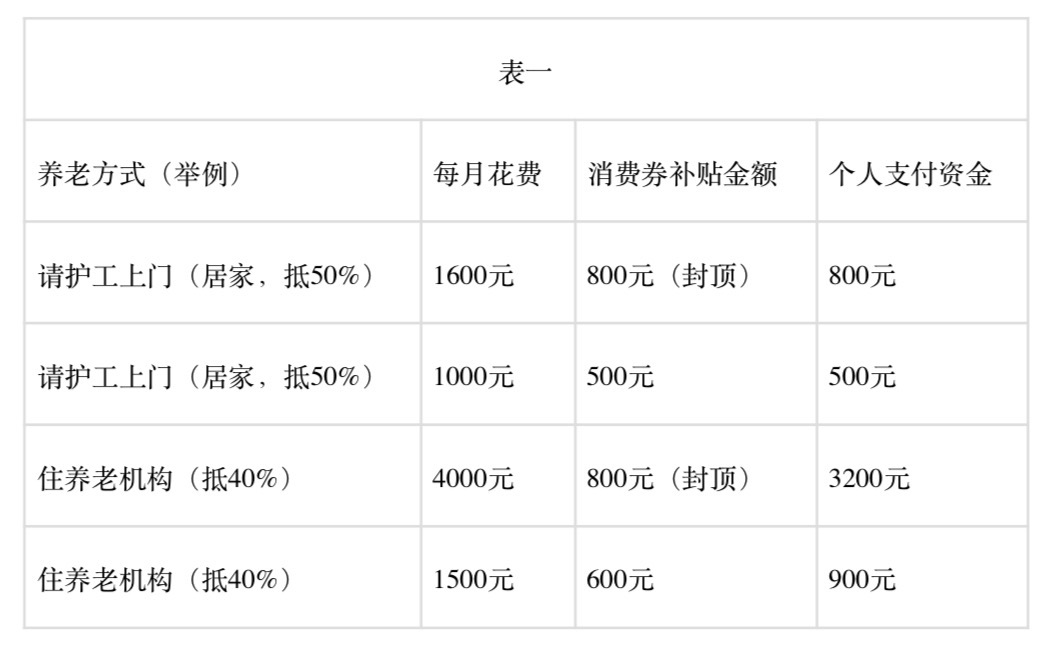
In January of this year, pension consumption vouchers were officially issued nationwide to elderly people with moderate to severe disabilities. Pension consumption vouchers can be used to offset expenses related to pension services, covering both home-based and institutional pension projects. The former has a deduction ratio of 50%, while the latter has a deduction ratio of 40%, with a maximum deduction amount of 800 yuan (calculated as shown in Table 1). According to the established arrangement, the policy is expected to be implemented until the end of December 2026.
Disabled elderly people who stay in this nursing home usually spend between 4000 and 5000 yuan per month, and can basically use pension consumption vouchers up to a maximum of 800 yuan. The elderly are very interested in this policy, but the person in charge has mixed opinions on the implementation effect of pension consumption vouchers, as they also bring many troubles.
In April of this year, our newspaper published an investigation on pension subsidies: institutions providing millions of yuan in advance, heavy audit procedures, and hidden concerns about fraudulent subsidies, which mentioned that pension consumption vouchers encountered multiple obstacles in the initial landing stage. In the past six months, several leaders of elderly care institutions have stated that the issues faced at the beginning of the year, such as institutional funding, have not been resolved, and new problems such as insufficient coverage are gradually emerging.
In late July, the head of the above-mentioned elderly care institution attended a meeting organized by relevant departments. He learned from the meeting that the implementation of pension consumption vouchers has been more than half a year, and the amount of verification has not yet exceeded half of the special subsidy funds. Someone at the meeting judged that if the policy effect still does not meet expectations by the end of the year, the continuity of this policy may face challenges.
The person in charge stated that pension consumption vouchers have provided economic assistance to a large number of elderly people and families, but if such problems are not resolved for a long time, even if the policy continues, the enthusiasm of pension institutions to actively promote pension consumption vouchers may still be greatly reduced.
There is still room for acceleration in the verification progress
At the end of July this year, the Ministry of Civil Affairs announced the actual usage of pension consumption vouchers. In the first seven months, a total of 10.7992 million consumption vouchers were written off nationwide, with a write off amount of 6.512 billion yuan, driving a consumption amount of 29.093 billion yuan for elderly care services. No more than 2 million disabled elderly people used elderly care consumption vouchers.
In March of this year, the Ministry of Finance mentioned that the funds required for pension consumption vouchers would be shared by the central and local governments in a ratio of 9:1, with the central government providing a special subsidy of 12.09 billion yuan. According to this calculation, the cumulative write off amount of pension consumption vouchers in the first seven months only accounted for 53.9% of the central government's special subsidy funds. If taking into account the additional local investment, the cumulative actual write off amount in the first seven months is less than 49% of the write off limit.
In terms of policy coverage, pension consumption vouchers are mainly targeted at "moderately or above disabled elderly people". The fifth sampling survey on the living conditions of elderly people in urban and rural areas in China conducted in 2021 showed that there are currently about 35 million disabled elderly people in China.
Some regions also mentioned when releasing the verification data of pension consumption vouchers that the progress of using local subsidy funds is relatively slow. For example, Huaihua City in Hunan Province issued a document stating that the total amount of funds for the city's pension consumption vouchers in the first half of the year reached 32.03 million yuan, and as of the end of July, the city's pension consumption vouchers had been written off for a total of 11.8458 million yuan, with a verification progress of 36.98%.
The Economic Observer interviewed several leaders of elderly care institutions, and the consensus is that elderly care consumption vouchers are more like subsidies for existing consumption, with limited effectiveness in stimulating new consumption.
At the beginning of the year, when the elderly care consumption voucher was implemented, the Ministry of Civil Affairs mentioned the need to tap into the consumption potential of elderly care services, promote high-quality development, and promote a positive interaction between economic development and people's livelihood improvement. At the same time, the Notice on Fully Launching and Implementing the Elderly Care Service Consumption Subsidy Project for Moderately or Above Disabled Elderly Persons also proposes that localities should take the implementation of subsidy projects as an opportunity to strengthen the cultivation and development of specialized, chain, and branded elderly care service institutions, and encourage and support elderly care service institutions to extend their services to rural areas.
The heads of elderly care institutions headquartered in first tier cities and with institutions located in dozens of cities across the country have observed that the impact of elderly care consumption vouchers on the increase in occupancy rates of elderly care institutions has not yet fully manifested.
He said, "Unlike one-time purchases such as purchasing electronic products with large consumption vouchers, elderly care institutions need to pay continuously every month. In first and second tier cities, even if they can deduct 800 yuan per month, the elderly still need to pay more than 3000 yuan out of pocket, which is difficult to drive elderly people who do not originally live in elderly care institutions to move in. Elderly care consumption vouchers mainly benefit those elderly people who already need to pay monthly nursing fees
According to data released by Ningxia, as of mid August 2026, a total of 62700 elderly consumption vouchers have been written off, promoting the addition of 627 elderly people to elderly care institutions.
Regional differences in driving consumption
From the regions where data has been released, there have been significant differences in the effectiveness of consumption vouchers in different regions.
For example, 192000 elderly people in Jiangsu Province have used pension consumption vouchers, accounting for about 0.88% of the total number of permanent elderly residents in Jiangsu Province; The number of elderly consumption vouchers used in Guangzhou accounts for nearly 1% of the local resident elderly population. In contrast, the data in Fujian is only 0.56%.
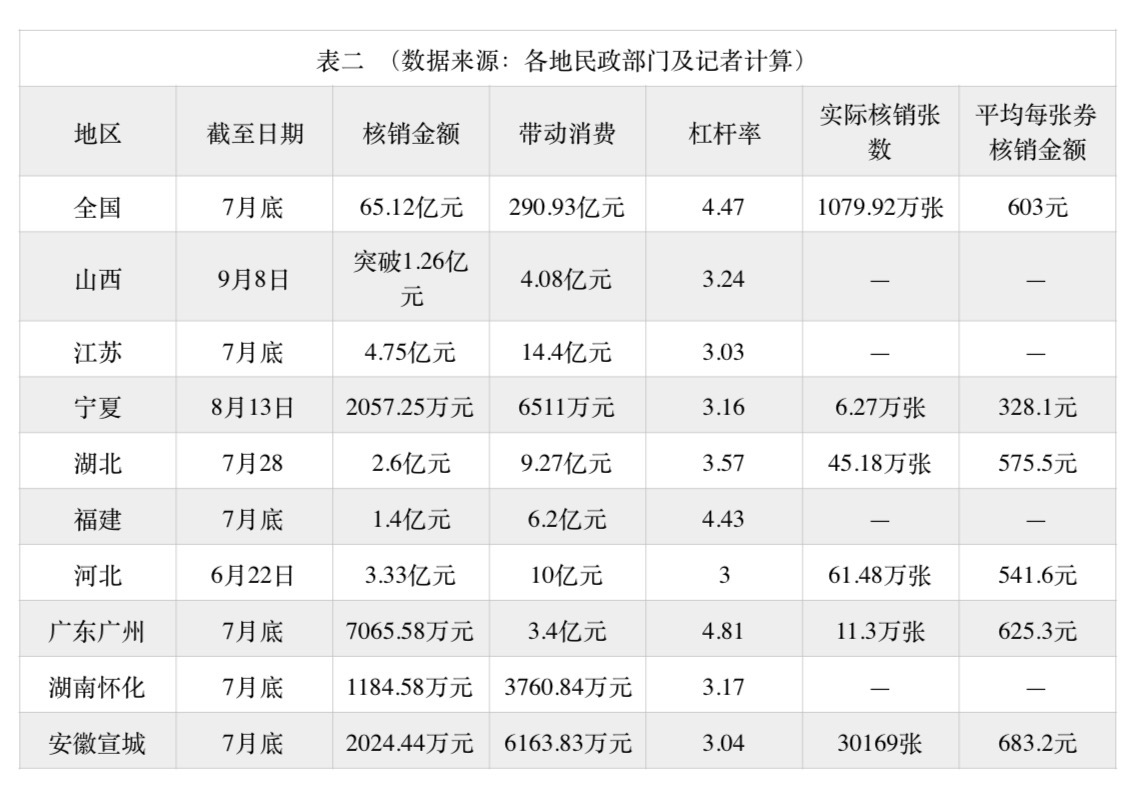
The leverage effect of consumer vouchers in stimulating consumption varies significantly in different regions. At the national level, the leverage ratio of pension consumption vouchers to stimulate consumption is 4.47:1. Equivalent to every 1 yuan of retirement consumption voucher written off, it can drive 4.47 yuan of retirement consumption (the elderly pays 3.47 yuan out of pocket, and the consumption voucher deducts 1 yuan).
As shown in Table 2, the leverage ratio of pension consumption vouchers driving consumption in Shanxi, Jiangsu, Ningxia, and Hebei is all below 3.3, significantly lower than the national average level. Taking Jiangsu as an example, as of the end of July, the verification amount of Jiangsu's pension consumption vouchers accounted for 7.29% of the national total, while the consumption driven by it only accounted for 4.95% of the national total.
The stimulating effect of Guangzhou's pension consumption vouchers is even more prominent, with a leverage ratio of 4.81. Based on this calculation, more than 21500 disabled elderly people in Guangzhou used pension consumption vouchers in the first seven months, with an average of about 3286.3 yuan of pension consumption vouchers written off per elderly person, and individuals simultaneously paying 12527.7 yuan out of pocket.
In practical operation, the deduction ratio of pension consumption vouchers is the same in various regions. Therefore, the higher the average amount of verification for each voucher, the higher the additional expenses that individuals need to pay will also increase proportionally.
As shown in Table 2, the average amount of verification for each consumption voucher in Ningxia is only 328.1 yuan (20.5725 million yuan verification amount ÷ 62700 verified consumption vouchers), which is significantly lower than the national average level.
In addition to regional differences, the gap between urban and rural areas will be more prominent.
Some of the nursing homes managed by the leaders of the chain nursing homes in East China are located in rural areas. She mentioned that unlike the "trade in" vouchers that can be used online, the pension vouchers can only be used in offline scenarios. Due to the limited supply capacity of elderly care services, elderly people in rural areas face the embarrassment of having no available services even if they want to purchase home care services with consumption vouchers. Some rural areas in the area do not even have nursing homes. To enhance the inclusiveness of elderly care consumption vouchers, it is necessary to strengthen the construction of elderly care service facilities in rural areas in the future
In the area where the person in charge is located, the monthly pension for urban and rural residents is less than 300 yuan.
The person in charge of the chain elderly care institutions in the first tier cities mentioned above stated that home care services are an important market demand in home-based elderly care and a consumption scenario covered by elderly care consumption vouchers. However, it is difficult to achieve a break even point by opening home care service institutions in rural areas, and there are few such institutions in rural areas. The lack of supply in such scenarios makes elderly consumption vouchers more friendly to urban elderly people.
Fraudulent compensation and trouble
On May 12, 2026, the Civil Affairs Bureau of Changshou District, Chongqing, announced a notice that elderly care institutions had fraudulently obtained "elderly care consumption vouchers", which has attracted widespread attention in the elderly care industry. This is the first time since the implementation of elderly care consumption vouchers at the beginning of this year that the official level has detailed the fraudulent subsidy behavior of elderly care institutions.
The announcement mentioned that Anboxin (Chongqing) Health and Elderly Care Service Co., Ltd. Changshou Branch engaged in fraudulent subsidy activities in the distribution of elderly care service consumption subsidies. In the end, this institution was disqualified from participating in the elderly care service consumption project, disqualified from filing, and all related orders will not be reviewed and paid.
The qualification for filing is a prerequisite for elderly care institutions to be included in the industry supervision of the civil affairs department and enjoy relevant policy support. In actual operation, once the registration qualification is cancelled, the elderly care institution must stop operating elderly care related businesses and shall not carry out elderly care business under any name of the elderly care institution.
Subsequently, some civil affairs departments in certain regions have also reported the fraudulent use of pension consumption vouchers.
On July 31st, the Civil Affairs Bureau of Yibin City mentioned that recently, the civil affairs department of Yibin City has received multiple reports from the public that some elderly care service institutions have induced and encouraged elderly people to use elderly care service consumption vouchers in violation of regulations, and have used false consumption, empty brush verification and other methods to embezzle financial subsidy funds; On September 8th, the Civil Affairs Bureau of Lanzhou City mentioned that recent investigations have found multiple cases of elderly care service institutions inducing and deceiving the elderly population to illegally use elderly care service consumption vouchers, and defrauding special funds by promising free services to the elderly, forging false certificates of services, and empty verification.
In fact, since the implementation of the self supported elderly consumption voucher policy, strict investigation of fraudulent subsidies has been repeatedly mentioned by the authorities.
On March 24th, the Ministry of Civil Affairs emphasized at a special press conference on the progress of the elderly care service consumption subsidy project that it will always adhere to the bottom line of fund security, improve the full process supervision system of subsidy funds, strictly implement the closed-loop management of "qualification review, consumption verification, fund settlement, and spot check audit", and ensure that every subsidy fund is used wisely.
Under the "red line" of fraudulent compensation, several managers of elderly care institutions mentioned that in order to avoid the risk of violations, institutions need to invest a lot of manpower to deal with potential compliance risks. The additional workload caused by some detailed issues has added a lot of hidden costs to the institution.
Li Lu operates dozens of elderly care institutions in more than ten provinces across the country. She gave an example to illustrate that for elderly people who enjoy consumption vouchers, if the family member (contract guardian) who signs the payment and the family member who settles the pension consumption voucher the next month are not the same person, it will cause the signing subject of the payment voucher to be inconsistent with the settlement list, making it difficult to pass the later review.
Many frontline nursing staff have complained to Li Lu that they need to upload service records and on-site service photos three times a month, in the early, middle, and late months. But the service mini program is not stable, often experiencing upload failures, prolonged inability to open, and other situations, requiring repeated re shooting and re uploading, which directly squeezes the time that nursing staff should use for care services.
Compliance risks have also dispelled the idea of expanding home care services for elderly care institution leaders in the East China region mentioned above. He said that compared to elderly care institutions, the preparation and review process of materials corresponding to home care will be more complex. If there is suspicion of insurance fraud due to data negligence, the institution cannot afford the series of consequences brought by this red line. Institutions need to strictly verify that the photos used for review were taken on the day of service, and the time and location of the service must be consistent with the photos. Due to caution, many small and medium-sized institutions in the local area are unwilling to be included in the list of elderly care consumption vouchers
Fund Advance Differentiation
In April of this year, our newspaper published a survey on pension subsidies: institutions advance millions, review procedures are cumbersome, and there are hidden concerns about fraudulent subsidies. It was mentioned that pension institutions need to advance funds for pension consumption vouchers, which greatly affects their cash flow.
Normally, elderly people first present their pension consumption vouchers to offset the corresponding proportion of expenses; After the institution completes the verification, it is necessary to promptly submit the verification vouchers, service records, elderly occupancy contracts (nursing homes) and other materials to the local civil affairs department and finance department for review; The next month, the elderly care institution can only receive the subsidy settlement payment after the civil affairs department and finance department have completed the review.
The review process previously announced by multiple regions shows that, in principle, the entire process from the initiation of the review to the actual issuance of funds by the civil affairs and finance departments takes about 24 days.
As of September this year, according to feedback from the heads of elderly care institutions, the problem of long payment terms still exists. Currently, elderly care institutions in Beijing and Shanghai need to advance payment for elderly consumption vouchers for 1 to 2 months; In many cities in the central and eastern regions, the funding cycle will be extended to 3 to 5 months.
As of early September this year, several elderly care institutions established by Li Lu in the top 15 cities with GDP in China by 2025 have not yet received settlement payments for elderly care consumption vouchers from March to July this year, which has seriously affected the cash flow of the institutions; Du Jun's institution has only received the advance payment for the first four months.
Li Lu has repeatedly asked the relevant local departments, and the response he received was that the multi-level review of consumer vouchers requires time, and each review process is concerned about errors. No one dares to touch the red line of illegal fund distribution, and the specific disbursement time can only wait for news. She stated that there is no clear standard for the review cycle of consumer vouchers, and the funding cycle and amount of institutions are constantly increasing. The ultimate policy dividend falls on the elderly, but the cost of capital occupation is all borne by elderly care institutions.
In order to alleviate the pressure of advance funding, the competent authorities and elderly care institutions have explored two response methods in the past six months.
One is' pay first, pay later '. Zhejiang Province allows elderly care institutions to first collect elderly care service fees according to the contract, and then refund the corresponding amount of subsidies to the elderly after the funds for elderly care consumption vouchers are issued. Although there is no clear official document to support it, Du Jun and many peers have also adopted a similar "pay first, pay later" approach.
Li Lu stated that in many regions, the management departments have strict control, and even if institutions want to adopt the "pay first, pay later" policy, they will be directly stopped by the civil affairs department.
Another way is to optimize the audit cycle. For example, Qingyunpu District in Nanchang, Jiangxi Province took the lead in piloting "differential direct payment": when elderly people move into institutions, they only need to pay the difference out of pocket, and the review cycle for pension consumption vouchers has been compressed from 15 working days to 5 working days, transferring the financial pressure from the server to the system.
Li Lu suggested that compared to the current hierarchical review model, if the pension consumption vouchers can be directly distributed to individuals like the annual childbirth subsidy of 3600 yuan, it can not only fairly cover all disabled elderly people, but also reduce the burden on pension institutions during the policy implementation process.
(At the request of the interviewee, Li Lu used a pseudonym in the article)


 Subscribe