2026-09-15 10:53


Author: Ouyang Xia
The cruise ship sailed from Bergen, Norway into the Caribbean Sea and took twelve days.
On the day of leaving Bergen, the fog in the fjord was thick like a pot of Congee that could not be boiled, and the whole city was huddled at the foot of the mountain like a wet stone. The ship sailed out of the harbor towards the depths of the Atlantic Ocean, and as the coastline of Santo Domingo rose from the horizon, hot winds carrying a humid and hot atmosphere swept towards it. In October, the Caribbean is deeply immersed in the rainy season, with clouds hanging low like a fermenting dough.
At that time, it was 2011 and the Dominican Republic had not yet established diplomatic relations with China. The signature on my passport came from the local commercial agency. Walking on the street, not many people have seen Chinese people or recognized the Chinese flag, but they are not too curious about unfamiliar faces. This city is neither enthusiastic nor indifferent, just living on its own, like an old man who doesn't care much about the world.
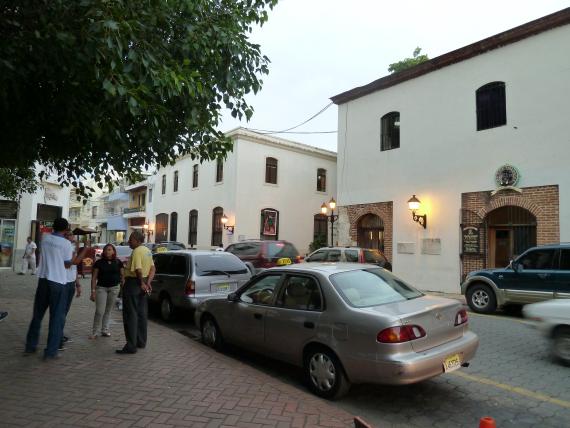
Street View of Santo Domingo (Photo by Ouyang Xia)
Xiwao Valley: The Bitter Sweet Cycle of Cocoa Fruits
Santo Domingo heads north as the car enters the Siwao Valley. The vegetation on both sides of the road becomes increasingly lush, with tall cocoa trees weaving a green dome above their heads. There is a damp, sweet scent wafting through the air.
The tour guide is a local with dark brown skin and speaks English clearly and fluently. As soon as the car set off, he recounted the history of this land: the planting history of sugarcane and cocoa; How this country gradually emerged from Trujillo's thirty year dictatorship and struggled to regenerate on the ruins... When the dictator was assassinated in 1961, he had not yet been born, but the memories of his ancestors were engraved with the imprint of that era. He speaks at a rapid pace, but his tone is calm and indifferent, as if telling a distant story that has no connection to himself.
Before disembarking, the waiter from Honduras in the restaurant grabbed me and whispered a warning, "These American countries are very chaotic. Don't walk alone in remote places, especially at night. They will kill for one dollar
The tour guide's narration is still ongoing. I looked out the window and a figure suddenly passed by the edge of the fork, with the silhouette of a firearm faintly visible around my waist. The speed is too fast, the image is fleeting, and I'm not even sure if I read it wrong.
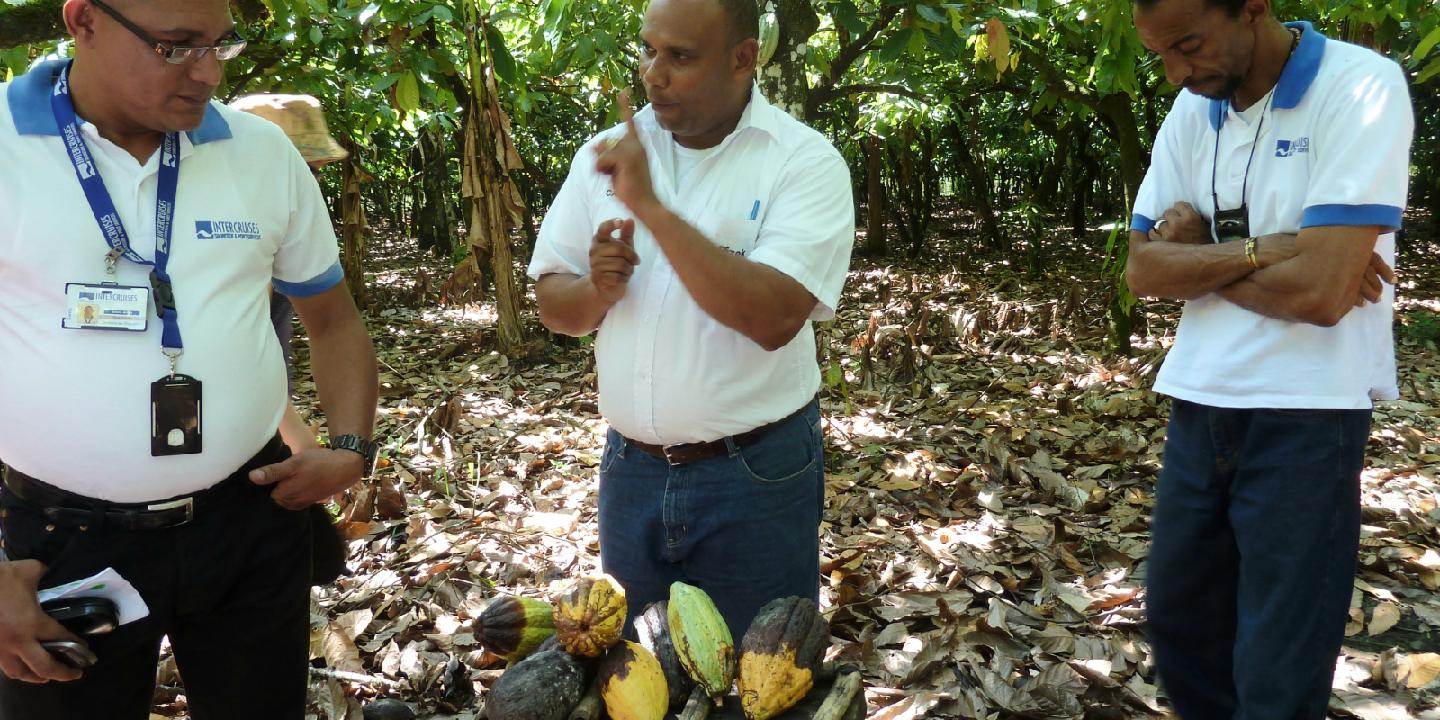
Large cocoa trees cover the valley, with cocoa fruits hanging directly from the trunks, low and easily accessible. The fruit is dyed with a colorful mixture of red, bright yellow, and red green, resembling a scaled down version of a rugby ball. The skin is rough and covered with a thin layer of wax luster like a cicada's wing. The tour guide asked the workers to use a long bamboo pole to knock down one, cut it open, and inside were white flesh wrapped in several flattened seeds. The flesh can be eaten directly, with a taste between mangosteen and lychee, and a lighter texture.
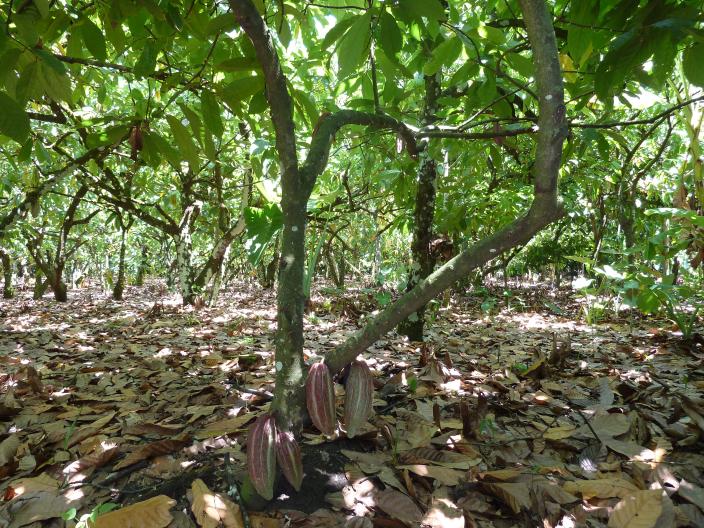
Cocoa fruit hanging from the trunk of a tree (photo by Ouyang Xia)
The cocoa cultivation in the Dominican Republic is concentrated in the Siwao Valley in the north, which is one of the northernmost cocoa planting belts in the world. Cocoa originated from the Amazon rainforest and was brought here by the Spanish in the late 16th century. But what truly nourishes this land of high-quality cocoa are the farmers who have been working here for generations. Their ancestors were trafficked from Africa to this island and forced to bend down to work, growing coffee, cocoa, and all the jobs that require bending down and sweating.
The old-fashioned machines in the chocolate workshop are covered in rust, and workers feed the roasted cocoa beans into the grinder. The black slurry slowly flows out, and the aroma in the air becomes thick, as if the entire rainforest has been boiled into a rich, dark soup.
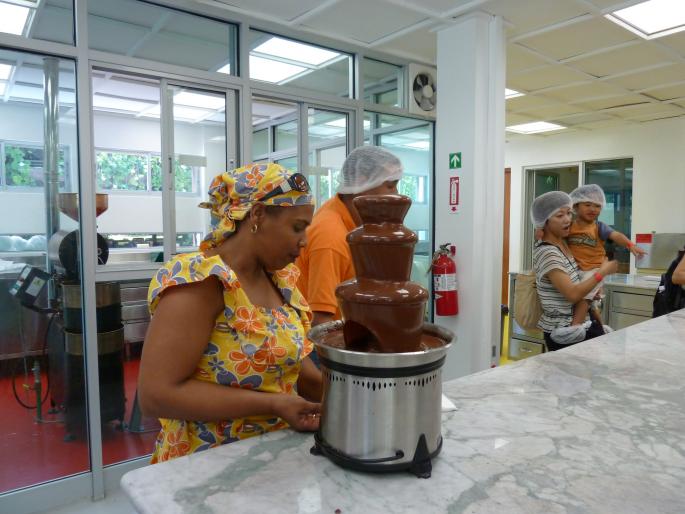
Workers are making chocolate (photo by Ouyang Xia)
It's finally my turn to make chocolate myself. The plastic molds of shells, starfish, and hearts are neatly arranged. I slowly pour the hot cocoa paste in and use a small shovel to scrape the surface flat. When the demolding is completed, the chocolate has already solidified and set. Taking a bite, the bitterness first spreads over the tip of the tongue, followed by sweetness, and finally a little bit of fruit acid. This is not chocolate produced on the assembly line in supermarkets, I made it myself. A cocoa fruit transforms into a piece of chocolate, separated by a whole rainforest of time.
Colonial Old Town: Coral Stone Remembers 500 Years of Noise
In the afternoon, returning to Santo Domingo, the vehicle drove into the colonial city. This is the earliest settlement established by European colonizers in the Americas. In 1498, Columbus' brother Bartolomeo Columbus built a city on the east bank of the Osama River. However, due to the ravages of hurricanes and termite infestations, the entire city was relocated to the west bank of the river in 1502 by Governor Odon, where the old city is located today. Over the next five hundred years, this place was ruled by the Spanish, occupied by the Haitians, and invaded twice by the Americans. During the reign of dictator Trujillo, the capital was renamed Trujillo City in 1936, and it was not until his assassination in 1961 that the city was restored to its old name of Santo Domingo. In 1990, the old colonial city was listed in the The World Heritage List.
The stone road made a muffled sound under the wheels, and the walls on both sides were made of coral stones, with dense holes eroded by centuries of sea breeze, like the weathered skin of an old man.
The car is parked next to an open square. The bronze statue of Columbus stands on a high stone foundation, wearing a 16th century robe. One hand rests on the cabin, while the other extends out, pointing towards the distant continent that he once mistook for India and later named America. The pedestal is engraved with his name and date of birth and death, and the handwriting is blurred by the salty sea breeze. In the corner of the stone foundation, several pigeons stood still, as if they had never left since the day the statue was completed. On the left side of the square is the Royal Court, a stone building that is entirely gray and white. Three giant arches suddenly open, like a silent witness to the past. This is the royal mansion completed in the 16th century, which was once the administrative center and judicial institution of the Spanish colonial authorities in the Americas, and has now been transformed into a museum. I stood under the arcade, the stone walls soaked with coolness, and the footsteps of countless pedestrians over the centuries polished the stone to a shiny and lustrous finish.
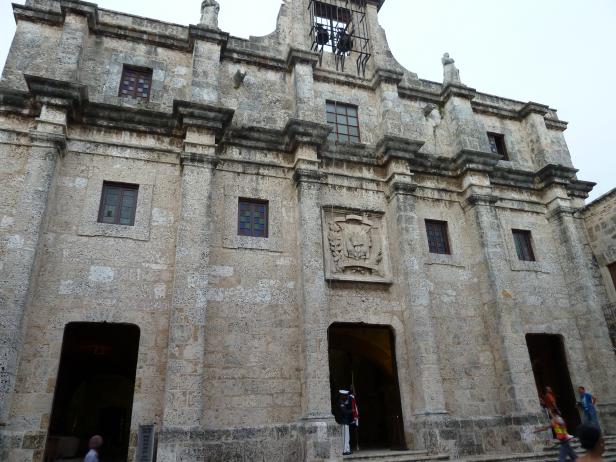
Royal Court Ruins (photo by Ouyang Xia)
Continuing forward, the Dominican Church and Monastery stand quietly. Its layout is not as grand as that of a royal mansion, with rough stone walls on the exterior. The Gothic, Isabella Gothic, and Baroque architectural styles are layered together, like a classic that has been repeatedly annotated by different eras. The saint sculpture on the wall has long been eroded by the sea breeze, leaving only a vague outline.
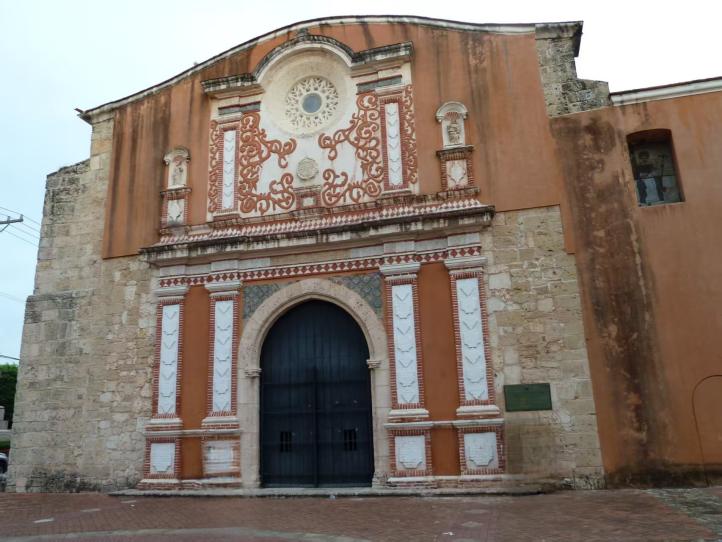
Dominican Monastery, where the first university in the Americas was born (photo by Ouyang Xia)
The most remarkable secret of this building is hidden within the walls.
In 1538, the first university in the Americas, Saint Thomas Aquinas University, was born here. Dominican monks teach theology, grammar, and philosophy in monasteries. The students come from the Antilles and also from the mainland. This university later evolved into today's Autonomous University of Santo Domingo. There are still differences in the historical community regarding the ownership of the "first university in the Americas": the University of San Marcos in Peru received an official decree from the Spanish royal family in 1551, while the University of Santo Tomas Aquinas, although obtained a decree from Pope Paul III in 1538, did not receive official recognition from the Spanish royal family until 1558. Both universities have historical records to support them, and the debate continues to this day.
But the most remarkable scene here happened before 1538.
In 1511, the monk Antonio de Montesinos stood on a pulpit and questioned a group of colonizers in front of him, "Why do you regard Native Americans as domesticated animals and drive them to die in mines and fields?" This was the first time that someone publicly accused the legitimacy of colonial plunder on New World soil. At that time, Bartolome de las Casas was sitting in the audience, and he later spent his whole life advocating for the Native American community, becoming a defender of the Native Americans. He wrote thick footnotes for this resounding sermon throughout his life.
The stone doesn't speak, but it remembers everything.
Cold numbers hide the weight of survival
When leaving, the tour guide talked about his child in the car. He said that his eldest son had a strong desire to study medicine, but unfortunately the high tuition fees became an obstacle that stood in the way.
In 2011, the Dominican Republic's GDP grew by 4.5%. But beneath the impressive official figures, there is a different picture: over 14% of the workforce is unemployed, more than half of the workers are employed in informal positions without stable salaries, and nearly half of households are deeply mired in poverty. In the same year, the homicide rate in this country was 24.8 per 100000 residents, and United Nations statistics show that over 60% of homicides were related to gun violence.
The tour guide said that this country is slowly improving, society is more stable than before, and income is increasing. When he said these words, I couldn't see his expression, only the back of his deep brown and thin head, with a strand of hair slightly raised upwards.
Some truths may not be in the mouths of tour guides, but in those numbers. Numbers are silent, but often more honest than human words.
The cruise ship anchored off the shore, and the lights of Santo Domingo filled the city, gradually melting into the night behind it.
The stone walls of the Dominican monastery, the pulpit where Montesinos stood, the arcade of the Royal Court, the bronze statue pointing towards the distance on the square, the fruit knocked down from the cocoa grove... they will not leave with the ship and will still hold on to that land. Lights are the farewell of passersby, and rocks are the steadfastness of time.
The taste of that chocolate still lingers on the tip of my tongue, bitter, sweet, sour, mixed together, I can't tell what flavor it is. Like the Dominican Republic itself, it has the sweet smell of cocoa, the bitter taste of dictatorship, the sour taste of poverty, and the smell of soil and grass after rainstorm. They mix together, you can't just pick out one of them.
The Dominican Republic has not yet moved towards prosperity. The tour guide said it's slowly getting better.

Xilinx officially announced that Wanjie has joined the Mercedes Benz and BMW supercharging camp, with over 600 stations directly connected

OPPO Find X10 tops sales on the standard version track

Technology Show | iQOO16 is now available for sale, under the name of Standard Edition, to meet the requirements of Pro Max product strength