Economic Observer Follow
2026-10-03 10:38

Economic Observer reporter Wang Yajie
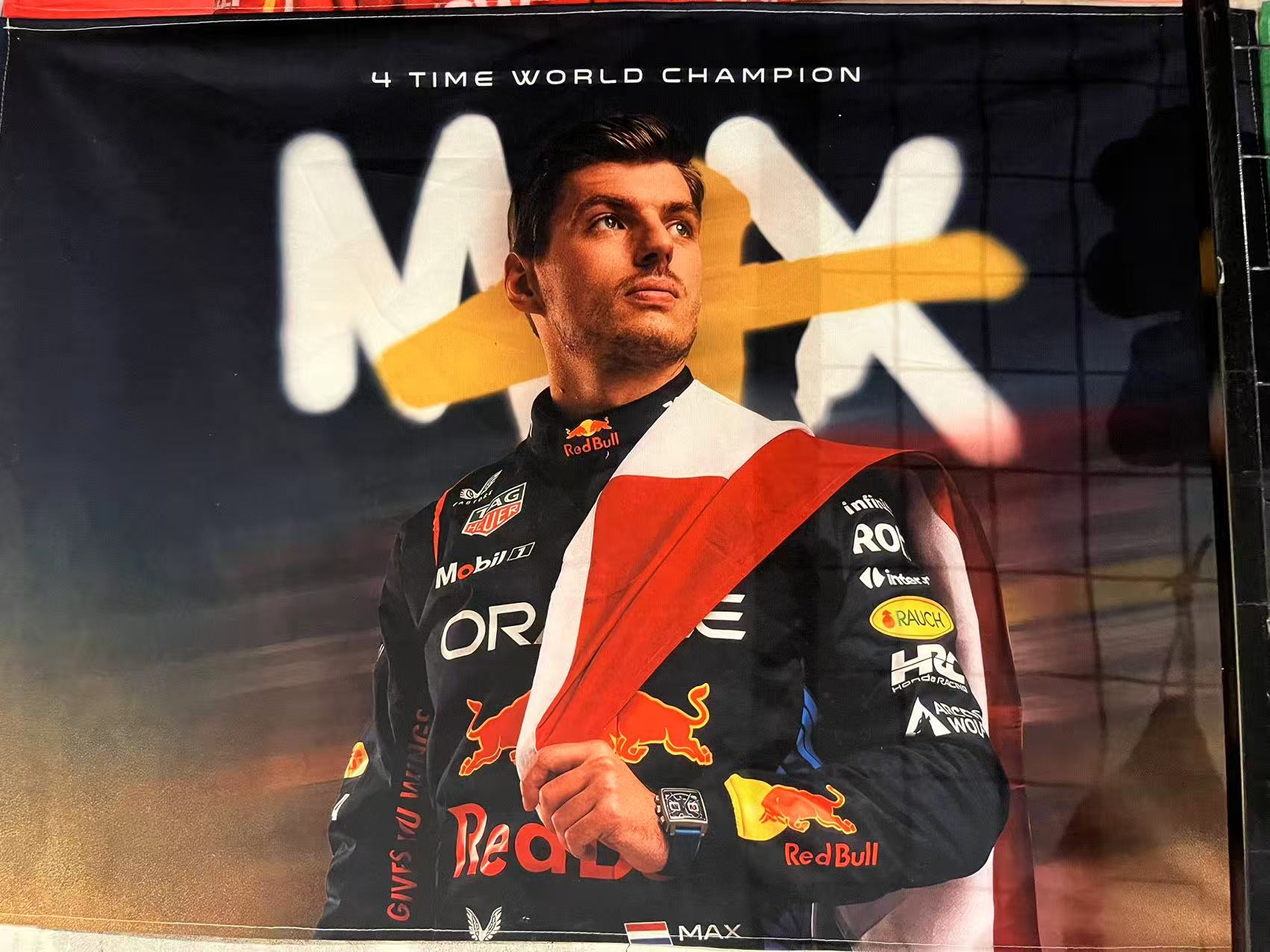
After the Suzuki race in Japan, a photo of Max Verstappen appeared on the screen with three words next to it: "Winner".
The name belongs to this Dutch F1 driver, but the steering wheel of that race just now has been in my hands.
The cockpit came to a stop, and the things outside the screen became clear again: the brackets, cables, the computer mainframe at the feet, and the sofa a few steps away.
I did not go to Japan during the Rain War, nor did I drive a real F1 car. The entire process mentioned above occurred at a racing simulator experience store in Beijing that has been open for less than three years.
But the impact felt by the body when braking, the tilting of the cabin when entering corners, and the attention to tightening the height when overtaking cannot be provided by watching a racing video.
I like the track and I also like Verstappen. For this experience, I chose his racing car and ran a rain battle in a simulated race. The regrets left by real-life events for the audience will not change as a result. But at least in this device, I can get off the stands and hold the steering wheel myself once.
Finally, I won for him again.
One
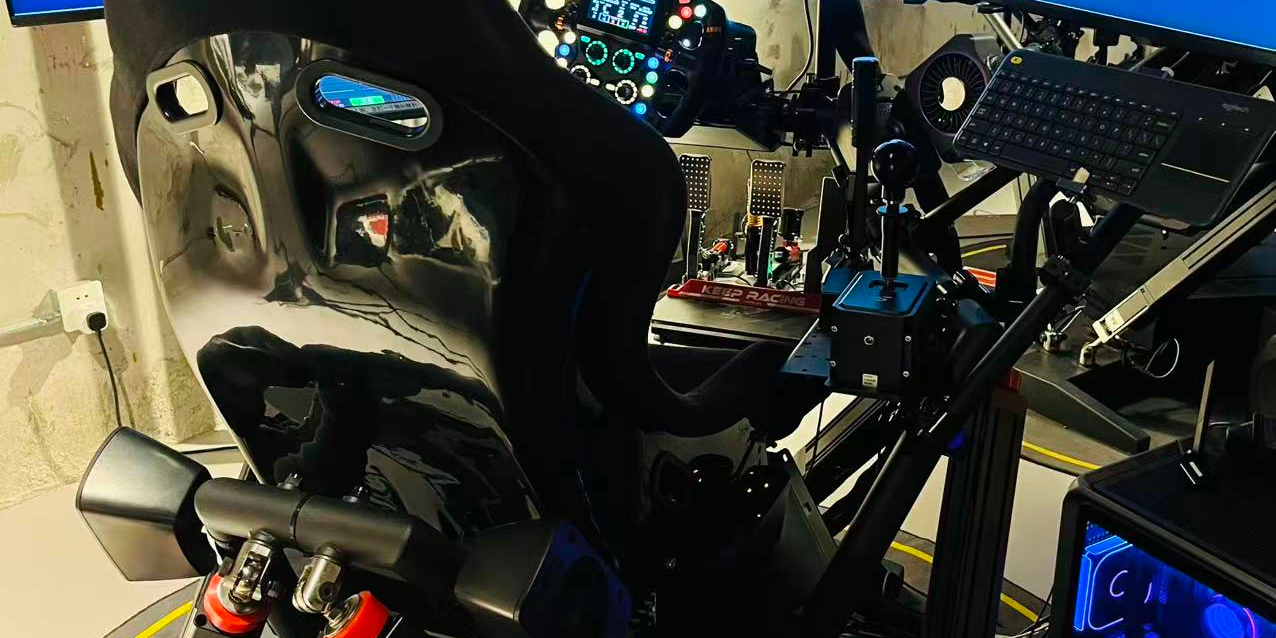
Before sitting in the simulator, the mechanical structure of this device was almost completely exposed in front of my eyes.
The black seat is fixed on a metal bracket, and the bottom is connected to the motion mechanism. The steering wheel, pedals, screen, and computer each have their own positions, and cables extend along the frame. Three screens are unfolded in front of the driver's seat, surrounded inward on both sides. The person sat in, their feet extended forward, and their view was occupied by the track.
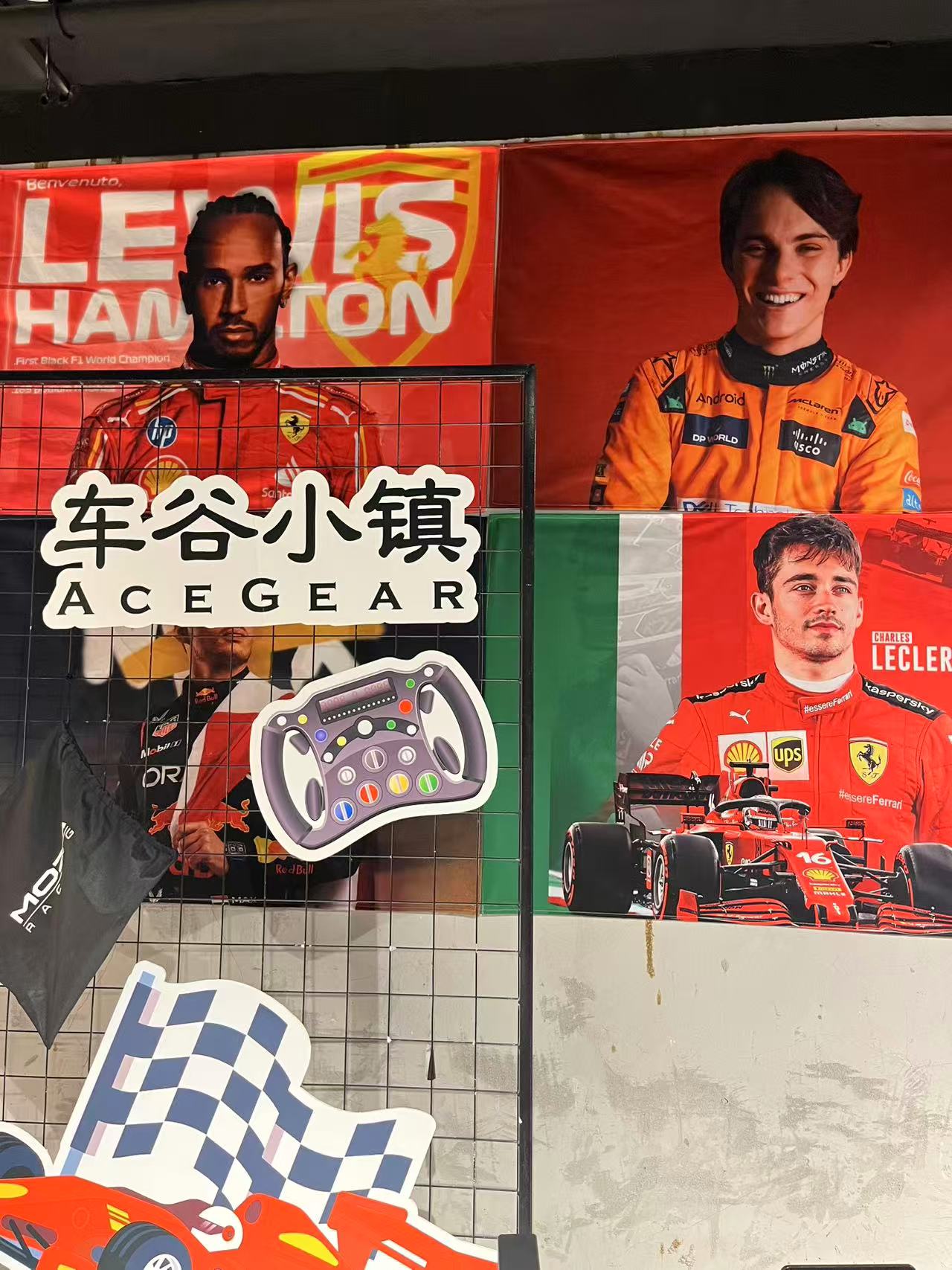
There is a driver poster hanging on the wall next to it. The posters of Verstappen, Hamilton, Leclerc, and Chinese driver Zhou Guanyu are all in this space.
At first, they were decorations for a racing themed store. By the time the simulation competition started, I didn't even bother looking at the wall.
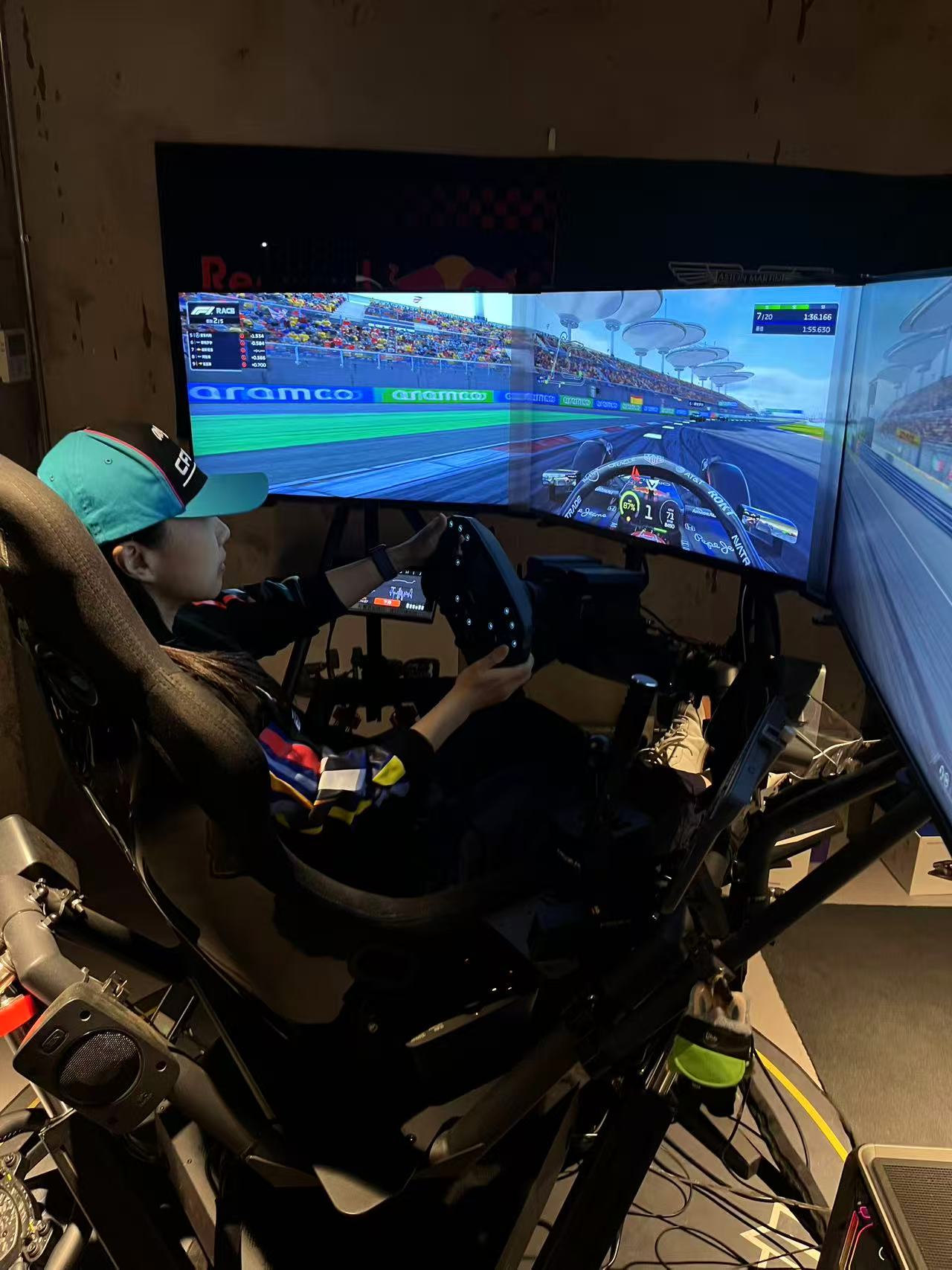
The devices here can adjust the intensity of the experience. After adjusting to the A level marked in the store, the amplitude of cabin movement significantly increases, and vibrations during vehicle operation are also transmitted to the body.
Braking and cornering, the changes in the picture do not just stay on the screen. The cockpit moves accordingly, and the body needs to withstand sudden changes in motion feedback. When overtaking, keep your eyes fixed on the front and do not leave your hands and feet idle. In the event of a collision, the impact will also be transmitted through the device.
I know I am sitting indoors, but when the vehicle, steering wheel, and body feedback in front of me continue to correspond, my judgment will increasingly rely on information from the track.
Distance, speed, and the position of the preceding vehicle begin to be more important than anything else in the room.
This kind of focus carries a clear confrontational nature.
For those who love racing, this is also where simulators differ from watching races. Sitting outside the screen, judging the driver's choice is always easier. Once you take over the steering wheel, you need to make instant and continuous choices, and immediately bear the consequences.
Two
The shop owner Xiaoshen introduced that the store uses the Angry Bear NOOXION six degree of freedom racing simulator. The vehicle status in the software is converted into control signals, driving the cabin to move and providing corresponding body feedback for acceleration, braking, cornering, and road bumps.
The so-called six degrees of freedom refer to the translation in the front back, left and right, and up and down directions, as well as the rotation in the pitch, roll, and yaw directions.
Ordinary vibration devices mainly tell people that 'there is movement', while multi degree of freedom platforms attempt to further transmit how the vehicle is moving.
This requires algorithms to make arrangements in a finite space. Real racing cars can continuously accelerate along straight roads, and indoor platforms cannot move forward continuously. It combines short distance displacement and tilting to create corresponding motion sensations by utilizing the changes in gravity relative to the direction of the body.
Therefore, a realistic sense of motion does not necessarily equate to a complete replication of the payload of a real racing car. A sports platform within a few square meters cannot sustain the high-intensity forces experienced by F1 cars during high-speed cornering. The simulation effect also depends on software, hardware, and tuning, rather than the more axles, the closer it is to the real car.
However, for the participants sitting inside, these limited exercises are already enough to change the way they participate.
The eyes no longer bear all the information alone. The actions of the cockpit and the visuals complement each other, and the speed on the screen has a physical response.
Xiaoshen introduced that there are also professional drivers who use simulation equipment to familiarize themselves with the track. For them, value lies not only in stimulation, but also in repeated practice and route memory. But professional training and the entertainment experience of ordinary people are not the same thing, and simulators cannot replace all training on the real track.
The same set of equipment connects different depth requirements. Some people want to practice more accurately, while others just want to know what the world will be like after getting into a racing car.
Three
In offline stores, a complete dynamic simulation system requires computers, display devices, steering wheels, pedals, seats, and a sports platform, as well as space, installation, and debugging. Moving it home and occasionally wanting to run a race are two different levels of investment.
The threshold for real racing cars is higher. Vehicles, equipment, track use and maintenance, none of which can be omitted at the last minute. The simulator brings a portion of the experience indoors, allowing ordinary people to approach racing on a per use basis without having to become long-term participants in the sport.
Lowering the barrier to entry is not about completely eliminating the difficulty.
The competition still requires judgment, and mistakes can still affect the results. Consumers can feel the competition while also leaving room for a fresh start.
This makes simulators an offline service that lies between gaming entertainment and racing training. You can try something new when you first arrive at the store, but if you continue to play, you may start to pay attention to lap speed, stability, and differences in handling between different vehicles.
For operators, the impact of equipment can attract the first glance, and then they need to answer the question 'Why are customers coming back?'
Xiaoshen told the Economic Observer reporter that such devices have entered scenes such as car shows, pop-up shopping malls, and car museums, and have also been combined with karting activities to carry out simulated lap speed challenges. They can be both short-term experiential projects and activities organized around timing and competitions.
There is still a distance between displaying equipment and operating stores. The former is visible, while the latter requires people to be willing to pay repeatedly. Whether the equipment can operate stably, whether the feedback is coordinated, and whether customers of different levels can find the difficulty that suits them all will affect the experience.
The sofa area in the store is not far from the simulated cockpit. You can sit down and chat while entering the game. For racing enthusiasts, this space provides a connection between watching, communicating, and personally driving.
And what I care about is the identity change brought about by this transition.
I usually watch F1 and the driver's name appears on the timing screen, so I can only wait for the next lap. After sitting in the simulator, the familiar name still remained on the screen, but the game needed to continue with my actions.
For someone who loves the track, being able to temporarily step away from the audience's position and conscientiously complete a race with feedback, confrontation, and results is already a sufficient reason.
On the screen, the three words' winner 'are still there.
Outside the cockpit, the cables and brackets did not move too far. I have already finished a race.

Xilinx officially announced that Wanjie has joined the Mercedes Benz and BMW supercharging camp, with over 600 stations directly connected
OPPO Find X10 tops sales on the standard version track
Technology Show | iQOO16 is now available for sale, under the name of Standard Edition, to meet the requirements of Pro Max product strength


 Subscribe