Economic Observer Follow
2026-09-14 16:23


Cheng Yuqi | Text
The conversation with the deceased cannot be interrupted until they surrender the future buried with them.
——Heiner Muller
1
On January 15, 1990, angry citizens stormed into the headquarters building of the East German Security Ministry in Berlin. Since the fall of the Berlin Wall, how to deal with these thorny archives has been a difficult problem for the high-level officials of both Germany and Germany. On one hand, they are indecisive, while on the other hand, Stasi's agents have been systematically destroying tens of thousands of confidential archives. It was precisely this public assault that prevented the archives from being destroyed. This also laid the foundation for the Stasi Archives Act - the preserved archives were transformed from spy agency functional archives to citizen memory archives in the new unified Germany, transferred from the security department building to specialized institutions for management, and merged into the German National Archives as part of it in 2021, with the files scanned into electronic storage.
The democratization of this historical archive is also a redistribution of political power, as Derrida said, 'If we cannot control the archives (even if we temporarily ignore memory), we cannot have true political power.'. For many East Germans, the opening of archives also placed ideological scars and opposition on the legitimacy agenda of the new government, making it difficult for the wounds to heal yesterday.
More than 30 years after the fall of the Berlin Wall, a turbulent world permeated with a post historical atmosphere. At that time, the pandemic had not yet subsided and war had begun again. Eppenbeck presented readers with an East German romance novel about archives and destruction, history and memory, touching on a somewhat untimely historical cross-section in Germany. The most crucial narrative mechanism in 'Keros' is closely related to the fateful migration of the Stasi archives, or rather, the countless individual destinies involved.
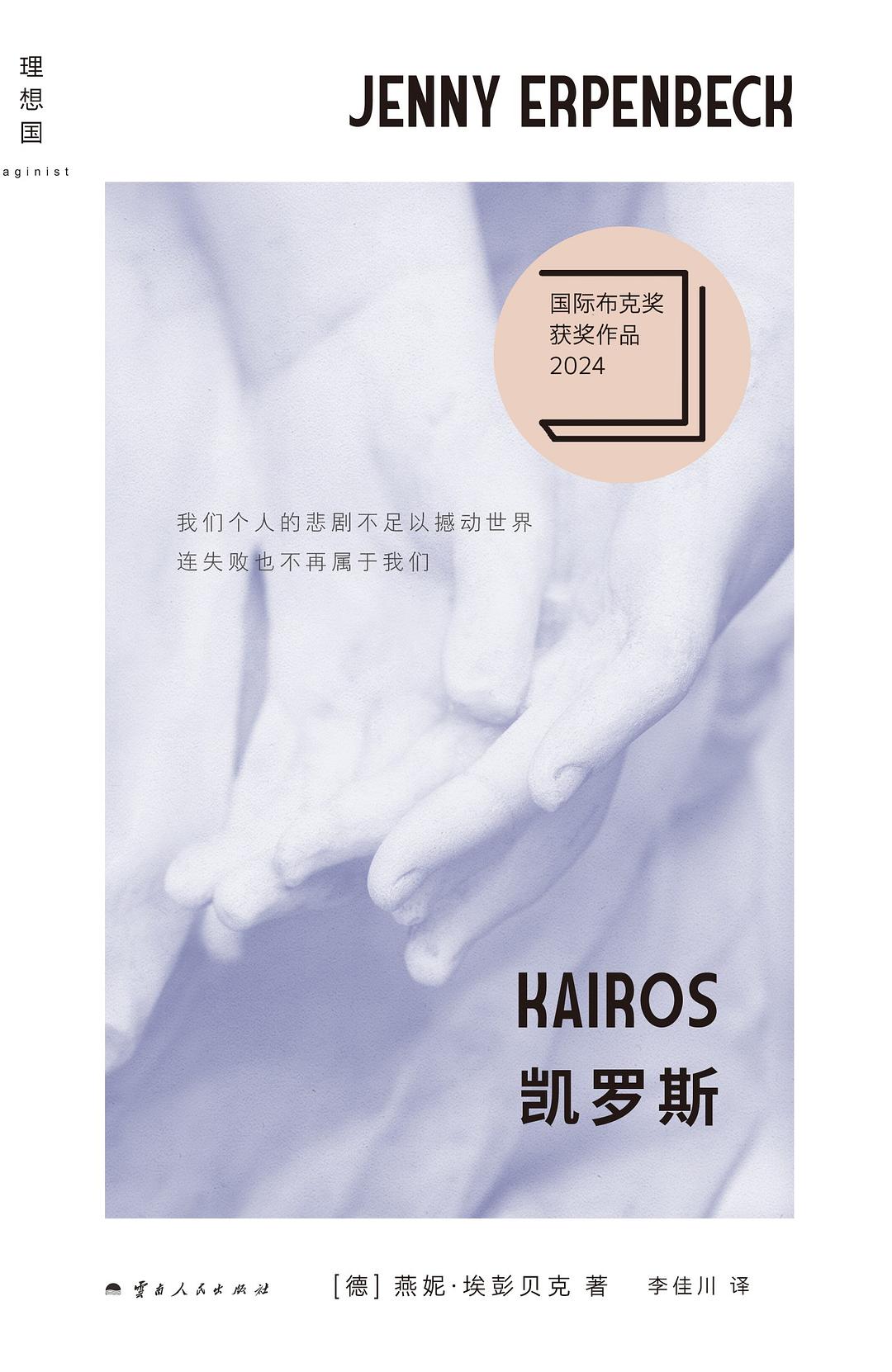
Keros "
Written by Yanni Eppenbeck
Li Jiachuan | Translation
Ideal Country | Yunnan People's Publishing House
January 2026
The "finale" of "Kerros" is also the ending part of the novel, where the female protagonist Katarina applies for access to the male protagonist Hans' file for "integrity" and discovers an IM (Stasi informant) Hans whom she does not know. She also discovers Hans, who is suspected and therefore subject to surveillance and interrogation. This also means that besides death, the character Hans has a cruel and universal ending, where his IM (Inoffizieller Mitarbeiter) experience will be recognized by anyone who has been monitored by him, and those resentments will coexist with the preservation of the archives.
Love is ultimately revealed to have always existed in the shadow of politics, but it also seems natural. At this point, the third person narrator has completed a long reminiscence. Kairos "takes the protagonist Katarina's receipt of a private box filled with various paper scraps as the narrative opportunity, and the retrieval of the Stasi archives as the supplement and ending. It is a carefully designed narrative framework. The former is a private archive, given to an old lover for safekeeping, containing many fragments from social life, while the latter is a national archive, an old archive kept by the new government, whose content is secretly seized through surveillance and interrogation.
Eppenbeck uses the power of fiction to explore more subtle operational mechanisms between two different memory systems, asking what is worth preserving and what is worth remembering. Perhaps this is the responsibility still borne by the art of fiction in our era.
After reminiscing, Katarina remained passive in this emotional relationship for a long time. As an educated person, she became a reviewer and interpreter in the "finale" chapter, gaining the freedom of suspension in the process of interpreting the archives. This is a post tragic coming of age novel, where readers, like Katarina, cannot attain the classical tragic purification (Catharsis), but instead, in a calm contemplation, replenish and question their own experiences. When dealing with the historical situation of dual disillusionment of political ideals and artistic illusions, Eppenbeck did not take this disillusionment as the ending like those metropolitan novels at the end of the 19th century, but instead placed it at the origin of his own novels. The novel once again achieves creation by imposing limitations on itself.
2
Yanni Eppenbeck, born in 1967, is one of the few living novelists who still possesses pioneering qualities in the form of novels. In 2024, she won the International Booker Prize for her work "Kerros" and is considered a strong contender for the future Nobel Prize in Literature. Eppenbeck had a similar experience as the female lead Katarina in "Keros", briefly serving as a prop assistant at the Kleist Theater in Frankfurt in 1987. Afterwards, she worked in the opera industry for a long time. The study of this overall art undoubtedly greatly benefits her novel creation, as her novels excel in scene coordination and harmony shaping.
Since her debut novel "The Story of an Old Child", Eppenbeck has been writing in a restricted third person perspective, which is a polyphonic and synthesis of the order of things, the polyphony of characters, and different discourse systems. She always strives to carry the respect for the perspectives of others and non-human centeredness, so her sentences are cautious and restrained. However, on the other hand, Eppenbeck's writing style is actually a restoration of the modernist form of German in the 20th century to more concrete real-life scenarios.
The montage filled, fast-moving image, concise and lyrical writing of Eppenbeck can be traced back to Debrin's pioneering work in Berlin's Alexanderplatz, which has also served as an important literary space in Eppenbeck's novels multiple times. In 'Kerros', the tribute to style further serves as the most important intertextuality within the text, and Eppenbeck displays his literary lineage. This time, the montage in the novel is not only a technique, but also clearly points to the tradition of avant-garde artists involved in the founding of East Germany.
The memories triggered by the two cardboard boxes in "Keros" focus on the romantic relationship between the male and female protagonists from July 1986 to January 1992. Eppenbeck tells the story of this love in chronological order, which includes some obvious romantic elements, such as vastly different ages (30 years old), extramarital affairs, sexual abuse, and second betrayal. Their emotional twists and turns include the transcendent happiness of being in love, the failure of promises and plans (Hans and Katarina did consider living together), possessiveness, and the confrontation of different selves.
Hans is a radio program producer and writer who already has a place, over fifty years old. Katarina is a young girl who has just reached adulthood. In the novel, this treacherous love has been widely accepted in the intellectual circles of East Berlin where the male and female protagonists are located. Katarina's father even affirmed Hans' educational significance to Katarina, while her peers expressed varying degrees of disgust. Eppenbeck reminds us that this moral weakness belongs to that specific late East German social landscape that no longer exists, as evidenced by Katarina and Hans' habitual deconstruction of political discourse during flirting.
Both chapters "Carton 1" and "Carton 2" should be regarded as stimulated "memories", specific texts limited by narrative frameworks. These texts occasionally present a precision beyond memory, stemming from the rigid retrieval of life details, as if reaching out to explore and gather evidence in a cardboard box, rather than reproducing them. Eppenbeck occasionally inserts the price of items, more detailed place names, and citations (books, slogans, manuals, letters, lists) into a smooth and restrained narrative, describing how these remnants were collected, further placing the act of collection in a meta narrative.
After a meeting with Katarina, Hans carefully collected the bill: for the reunion after your trip to Hungary, this bill is worth visiting the museum. Not long before this action occurred, Katarina said affectionately, "How lucky it is to meet in the same century." Museumizing the remnants of daily life, "Keros" reminds people of Pamuk's "Museum of Innocence". The two novels have many similarities, such as portraying a protagonist who is close to the author's birth year, creating a social atmosphere where a certain industry has collapsed, and of course, both are based on an immoral love story.
Pamuk's novels summon the Westernized middle-class society of Istanbul in the 1970s, while Eppenbeck awakens the youth gatherings and intellectual circles of East Berlin in the 1980s. But the intrinsic motivation and plot direction of the two novels are completely opposite. The Museum of Innocence is a space where time condenses, while 'Kerros' is a space where material diffusion and memories are found, reclaiming lost time in a fixed space.
As a novelist who is very good at designing the moral position of readers in fiction, the last time Eppenbeck reserved a seat for readers to communicate in "Time Passes", but when reading "Keros", readers can realize that they are in an immoral position with just a slight pause. From the beginning, we were the trackers, the most secretive spies in this story, with bias afterwards.
We not only followed the girl on a nostalgic and comfortable stroll through the streets of East Berlin in the late 1980s, but also eavesdropped on various whispers, feeling the confusion and decadence that pervaded the depressed planned economy society. The most crucial part of this pursuit was that we had to repeatedly cross moral boundaries with her and step into the room of a middle-aged writer. Yes, they would have sex, and later Katarina would have sex with other people, both men and women.
The third person style of Eppenbeck appears strange in these scenes, reminiscent of body measurements and descriptions. She also adds some literary descriptions to make these scenes less crude and explicit, further preventing readers from daydreaming. The desire to write these texts is not a desire for love, but a longing for confirmation, allowing passion and existence to prove each other.
When describing the most naked core of this relationship, all one-on-one love scenes, Eppenbeck focuses on the medium between the two.
When Katarina first went to Hans' residence to explore a fascinating world she loved, this world descended upon the bedroom in a simulated form, a world of artistic replicas. Firstly, there are those records, from Schubert, Bach, Mozart, to Ernst Busch, Eisler, and Hans. They first take Katarina to experience the absolute greatness of music, and then share with her the music that she is most concerned about. Next, there are those picture books, painting replicas, Picasso's 1935 sketch of Minotaur. In chronological order, they will soon see Picasso's Guernica in the picture books.
This seasoned lover is adept at using his experience and intellectual advantages to attract the opposite sex. Hans often inadvertently mentions his contact with a well-known person to showcase his status. These replicas of art and cultural tastes amplify this advantage. In Benjamin's words, this is the absolute advantage of artistic "exhibition value, bringing new functions to the work". It cannot be denied that through these media, the exchange and discussion of art have contributed a rare freshness and brightness to the relationship between the two in the novel.
When the two are living apart, media also becomes the core of the plot. As the distance between them increases, the importance of the media used for communication and the content of the communication itself are equally significant. Hans learned that Katarina had another lover, Vadim, and emphasized, 'I hope you write to me on a typewriter. I can no longer tolerate your handwriting.' To distance oneself from a handwriting is to distance oneself from a tangible quality and existence; And the tape sent by Hans is the same, he must extend his control to a distance through the medium of sound, which is more "present" than words.
Here, media is by no means a neutral intermediary; what Eppenbeck reveals is the political nature of media within private spaces. Hans, with his professional experience working at the radio station, skillfully manipulated these technical codes and established a miniature power attachment in intimate relationships. And the private space has not become transparent with the intervention of technology, but has become even darker due to the decay of desire and control frenzy.
The various media that appear alternately in the novel were transformed into objects of memory many years later, after their relationships were shattered. This forms a wonderful isomorphism with the later rescued Stasi archives - which are also a vast media network consisting of "111 kilometers of written materials, 2 million photos, 2900 films, and 23000 recordings".
3
On the other hand, in this romantic relationship, the shock caused by the untimely nature of the age difference reflects the various dislocations, ruptures, and legacies of East Germany's 40 year history from its establishment to its end, supporting most of the plot development in the novel.
Hans was once a member of the Nazi Youth League, a passionate youth who voluntarily built this ruined republic, and a dissident in the democratic wave of the 1960s. However, as he entered middle age, Hans' generation of East German intellectuals' intellectual independence was already tied to the privileges given to them by the bureaucratic system they parasitized. As for Katarina, in Hans' words, "she is a product of the new era. She is resilient, intact, protected, and very clean. Regarding whether history has come to an end, Eppenbeck did not answer. This novel always captures a mysterious atmosphere of what will happen when the past and the future meet.
The contemplation on history in the novel mainly relies on Hans' perspective and attempts to discern the truth. They are displayed in Eppenbeck's usual calm tone, appearing so unrestrained. Melancholy and Mourning are about history, as well as left-wing ideology. The lengthy monologues expose Hans' past and fabricate it, constantly arousing passion and nostalgia. The recurring ghost of Brecht in the novel reminds readers that these monologues are a kind of intermission, used to "destroy the illusions that the audience experiences while watching the play". For example, a highly ironic turning point happens to occur after a sentimental historical montage, which Eppenbeck intentionally did.
When Katarina invited Hans to her home for the first time, Hans discovered that she actually lived at the "intersection of the night paths she had walked when she was young". Historical memories were instantly intertwined, and the choir like voice and current scene were superimposed. After all these thoughts, Hans only saw the details of the brass bed, and his sexual impulses pushed "all possible topics of conversation to the other side". In fact, this is also a turning point close to montage, the two are too disconnected, but they occur in a coherent sequence. The handling here can demonstrate that Eppenbeck has a profound understanding of montage.
This talented Hans was mixed with left-wing depression and hedonism, which was a kind of epitome of East German intellectuals at that time. He can live a frugal life, but he cannot tolerate the sweat odor of the working class; He carefully collects the leftovers of his daily life, but it takes great courage and determination to retrieve his novel manuscript from the garbage dump; He can praise Katarina's talent and provide her with knowledge assistance, but in order to avoid affecting his own work, he refuses to take her to watch play rehearsals; He can also engage in self reflection, doubt his sincerity, but repeatedly resort to violence in relationships.
So Eppenbeck asked him to use the name of the protagonist in Brecht's play who sacrificed his life for righteousness as his own informant code, and also used Brecht's radio drama technique for emotional manipulation. Decades later, after reading Hans' archives, Katarina had a sharp judgment, stripping away the idealistic and narcissistic aura that Hans had draped over him as a defense mechanism: "To the west, she thought, he would probably become a corporate consultant, or a real estate agent, or do advertising campaigns. To the east, he was one person, and to the west, he would still be one person. Some kind of person
The disintegration of this love was also Katarina's personal growth breaking free from Hans' control, and the dramatic changes in the political and historical environment only accelerated this process. In the novel, the turning point in the relationship between Katarina and Hans is Katarina's solo internship at a theater in Frankfurt. The ultimate metaphor in "Keros" also appears in this part. The novel begins with an intimate relationship, and history gradually seeps in. At this point, the novel's questioning of history reaches its peak. Eppenbeck showed us the "paper apartments", "eagles made of real feathers", "black snow made of plastic", and "plowing soil on stage" in the theatrical setting. Katarina's internship involves collaborating on the production of these sets.
Everything is just a backdrop made of paper, with nothing behind it. There is only nothingness, nothingness, and nothingness behind it. However, maintaining all of this requires so much power. Half asleep and half awake, Katarina saw the wind sweeping across an empty plain, seeing some unclaimed things, scattered small objects, crumpled paper, and helpless fragments being lifted up, falling back to the ground, lifted up again, and falling elsewhere, an endless journey without beginning, end, or purpose. If she is no longer herself, and she is no longer anyone else, where does this power come from
This passage is similar to Benjamin's famous description of the "new angel", but the novel has been completely rewritten. The angel who cannot redeem the world is no longer there, and it is humans who maintain the stage setting and replace it. When the fragments of these abandoned sets float endlessly in nothingness, they can no longer be pieced together. The stage setting is a metaphor for history and a fable about art.
Eppenbeck engages in another conversation with Brecht. Caspar Neher, who designed the sets for Brecht's historical plays (Hans showed Catherine Neher's designs in the novel), once created a projection style set form that was no longer limited to realistic effects, but "like Plato's ideas, influenced by providing models for things," just like Brecht's plays, these sets rejected illusions.
The phrase 'maintaining all of this requires so much force' has a slightly weaker expression in the novel. When Katarina participated in the set production, stage designer Klaus said, 'The truth must be carefully crafted.' Later, this sentence appeared twice in the novel. When Hans accused Katarina of betraying him, Katarina faced Hans' suspicion and anger, and realized that whether it was to confess the truth or tell a lie, these 'must be carefully crafted.'. This sentence has a profound dialectical nature: it not only reveals the fiction and fabrication of political and historical discourse, but also endows artistic labor with a certain dignity - the pursuit of truth by art relies precisely on this laborious labor that knows it as a backdrop but still strives to produce it. After Brecht's political failure, Eppenbeck's ambiguity about illusions was built on a hard labor of pursuing artistic reality.
4
Eppenbeck's current novels can be described as laborious and meticulous. Eppenbeck's way of writing novels is similar to her admired Walter Kembovski. This little-known German writer in China relies on a vast collection of authentic archives, which fill several rooms in his home with literature collected for his novels.
This way of working means that organizing materials and reading requires a lot of energy and time, while also facing a classic problem in novel creation: excessive real information can affect fictional imagination. When writing 'Keros', Eppenbeck's approach was to' put all the collected materials and ideas in it, and then try to connect them with the core of the chapter '. When she obtained the Stasi archive of the Hans prototype, the archive overturned her initial idea, and Eppenbeck chose to face these realities and go straight through it.
Eppenbeck's novels run counter to the autobiographical novels that have become popular in mainstream literature in Europe and America in recent years. The self has stepped back from the stage and entered into invisible labor behind the scenes. Every time Eppenbeck eliminates the self, it is reorganized by others in the process of writing. If writing is seen as an action, then Eppenbeck's texts always make this action visible. Whenever self fiction gives way to the reality of others, self fiction creates a new reality.
This novel is not without regrets, as Eppenbeck confronts moral laxity with well-organized and refined language. These sentences are carefully crafted and filtered. Perhaps it can be said that this is her most dangerous novel to date. The theme of "Keros" is difficult to release power and hope, and its theme is a very dangerous combination of failed revolution and treacherous love. This is a dark version of the classic combination of the international communist revolution era, but Eppenbeck has not reached the heart of darkness either. It gathers power in nothingness and ultimately provides an image that can be repeatedly recalled. When we look closer, we will find that it is just composed of countless pixels.
On the day when protesters broke into the headquarters building of the former East German security department, photographer Thomas Ullmann, who followed the crowd into the building, captured a famous historical image. He aimed his camera at the chaotic interior of the security department office, where machines such as typewriters, shredders, and telephones were still placed on desks. The ground was covered with scattered paper documents, some of which had already been shredded by shredders.
In 1995, German artist Thomas De Man created the work "The Office" based on this photo. De Man finely constructed the complex scene presented in this photo using a paper model. De Man's completed work was ultimately presented in the form of photographic images. After adjusting the angle and lighting, he took a photo that resembled a historical image, and then destroyed the scene built on this paper. The charm of this work lies in the flatness of photography, the smoothness of the paper surface, and the emptiness behind the historical surface, which together constitute the image.

Xilinx officially announced that Wanjie has joined the Mercedes Benz and BMW supercharging camp, with over 600 stations directly connected

OPPO Find X10 tops sales on the standard version track

Technology Show | iQOO16 is now available for sale, under the name of Standard Edition, to meet the requirements of Pro Max product strength