2026-09-12 17:14



From September 10th to 12th, at the 2026 Inclusion · Bund Conference held by the Huangpu River in Shanghai, over 500 investors saw a brand new AI new economy "world".
At the 2026 Inclusion · Bund Conference Venture Capital Meetup, someone installed a brain computer interface into sleep management hardware; Someone asked AI agents to help one person company (OPC) efficiently operate extremely complex cross-border businesses
Some people have opened their minds and developed exoskeleton robots, allowing elderly people who were previously struggling to climb stairs and continue to pursue their "dreams" from their youth;
Some people simply transform AI into quantitative investment and financial trading tools, allowing the vast number of financial novices to "transform" into experienced investment experts and achieve their long cherished dream of creating wealth.
Watching these cutting-edge AI new species shine during the Bund Conference, many venture capitalists truly realize that AI is no longer a "concept", it is creating new transactions, new productivity, and new incremental economies.
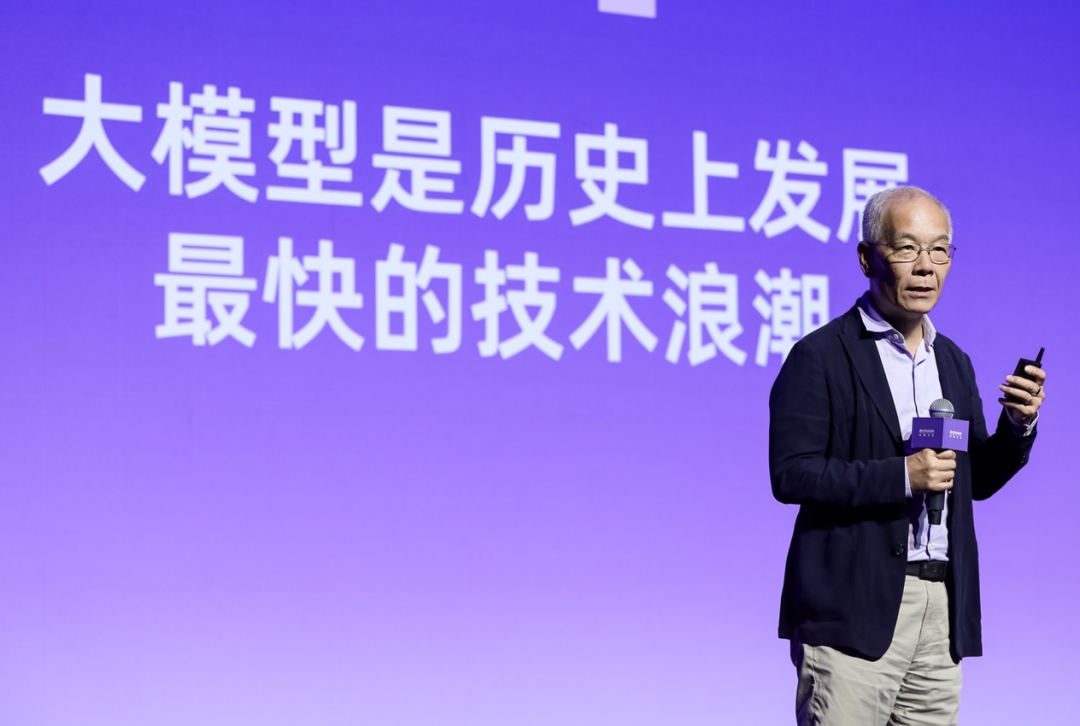
During his keynote speech at the Bund Conference, Zhang Hongjiang, Partner of Source Code Capital Investment and Foreign Academician of the National Academy of Engineering, stated that AI is becoming one of the fastest developing technological waves in human history. With the improvement of cutting-edge model capabilities, the enhancement of AI's self-improvement ability, and the formation of faster feedback loops between the virtual world and the physical world, these changes will ultimately drive the emergence of a completely new economic relationship.
As for the future development trend of AI new economy, Yan Qianhang, Vice President of Fengrui Capital, believes that with the maturity of the big model, the continuous improvement of the Internet and communication system, and the rise of AI coding tools, more and more people can generate AI applications themselves in the future. As a result, more people will participate in the AI ecosystem, driving the rapid development of AI applications like during the Cambrian Explosion. In the next 3-5 years, there will be more "unimaginable" AI new products born, becoming a part of people's lives and building an extremely extensive AI new economic system.
This brainstorming session around the "AI New Economy" not only appeared in various forums of the Bund Conference, but also constantly sparked discussions between investors and young AI entrepreneurs.
Several attending investors expressed that whether it is young AI entrepreneurs who are determined to change the development trend of the industry, or venture capitalists who are eager to "show their skills" in the AI new economy era, they can find each other's "best partners" at the Bund Conference.
AI is integrating into different economic environments of society
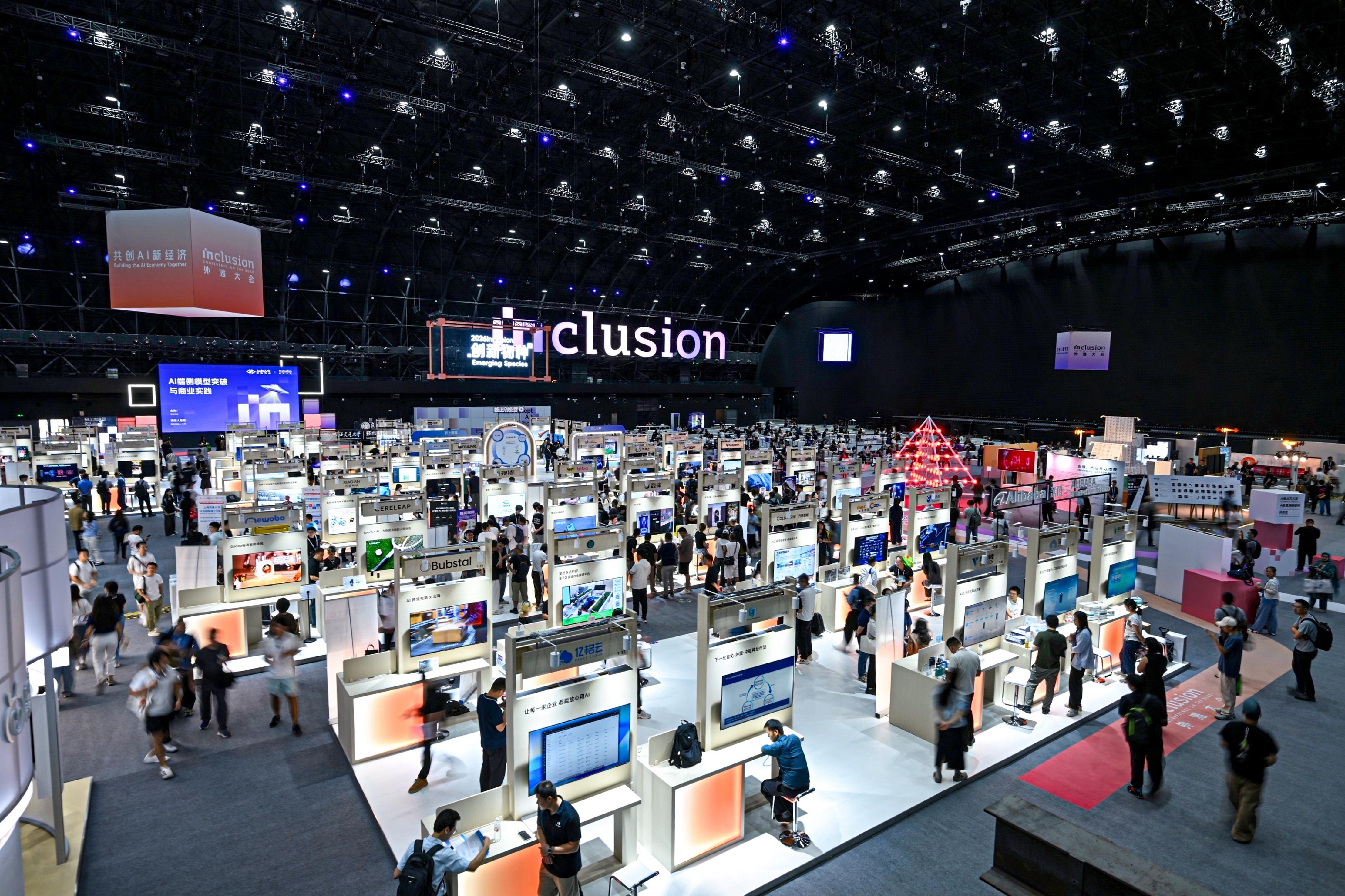
During the 2026 Inclusion · Bund Conference, over 120 AI startups gathered in the new species exhibition area of Hall H, showcasing the latest changes brought by AI and embodied intelligence to the real world.
Omnify AI aims to enable ordinary people to quickly form professional "AI employee teams" through natural language, automate the process from creativity to results, easily create comics and short dramas, and become their own "playwrights".
Infinite Language Research Technology is developing a personalized expression model for Language DNA, which can adjust the difficulty of text, interpretation methods, and language styles in real-time based on users' understanding ability, knowledge background, and expression preferences, achieving personalized communication.
Coartis focuses on spatial cognition and visual data processing, committed to bridging the gap between embodied intelligence's "seeing" and "understanding". Its self-developed world model can generate 3D assets with physical properties through images or videos, providing data support for robot training.
AgiPhant focuses on AI native wearable neural interfaces and embodied intelligence, and is building a wrist sEMG non-invasive brain computer interaction system to explore the next generation of human-machine interaction entrances in the AGI era.
These new application achievements of AI have convinced many attending investors that the AI new economy is exploding with great growth potential as AI technology and application scenarios continue to innovate.
Ji Yuan Capital investor Jiang Haonan stated that with the emergence of intelligent technology, it is spreading to different economic environments throughout society, including the landing of AI for Science and AI agents in various economic scenarios. Especially in recent hot fields such as AI office and AI hardware, a series of new changes are emerging.
He admitted that with the booming development of the AI new economy, both economic and social resources will tilt towards the "two ends". On the one hand, there is what AI needs, that is, more chips are needed for AI training, and chips need to be interconnected, which will generate a lot of heat and solve the problem of heat dissipation. So various fields such as nuclear fusion, quantum, heat dissipation, interconnection, and optical modules will attract a large amount of capital investment, creating a huge economic increment by solving the above problems; On the other hand, after AI continuously unleashes productivity and reconstructs production relations, what else do humans need?
When AI solves 70% -80% of society's problems, where will people spend their time? Where will people spend their money? This will be the greater value of AI at the application layer. ”Jiang Haonan pointed out.
Dialectically treat the "gains and losses" of valuation foam
Under the continuous rise of capital's pursuit of the AI industry, more and more AI related startups are frequently receiving extremely high valuation equity financing. This makes the market worry about whether there is a valuation foam in the AI industry and the AI new economy.
Feng Tian, head of BAI Capital Al Investment, clearly gave her own view that foam is positively related to innovation. If there is no foam, a large number of funds and talents will not flow into the AI industry to promote the vigorous development of the AI new economy. Therefore, in the process of innovation, it is inevitable for investors to pay a certain premium.
But from a valuation perspective, I believe the market is efficient. For example, AI companies such as OpenAI, Kimi, and Zhipu face a lot of doubts at every stage of development, whether it is products or revenue. But we see that these enterprises are evolving towards AGI at every stage, and their level of intelligence continues to improve. If a company can weather the cycle, its valuation will inevitably rise, so it is reasonable for capital to give a high valuation now. ”She pointed out.
Zhao Fuheng, chief investment officer of Jiuhe Venture Capital, believes that the formation of the valuation foam can be divided into two main reasons: first, the market expects that its future business value will be greater than the business value it can actually solve in the end. For example, many people assume that robots can solve all human labor. If robots can not solve all human labor eventually, we may be in a robot industry foam at this time; Secondly, capital believes that there will be numerous top companies in a certain track, but the fact is that the number of top companies in this track is much lower than capital expectations.
"Objectively speaking, these two valuation foam have appeared in AI, embodied intelligence and other cutting-edge technology fields. But we are optimistic that both AI and embodied intelligence have great potential in the future. ”He emphasized.
Jiang Haonan interpreted whether the valuation foam could be effectively resolved from the perspective of equity investment.
He pointed out that the duration of an equity investment project can last for more than 5 years. Before making an investment, investors must consider whether the investment company can withstand the cycle. Especially during periods of high market sentiment, investors are willing to invest at a high valuation in an AI startup. They need to see this AI startup come up with truly valuable products and prove that they can weather the cycle.
I hope everyone can remain rational. Especially for AI startups, each of their products needs to have a reasonable valuation to support the sustainable development of the business. When the next generation of products is launched and achieves better performance, companies can also receive higher valuation rewards. This is very helpful for the sustainable development of the enterprise. ”He candidly admitted.
Wang, Executive Director of Zhongke Chuangxing, has been paying long-term attention to the development trend of embodied intelligence industry.
He said frankly that, in terms of parts, there is indeed a foam in the embodied intelligent industry. But if the embodied intelligence model can achieve good results, for the entire industry, the equity financing obtained by various embodied intelligence enterprises is not enough. Therefore, capital will continue to layout the embodied intelligence industry and promote continuous breakthroughs in this cutting-edge technology industry.
Advice for young AI entrepreneurs
During the Bund Conference, facing the AI and embodied intelligence application achievements presented by over 300 technology companies, many attending investors were quite excited.

What they see is not only numerous excellent enterprises worth investing in, but also a solid foundation for the flourishing development of the AI new economy.
This makes them have high expectations for the development of young entrepreneurs.
Jiang Haonan stated that in the past two years, a large number of young people born after 2000 and 2005 have started entrepreneurship, which is closely related to the AI wave. Because AI has quickly adjusted the entry barriers for various industries, young people can bring disruptive changes to many industries and create new economic growth through AI without the need for long-term industry accumulation. Moreover, the creativity of young people is often amplified by the multiplier effect of AI.
So my focus on young entrepreneurs will be on their strengths. This is completely different from five years ago, when investors valued the barrel effect and hoped that entrepreneurs would not have obvious shortcomings in all aspects. But now the times are different, and AI allows young entrepreneurs to stand on the shoulders of giants and move forward. ”He pointed out.
Jiang Haonan also noticed that entrepreneurship and AI product development are "two different things". Young entrepreneurs need to transform from product developers to qualified CEOs, and it also depends on whether they have other abilities, such as whether they can recruit other talents to make up for the shortcomings of enterprise development.
Zhao Fuheng revealed that during the launch of GPT-3 in 2020, many young people studied Transformer technology and AI big model research and development during their undergraduate studies, which gave them a natural advantage in understanding AI, applying AI, and AI entrepreneurship.
However, the young AI entrepreneurs favored by venture capital institutions are those who are quite familiar with the AI field, have conducted in-depth AI research, and possess good abilities in training large models. ”He candidly admitted.
Feng Tian stated that the youngest entrepreneur among the world model research and development companies they invested in was born in 2004.
She said that for venture capital firms, choosing young AI entrepreneurs will focus on two dimensions: first, whether the track they are on for entrepreneurship is big enough and important enough; The second is the comprehensive ability of the entire entrepreneurial team, such as whether the CEO of the enterprise has the ability to recruit top talents, financing ability, and data processing ability. Especially when it is difficult to determine who can ultimately stand out in the AI technology roadmap, team capability becomes an extremely important investment decision evaluation factor.
During the Bund Conference, Zhai Ning, a veteran venture capitalist with about 20 years of equity investment experience and founder of Mingyisheng Capital, had in-depth discussions with numerous young AI entrepreneurs.
He said he particularly admires these young AI entrepreneurs, who do not have too much "historical baggage" and can form disruptive ideas in the rapidly changing wave of AI new economy development, bringing richer "creativity" to the innovation and development of the AI industry.
Zhai Ning also noticed that many young AI entrepreneurs with a background in AI technology research and development have been struggling with how to become qualified CEOs.
I suggest that they focus more on leveraging their strengths, continuously accumulating and enhancing their AI technology research and development capabilities, and gradually supplementing their business acumen in the market refining process. ”He said,In the era of AI new economy, many tasks can be entrusted to partners to complete, and entrepreneurs do not need to force themselves to become versatile CEOs.
At the Bund Conference, many young AI entrepreneurs are also "reverse selecting" investors.
They expressed that they hope to receive not only equity investment funds, but also investment partners who truly understand themselves, the AI industry, and the development trends of the AI new economy. These investment partners can help them assess market demand, connect channels and resources, and provide specific support in supply chain, product layout, and other aspects.
In their view, the resources brought by investors and forward-looking judgments in the AI industry may be more crucial than an investment.