Economic Observer Follow
2026-09-07 15:18



Jin Shanming/Wen
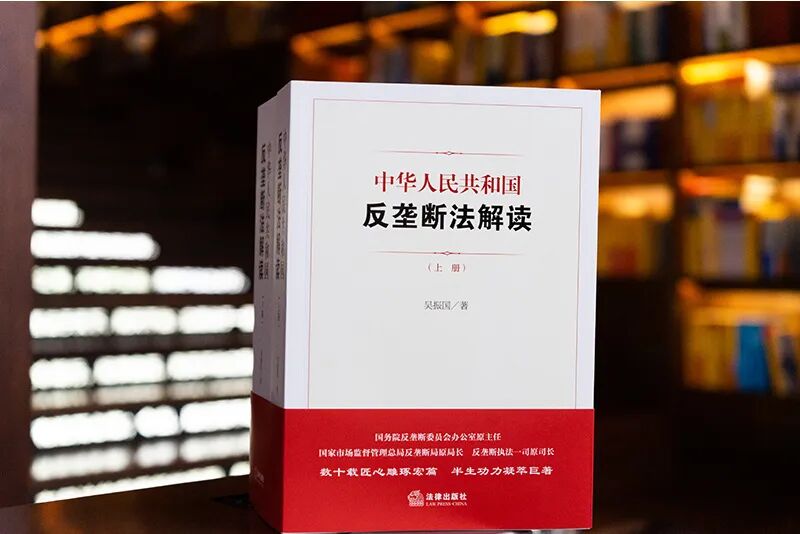
The Anti Monopoly Law is a fundamental legal system for maintaining fair competition in the market and ensuring the healthy operation of the market economy. Since its implementation in 2008, the Anti Monopoly Law of the People's Republic of China (hereinafter referred to as the "Anti Monopoly Law") has undergone more than ten years of practical exploration and systematic revision in 2022, and has become an important institutional support for building a high standard market system and promoting high-quality development. Mr. Wu Zhenguo's "Interpretation of the Anti Monopoly Law of the People's Republic of China" (Volume 1 and 2) was published by the Law Press a year ago. The book is 1.68 million words long and embodies the author's profound accumulation of more than 30 years of participation in anti-monopoly legislation, law enforcement, and theoretical research. It is not only a systematic review of the development process of China's anti-monopoly legal system, but also an authoritative interpretation for practical needs. Reading the whole book, I have gained a lot and felt a lot of emotions.
Thirty years of cultivation, initially focused on competition
Seemingly ordinary and extraordinary, achieving success is as easy as it is difficult. A high-quality legal interpretation work is inevitably imprinted with the author's professional trajectory and practical accumulation. The author is one of the important drafters of China's Anti Monopoly Law, and also a witness and promoter of the gradual improvement of China's anti-monopoly system from scratch. He has successively worked in anti-monopoly related work at the State Economic and Trade Commission, the Ministry of Commerce, and the State Administration for Market Regulation. Through experience in multiple departments and positions, he has been fully involved in the entire process of drafting, implementing, and revising the Anti Monopoly Law. He has presided over or participated in the formulation of many important laws and regulations such as the Foreign Trade Law of the People's Republic of China, and organized the investigation and handling of many landmark anti-monopoly cases, making significant contributions to the construction and implementation of the anti-monopoly legal system with Chinese characteristics.
For over thirty years, the author has been rooted in the forefront of anti-monopoly practice, deeply involved in top-level institutional design, and directly promoting the implementation of specific law enforcement. They have witnessed the institutional transformation of China's anti-monopoly law enforcement from decentralization to unity, from weakness to strengthening, and also witnessed the historical process of fair competition policy moving from behind the scenes to the front stage and gradually establishing its fundamental position. As he said, "Antitrust is a systematic project that requires both a focus on China's development stage and a global perspective. It requires strengthening regulatory efforts and paying attention to institutional warmth, ultimately achieving an organic unity of political, legal, and social effects." It is his unique experience and profound understanding that naturally gives this book the distinctive feature of a "practitioner's perspective": the interpretation of the articles is not a mere theoretical talk on paper, but integrates repeated weighing in the legislative process, experience summary in law enforcement practice, and deep thinking in difficult cases, reflecting the author's persistent pursuit and profound understanding of the anti-monopoly cause between the lines.
In fact, every step of the improvement of China's anti-monopoly law system embodies the hard work of countless cultivators like the author. From the rule gaps at the beginning of the implementation of the Anti Monopoly Law in 2008, to the unified integration of anti-monopoly law enforcement agencies in 2018, and to the official listing of the National Anti Monopoly Bureau in 2021, the author has been involved throughout the process, serving as both a "drafter" of institutional design and a "builder" of implementation, and becoming a "recorder" of practical experience. The combination of these three identities allows this book to break free from the limitations of ordinary academic works and become a "factual record of the development of China's anti-monopoly system" that combines historical thickness, practical depth, and theoretical height. As the ancient saying goes, 'After playing a thousand melodies, one can hear the sound; after observing a thousand swords, one can recognize the instrument.' Thirty years of frontline accumulation ultimately led to the author's 1.68 million word masterpiece.
Tracing back to the source and identifying the true chapter
The application of anti-monopoly law is highly complex and professional, and it is often difficult to grasp the essence of its system if it only stays on the surface of the articles. One of the most prominent features of this book is that it not only "explains its nature", but also "explains its reasons", leading readers to penetrate the text of the articles and deeply understand the historical context, practical logic, and value considerations behind the system.
The whole book takes the revised Anti Monopoly Law of 2022 as the main line, and gradually unfolds according to the analytical logic of "essence of the provisions - interpretation of the provisions - typical cases - reference legislation". It clearly sorts out the origin and development of each system: from the original intention and positioning of the legislation in 2007, to the practical problems encountered in the implementation process, and to the background considerations for the 2022 revision, it provides detailed explanations. Based on the author's personal experience of participating in the revision of the Anti Monopoly Law, the legislative background of the newly added content such as "strengthening the basic position of competition policy" and "special provisions for anti-monopoly in the digital economy" is explained in detail. It is pointed out that these revisions are not only a systematic summary of more than ten years of law enforcement experience, but also an inevitable requirement to respond to new challenges in the digital economy era, reflecting the institutional vitality of China's anti-monopoly law keeping pace with the times. In response to emerging fields and key issues such as anti-monopoly, intellectual property abuse, and fair competition review in the digital economy, the book combines recent law enforcement practices to analyze in detail the practical motivations and application boundaries of institutional improvement, allowing readers to clearly grasp the evolution trajectory of China's anti-monopoly law "developing in practice and improving in development", and truly understand the underlying logic of institutional "establishment and change".
The in-depth analysis of practical cases is another highlight of this book. The book incorporates interpretations of dozens of classic antitrust cases from both domestic and international sources, including benchmark cases in traditional fields such as Qualcomm and Tetra Pak, as well as new cases such as the "two choice" monopoly case in the platform economy field and the prohibition of concentration of operators in the game live streaming field. It also compares and analyzes representative enforcement cases from major jurisdictions such as the European Union and the United States. As the author has repeatedly emphasized, "Typical cases are the best 'living textbooks' for anti-monopoly systems. The investigation and handling of every major case is a vivid interpretation of institutional rules and an important window for conveying regulatory guidance to society." Through the method of "interpreting laws through cases," selected legal provisions become concrete and tangible, allowing readers to intuitively understand the criteria for identifying monopolistic behavior, enforcement ideas, and social impact, and truly understand how the system is implemented and effective in practice. This closed-loop structure of "theory rules case" breaks down the barriers between academic works and practical applications, making this book both theoretically profound and highly valuable for practical guidance. It can be said that "what is learned on paper is shallow, but what is truly understood is practical." The author integrates the insights of thirty years of law enforcement practice into the interpretation of the text, allowing this book to truly achieve a deep integration of theory and practice.
It is particularly worth mentioning that the author incorporates a large number of "behind the scenes stories" from the front line of law enforcement in the interpretation: when interpreting the system of examination of business concentration, the formation process of the "Five Step Discretionary Law" is introduced in detail; When interpreting the anti-monopoly rules of the platform economy, key considerations in the investigation of Alibaba's "choose one from two" case were shared; When interpreting administrative monopoly regulations, the evolution of the fair competition review system from pilot to comprehensive implementation was outlined. These little-known details add warmth to the cold legal provisions and deepen readers' understanding of the practical wisdom behind each system.
Integrating Chinese and foreign wisdom, building a fair path together
As the universal rule of the market economy, anti-monopoly not only follows the universal laws of the world, but also needs to be combined with the specific situations of each country (region). This book always adheres to the principle of "based on Chinese practice, drawing on international experience, and reflecting institutional characteristics", which not only systematically demonstrates the value of China's anti-monopoly system, but also contributes Chinese wisdom to global competition governance.
The author elaborates in depth on the core values of China's anti-monopoly law, which are to serve the overall development, safeguard consumer interests, and promote fair competition. Unlike the Western anti-monopoly system, China's anti-monopoly law always regards maintaining a unified national market, safeguarding people's livelihoods, and promoting high-quality development as important goals. It not only focuses on regulating the monopolistic behavior of market entities, but also emphasizes the governance of abuse of administrative power to exclude restrictive competition behavior. This institutional design fully reflects the essential requirements of the socialist market economy with Chinese characteristics. As the author clearly stated in the article "The Chinese Path of Antitrust Regulation": "China's anti-monopoly regulation has always adhered to three positions - adhering to the leadership of the Party in the political position, coordinating effective markets and a proactive government in the development position, and taking safeguarding consumer interests as the fundamental starting point in the livelihood position." The detailed interpretation of the fair competition review system and the key analysis of anti-monopoly law enforcement cases in the livelihood field in the book clearly demonstrate the fundamental position of China's anti-monopoly system of "putting the people at the center", which is in line with the governance concept of "the road is the road, the world is the public". The ultimate goal of anti-monopoly is to safeguard the fair road of the market economy and make the development achievements more and fairly benefit all people. The sentence is:.
While rooted in the local context, this book also maintains a broad international perspective, systematically comparing anti-monopoly legislation and enforcement practices in more than ten jurisdictions such as the European Union, the United States, Germany, and Japan. It not only draws on mature international enforcement experience and analytical methods, but also rationally analyzes the application background and limitations of different systems. The author explicitly states that "the anti-monopoly system cannot simply copy foreign models, but must be adapted to the country's economic development stage, market development level, and cultural traditions." This comparative research approach of "putting oneself first and using for oneself" not only avoids the closed door nature of closed door work, but also prevents the blindness of complete Westernization, providing a useful demonstration for building a Chinese characteristic anti-monopoly theoretical system. The book's exploration of the new balance between intellectual property and competition law in the era of artificial intelligence, as well as systematic guidance on overseas anti-monopoly compliance for enterprises, further reflects the author's forward-looking thinking on cutting-edge issues and the Chinese perspective on participating in global competition governance. All things coexist without harming each other, and the Tao runs parallel without contradicting each other. China's anti-monopoly system respects universal international laws while adhering to local characteristics, and has embarked on a path of competition governance with Chinese characteristics.
The author pours thirty years of personal practice, frontline cultivation, and lifelong accumulation into this work, but always maintains a humble sense of duty and background, without utilitarian considerations, immersed in the loneliness and tranquility of scholarship, and a serious and persistent research spirit and attitude towards life. The book is 1.68 million words long, with a rich but comprehensive content that is not obscure or difficult to understand. Whether it is anti-monopoly law enforcement personnel, lawyers, corporate law, university researchers, or ordinary readers who are concerned about market competition, they can all draw inspiration from it. I believe that this book, which embodies the author's 30-year practical accumulation, will play an important role in deepening anti-monopoly theory research, promoting the improvement of law enforcement practices, and spreading a culture of fair competition, and contribute solid strength to the stable and far-reaching development of China's anti-monopoly industry.
(The author is the Deputy Director of the Economic Law Department at the Institute of Law, Chinese Academy of Social Sciences)

Xilinx officially announced that Wanjie has joined the Mercedes Benz and BMW supercharging camp, with over 600 stations directly connected

OPPO Find X10 tops sales on the standard version track

Technology Show | iQOO16 is now available for sale, under the name of Standard Edition, to meet the requirements of Pro Max product strength