Economic Observer Follow
2026-08-16 10:58


Economic Observer reporter Tian Guobao
On August 13, 2026, 2 kilometers north of Shengjiaying Village in Jining District, Ulanqab, Inner Mongolia, a large area of land surrounded by blue iron sheets, several sheep were still grazing. On the west side of the fence, several power workers are assembling steel pipe towers. Wanrun (Ulanqab) low-carbon intelligent computing power base will be built here.
About 1 kilometer west of Wanrun Computing Power Base, several rows of blue roofed and white walled work sheds are particularly eye-catching, with dozens of cars parked at the entrance. The staff said that this is the construction project department of Ulanqab Kwai Galaxy Data Center. Many cement piles have been laid around the project and have not yet officially started construction.
From the Wanrun Computing Power Base and 5 kilometers south along Township Road 302, it is the core area of the Ulanqab Green Computing Power Cluster (Bayin) (hereinafter referred to as the "Bayin Core Area"). Here, dozens of computing center projects such as CICC Data, Kwai Smart Cloud Data, Huawei Cloud Data, Zoomlion Data, 21Vianet, Yueke (Ulanqab) Data, Wanbo Data are gathering here, most of which are still under construction, and a few have been put into production.
About 5 kilometers west along National Highway 110 from the core area of Bayin is another computing power center concentration area in Ulanqab. There are more than ten projects distributed here, including Huawei Phase I and Phase II, Zhonglian AsiaInfo, Apple Data Center, Yunlian Data, Alibaba Data, Youke Data, Bank of China Baoxin Data, Datang Data, etc. Most of these data centers have already been put into operation.
An official from Ulanqab told the Economic Observer that the local computing power center projects are mainly concentrated in the Bayin and Yiwu Tang areas of Chahar High tech Zone. In addition, it is also distributed in the logistics park area of Jining District, Chahar Right Front Banner (hereinafter referred to as "Front Banner"), Chahar Right Middle Banner (hereinafter referred to as "Middle Banner"), Xinghe County and other places.
Ulanqab is becoming a hot spot for the computing power industry, with a group of computing power center projects pouring in and in the midst of a construction boom.
At the end of 2024, there were 36 signed computing power center projects in Ulanqab, and by the end of June 2026, the number had reached 89. The computing power center project is being launched intensively, and land use indicators have become new constraints. Some signed projects are still waiting to be implemented or started.
The reason why Ulanqab City has been able to attract so many computing power centers in a short period of time is closely related to the abundant wind and solar resources in the area, as well as the direct connection mode of green electricity. For the computing power center, electricity costs account for 60% -70% of the total operating costs, and the full lifecycle electricity expenses of the same scale of computing power in Ulanqab can be 30% -40% lower than those in the eastern coastal areas.
An article released by the Chongqing Association for Science and Technology shows that a large intelligent computing center with a capacity of 10000 calories consumes 7000 kWh of electricity per hour, equivalent to the daily electricity consumption of 300 households. The actual power consumption of supporting facilities such as cooling systems, uninterruptible power supplies, and network equipment far exceeds that of the computing units themselves.
The government work report for 2026 first proposed the concept of "computer and electronic collaboration". On the current domestic computing power track, the competition between cities has shifted from traditional land and preferential policies to energy cost competition. Whoever can connect the direct supply of green electricity and control the cost of computing power consumption can seize the main track of national intelligent computing power expansion.
89 projects
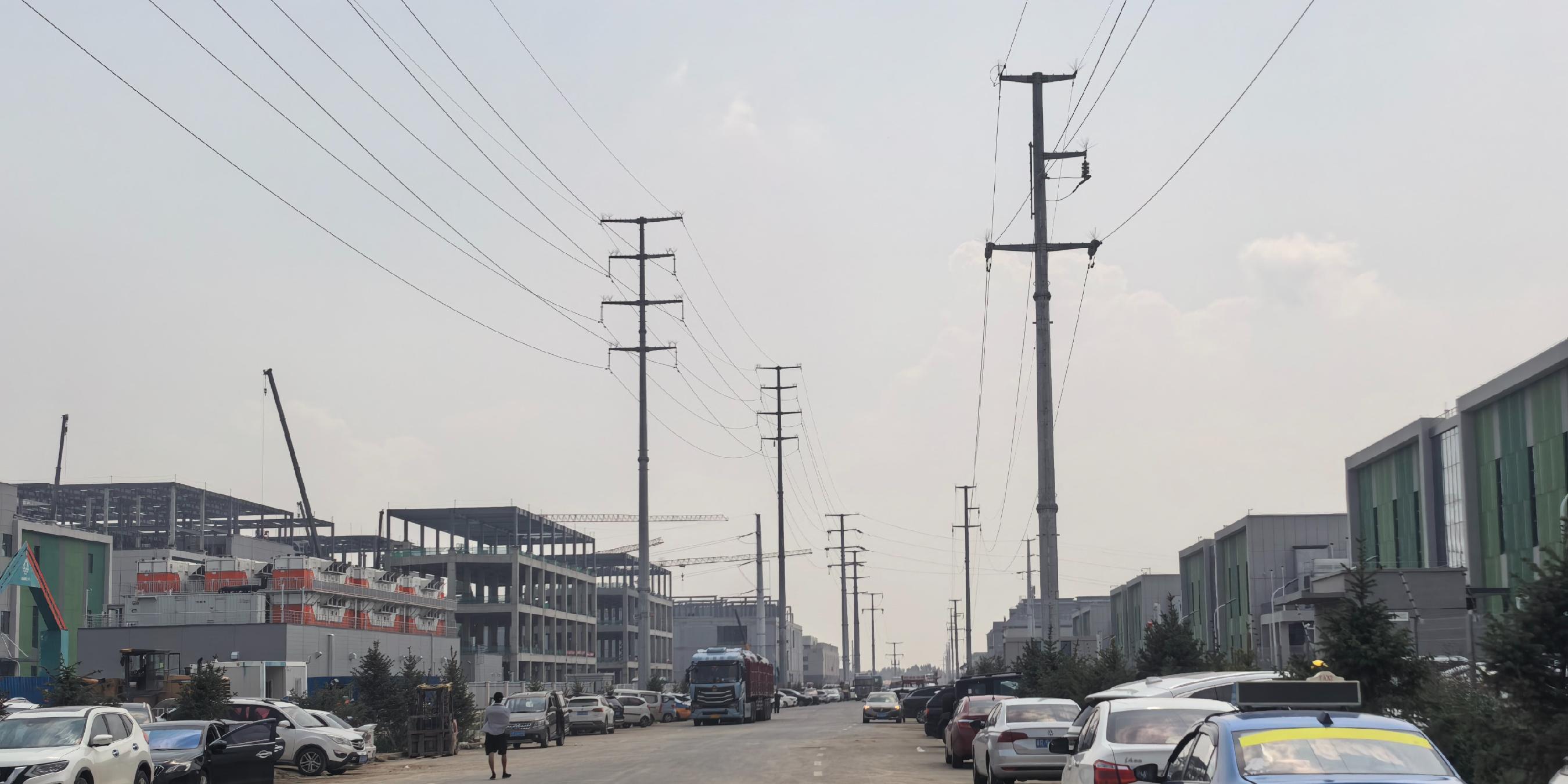
The core area of Bayin is located in the Bayin area of Chahar High tech Zone, with a straight-line distance of about 1.5 kilometers from east to west and north to south. The entire area is almost a construction site. On the afternoon of August 9th, as the end of work approached, groups of three or five construction workers dressed in various work uniforms crossed the road, and as the truck passed by, it raised waves of dust.
The Zhongjin Data Center is located on the north side of the core area of Bayin. The first and second phases of the project span the entire area from east to west, with contiguous farmland behind them. The main framework of both phases of the project has been formed, with gray walls separated by green stripes. Some buildings are still empty frames, while others have already been equipped with cabinets.
A staff member from the project department of Zhongjin Data Center told Economic Observer that some of the space in Phase I has already been put into operation, while the remaining parts and Phase II projects are improving the main structure and installing mechanical and electrical equipment. "According to requirements, the entire project will be put into operation next year, and the construction period is relatively tight.
To the south of the Zhongjin Data Center is the Zhonglian Green Intelligent Computing Center, whose fourth phase project under construction also spans the entire area from east to west. Further south, there are Huawei Data Phase III, 21Vianet, Kwai Data Phase II, Sinogold, Yueke Data, and Broadcom Data Phase I and Phase II projects in turn.
According to the planning map of the Chahar High tech Zone Management Committee, the Bayin area extends northward from National Highway 110 to the vicinity of National Highway 335, with a distance of nearly 7 kilometers from north to south. On the south side of National Highway 335, in addition to the projects planned to be started in the near future by Kwai Galaxy and Wanrun, the figure also marks several proposed site selection projects such as CICC Data, Zhongcheng Linuo Data, Youzu, Xiechuang Rendong, Yuanyuan Data, Zoomlion Data, Tiktok, and Wanguo Data.
To the west of the core area of Bayin is the Yiwu Tang area of Chahar High tech Zone, which is 5 kilometers away. The area forms an irregular triangle, with Huawei Data Center Phase I located at the northernmost end. The project was launched in 2013 and put into operation around 2017, making it the earliest data center project to be put into operation in Ulanqab.
To the south of Phase I of Huawei, there are Phase II of AsiaInfo, Phase II of AsiaInfo Dataport, and Phase II of Huawei. To the south, there are Cloud Connect Data, Apple Data, and Datang Data. To the south of Datang Data, there are also Alibaba, Youcarve, and Kwai projects. To the south of Youcarve, there are data centers such as BOC Insurance Trust and AsiaInfo.
For security reasons, the same enterprise usually does not centralize its data center in one place. Huawei, Ali, Kwai, Zoomlion, 21Vianet and other enterprises are all located in Ulanqab. Taking Huawei as an example, its Phase I and Phase II projects are located in the Yiwu Tang area, Phase III is located in the Bayin area, and there are also other projects that have landed before the flag.
In addition to Huawei's projects, Qianqi also has data center projects from Alibaba and Zoomlion; The logistics park area in Jining District is home to projects from Alibaba, Inner Mongolia Government Cloud Big Data, and China Unicom; Zhongqi plans to implement Century Internet, Prolos, Qinhuai Data, and New Vision Intelligent Computing; The registered projects in Xinghe County include Zhonglian Yunqi, Chenwei Computing Power, Xunheng Yungu Computing Power, etc.
The above-mentioned official said that Ulanqab's data business started early, but its development was slow before. Until the rise of artificial intelligence (AI) and the city's inclusion in the national "East West Calculation" node, the influx of computing power center projects began to accelerate, with new projects mainly concentrated in 2024 and 2025, and most of them have not yet been put into operation.
A person from the Chahar High tech Zone Management Committee introduced that land indicators have become a practical constraint for the expansion of computing power centers. Many projects are delayed in landing after signing contracts, or cannot start construction in a timely manner after landing. Nevertheless, Ulanqab remains one of the cities with the fastest expansion of computing power in China.
On June 30th, Gao Yongbin, Deputy Mayor of Ulanqab City, stated in a public event that as of the first half of 2026, the city has signed 89 computing power center projects, with a computing power operation scale of 165000 PFLOPS (PetaFloating point Operations Per Second, which is an authoritative standard unit for measuring computer computing power), and intelligent computing power accounts for over 90%, accounting for 8.7% of the national total.
According to this caliber, Ulanqab has surpassed Hohhot. Looking at the whole country, Ulanqab and Qingyang City in Gansu Province are both in the first tier, with a computing power operation scale of 168000 PFLOPS in Qingyang. According to the plan, the operating scale of computing power in Ulanqab City will strive to reach 200000 PFLOPS by the end of 2026.
This expansion of computing power scale is also reflected in the electricity consumption structure. In 2023, the electricity consumption of the tertiary industry in Ulanqab will reach 4.04 billion kilowatt hours, accounting for 5.9% of the total electricity consumption in the society; From January to November 2024, it will increase to 6.5%; By 2025, it will increase to 8.8%, with data center electricity accounting for 5.2%; From January to July 2026, the proportion of electricity consumption in the tertiary industry will further increase to 10.8%, and data centers will reach 7.3%.
Cheap Electricity
One step west of Beijing is Ulanqab "is the city's brand slogan. Ulanqab is adjacent to the Beijing Tianjin Hebei region, and its computing power mainly serves enterprises in the region. However, the spatial distance directly affects network latency.
Since 2017, Ulanqab has been constructing a 144 core point-to-point optical cable directly connecting to Beijing. The second one was completed in 2019, and by 2021, the point-to-point bidirectional optical cable between the two cities has been put into operation, with a network latency of only 4.2 milliseconds and a measured one-way delay of 2.1 milliseconds.
For the operation of data centers, year-round low temperatures can also reduce costs. The annual average temperature in Ulanqab City is 4.3 ℃, with an average summer temperature of 18.8 ℃. For nearly 10 months each year, natural cooling sources can be used for refrigeration, which can save about 30% of energy consumption under the same technical conditions. Based on a data center with 10000 server cabinets, it can save 200 million to 300 million kilowatt hours of electricity and over 100 million yuan in electricity costs annually.
Of course, attracting the influx of computing power centers, and more importantly, "cheap electricity". According to a local computing power center enterprise, there is a significant difference in industrial electricity prices across the country, with the western region generally having lower prices. Among them, the peak electricity price in the western region of Inner Mongolia (excluding Chifeng, Tongliao, Hulunbuir, and Xing'an League) is the lowest in the country during peak hours. On the one hand, thermal power is located near coal producing areas, resulting in lower power generation costs; On the other hand, the local wind and photovoltaic resources are abundant.
According to information disclosed by the Development and Reform Commission of Ulanqab City, as of the end of 2025, the city's power generation will reach 80.77 billion kilowatt hours, including 32.716 billion kilowatt hours of wind power, a year-on-year increase of 25.3%; Solar power generation reached 5.059 billion kilowatt hours, a year-on-year increase of 73.8%. The combined proportion of wind and solar power is 46.8%.
The electricity price table for commercial users who purchase electricity through agents released by Inner Mongolia Electric Power Group (Mengxi Power Grid) shows that the price for purchasing electricity through agents in August 2026 was 0.3234 yuan/kWh. According to the official sources mentioned above, the current door-to-door electricity price for some computing power centers in Ulanqab is about 0.358 yuan/kWh.
In addition to the relatively low electricity prices in the Mengxi power grid, direct connection of green electricity can further reduce the electricity costs of computing power centers.
In July 2025, the Zhongjin Data Low Carbon Computing Power Base's integrated project of source, grid, load, and storage will be connected to the grid and put into operation, known as the country's first data center green power direct connection project. The project is equipped with a 300 MW wind and solar energy storage power station located 18 kilometers away, which is directly connected through a 220 kV dedicated line. The annual self generated green electricity consumption is 850 million kilowatt hours, and the renewable energy substitution rate can reach 40%. In Qingyang, Gansu and Zhongwei, Ningxia, the computing power nodes are directly connected through green electricity, which can reduce the cost of industrial electricity to 0.36 yuan/kWh to 0.4 yuan/kWh.
In April 2025, the "Computing Power Collaborative Near Zero Carbon Data Center Demonstration Project" built by Century Internet in Ulanqab was included in the National Development and Reform Commission's "Green and Low Carbon Advanced Technology Demonstration Project List" (second batch). After the completion of the project, PUE (Power Usage Effectiveness) can be lower than 1.2, green electricity consumption accounts for 100%, and the annual green electricity consumption exceeds 600 million kilowatt hours.
A person in charge of a power construction enterprise in Ulanqab told the Economic Observer that green power direct connection refers to the direct transmission of green power such as wind power and photovoltaic power to the user end through dedicated lines, without going through the power grid. Its core is "load determines source", which means planning the new energy installation scale based on the enterprise's electricity load, and then solving the problem of green electricity fluctuations through the synergy of wind, solar, and storage.
The official mentioned above said that direct connection of green power can not only reduce losses in the transmission and distribution process, but also lower costs. "One kilowatt hour is 1 cent cheaper, and in a year, a company can save tens of millions of yuan. Low operating costs make it competitive in the market.
In addition, the geological conditions in Ulanqab are relatively stable, and earthquakes and other geological disasters have rarely occurred in history. The underground is mainly granite, which can reduce the risk of unexpected disasters to the data center.
Several local officials stated that the computing power centers that have already signed contracts in Ulanqab have not been introduced through government initiated investment, and most enterprises have actively contacted the local government.
The third business card
Before the computing power center, Ulanqab was better known as the "Potato Capital". In 2009, the China Food Industry Association awarded Ulanqab the title of "Potato Capital of China".
According to the information released on the website of Ulanqab Municipal Government in 2025, the potato planting area in the city has remained stable at around 4 million mu for a long time, with a total output of around 4.5 million tons, ranking first among prefecture level cities in China, accounting for about 6% of the total national output and nearly half of the total output in Inner Mongolia.
Another industrial business card of Ulanqab is ferroalloy, which is the largest green ferroalloy production base in the country. Since 2021, the local government has been promoting the green and intelligent transformation of industries through the elimination of outdated production capacity, technological transformation, and chain extension and strengthening. By 2025, the output value of the ferroalloy industry cluster will exceed 100 billion yuan, becoming the first 100 billion level industrial cluster in the city.
The ferroalloy industry that relies on "cheap electricity" is also the result of years of investment promotion in Ulanqab. From January to July 2026, the electricity consumption of the ferroalloy industry accounted for 54.4% of the city's total.
By comparison, computing power centers also require low temperatures, land, and cheap electricity, with the difference being that high power consuming mineral heat furnaces have been replaced with cabinets.
The data center entered Ulanqab not too late, and the real acceleration occurred in the past three years.
Since 2013, projects such as Huawei, Alibaba, Apple, and Youke have successively landed in Ulanqab. These data centers mainly carry cloud services, with servers from Huawei Cloud, Alibaba Cloud, and Apple iCloud all located here. By around 2020, Ulanqab had completed its initial industrial accumulation.
Before and after the launch of the "East Data and West Computing" project in 2022, a batch of projects, such as Kwai Smart Cloud, CICC Data, and Youkede Phase II, have also been started in succession. Early projects have also begun to be put into centralized production, and the scale of the data center has expanded rapidly.
After 2024, the expansion of computing power centers will significantly accelerate. Multiple projects such as Zhongjin, Century Internet, Zhonglian, Datang Data, Shudao Intelligent Computing, Yuanjing Intelligent Computing, and Northern Xinjiang Film and Television Computing Power have started construction or production, and Ulanqab has also entered the first tier of national computing power.
At the end of 2025, the Ulanqab Municipal Government issued the "Ulanqab Three Year Action Plan for Building the 'Token Capital' (2026-2028)", proposing to exceed 200000 PFLOPS in total computing power scale by 2026, achieve revenue of 8 billion yuan, and complete the industrial transition from 'Grassland Cloud Valley' to 'Smart Computing City' and then to 'Token Capital' by 2028, and lay out computing power services, token trading, and intelligent applications.
Around the computing power industry, Ulanqab has introduced a large number of supporting policies in terms of financial subsidies, special funds, land use, electricity prices, talent, etc., but the specific investment amount has not been disclosed, nor has the specific caliber of financial subsidies, land and electricity price reductions been disclosed. In terms of output, only in 2024, the tax revenue of its computing power industry was announced to be nearly 100 million yuan, and there is no specific data for other years.
An official in the city stated that the computing industry is still in the investment phase and is "still losing money". As ongoing projects are put into operation, the output value, tax revenue, and employment contributions will gradually be released.
A local tax official also introduced that the contribution of the computing power center to local taxation mainly occurs during the construction phase. After the computing power center is put into operation, most of the data business is sold by the enterprise headquarters, and the tax sources left in the project location mainly come from land, real estate, and personal income tax of employees.
To convert more computing power scale into local revenue, it is necessary to extend upstream and downstream, including introducing high-end manufacturing and computing power application enterprises, and exploring local token trading.
At present, Ulanqab has formed a certain scale in the upstream of computing power, such as green electricity and new materials, while high-end manufacturing, application, and trading related to computing power are still in their infancy.
In the first seven months of 2026, ferroalloys consumed 54.4% of the city's electricity, while data centers accounted for 7.3% of this proportion. The former is already a billion level industrial cluster, while the latter's output value and tax revenue have not yet formed a publicly available caliber. The replacement of mining furnaces with cabinets has just begun. What is the proportion of output value in the computing industry? It is Ulanqab's imagination left for the future.


The new photovoltaic regulations have not yet been implemented, and some components have already exited the competition for large orders

Towards the end of the year, grid connected energy storage encounters an 'invisible barrier'

The new regulations for innovative drugs do not limit BD, but it has become difficult to sell companies



 Subscribe