Economic Observer Follow
2026-07-25 13:14



Recently, several major economic provinces (usually referring to the top ten provinces in terms of GDP) have successively released their economic data for the first half of 2026. Overall, there has been a significant differentiation in GDP growth rate, import data, and consumption trends among major economic provinces.
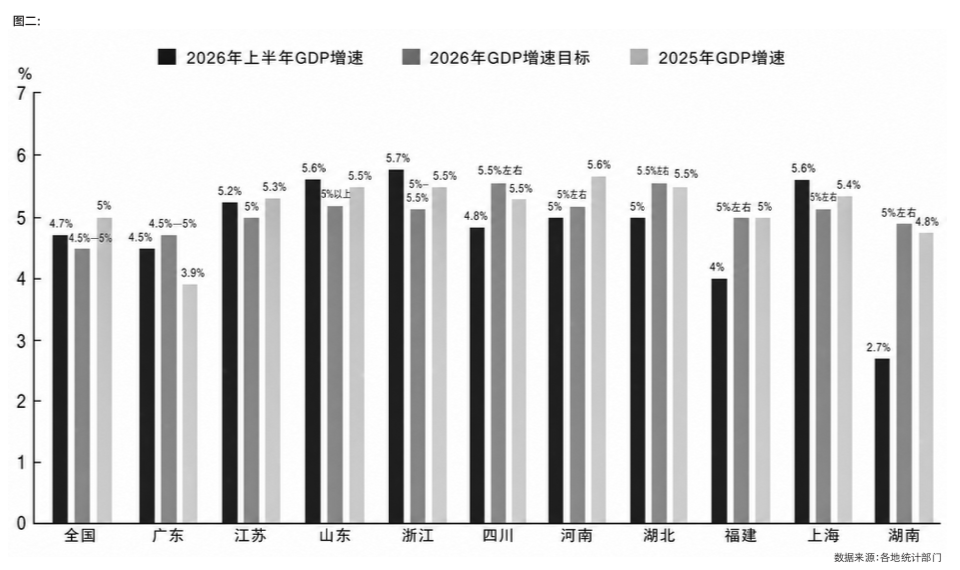
In terms of GDP growth rate, except for Guangdong, Fujian, and Hunan, the GDP growth rate of the other seven major economic provinces in the first half of the year exceeded the national average growth rate (4.7%). Among them, Shandong, Zhejiang, and Shanghai have grown against the trend, with GDP growth rates of 5.6% or above in the first half of the year, all exceeding the province's GDP growth rate for the whole year of last year.
It is worth noting that Hunan's economic growth has shown a trend of falling behind. From 2021 to 2023, Hunan's GDP will rank ninth in the country; From 2024 to 2025, it will be overtaken by Shanghai and fall to tenth place; In the first half of this year, Hunan's GDP was surpassed by Anhui, and its ranking fell to the eleventh place in the country.
Looking at the sub items, there was a certain degree of differentiation in the consumption data of major economic provinces in the first half of the year. Among them, the growth rate of total retail sales of consumer goods in Hunan (hereinafter referred to as "social zero") has fallen into the negative growth range, while the growth rate of social zero in Jiangsu and Shanghai has fallen below 1%, while the growth rate of social zero in Henan, Shandong, and Zhejiang is more than twice the national average level.
In addition, against the backdrop of record high import data in the first half of the year, the total import value of automatic data processing equipment and its components reached 610.71 billion yuan, a year-on-year increase of 72.2%. Among them, Guangdong Province alone accounts for almost half of the country's total import value of this product. The total import value of such goods in Henan, Fujian, and Shanghai has also shown a doubling growth.
According to the definition of the National Bureau of Statistics, automatic data processing equipment and its components include four categories: automatic data processing equipment, central processing components, storage components, and parts and accessories of automatic data processing equipment.
Multiple provinces set new highs in imports
In the first half of 2026, China's imports and exports experienced a strong rebound, with the scale of imports and exports exceeding 25 trillion yuan for the first time in history, an increase of 3.68 trillion yuan compared to the same period last year. From monthly data, it has exceeded 4 trillion yuan for four consecutive months.
Among them, the performance of import data is particularly impressive. In the first half of the year, China's imports exceeded 10 trillion yuan for the first time in history, with a year-on-year growth rate of 22.1%. The growth rate was 8.7 percentage points higher than that of exports, and the contribution to foreign trade growth was greater than that of exports.
According to Lu Ting, Chief Economist of Nomura China, the high price of integrated circuits is an important driving force for the high growth of national import data this year. In June, the total import value of integrated circuits in China increased by 72.3% year-on-year, while the import quantity only increased by 6.6% year-on-year. The contribution of price increase factors to the growth of the total import value of integrated circuits in June reached 61.7 percentage points.
Looking at it separately, the characteristic of the high prices of AI (artificial intelligence) industry chain equipment driving the growth of import value is also evident in major economic provinces.
Taking storage components as an example, the total import value of storage components in Shanghai in the first half of the year was 25.8 billion yuan, a year-on-year increase of 120.7%, but the import quantity was 10.534 million units, a year-on-year decrease of 2.8%. Based on this conversion, the average import price of each storage component in Shanghai increased by 127.1% year-on-year in the first half of the year.
Since March this year, Guangdong's imports have maintained a growth rate of over 30% for four consecutive months, with a year-on-year increase of 59.1% in June, setting the fastest monthly growth rate in nearly 10 years. In the first five months of this year, the total import value of automatic data processing equipment and its components in Guangdong reached 254.26 billion yuan, a year-on-year increase of 49.5%. On the one hand, the import value of this category accounted for 13.9% of Guangdong's total import value in the first five months, compared to only 10.2% for the whole of last year; On the other hand, the total import value of automatic data processing equipment and its components in the first five months of the year was 480.78 billion yuan, with Guangdong accounting for more than half of the country's imports in this category.
Shenzhen, Guangdong is the "main force" in the import of mechanical and electrical products. According to data released by Shenzhen Customs, in the first five months of this year, Shenzhen imported mechanical and electrical products worth 830.09 billion yuan, accounting for approximately 66.9% of Guangdong's imports during the same period. Among them, in the first five months, the total value of imported integrated circuits in Shenzhen increased by 48.4% year-on-year; The total value of imported computer components, mainly graphics cards and servers, increased by 59.3%.
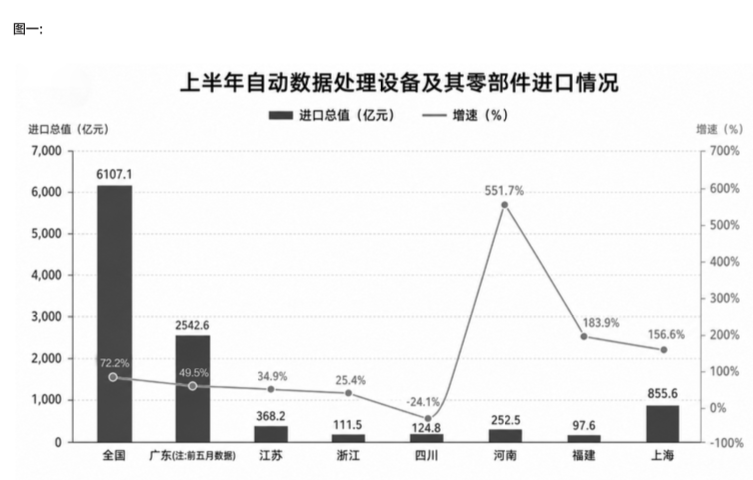
In addition, as shown in Figure 1, with the high prices of AI industry chain equipment, there has been a certain degree of differentiation in the import of related equipment by major economic provinces. In the first half of the year, the total import value of automatic data processing equipment and its components in Sichuan showed a year-on-year negative growth, while the year-on-year growth rates in Jiangsu and Zhejiang were below 40%, lower than the national average level (72.2%); On the other hand, the growth rates in Henan, Fujian, and Shanghai are all above 150%.
Among them, Henan's performance is the most outstanding, with a total import value of automatic data processing equipment and its components reaching 25.25 billion yuan in the first half of the year, a year-on-year increase of 551.7%. As a result, the total import value of Henan Province in the first half of the year rose to 2008.8 billion yuan, a year-on-year increase of 49.8%, and the import scale exceeded 200 billion yuan for the first time in history during the same period.
Looking ahead to the import and export trend in the second half of the year, on July 17th, Bi Kexin, Deputy Director of the Guangdong Branch of the General Administration of Customs, stated at a press conference that in June, the customs conducted a trade prosperity survey on thousands of key foreign trade enterprises in the province, and the proportion of enterprises reflecting an increase in import and export orders has significantly increased. The confidence of enterprises continues to grow, and it is expected that Guangdong's foreign trade import and export will continue to maintain a positive trend in the second half of the year.
Multiple provinces have exceeded expectations in growth, while Hunan's growth has fallen behind
At the beginning of this year, several major economic provinces lowered their GDP growth targets for 2026. Specifically, six major economic provinces directly lowered their growth target values; Among the remaining four major economic provinces, the growth targets of Shandong and Shanghai remain unchanged from 2025, Jiangsu has adjusted from "above 5%" to "5%", and Sichuan has adjusted from "above 5.5%" to "around 5.5%". By 2025, only three major economic provinces have lowered their GDP growth targets.
Against this backdrop, there has been a certain degree of differentiation in the performance of major economic provinces in the first half of this year.
On the one hand, in the first half of this year, the GDP growth rates of Jiangsu, Shandong, Zhejiang, and Shanghai were all above 5%, exceeding the GDP growth target set at the beginning of the year, laying a solid foundation for achieving the annual economic growth target. (See Figure 2)
The Shanghai Municipal Bureau of Statistics issued a document stating that overall, the city's economy and society achieved steady progress in the first half of the year, with high-quality development moving towards new and better directions. At the same time, it should be noted that there are many unstable and uncertain factors in the current international environment, and the foundation for economic growth still needs to be consolidated. In the next stage, we must adhere to seeking progress while maintaining stability, improving quality and efficiency, vigorously boosting consumption, expanding effective investment, exploring industrial increments, accelerating transformation and upgrading, continuously promoting the construction of a modern industrial system, and making better contributions to the country through high-quality development.
On the other hand, in the first half of this year, the GDP growth rates of Sichuan, Fujian, and Hunan provinces have slipped below their annual GDP growth targets. To achieve the annual growth target, these three provinces still need to make more efforts in the second half of the year.
In recent years, there have been frequent occurrences of major economic provinces failing to achieve their GDP growth targets. From 2023 to 2025, there will be 6, 4, and 3 major economic provinces that have failed to achieve their growth targets. Among them, Guangdong, Hubei, and Hunan have not achieved the expected GDP growth rate in the past three years, while Henan has failed to achieve its GDP growth target for five consecutive years from 2020 to 2024.
It is worth noting that among the major economic provinces, Hunan's economic growth rate has declined particularly significantly. From 2022 to 2025, Hunan's actual GDP growth rate will be between 4.5% and 4.8%, but its growth target is set at 5.5% or higher. In 2026, the province will further lower its growth target to around 5%.
In the first quarter of this year, Hunan's total GDP was 1315.61 billion yuan, with a year-on-year growth rate of only 3.0%, and the total continued to rank tenth in the country; During the same period, the total GDP of Anhui was 1301.4 billion yuan, with a growth rate of 5.8%, and the gap with Hunan was less than 15 billion yuan. In the first half of this year, the total GDP of Hunan was surpassed by Anhui, and the GDP growth rate further declined to 2.7%.
On July 20th, the Hunan Provincial Bureau of Statistics issued a document summarizing the economic performance in the first half of the year from five major parts. Some of them directly proposed "moving forward under pressure of demand", but did not simultaneously announce the specific zero growth rate of the first half of the year. From July 21st to July 23rd, Hunan Daily launched a series of interpretation articles titled "Rationally Viewing Hunan Economic Half Year Report", with titles including "The Advancement of Quality Behind the 'Retreat of Speed'", "The Transformation of Industry from Old to New", and "Short term Pain Nurtures Future Dividends".
The article "Behind the 'Retreat of Speed' and the 'Advancement of Quality'" mentioned that in the more than 40 years since the reform and opening up, Hunan has also experienced multiple tests of declining growth rates. 20 years ago, due to the booming development of industries such as construction machinery, rail transit, and traditional tobacco and petrochemical industries, Hunan's economy ushered in a "shining moment". What were the sister provinces doing at that time? Anhui, with the determination of "sharpening a sword in ten years", silently cultivates the "chip screen automotive integration" industry cluster - enterprises such as BOE and Changxin Storage, which are the seeds sown at that time; Hubei, adhering to the track of "optical core screen terminal network", Changjiang Storage has grown from scratch into the backbone of domestic storage. At that time, Hunan relied on its traditional advantages to achieve steady and far-reaching development; Hubei and Anhui are devoted to "fish farming". Now, the wind direction has changed. Hunan's traditional advantageous industries have undergone deep adjustments, and the "fish" carefully nurtured by others have grown up. The "Six Little Dragons" of Hangzhou have emerged in the global technology landscape, with integrated circuits in Anhui and optoelectronic information in Hubei becoming national strategic forces.
Consumer data has hidden concerns
In recent years, consumption has gradually become the primary driving force of economic growth. By 2025, the contribution rate of consumption to economic growth will reach 52%, an increase of 5 percentage points from the previous year.
Entering 2026, multiple consumption data trends reflect that consumption growth is facing certain pressure. According to data from the National Bureau of Statistics, the year-on-year growth rate of social media zero in the first half of the year was 1.3%, lower than last year's full year level (3.7%). Among the 31 provinces, 9 provinces have experienced zero negative social growth in the first half of the year.
In the first half of the year, Jiangsu and Shanghai, which ranked second and ninth in terms of GDP among major economic provinces in China, saw their social zero growth rate fall below 1%. Since the beginning of this year, the cumulative growth rate of Shanghai's social zero has shown a rapid downward trend, with the growth rate dropping to -5.5% in June.
Specifically, in June of this year, seven out of the top ten units above designated size in Shanghai experienced negative growth in retail sales, including a year-on-year decrease of 31.2% in retail sales of household appliances and audio-visual equipment, 18.9% in retail sales of communication equipment, and 20% in retail sales of automobiles.
Beijing and Shenzhen, both first tier cities, also face certain challenges in achieving zero social growth. In the first half of the year, Beijing's zero social growth decreased by 2.2% year-on-year, with retail sales of goods decreasing by 2.4% year-on-year; In the first five months, Shenzhen's retail sales increased by 0.3% year-on-year, with a decrease of 0.5% in commodity retail sales.
Faced with this situation, many provinces have also emphasized that they will further increase efforts to boost domestic demand, especially policies to promote consumption, in the second half of the year. On July 22, Xu Guo, Director of the Trade and Foreign Economic Statistics Department of Jiangsu Provincial Bureau of Statistics, issued a document interpreting that the consumer market in the province has rebounded in the first half of the year. In the next stage, we should continue to track the structural changes of the consumer market, dynamically optimize the coverage of consumer policies and standards, pay more attention to optimizing the consumption environment, cultivating new consumption formats, increasing residents' income and other long-term mechanisms. While playing a role in short-term policy leverage, we should accelerate the stimulation of endogenous consumption power and provide solid support for consolidating and expanding the stable and positive momentum of the consumer economy.
In the interview, multiple macroeconomic experts coincidentally mentioned that further efforts should be made to promote consumption in the second half of the year. In the first half of 2026, the year-on-year growth rate of social zero is 1.3%, still at a historically low level.
In the view of Zhang Lin, Vice President of Far East Credit Research Institute, consumer policies need to continue to be strengthened in the second half of the year to hedge against the blank period caused by the decline of the "trade in" policy. Without new follow-up policies, the zero year-on-year growth rate of social enterprises in the fourth quarter of this year may face significant pressure.
Liao Bo, Chief Macro Economic Analyst at Northeast Securities Research Institute, stated that expanding consumption and domestic demand are the focus of economic development. It is expected that subsequent policies will continue to focus on breaking down consumption constraints and enhancing the inherent stability of the capital market. Macro control policies may focus on boosting consumer confidence and increasing residents' disposable income through multiple channels.


 WeChat registration or login


 Subscribe