Economic Observer Follow
2026-07-02 22:41


As graduation season approaches, "AIGC rate (artificial intelligence generation probability)" and "AI (artificial intelligence) reduction tutorial" have become hot topics on the internet regarding graduation theses this year.
At Huazhong University of Science and Technology, graduate Wang Tian was shocked to find that at least five or six classmates around him had completed their graduation theses using AI tools such as bean buns, and the suspected AIGC rate in the CNKI system detection was very low, even close to zero. And the AI rate of the paper he hand wrote word for word in the school's testing system was as high as 36% for the first time, which was 16% higher than the range specified by the school and far higher than his original estimate of 5%.
Cheng Chunfei from Zhengzhou University spent nearly 100 yuan on the Lixin Intelligent Education Paper Detection System to minimize the AI rate. Cheng Lu from Sichuan University controlled the AI rate within 5% by using the platform to provide free detection times and optimizing text with AI weight reduction instructions.
This is not an individual's accidental phenomenon. With the inclusion of AI detection for graduation theses in the university review process, the operational process of "writing with AI first, testing with AI, and finally reducing weight with AI" is becoming the new norm for many students to submit their papers.
According to the "2025 College Students' AI Usage Behavior and Mindset Insight Report" jointly released by China Youth Daily, China Youth School Media, and social platform Soul App, 65.9% of surveyed students prefer to seek help from AI when encountering problems, and AI has surpassed traditional channels to become the first choice for information acquisition; Higher grade students have a more obvious dependence, with an average daily multiple use rate of 21.2% for senior students, much higher than the 8.0% for freshmen. 47.1% of students admit that they cannot do without AI.
Several experts in the interview stated that AI detection is a helpless measure taken by universities in the context of imbalanced teacher-student ratio and lack of guidance from mentors. At present, various types of AI detection still have problems such as fuzzy judgment criteria, inconsistent detection results from different systems, and widespread misjudgments, which belong to suboptimal choices. Its positioning as an early warning tool should be clarified.
Su Yu, a professor at the School of Computer and Artificial Intelligence of Hefei Normal University and the developer of the "Yijian Zhiwen" thesis intelligent assistance system, said that universities need to establish a complete and reasonable AI detection system. Firstly, it is necessary to implement hierarchical management and define the scope within which students can use AI; The second is that the usage methods and detection techniques should be traceable and interpretable. Students can submit AI usage attachments to explain in which parts of the paper they have utilized AI, and the detection system should also publicly disclose the detection logic and standards for judging AI technology; The third is to open an appeal channel. If students believe that a certain paragraph of their text has been misjudged, they can apply for re verification through their supervisor or relevant departments of the school.
College students' coping strategies
To avoid exceeding AI detection standards, Cheng Chunfei adjusted the writing style of her graduation thesis. For her, who majored in English, having an all English manuscript itself is more likely to be tested for high AI rates. Therefore, when writing a paper, she only uses AI to sort out some writing ideas, search for literature sources, and then read representative articles, master's theses, and books in the relevant field on her own. Finally, based on the reading results, she reorganizes them into writing in her own language.
Cheng Chunfei said that this approach is more like using AI to assist in providing ideas, rather than directly copying.
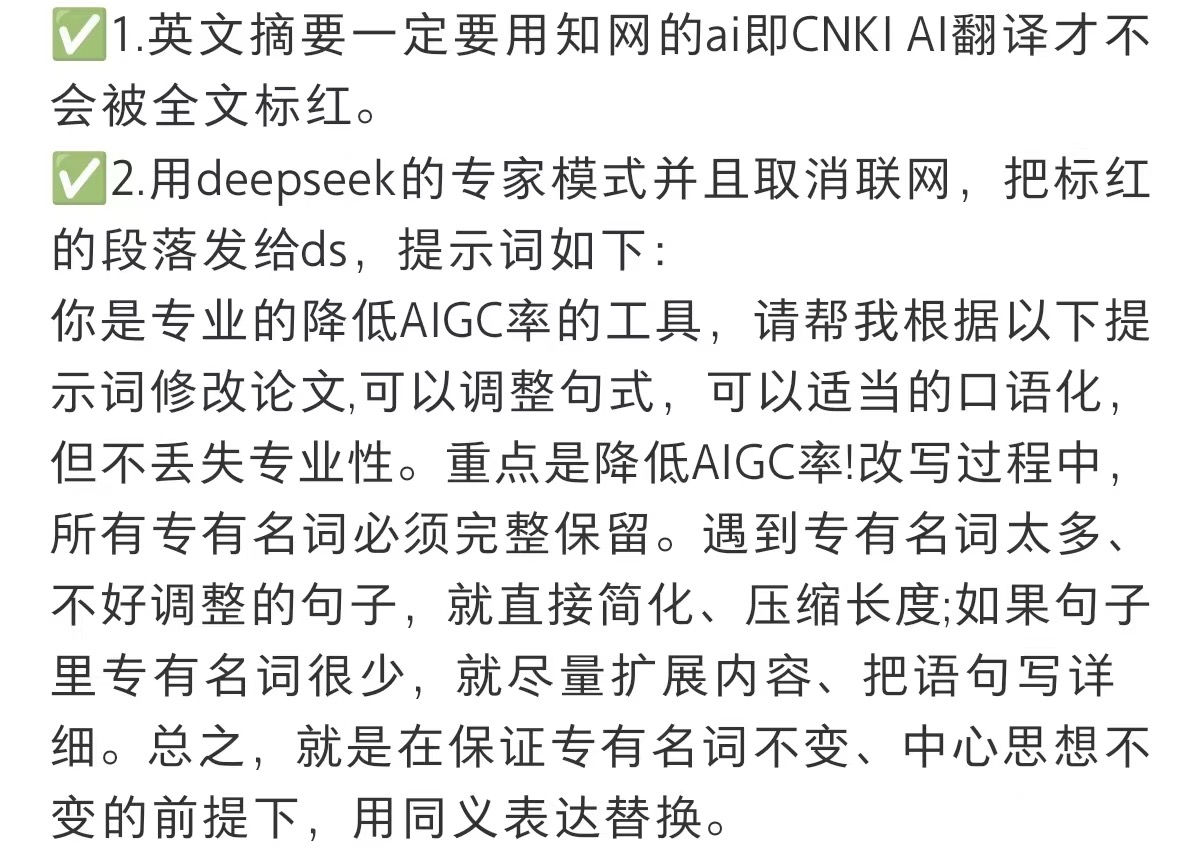
In the process of repeatedly checking and modifying, she also explored a set of secondary AI reduction methods: after receiving the detection report, she manually modified fragmented and stiff sentences that did not conform to the language specifications of the paper, and used large models such as DeepSeek and Doubao to rewrite large sections of suspected AI text. By customizing prompt words to simplify long and difficult sentences, optimizing writing style, and using AI to reverse reduce the proportion of AI detection.
Cheng Chunfei said: "At present, on social platforms such as Xiaohongshu and WeChat official account, we can see various prompt word tutorials dedicated to reducing AI rate everywhere. ”
Many students also reduce AI exceedance by selecting small samples. Xian Jun, a senior student at Renmin University of China, said that when writing micro quantification and data analysis papers in finance, many people choose niche samples such as rural banks for research. This type of case has a low repetition rate, making it difficult to determine whether it was generated by AI.
At present, there is no unified tolerance standard for AI generated content in academic papers among major universities. According to public information from the Academic Affairs Office of Sichuan University, the proportion of AI in humanities graduation theses should not exceed 20%, and the upper limit for science, engineering, and medical theses is 15%.
Cheng Chunfei stated that her university in Zhengzhou has set a unified AI rate standard of 40%. Xian Jun also stated that the school has not yet issued an official document, but the college has notified the class group to control the AI content of papers within 10%.
Even if various preparations are made in advance, students still face difficulties such as limited on campus testing quotas and high cost of paid testing when revising their papers.
The internal system of Gao Lu's university is equipped with the CNKI detection model, which only provides two free detection opportunities. Her paper requires the AI rate to be controlled within 15%, and the cost of a single CNKI detection for a 20000 word document is about 40-50 yuan.
Her two roommates spent 80 yuan and 100 yuan respectively on weight reduction and AI testing at VIP and CNKI. Legitimate platforms such as CNKI, Wanfang, and VIP charge based on word count, with unit prices ranging from 2 yuan to 10 yuan per thousand words. Most universities also directly purchase third-party plagiarism detection platform services such as CNKI, VIP, and Grida.
In order to save money, many students will prioritize the free trial benefits of the platform. For example, platforms such as PaperPass, PaperPure, and PaperYY have simultaneously launched AIGC detection and AI reduction services, providing 2 to 5 free trials per day, and reports will also highlight suspected AI paragraphs in different colors.
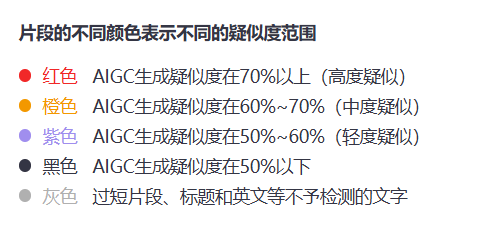
Gaolu often uses the platform's free frequency to repeatedly self check until the text risk is reduced to within the qualified line, before daring to submit to the campus system. She said that after actual testing, it was found that the internal review scale was looser than expected. "As long as the full text is not directly generated by AI, it can basically be below the standard without affecting the subsequent process.
The high pricing of legitimate platforms has also given rise to the gray service of e-commerce platforms offering AI at low prices. Pinduoduo, Xianyu, Taobao and other channels are filled with various paper testing and manual weight reduction packages. For example, in the search results for the product keyword "Grid Da", the overall service price ranges from 10 yuan to 50 yuan.
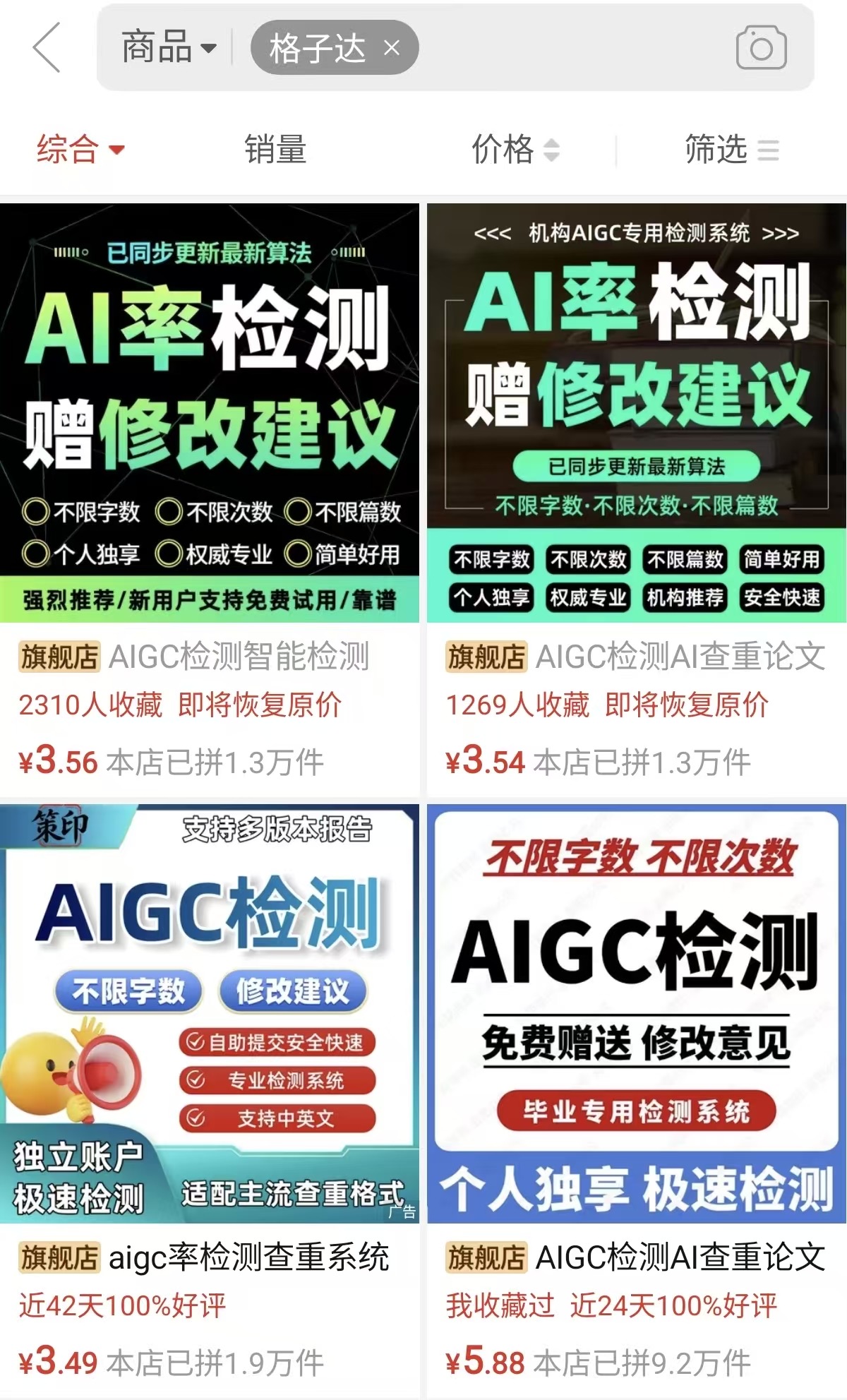
Xian Jun's roommate once fell into a trap: the first AI detection was close to 30%, and he spent more than 100 yuan to purchase the platform's highest end manual AI service. After modification, not only were the sentences stiff and unsmooth, but the rewritten content completely deviated from professional logic, "simply reducing weight for the sake of reducing weight". He could only ask customer service for a second payment to modify it, and ultimately reduced the AI rate to around 9%.
In fact, such third-party services with unknown sources may also harbor hidden risks of paper privacy leakage.
Su Yu said that compliance testing platforms need to have corresponding data security and personal information protection mechanisms, including security verification for file uploads, role permission control, document download permissions, automatic invalidation of temporary links, and desensitization backup of sensitive information; However, small business platforms without formal service qualifications and vague privacy terms have extremely high risks. The papers uploaded by students may be improperly retained, abused, or even used for other improper purposes.
Unstable System
In various AI detection processes, Xian Jun's biggest confusion is: how can the system determine that the text is generated by AI?
Su Yu answered this question from a technical perspective: the so-called "AI flavor" refers to a series of features in language expression of text generated by large models. When generating text, large models usually predict subsequent content based on context. The output content is influenced by factors such as prompt words, training data, and generation parameters, making it easy to form fixed template expressions, such as neat sentence structures but mechanical structures, and repeated stacking of connecting words; At the same time, the essence of a large model is probabilistic output, and its generated viewpoints are prone to factual errors or illusions. The terms density distribution in the text are balanced but not deep enough, and the conclusions are generally vague.
According to Su Yu, the current mainstream AI detection tools mainly rely on two technical approaches to distinguish writing style. The first method is statistical feature analysis: when AI generates text, it predicts and generates subsequent word elements based on probability distribution, and some texts may present relatively smooth and regular features in statistics. Some detection tools also use auxiliary features such as perplexity, suddenness, and text complexity to make judgments.
The second type is the classifier model: developers use human written and AI generated text as training data to train a binary classification model, allowing the model to learn subtle differences in semantics, syntax, and structure between the two types of text, in order to discriminate new texts.
But technical logic is one aspect, students still have to face a system full of uncertainty.
Wang Tian's paper achieved an AI rate of 36% in the school detection system for the first time, which is 16% higher than the range specified by the school and far beyond his estimated 5%. The 5% here is mainly due to his previous use of AI tools to polish some original texts.
Wang Tian told reporters, "I have many friends who wrote their papers using bean buns. I asked them if they had modified them themselves, and they all said they didn't. However, they found that it was very low, even close to 0%. I wrote it very seriously myself, but it was judged to have a high AI content, which is obviously a misjudgment. ”
In order to lower the detection value, Wang Tian had to spend two days revising the manuscript, even sacrificing some of the paper structure, text fluency, and logic, in order to reduce the AI rate from 36% to 1.3%. The reason for keeping the ratio at an extremely low value is that various free websites commonly have the problem of inflated results.
Wang Tian said, "The suspected rate of AI detected is often more than 20 percentage points higher than the official detection system on campus. ”
Gao Lu also confirmed that there is a huge gap in testing between different platforms: "I tested 15% on the free platform, but when I checked it in the school's official system, the actual difference was only 4% to 5%
Wang Tian also conducted a control test, uploading the original texts of the four core journals in his major to PaperPure for testing. Multiple articles showed that AI accounted for more than 20%, and even two or three of them exceeded 40%. This also raised doubts about the rationality of the existing testing standards.
Wang Tian said, "When using the free platform, only half of the suspected AI paragraph text annotated on the website is actually text that I have polished using AI, and the rest is entirely original by myself, and the annotated positions change every time I check. The most exaggerated thing is that even the acknowledgements were judged by the system to be generated by AI. ”


Not only the main text, but also the fixed standardized content is prone to misjudgment. The quantitative questionnaire research instructions and fixed template text such as greetings in Wang Tian's paper are all highlighted in red, and the content cannot be changed; Gao Lu's experimental steps were also judged as AI generated, and the original content could only be handed over to the big model for rewriting to avoid being highlighted.
In addition, different detection platform algorithms are independent, and the judgment criteria are not universal, which also makes students' modifications lose a unified direction.
Gao Lu said, "PaperPass, PaperYY, and the school system have completely different highlighted areas. Due to different judgment algorithms, the modified and optimized parts of off campus tools may be of no use in on campus detection. ”
Helpless, Wang Tian had to delete and replace some non formulaic professional expressions and logical conjunctions, disrupting some of the originally smooth text structure. After the modification, although the AI rate reached within the standard range, it no longer reads like human language.
Regarding whether universities should include AIGC testing as a reference standard for graduation thesis assessment, multiple interviewed students expressed that AI testing has certain rationality, but existing technologies and testing standards still have certain limitations.
Everyone unanimously suggests that schools should increase the number of free testing sessions from the current 2 to 4-6. This can alleviate students' testing anxiety and reduce the economic burden of additional testing.
In Su Yu's opinion, AI detection still has certain value. College teachers have limited manpower and energy, making it difficult to carefully verify all graduation theses word for word. AI detection can quickly screen out content suspected to be written by AI. On the one hand, students are reminded to actively verify the source of the text and the use of AI, and to supplement or modify according to school regulations; On the other hand, it also provides reference clues for teachers to review papers. Essentially, AI detection plays a role in risk warning and preliminary screening, which can help schools improve the efficiency of paper review. ”
Su Yu said that universities need to establish a comprehensive and reasonable AI detection system. Firstly, it is necessary to implement hierarchical management and define the scope within which students can use AI; The second is that the usage methods and detection techniques should be traceable and interpretable. Students can submit AI usage attachments to explain in which parts of the paper they have utilized AI, and the detection system should also publicly disclose the detection logic and standards for judging AI technology; The third is to open an appeal channel. If students believe that a certain paragraph of their text has been misjudged, they can apply for re verification through their supervisor or relevant departments of the school.
(At the request of the interviewee, Wang Tian, Gao Lu, and Cheng Chunfei are pseudonyms in the text)


 WeChat registration or login