Economic Observer Follow
2026-06-13 16:31


Economic Observer reporter Wang Yajie reports from Laos
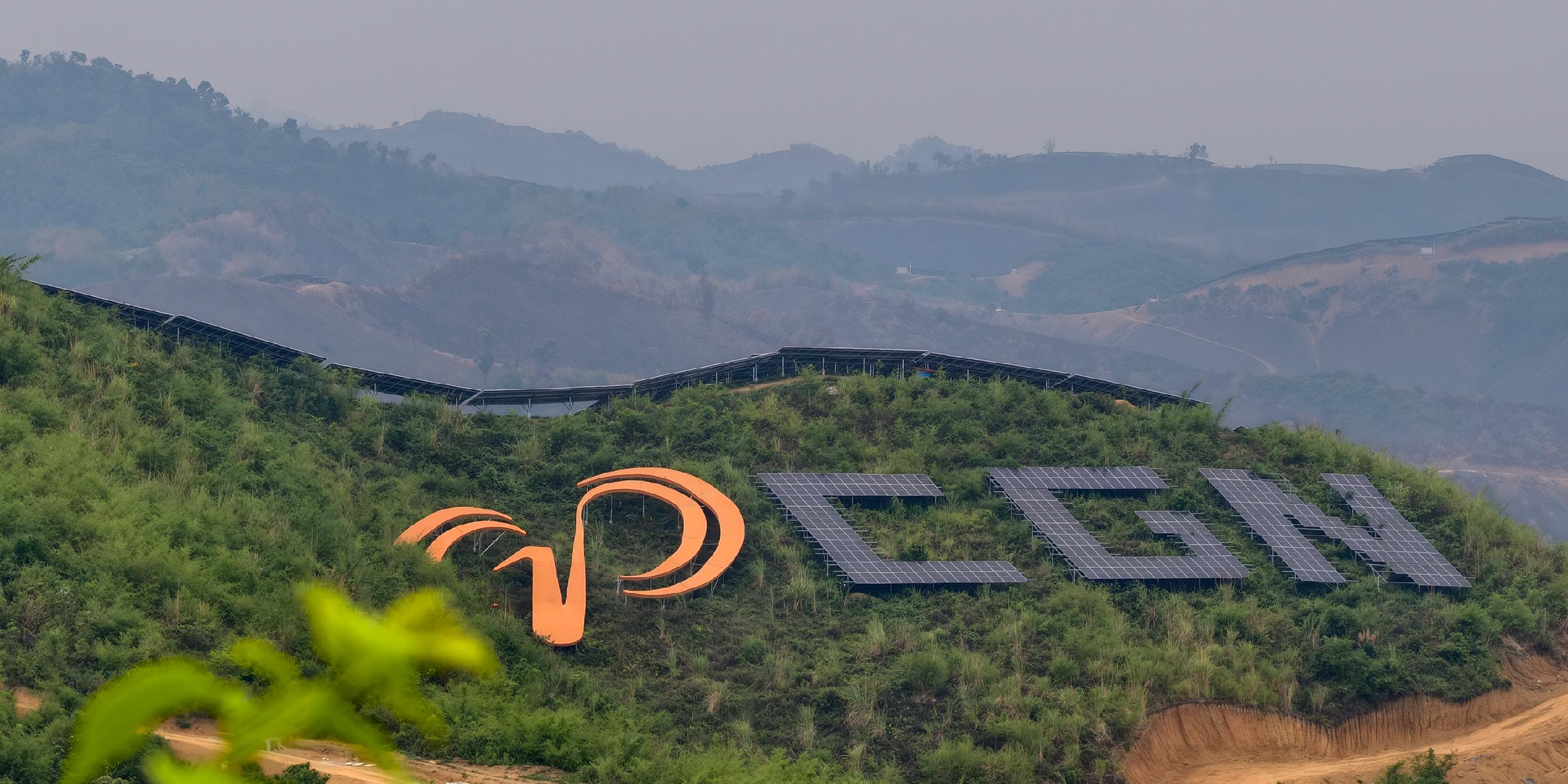
In early June 2026, relying on the 1000 MW photovoltaic power plant of China General Nuclear Power in Laos, the China Laos 500 kV cross-border interconnection project will complete the country's first two-way import and export clearance of 500 kV ultra-high voltage power, with a cumulative cross-border transmission of 250 million kilowatt hours of clean electricity.
When batches of Chinese companies followed the clues of industrial chain transfer and came to this neighboring country with a population of less than 8 million and a land area equivalent to Guangxi, they found that a seemingly impossible energy project (the largest single unit 1 million kilowatt photovoltaic power plant project in Southeast Asia, which was put into operation on April 7, 2026) had quietly completed all critical paths.
The above-mentioned mountain photovoltaic project took only over 400 days from groundbreaking to full capacity production.
During the on-site visit of the Economic Observer reporter to the province of Udomsa where the project is located, they attempted to find an answer. In this place where the industrial foundation is weak and there have been few successful large-scale Chinese clean energy power projects in the past, how did Chinese clean energy enterprises start from scratch, identify and overcome risks? The implementation of this project may provide a valuable reference for overseas samples.
An energy expedition triggered by an unexpected detention
Wang Xiupeng, Deputy General Manager of China General Nuclear Power Technology (Laos) Co., Ltd. (hereinafter referred to as the "Laos Company") and Project Manager of the Northern Power Interconnection Clean Energy Base in Laos, recalled to the Economic Observer that the main leaders of China General Nuclear Power International Holdings Co., Ltd. (a shareholder of the Laos Company) took the initiative to research the local market in Laos and frequently communicated and coordinated with local enterprises and governments during their business trip through Laos.
It was this' squat 'that made them keenly capture a market gap - Laos' electricity is facing a structural shortage of energy, but its light resources are relatively superior, and at that time, no Chinese clean energy company had landed large-scale projects here. More importantly, the vast land in northern Laos has the natural conditions for building large-scale photovoltaic power stations. This judgment was quickly recognized by the senior management of China General Nuclear Power Corporation.
However, Wang Xiupeng admitted that "even with preliminary ideas, the actual success rate of large-scale clean energy projects overseas is less than 1%." Over the next year, Wang Xiupeng's team continued to promote feasibility studies, specifically forming a team and setting up overseas offices, gradually moving towards the goal.
The core difficulty is not the hardships of market development, but a shackle that has plagued the energy industry of China and Laos for more than a decade, which is the power transmission channel.
Wang Xiupeng introduced that the domestic power consumption capacity of Laos is extremely limited. Without cross-border transmission lines to send away surplus electricity, any large-scale power station cannot escape the fate of "basking in the sun". Although there have been strategic plans for the China Laos cross-border power channel, the long-term lack of supporting power sources on the Laotian side has affected the rapid implementation of the plan.
The key to solving this problem lies in the deep collaboration between the power source and the power grid.
CGN needs external transmission channels to ensure power consumption, while China Southern Power Grid needs stable power sources to activate the planned channels. The core considerations of both parties are highly consistent: only when the power station and the line are precisely matched in terms of construction period and operation arrangement, can their investments form an effective closed loop.
Wang Xiupeng participated in multiple rounds of negotiations with China Southern Power Grid, and both sides conducted extensive professional docking and integration on their respective focus areas. The turning point lies in the collaborative genes of both state-owned enterprises and the pragmatic sincerity in solving common problems. Many companies in the past had difficulty landing, and the key was being stuck in the channel. The channel has been planned for more than a decade, and what we need to do is to make up for the missing power supply link
In the end, China Southern Power Grid officially started the construction of power lines based on the power plant project of CGN, and CGN also obtained the guarantee of power transmission through this channel. Cross border transmission lines and power stations are advancing synchronously, and a cross-border clean energy chain is moving from blueprint to reality.
The line side needs a stable power supply, and we need a reliable transmission channel. This is a mutually beneficial thing, "said Wang Xiupeng.
How to bridge the gap between 5 MW and 1000 MW?
If opening up physical channels is the hardware foundation for the success of the project, then winning the trust of the Laotian government from the policy level to the villages is a more complex and sophisticated "software engineering".
Peng Teng, the deputy general manager of the Laos company, described this process as "clearing the way inch by inch in the fog".
The process from 0 to 1 is the most difficult. Especially in Laos, we need to learn the local policies and national environment from scratch, "Peng Teng said." What the team needs to do is not to completely eliminate all risks, but to identify risks and find a clear path. More importantly, "we need to show the Laotian government what we want to do and what the project can bring to this country and its people
Peng Teng recalled that in the early stage of project investment, when they first proposed to the Laos Planning and Investment Department to develop large-scale clean energy, the other party was not very familiar with this concept; When China General Nuclear Power further elaborated on its overall plan and hoped to systematically develop a large area of land through "overall planning and step-by-step implementation", the other party was even more puzzled.
For Chinese state-owned enterprises, Laos is an important part of their overseas layout. To convince the investment department to confidently hand over the development rights to themselves, the team from CGN chose to return to the three provinces involved in the project, from provinces to counties and villages, conducting on-site surveys layer by layer to understand the social and environmental conditions of the land, verify the nature of the land, and investigate various potential problems.
The development process in Laos is very different from that in China, "Peng Teng explained." Many projects in China can be approved at the county or provincial level, but in Laos, a 5-megawatt photovoltaic project needs to go up to central approval, while what they need to do is a mega project of 1000 megawatts. This requires them to advance simultaneously at both the central and local levels, while coordinating with multiple central ministries and units such as the Investment Promotion Management Committee, the Ministry of Industry and Trade, as well as the province where the project is located.
To this end, Peng Teng's team has established a three-dimensional communication mechanism from the central government to the provinces, counties, and villages. The personnel division of labor is clear, and the technical team is responsible for coordinating with the technical review of the department; The business negotiation team focuses on the central investment department; Survey, technical, and local land acquisition personnel are directly rooted in the province.
This kind of communication network that combines blocks and layers makes the team's work ideas and pace clear and transparent. The process of dealing with the relevant departments of Lao Fang has also been able to quickly move from a relatively unfamiliar state to familiarity, and gradually establish trust through the coordination of specific affairs.
What truly opened up the situation for CGN is a set of value creation and symbiotic development strategies with clear business logic. In project development, CGN does not only account for itself. Wang Lei, the Executive Director and Secretary of the Board of Directors of the Lao company, told the Economic Observer reporter, "We are building an industry circle of friends as a 'chain owner', putting ourselves in the shoes of others, actively paying attention to the difficulties of our partners and the Lao government, and gradually making them feel that they can achieve development in the project
Wang Lei said that this approach is particularly important in overseas markets because the cost of trust is the biggest implicit cost.
A micro case can prove the effectiveness of this strategy. Peng Teng mentioned that they did not subjectively judge what the villagers needed, but held job fairs in the village, went door-to-door to understand, and accurately calculated the age, education, and skill information of nearly 400 households and over 1100 villagers for job matching.
Peng Teng said, "In the traditional concept of entering Laos, enterprises focused more on realizing the value of resources themselves. However, the Laotian government values more the transformation of resource advantages into industrial foundations, talent accumulation, and sustainable development through cooperation, as well as what it brings to the local people in the project location
China General Nuclear Power Corporation (CGN) has started promoting the park based electricity production collaboration model of "promoting production through electricity" to the Laotian government, and has taken various opportunities to show officials the sincerity of Chinese companies.
They once invited the Minister of Energy and Mines of Laos and three provincial governors from the north to visit Guangdong, Guangxi, and Yunnan provinces in China, visiting the photovoltaic industrial park and water surface photovoltaic project in Shanwei. In Wang Lei's view, this is essentially a long-term investment: "Many seemingly small tasks may seem to progress slowly, but in reality, 'slow is fast', buying insurance for the long-term implementation of the project
Exploring cross-border electricity pricing mechanisms
The establishment of a large-scale energy project relies not only on macro construction, but also on a business model that can withstand professional scrutiny.
The commercial logic of the first phase project in Laos mentioned above is groundbreaking, as it breaks away from the simple electricity sales model of traditional IPP (Independent Power Producer) and closely follows the word "cross-border" to design a robust closed-loop system.
Firstly, where is the "anchor" on the income side?
Unlike the traditional practice of many overseas enterprises choosing to sell electricity directly to local power grid companies, CGN is striving to explore a new path, which is cross-border power transmission, sending most of the electricity to the southern regional electricity market in China for consumption.
Peng Teng gave a popular explanation for this: "Electricity is still the same electricity. Participating in transactions in the Chinese market is equivalent to a Chinese project being consumed in China, except that the power plant is built in Laos
The outstanding characteristics of this model are reflected in the electricity price settlement path and the electricity price formation mechanism.
In the past, some overseas power projects faced exchange rate risks in fulfilling power purchase agreements, but CGN's cross-border power transmission model, relying on the settlement system of the domestic market, effectively avoided this problem. The electricity pricing mechanism of the project applies relevant domestic electricity market rules and new energy policy frameworks, forming a predictable revenue model. This means that the revenue foundation of the project is built on the mature and stable electricity market in China, enhancing the predictability and risk resistance of profitability.
The core characteristics of this model are embodied in the way of electricity fee settlement and price formation. It adapts and integrates the project's revenue loop with China's mature and stable electricity market system, improving the predictability of project revenue from the source, and is also an exploration in cross-border electricity cooperation practice.
Secondly, the operation arrangement of cross-border power transmission is a complex issue that requires multi-party collaboration to solve.
Due to the cross-border coordination involved in power transmission, how to achieve efficient scheduling and operation while ensuring safety and reliability is a key factor in the success or failure of the project. In the end, after multiple rounds of professional consultations, all relevant parties jointly formed a collaborative operation plan that takes into account the feasibility of cross-border power transmission and the reliability of dispatch operation. This complex scheduling chain is the operational guarantee for the operation of the business model.
On the cost side, the project has also undergone repeated and meticulous calculations.
Peng Teng calculated for the Economic Observer reporter that although the construction cost of mountain photovoltaics in Laos is slightly higher than similar projects in China, the local resource adaptation advantage is significant. As a large-scale foreign investment project approved by the Laotian parliament, the investment preferential policies it enjoys have effectively optimized the overall cost structure of the project.
Peng Teng introduced to the Economic Observer reporter that although overseas construction has certain additional costs, the overall cost structure of the project has been repeatedly calculated based on various factors such as land use and policies, and has sustainable competitiveness.
In the preliminary demonstration of the project, the team has fully considered various changes in industry policies and market environment, and confirmed that relying on large-scale layout, comprehensive cost advantages, and stable external channels, the project still has stable operational support.
Wang Xiupeng also stated that the clarification of the electricity pricing mechanism for overseas projects has laid the foundation for long-term operation of the projects. With the joint efforts of multiple parties, the revenue stability of the project has been effectively guaranteed.
In the early stage of argumentation, the team has conducted a thorough evaluation of the industry policy direction and market environment changes, confirming that the project's business model has the resilience and robustness to cope with various changes.
This commercial closed loop also nurtures greater imagination.
Peng Teng said, "We always adhere to the model of 'using electricity to promote production and using production to promote electricity'
The implementation of the CGN project provides the possibility for high energy consuming industries seeking economic and stable clean electricity to settle in Laos.
The Economic Observer learned locally that ten years ago, domestic high-capacity enterprises had inspected Laos, but were stuck without stable and favorable power support. Nowadays, this clean energy solution explored by CGN has given hope to some industry projects that were previously unable to be implemented, and the deadlock of "energy restricted industries, industry restricted energy" is being broken.
CGN has also gone from selling electricity to selling energy solutions, and then to driving the industry to "go global" with more than 40 domestic supporting manufacturers, exploring what true "industrial chain going global" is.
The long-term development plan of this project, which is internally referred to by China General Nuclear Power Corporation as the "Going Global Daya Bay" in the field of new energy, provides continuous exploration space for this clean energy interconnection solution.

Xilinx officially announced that Wanjie has joined the Mercedes Benz and BMW supercharging camp, with over 600 stations directly connected
OPPO Find X10 tops sales on the standard version track

Technology Show | iQOO16 is now available for sale, under the name of Standard Edition, to meet the requirements of Pro Max product strength



 Subscribe