Economic Observer Follow
2026-05-22 19:56


Economic Observer reporter Tian Guobao
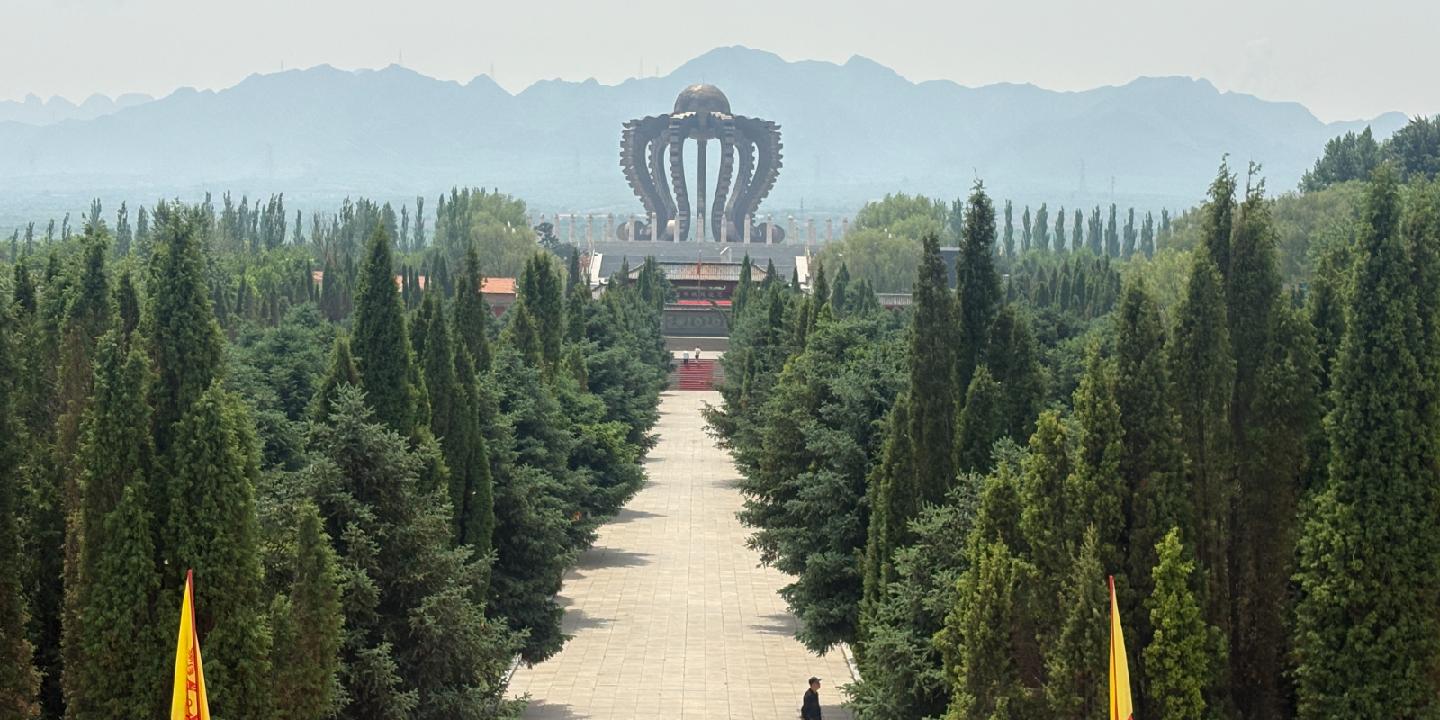
On Tuesday, May 19th, at the Huangdi City Ruins Scenic Area located in Fanshan Town, Zhuolu County, Hebei Province, there were three or three pairs of individual visitors entering. Most of the time, this scenic area appears quiet except for a lively elderly tour group. According to the staff of the scenic area, many overseas Chinese come to Huangdi City to worship every year.
The Huangdi City Site was discovered in 1957. After multiple rounds of archaeological excavations, it was listed as a key cultural relic protection unit in Hebei Province in 1993, classified as an ancient site. The Huangdi City Site, along with the Three Ancestral Halls (formerly Huangdi Temple), Hefu Altar, Huangdi Spring, Xuanyuan Lake, etc., together constitute the core landscape of the Huangdi City Scenic Area. In 2011, the scenic area was rated as a national AAAA level tourist attraction.
Since 2007, Dahua Group has been involved in the Huangdi City project, collaborating with the local government to create a Huangdi City characteristic town with an area of approximately 10 square kilometers based on the Huangdi City scenic area.
Du Donghui, the head of Dahua Group, told the Economic Observer that Dahua's cumulative investment has exceeded 1.8 billion yuan. Both the operation of Huangdi City scenic area and the construction of related supporting industries require continuous investment. Due to the large scale of heavy asset investment and low return on investment in the early stage, it is difficult to cover the cost of funds, putting pressure on the enterprise's funding chain and causing the entire project to fall into difficulties.
A person in charge of Huangdi City Scenic Area told Economic Observer that before 2020, the scenic area received about 100000 visitors per year, and currently receives about 60000 visitors per year.
Comparatively, according to official disclosures, on the day of the Ancestral Worship Ceremony on April 19, 2026, the Huangdi Hometown Scenic Area in Xinzheng, Henan Province received over 64000 visitors; Since April this year, the daily average passenger flow of Huangdi Mausoleum in Shaanxi has exceeded a thousand people.
Ambition
Take the Donghuayuan exit of the Beijing Tibet Expressway and drive westward along the Kangqi Highway for more than 40 kilometers to enter Fanshan Town, Zhuolu County.
Fanshan Town is located in the same small basin as Guanting Town and Sangyuan Town in Huailai County. On the east side is Guanting Reservoir, surrounded by mountains on the other three sides, and on the south side, the mountains connect with Lingshan Mountain in Mentougou, Beijing.
Huangdi City Scenic Area is located in the western part of Fanshan Town. The core area of the scenic spot is Xuanyuan Lake, with Sanzu Hall on the east side of the lake, Huangdi Spring, Zhuolu Museum, and Hefu Altar distributed in the southeast direction, and Huangdi City Site on the west side. It takes about an hour to fully tour the scenic area, and the ticket price is 70 yuan.
According to Du Donghui, in 2007, his father Du Yonglin was invited by the local government to visit Huangdi City. He was shocked by the 5000 year history and decided to invest after seeing the local resources of "One City (Huangdi City), One Lake (Xuanyuan Lake), and One Spring (Huangdi Spring)".
Dahua Group's main business is engineering consulting and has a certain technological accumulation in the field of new energy. When initially entering Huangdi City, the group had planned to lay out ice wine factories and elderly care centers, but the relevant procedures could not be advanced, and the business direction gradually shifted towards cultural and tourism development.
At the end of 2012, Dahua Group established Zhuolu Huangdi City Site Protection and Development Co., Ltd. In 2013, he signed a "Site City Wall Protection Agreement" with the local government and obtained the management rights of the Huangdi City Site City Wall. At that time, the core scenic area of Huangdi City was managed by the government.
Around Huangdi City, Dahua Group has planned Huangdi City Town, cultural and tourism supporting facilities, and related industrial systems.
The overall planned area of Huangdi City Town is about 10 square kilometers, mainly composed of two parts.
Part of it is the construction of new residential buildings, mainly used to replace local villagers' homesteads. The property rights of the new residential buildings belong to Dahua Group and will be provided to villagers for long-term free use; Villagers will hand over the right to use their original homestead to Dahua Group for unified development free of charge.
The other part is the dual villa area, which will be constructed in three phases, with a total of 381 villas planned, each with a large courtyard area.
According to Dahua Group's plan, with the opening of National Highway 109, the distance from the core urban area of Beijing to Huangdi City will be shortened to about 120 kilometers. These villas are mainly aimed at meeting the weekend vacation and holiday leisure needs of Beijing citizens.
In addition to property rights villas, Dahua Group also plans to transform the replaced villagers' homesteads into citizen farms or homestays, and provide them to residents in first and second tier cities such as Beijing in the form of leasing for short-term vacations.
Du Donghui introduced that more than 140 homesteads have been replaced so far.
Since 2014, Dahua Group has successively transferred over 7000 acres of arable land in Fanshan Town and surrounding towns in Zhuolu County, with plans to use it for planting and breeding, deep processing of agricultural and meat products, as well as tourism and vacation industries. The first, second, and third industries will be linked together to serve as supporting facilities for Huangdi City Scenic Area and Huangdi City Town.
In addition, Dahua Group has invested 450 million yuan to build Dahua Jianguo Hotel as a supporting hotel for the scenic area.
This hotel is the only five-star hotel in Zhuolu County, with a construction area of approximately 48000 square meters. It has nearly 400 guest rooms and 10 meeting rooms, with the largest meeting room accommodating six to seven hundred people.
In 2024, Du Yonglin passed away due to illness. He once envisioned achieving energy self-sufficiency for the entire Huangdi City project before his death: using photovoltaic solar energy to meet electricity supply, using biogas stations to supply gas, and then utilizing thermal storage equipment and related technologies to achieve heating self-sufficiency.
The change of the operating rights of Huangdi City Scenic Area is another important milestone for Dahua Group's deep involvement in the project.
According to the initial plan of the local government and Dahua Group, both parties established a joint venture to jointly operate the Huangdi City Scenic Area. The joint venture entity has been registered and established, but some of the funds owed by the local government to Dahua Group cannot be repaid. In 2023, the 20-year operating rights of Huangdi City Scenic Area will be transferred to Dahua Group in the form of debt repayment.
At this point, the pressure brought by high-intensity and heavy asset investment in the early stage is gradually emerging.
Predicament
The Huangdi City Site is about 500 meters long from north to south and 450 meters wide from east to west. The city wall is a rammed earth structure, and the soil layer contains relics from the Spring and Autumn and Warring States periods. Most of the city is currently farmland.
According to the staff of the scenic area, the Huangdi City site has undergone five archaeological excavations and belongs to a dating site. Currently, further archaeological excavations are no longer allowed.
Another staff member stated that among the many relics related to Huangdi, Huangdi City is one of the few sites supported by unearthed cultural relics, while others are mostly recorded in literature.
The Three Ancestral Halls were rebuilt on the site of the former Huangdi Temple in 1994, completed in 1996, and officially opened to the public in 1998. Nowadays, the ancestral worship ceremony in Huangdi City Scenic Area is mainly held in Sanzu Hall.
The area of the Hefu Altar is equivalent to that of Tiananmen Square, with a square square square structure and a circular main altar in the middle. The periphery is surrounded by 56 ethnic columns forming a circle.
The Huangdi City Site, Sanzu Hall, Hefu Altar, as well as attractions such as Xuanyuan Lake and Huangdi Spring, together constitute the main body of the Huangdi City Scenic Area.
The Huangdi City Film and Television Base, Dahua Jianguo Hotel, Huangdi City Town, as well as the hot spring soup houses, children's farms, sketching places, tree houses, Jiuqu Flower Street, Love Houses, cave restaurants, and other facilities distributed along the line, are the supporting facilities and extended formats of Huangdi City. Dahua Group once designed a cultural and tourism line about 15 kilometers long, connecting these supporting facilities and business formats.
Both the operation of scenic spots and the development of supporting facilities and related industries require continuous investment and maintenance. Due to the large scale of initial investment and relatively limited returns, Dahua Group's operations gradually became unable to make ends meet.
A person from Huangdi City Scenic Area believes that the scenic area has long lacked sufficient investment in publicity. Although it is relatively close to Beijing, many people living in Beijing are not familiar with the Huangdi City project. In addition, the format of scenic spots is relatively single. The IP of Huangdi has high recognition, but the actual operational effect of Huangdi City is significantly inferior to Huangdi's hometown and Huangdi Mausoleum.
Insufficient passenger flow and inability to support the operation of supporting facilities.
Taking Dahua Jianguo Hotel as an example, on May 19th, there were almost no guests entering or leaving the entire hotel. There are overgrown weeds in front of the villa style guest rooms in the back row of the hotel.
A hotel staff member explained that, except for large-scale events or film and television crews going abroad, the hotel has a high vacancy rate for most of the time and can only barely maintain a balance between income and expenses.
The characteristic town of Huangdi City is also facing a similar situation. More than 140 homesteads that have been replaced have mostly remained in their original state and have not been transformed into farms or homestays. There is no plan to proceed with the replacement of homesteads in the future.
The main framework of the second phase of the new residential building has been completed, but doors, windows, and decorative facades have not yet been installed, but it is currently in a state of suspension.
The more than 7000 acres of land previously transferred, except for a small amount used for planting and breeding, most of the land is idle, and some land is leased back to farmers for cultivation.
Du Donghui introduced that currently, planting and breeding products have gradually opened up markets in Beijing, which can supply organic vegetables, meat, eggs and other products to about 4500 households. The existing production capacity is slightly insufficient. If we expand the scale of planting and breeding, we still need a large amount of new investment, and the company currently does not have the ability to reinvest on a large scale.
Way Out
At present, Dahua Group needs to pay tens of millions of yuan in loan interest every year.
In Du Donghui's view, one important reason for the current predicament of the Huangdi City project is the mistakes made in several heavy asset investments in the early years. These investments not only consumed a large amount of cash flow, but also burdened the enterprise with nearly 400 million yuan in loans. He stated that Dahua Group has been conducting business with its own funds in the past, and the overall debt scale is not high.
In 2015, Dahua Group took over a technology park project for 300 million yuan, which is the only national level incubator in the area. At that time, the real estate market was still in an upward trend with good appreciation potential. But with the shift towards real estate, the project is located in a county town, and the actual operational effect is not ideal. The asset value has shrunk, and the current valuation is about 200 million yuan.
In 2018, the Hebei Tourism Development Conference was held in Huangdi City. Dahua Group invested 450 million yuan to build Dahua Jianguo Hotel and assisted the government in completing some infrastructure projects. During the construction of the hotel, Dahua Group borrowed 400 million yuan to meet the deadline.
Du Donghui stated that the two large investments mentioned above have consumed a significant amount of cash flow. These projects generally suffer from problems such as large investment scale, long return cycle, and limited benefit release.
In addition, Dahua Group also attempted to layout a circular energy system in Huangdi City to achieve the energy self-sufficiency goal envisioned by Du Yonglin before his death. Due to the fact that the system is still in the exploratory stage and the commercialization path is not yet mature, a large number of devices require customized investment, resulting in high initial costs. At the same time, the technical stability is insufficient, and continuous debugging is required during the later operation process, which continuously increases the operation and maintenance costs. As of now, this investment has not yet generated effective returns.
According to Du Donghui's calculation, the entire Huangdi City project still requires an additional nearly 600 million yuan in funding in the future. Among them, the construction of 1400 citizen farms requires about 392 million yuan, the construction of ski resorts requires 50 million yuan, the construction of the second phase of new residential buildings requires about 70 million yuan, the construction of infrastructure requires 50 million yuan, and the technology incubator still needs to add about 28 million yuan. If we only push for the project to restart, we will need at least 125 million yuan in funding in the short term.
Du Donghui proposed several ideas around revitalizing the project.
The first path is for the government or state-owned enterprises to take over the technology incubator project in order to recoup the initial start-up funds. In his opinion, as a national level incubator platform, technology incubators have limited collaborative value within the Dahua Group system, but still have certain industrial significance for local governments.
A local government official told the Economic Observer that the government also hopes to help Dahua Group overcome difficulties, but in reality, it also faces significant financial and execution pressures. Du Donghui also stated that local governments are doing their best to provide assistance in the daily operations of scenic spots and enterprises.
The second path is to sell some of the existing assets. Du Donghui stated that the valuation of Dahua Jianguo Hotel is about 450 million yuan, the remaining value of the twin villas is close to 300 million yuan, and the valuation of the Zhuolu Science and Technology Park incubator project is about 200 million yuan. If the above assets can be realized, not only can they repay bank loans, but they can also cover most of the subsequent construction funding gap.
The third path is to introduce partners. According to Du Donghui's calculation, the total assets of the Huangdi City project are currently about 1.8 billion yuan, and after deducting a loan of 400 million yuan, the net assets are about 1.4 billion yuan. If cash is raised through the transfer of some equity, and then the project is financed through shareholder loans, it is also possible to revitalize the project.
From the perspective of the entire Huangdi City project, the real core is still the operation of the Huangdi City scenic area. Only when the passenger flow in scenic spots increases and the scale of tourists expands, can hotels, towns, agricultural facilities, and related cultural and tourism industries form a linkage. This also means that the revitalization of the Huangdi City project is not only a financing issue, but also an operational issue.
In the live broadcast of the 2026 Haier Hope Primary School Children's Day Science and Technology Experience Day, Mei Feng, Chairman of the China Youth Foundation, praised Haier: cooperating with Haier for public welfare can be divided into three levels: public donation, resource linkage, and value co creation. Haier adheres to long termism and a sense of social responsibility, making public welfare projects more in-depth and effective.

CEO of Bangyao Biotechnology responds: has never been subject to regulatory interviews due to BD
Computing power leasing 'grabbing the beach' in 2026


 WeChat registration or login


 Subscribe