Economic Observer Follow
2026-05-22 18:31


Teng Binsheng, He Jianshi/Wen
In May 2026, Kim Yong beom, the head of the Policy Office of the South Korean Presidential Office, posted on social media, proposing the idea of a "citizen dividend" and advocating for the return of some of the excess tax revenue generated by the AI industry boom to the public. The background is that, influenced by the upward trend of the semiconductor cycle driven by AI, Samsung Electronics and SK Hynix are expected to form a considerable new tax source in the coming years, with a market estimate of about KRW 12 trillion (approximately USD 80.5 billion).
Behind this idea is a broader question: how to allocate the newly added benefits when AI significantly improves productivity and drives profit concentration to a few entities.
This debate is not only limited to the policy level, similar pressures have gradually emerged on both the employment and income ends: holders of capital, computing power, and core technologies benefit more, while some white-collar and newcomer groups bear greater pressure.
The Impact of AI Revolution on Employment
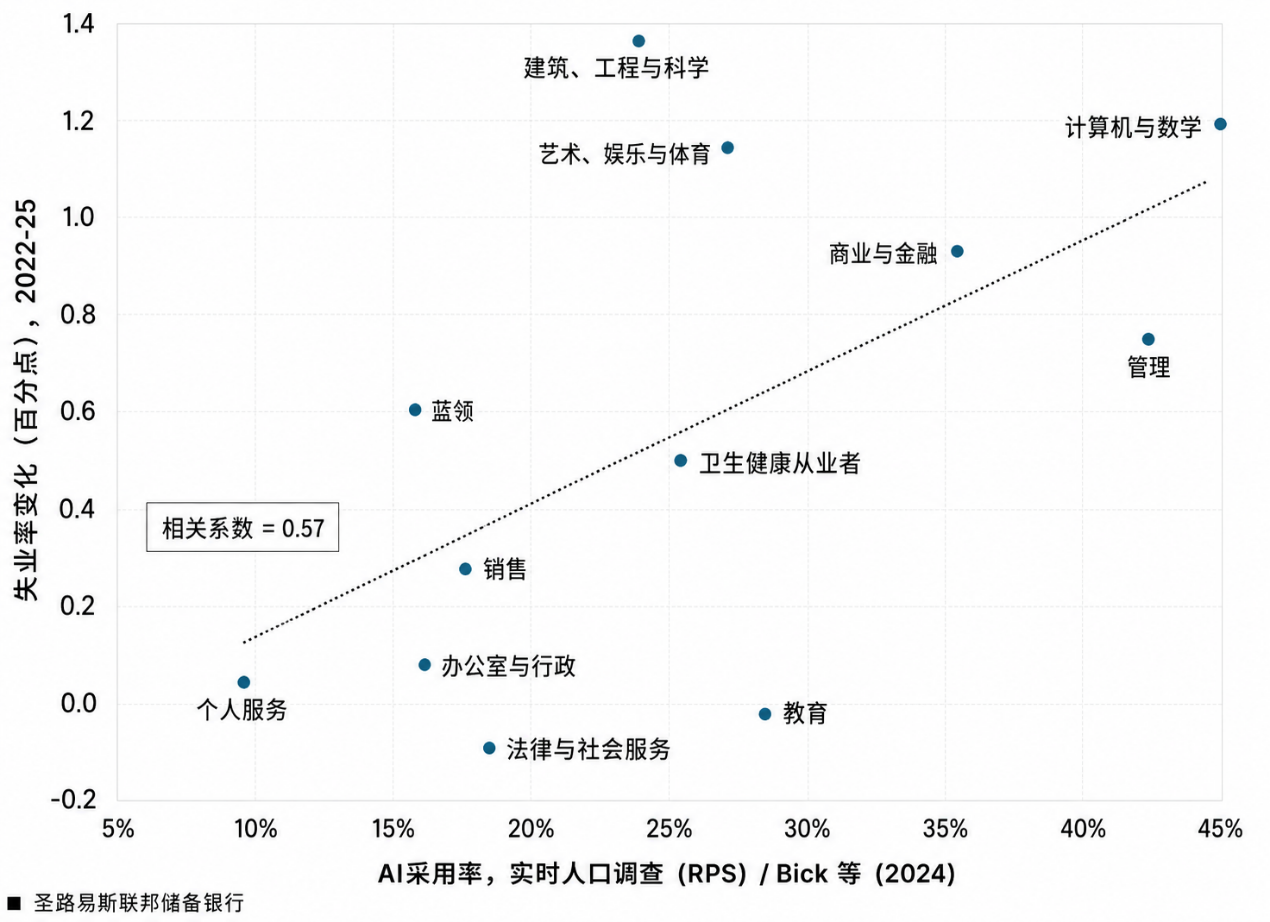
Unlike previous automation that mainly impacted physical labor and routine tasks, this round of AI is more widely entering cognitive and high skilled positions (Figure 1). The International Monetary Fund (IMF) estimated in its 2025 study that the proportion of jobs with high AI exposure is as high as 60% in developed economies, about 42% in emerging markets, and about 26% in low-income countries. The higher the income level, the greater the proportion of cognitive positions, and the more employment population exposed to AI.
Figure 1: The relationship between the unemployment rate changes of various professions from 2022 to 2025 and their AI adoption rates
AI is shaking the social structure that has been supported by white-collar middle-class workers for decades. In the past 30 years, globalization and informatization have created a large middle-class white-collar class: they are important carriers of consumption expansion, tax base, and middle voting groups, and also constitute the stable "middle waist" of the existing social contract.
When this round of AI first weakens the bargaining power and income expectations of this group, its impact is not limited to the labor market, but may also affect consumption structure, tax base, and social stability.
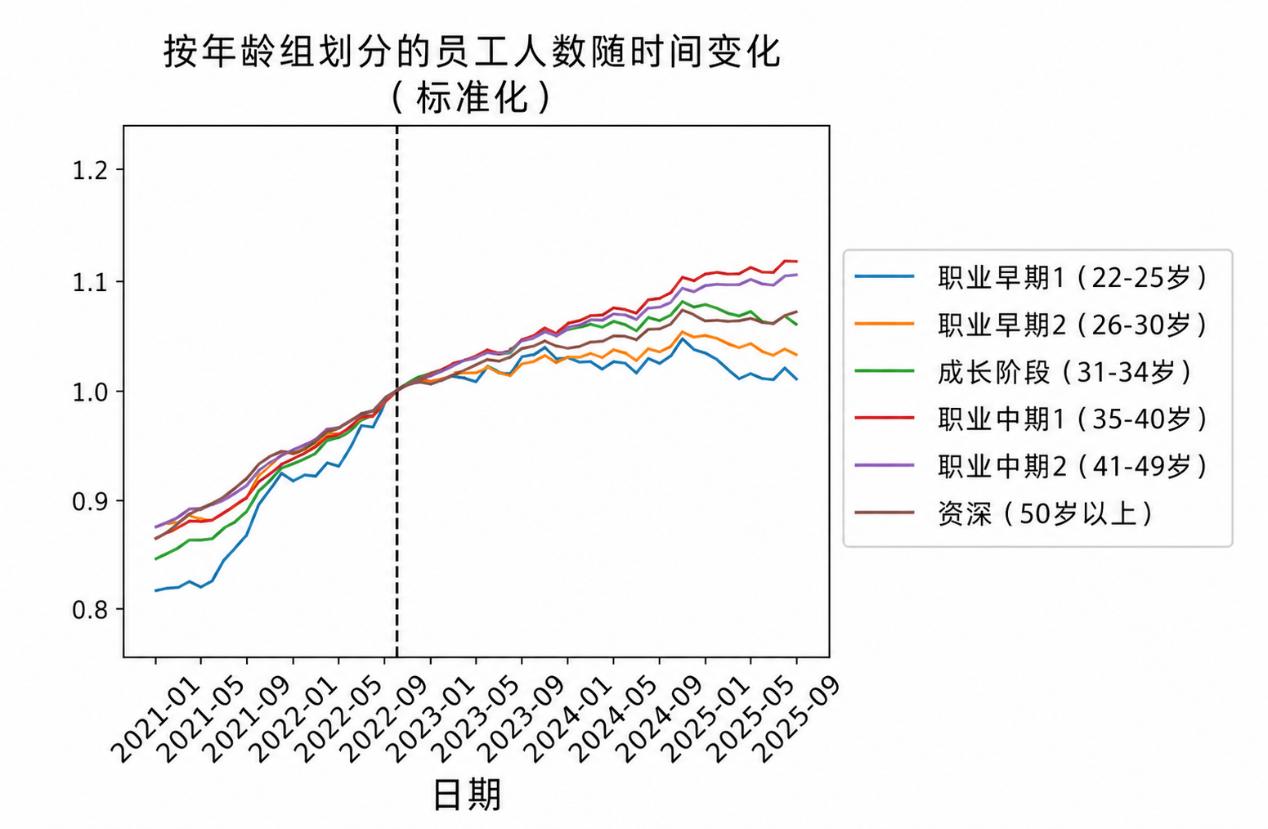
Researchers such as Erik Brynjolfsson, director of the Digital Economy Laboratory at Stanford University, found in their 2025 study that since the widespread spread of self generated AI (Figure 2), the employment of 22-25-year-old workers in high AI exposed occupations has experienced a relative decline of about 16%; Among them, the employment of software developers aged 22-25 has decreased by nearly 20% from the peak in mid-2022 by mid-2025.
Figure 2: Changes in employment index for employees of different age groups since the release of ChatGPT at the end of 2022. The curve representing early career 1 employees aged 22-25 showed the most significant cliff like decline, while the senior employee group remained relatively stable.
The reason is not difficult to understand, AI is currently best at doing the job of a newcomer in the workplace: writing basic code, drafting reports, researching, recording data, and answering routine customer service questions. In traditional workplaces, these miscellaneous tasks are a necessary step for newcomers to accumulate experience and move towards senior positions.
When AI can take over these basic tasks at a very low cost, the growth path of newcomers will be significantly impacted. If this situation continues, companies may find it increasingly difficult to find middle-level managers who can carry the weight, and the accumulation of experience within the team will also slow down in the coming years.
At the same time, there is also a clear differentiation within the white-collar group. According to an observation by The Wall Street Journal in May 2026, despite ongoing layoffs in the entire technology industry, the number of IT and computer science job openings in the United States still increased by 14.2% year-on-year in April 2026. However, the job structure has changed: the proportion of junior positions has decreased from 8.1% a year ago to 7.4%, while the proportion of senior positions has increased from 38.8% to 43.1%. Popular directions include senior engineers who can manage AI agent teams, AI operation and maintenance personnel, and solution engineers responsible for deploying AI to specific businesses.
In other words, senior practitioners who can handle AI and fill in its weaknesses are in high demand, while junior positions that focus on executing and standardizing tasks are rapidly being squeezed. This means that the impact of AI on employment is increasingly showing characteristics of intra occupational differentiation, rather than just simple substitution relationships between professions.
The Task Based Models proposed by MIT professor Daron Acemoglu can help us understand the above phenomenon: AI replaces not the entire profession, but specific tasks within the profession; The net change in employment depends on the competition between substitution effects, productivity effects, and recovery effects. He warned that once companies deploy AI only to save labor costs without investing in creating new tasks, the economy may fall into "mediocre automation": people will be laid off without significant productivity improvement, and there will not be enough new positions. This deployment method, which can only lay off personnel without creating new demand, is also one of the important mechanisms for the distribution pattern to passively tilt towards the capital side.
The AI revolution may shake wealth distribution and social structure
At present, the speed of job creation cannot keep up with the pace of substitution, and the concentration of new income to a few entities is obviously more worrying. Eric Blaine Johansson proposed a concept called the "Turing Trap". It refers to a tendency in AI research and deployment to aim for "imitating and completely replacing humans" rather than "expanding or enhancing human capabilities".
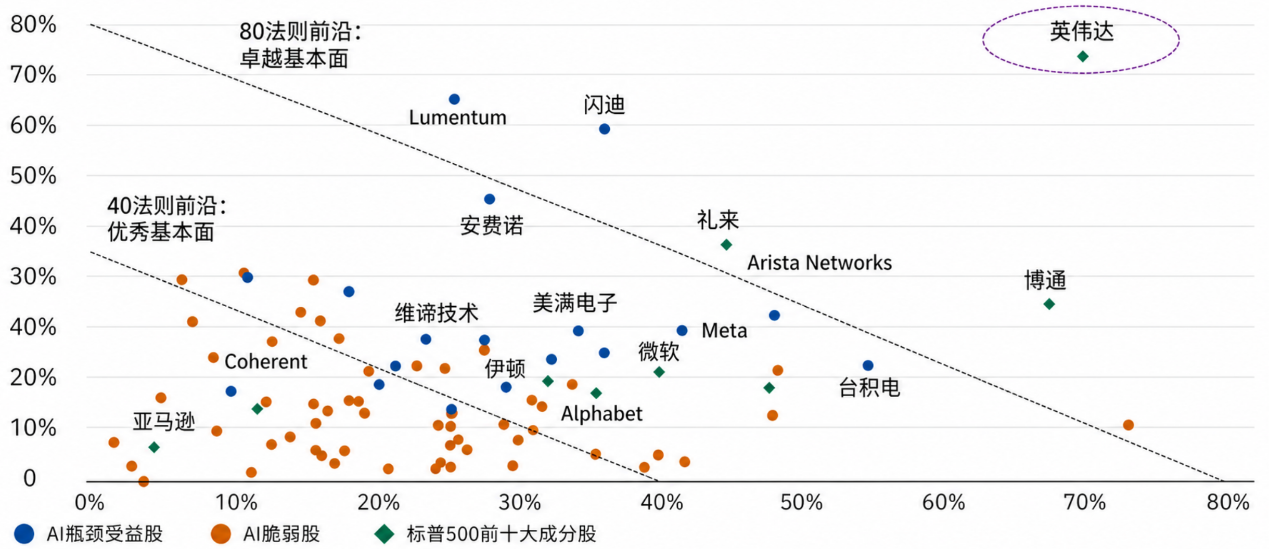
Eric Brian Yoffson has two main concerns about this. Firstly, if AI takes an alternative route, workers will become increasingly disadvantaged when negotiating with capital: replaceable labor will lose its scarcity, and wages and bargaining space will naturally narrow (Figure 3). Secondly, due to the high concentration of AI research and computing power in the hands of a few large platforms and capital, the money earned from this route will also be concentrated among a few owners (Figure 4). In his view, this is not an inevitable result of technology itself, but a joint choice of research and development incentives, tax arrangements, and public investment directions.
Figure 3: Workers who are unemployed due to technology spend longer searching for new jobs and experience a decrease in their actual wages after re employment
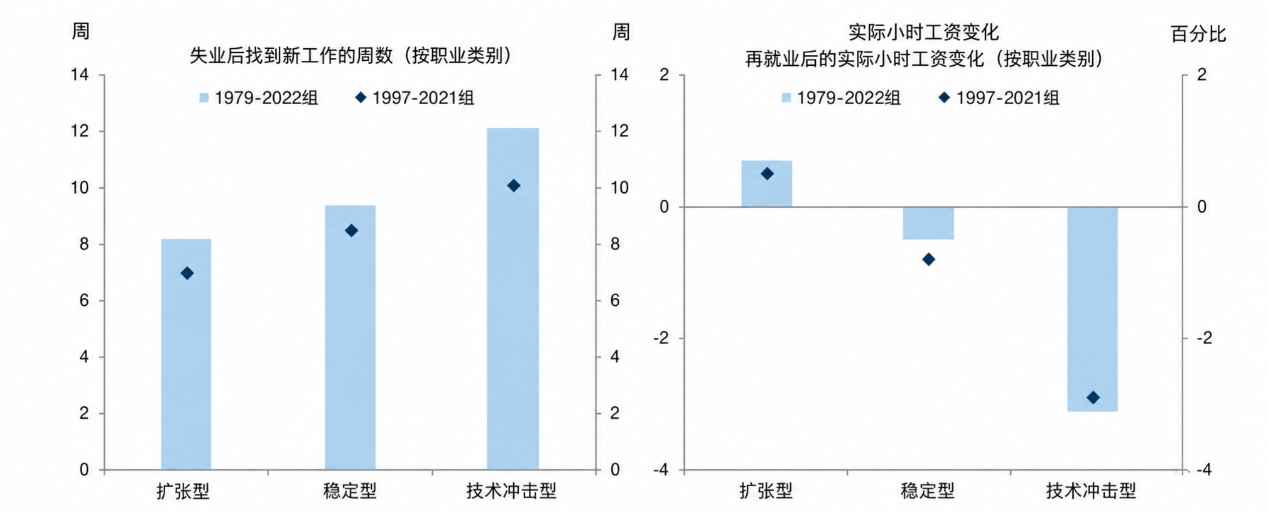
Figure 4: Strong fundamentals of AI beneficiaries (year-on-year revenue growth vs. adjusted operating profit margin)
The technological roadmap has never been "value neutral". Who invests in it, serves whom, and optimizes it towards what goals determines whose bargaining power it ultimately strengthens and weakens.
When the tax system accelerates the depreciation of capital investment and imposes social security and wage taxes on human employment, the rational choice of enterprises naturally tends to "replace humans with machines"; When public research and development funds mainly flow to a few cutting-edge model laboratories rather than enhanced tools for workers, technology naturally tends to concentrate.
In this sense, the 'Turing Trap' is not a technical issue, but an institutional issue. Without external intervention, the market will spontaneously steer general technology towards the direction of "replacing people" rather than "assisting people".
The opposite of the "Turing trap" is the path of "empowering the middle class" advocated by MIT economists David Autor and others. He proposed that if AI is deployed in an appropriate way, modularizing the knowledge of experts, allowing medium skilled workers to make more complex decisions, thereby expanding middle tier positions. AI has lowered the threshold for acquiring professional skills, giving people who were previously blocked by educational qualifications, experience, and resource barriers the opportunity to re-enter the competition for mid to high end positions.
The mechanism described by David Otto roughly has three layers: first, AI lowers the professional threshold, for example, junior nurses can use decision assistance systems to perform diagnostic screening that was previously undertaken by senior physicians; Secondly, AI expands its capability boundaries, such as product managers using low code and AI collaboration platforms to independently complete development that previously required the entire software team; Thirdly, AI makes "practical experience" valuable again, and the domain knowledge accumulated on the front line can be amplified into stronger outputs with the help of AI.
But achieving AI inclusiveness and equality requires two prerequisites. One prerequisite is whether the starting line is truly equal. Even if AI tools themselves are free or cheap, using AI still requires computing power, data, network environment, language ability, and basic scientific literacy, which are not evenly distributed. The actual threshold for whether developing countries and developed economies, cities and rural areas, and different age groups can use AI still varies greatly.
The second premise is whether the allocation mechanism of the "endpoint" is reasonable. Even if everyone can use AI equally, how the money earned from productivity improvement is distributed among workers, enterprises, platforms, and computing power providers depends on market structure and institutional arrangements. In a situation where computing power and basic models are highly concentrated on a few large platforms, the money earned by "using AI" is far less than the money earned by "owning AI".
Overall, 'empowering the middle class' is a possibility, not an automatic outcome. Whether it can be achieved depends on a complete set of supporting measures such as anti-monopoly policies, public computing power supply, skills retraining system, and tax redistribution. If these supporting facilities are missing, the phrase 'running on the same track' is more of an emotional comfort, and it is difficult to truly change the distribution pattern.
A 2025 IMF model using UK microdata as a sample provides a counterintuitive conclusion: the wage Gini coefficient is expected to decrease by about 3.91 percentage points (high earners' tasks are largely replaced, while low earners benefit from productivity gains); The Gini coefficient of wealth is expected to increase by about 13.67 percentage points.
The logic is roughly as follows: the exposure of AI to high paying white-collar tasks (about 60%) is much higher than that of low paying positions (about 15%), so the wage premium of top-level white-collar workers is compressed, and the wage gap is actually narrowed. At the same time, the efficiency dividend brought by AI mainly accumulates in capital returns, concentrated in the hands of those who hold semiconductor equity, platform equity, and computing power assets. Even if the wage gap narrows, it is difficult for ordinary working-class people to receive this portion of money. The ultimate result is a slight narrowing of the wage gap and a significant widening of the wealth gap.
In a society, if the wage gap narrows slightly but asset prices diverge rapidly, an improvement in the Gini coefficient on paper does not necessarily mean that everyone truly feels that fairness has been improved.
The modern distribution system since the second half of the 20th century mainly involves secondary distribution of labor income through wage taxes, progressive income taxes, and social insurance; However, the ability to redistribute capital income, especially stock appreciation, unrealized capital gains, and platform ownership returns, has always been relatively weak.
AI has amplified the concentration of capital returns, and the direction of future distribution system reform is to fill the long missing institutional link of "capital return redistribution".
If the Turing trap scenario dominates, the primary risk facing society is further narrowing of the channels for social mobility. There are already two paths mentioned earlier: one is that the "junior job gap" makes it difficult for young people to enter the workplace; The second is the further decoupling of capital returns and labor returns. The combination of the two may give rise to the "permanent bottom" phenomenon that some researchers are concerned about, where some workers are unable to re-enter the mainstream economic system for a long time and can only rely on transfer payments to maintain their basic livelihood.
This risk is currently more of a trend judgment rather than a fact. The World Economic Forum's (WEF) survey of corporate executives provides noteworthy side evidence: 54% of executives expect AI to replace a large number of existing positions, while only 24% believe AI will create a large number of new positions; 44.6% of people believe that AI can improve profit margins, while only 12.1% believe that AI will bring higher wages.
The above risks will eventually return to the education system. When AI can complete a considerable portion of knowledge-based tasks at a very low cost, the traditional education model centered on imparting knowledge is facing redesign. Two of these issues are particularly noteworthy.
One is the problem of "cognitive debt": if students overly rely on AI to complete their thinking, it may affect their development of independent judgment ability in the long run. The second issue is the disconnect between skills and job positions: the matching degree between university majors and actual employment needs is being redefined by AI, and popular majors from the past few years may soon no longer be popular.
A related discussion direction is whether future education should focus more on abilities that AI cannot replace, such as complex judgment, interdisciplinary integration, interpersonal collaboration, and moral decision-making. Some universities have started to experiment, but systematic reforms are still in their early stages.
How does the system respond
In the face of the distribution changes brought by AI, policy responses can be summarized into three categories: incentives, buffers, and allocations. The former determines the direction of technology, the middle provides transitional protection, and the latter determines whether dividends can flow back into society.
Firstly, on the incentive side: guide AI towards "enhancing people" rather than "replacing people". The specific measures include: adjusting the R&D tax credit, encouraging more "enhanced" AI, and rewarding less "pure substitute" AI; Provide public computing power to lower the usage barriers for small and medium-sized enterprises, universities, and ordinary workers; Strengthen anti-monopoly and interoperability to prevent computing power, data, and models from being monopolized by a few platforms; Retain the entrance for junior positions and provide tax support to companies that hire fresh graduates and junior employees.
On the buffer side: provide a safety pad for the impacted person. The specific measures include: expanding retraining to enable workers to transition from old positions to new positions; Pilot shorter working hours, if productivity improves, should explore sharing benefits with shorter working hours; Expand social security coverage and include flexible employment and platform workers in basic security.
On the distribution side: making the dividends of AI more widely accessible to all. The specific approach includes: redesigning the tax base, gradually shifting the tax base from labor to capital and consumption; Explore AI/computing power/excess profit tax to enable excess returns to bear more public responsibility; Promote citizen dividends or UBI (Universal Basic Income), converting some excess tax revenue into benefits that can be shared by the entire population; Developing sovereign funds and public shareholding, allowing society to share capital returns as a 'common owner'; Explore shared ownership and promote public participation in critical computing infrastructure and public platforms.
The pace of action is equally crucial. The Economist's May 2026 editorial suggests that before the true large-scale impact of AI becomes apparent, tools such as tax base adjustment, wage insurance, and retraining should be prepared first. About 70% of American respondents believe that AI will make it harder to find jobs in the future, and nearly one-third are worried about losing their jobs as a result. This emotion itself indicates that policies cannot wait until the problem fully erupts before taking action.
WEF estimates that by 2030, over 40% of core skills in the global workforce will undergo changes, and the demand for skills related to "AI and big data" will rapidly increase in the past year or two. This means that regardless of the type of policy adopted, large-scale and sustained retraining is an essential foundation project that cannot be avoided.
It should be emphasized that the above three types of tools are not a "one out of three" relationship, but require collaborative configuration. Ultimately, AI may not necessarily lead to more severe inequality, but without institutional response, it is highly likely to further amplify existing distribution imbalances and lock in more technological dividends in the hands of a few capital and platform owners. The key lies in whether the three tools of incentives, buffering, and distribution can be coordinated and configured as soon as possible, while maintaining innovation vitality, preserving upward mobility for workers, and allowing technological dividends to flow back into society more widely.
(Teng Binsheng, Professor of Strategic Studies and Vice Dean of Strategic Research at Changjiang Business School, Director of the Global Ecosystem Research Center for New Generation Unicorns, and He Jianshi, Researcher at the Global Ecosystem Research Center for New Generation Unicorns at Changjiang Business School)

In the live broadcast of the 2026 Haier Hope Primary School Children's Day Science and Technology Experience Day, Mei Feng, Chairman of the China Youth Foundation, praised Haier: cooperating with Haier for public welfare can be divided into three levels: public donation, resource linkage, and value co creation. Haier adheres to long termism and a sense of social responsibility, making public welfare projects more in-depth and effective.

CEO of Bangyao Biotechnology responds: has never been subject to regulatory interviews due to BD

Computing power leasing 'grabbing the beach' in 2026


 WeChat registration or login