Economic Observer Follow
2026-05-18 21:05


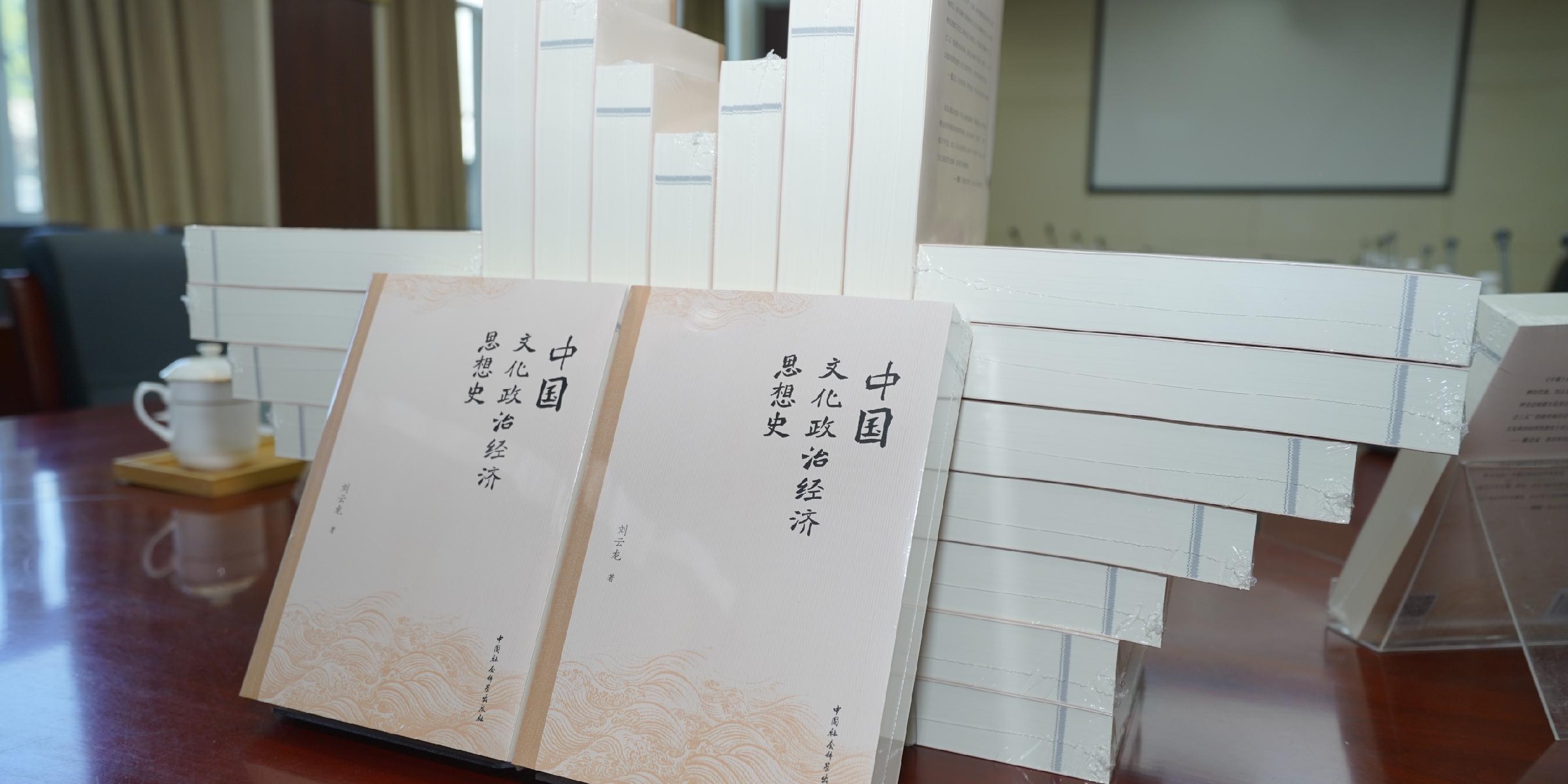
At the seminar on the new book "History of Chinese Culture, Politics, Economy, and Thought" held in Beijing on May 10, 2026, Liu Yunlong, Dean of the Institute of Pension Finance at Beijing Technology and Business University, stated that historical changes are like walking freely with people, with benevolence and righteousness as virtues (ideals) and intelligence and courage as strengths (realities). Virtue and strength are the two legs of a human being.
The core concept of "The History of Chinese Cultural, Political, and Economic Thought" is "wisdom, benevolence, and courage". Liu Yunlong creatively combines the three virtues of "wisdom, benevolence, and courage" in the Doctrine of the Mean with the "Three Meanings of Changes" (not easy, simple, and changeable) in the Book of Changes to construct an ontological historical philosophy. He hopes that the book will not only become an encyclopedia for interpreting the interrelationships between ancient Chinese culture, politics, and economy, but also provide important academic nourishment and ideological references for the construction of China's independent knowledge system, exploration of the development of humanities and economics, revival of classical academic traditions, and promotion of the "second combination".
This economist, who once studied under professors Fan Gang and Song Tao, is more well-known in the financial circle as a researcher in the field of Chinese pension finance. He has participated in the shareholding reform of China Life Insurance Company and the listing work in Hong Kong and New York. He also participated in policy research and institutional design for the development of enterprise annuity funds under the former Ministry of Labor and Social Security.
Around 2010, while studying Chinese elderly care culture, Liu Yunlong was shocked by the elderly care governance ideas proposed by Mencius during the Warring States period. He then sorted out the national governance ideas of filial piety, virtue, and ritual in the Han, Wei, and Jin dynasties, and deeply felt the weight of cultural history. He also shifted from economic research to cultural research, advocating for cultural political economy. In 2021, "Cultural Political Economy" (over 400000 words) was published; In 2026, the "History of Chinese Cultural, Political, Economic and Ideological Thought" (over 600000 words) with a greater emphasis on historical philosophy will be published.
How does Liu Yunlong's research philosophy integrate China's thousands of years of thought, culture, political changes, and socio-economic development? The Economic Observer reporter had a conversation with him.
Economic Observer: What processes or unforgettable experiences have you had in academic research?
Liu Yunlong:Most scholars are based in universities or research institutions, starting from existing academic theories, using theory to guide practice, and taking academia as their life. The important difference between me and them is that I am based in financial institutions and develop academic theories based on local social practices in China. I take life as my knowledge.
In 1971, I was born on the banks of the Gan River in Jiangxi Province and grew up in the mountains of Hunan. The family school atmosphere, which inherited Hunan culture and spirit, was strong and had a profound and subtle influence on me, which was beneficial for my later understanding of culture and history. In 1988, he was admitted to Shaoyang Teachers College to study political science; After graduating in 1990, he taught at the only rural key high school in Hunan Province (Shaodong No.3 Middle School); In 1992, I was admitted to Central South University of Finance and Economics to pursue a master's degree in political economy; In 1995, he was admitted to the Graduate School of the Chinese Academy of Social Sciences to pursue a doctoral degree in economics.
My unique family background and diverse academic background represent my historicity, while China Life Insurance represents my realism. My creativity is based on my historicity and realism, which help me integrate culture, politics, and economy, develop a cultural political economy perspective that integrates cultural studies, history, political science, and economics, and establish my knowledge theory, understand cultural theory, and develop ontology.
When I entered Shaoyang Teachers College, I aspired to take the postgraduate entrance examination. At that time, the economics major required taking advanced mathematics. I came from a humanities background and had a weak foundation in mathematics. However, knowing that there were tigers in the mountains, I chose to face the difficulties and self-study the "Lectures on Advanced Mathematics". Receiving training in advanced mathematics was very important for my future graduate and doctoral studies. Today, my cultivation of philosophical thinking ability begins with advanced mathematics.
In 1995, I entered the Graduate School of the Chinese Academy of Social Sciences to pursue a doctoral degree under the guidance of economist Professor Fan Gang. Teacher Fan prepared a box of books for me and Zhang Xiaojing (currently the director of the National Finance and Development Laboratory of the Chinese Academy of Social Sciences). Every time we go back and forth to the teacher's house, it is filled with a box full of English works. At that time, my feelings towards modern economics were not as good as Zhang Xiaojing's. Every time I returned the book, I was particularly afraid that Teacher Fan would ask for details, and I would often put down my chopsticks before I had eaten enough. My special opportunity lies in having a highly respected external doctoral supervisor, Professor Song Tao from the Department of Economics at Renmin University of China. Teacher Song is an important founder of Marxist political economy in New China. Through his personal actions, I have come to understand the true spirit and flavor of Marxist political economy.
After graduating as a doctoral student in 1998, I joined China Life Insurance Company. Learning while working, learning by doing. I completed two postdoctoral studies in applied economics from 1998 to 2003.
Economic Observer: How did you shift from economic research to historical and philosophical research?
Liu Yunlong:When I joined China Life Insurance Company, I first worked in the Policy Research Department and soon moved to the Group Insurance Business Department, while also conducting postdoctoral research while working. My first postdoctoral collaborator was renowned financial scientist Professor Wu Junpei, during which I conducted systematic research on private pension plans in the United States. In 2002, the academic paper "Development of Chinese Enterprise Annuities and Tax Benefit Policy Support" was published, which was the first academic paper in China to study the development of Chinese enterprise annuities from the perspective of fiscal and tax policies.In 2004, the book "Enterprise Annuity: Model Exploration and International Comparison" was published, which was the first academic work in China to study the pension system from the perspective of pension finance.
Around 2002, I applied for a postdoctoral position at the Institute of Finance, Chinese Academy of Social Sciences. My co supervisor was Professor Li Yang, who was then the director of the Institute and later the vice president of the Chinese Academy of Social Sciences. The title of my postdoctoral exit report is "Development of Pension Funds and Changes in Financial Structure", which marks the formation of my theory of "Pension Finance".
Around 2010, while studying Chinese elderly care culture, I was shocked by the concept of elderly care governance proposed by Mencius during the Warring States period, and deeply felt the weight of cultural history. At the same time, I conducted in-depth observations on three aspects of China's socio-economic development: firstly, corporate management and public decision-making rely more on European and American experience, and less on cultural history, making it difficult to see differences and creativity. The second is the widespread transplantation of systems in the political and economic fields, with few institutional creations. The desire for profit is rampant and pervasive, and institutional arrangements are nominal but not tangible. Thirdly, economic research is far from the real world, with insufficient attention paid to major social issues such as population structure, pension structure, financial structure, and economic structure. There is a lack of foresight and insightful perspectives. So, I shifted from economic research to cultural research, advocating for cultural political economy.
Economic Observer: What are the core logical changes between "Cultural Political Economy" and "History of Chinese Cultural Political Economic Thought"?
Liu Yunlong:Cultural Political Economy focuses on economic philosophy, while History of Chinese Cultural Political and Economic Thought emphasizes historical philosophy and cultural philosophy.
The characteristics of the economic philosophy in "Cultural Political Economy" are: from a structural perspective to a holistic perspective, based on structure, and understanding the whole; From a spatial perspective to a temporal perspective, based on space and connected to time; From epistemology to ontology, based on reason and understanding virtue. I simplify the complex interactive relationship between culture, politics, and economy as follows: culture shapes politics and regulates power; Politically leading the economy and regulating capital; Economic development culture, moderation culture.
Writing 'Cultural Political Economy' reflects my strong sense of crisis. In my opinion, power+capital+cultural expansion=war, wisdom and courage to seize benevolence+injury benevolence+harm benevolence=war.
The History of Chinese Cultural, Political, and Economic Thought is based on ontological philosophy and conducts a general historical study of the changes in ancient Chinese economic thought. It highlights four types of changes in cultural, political, cultural, and economic thought, and highlights the perspective of cultural, political, and economic economics as representing the path of moderation and harmony, which can achieve eternal peace. I believe that the subject of historical change lies in people and cultural spirit. The spirit of "wisdom, benevolence, and courage" can connect history, reality, and future, as well as culture, politics, and economy. The generation of institutions lies in the institutional virtue of "unanimous agreement", and the "institutionalist" has the "heart of connecting the world" and the "heart of serving the world".
I divide the historical changes in ancient China into seven cultural, political, and economic cycles based on the philosophy of ontological history. Relatively speaking, the Song Dynasty is not as good as the Han Dynasty, and the Han Dynasty is not as good as the Tang Dynasty. This is because the Han Dynasty emphasized intelligence and courage, while the Song Dynasty emphasized benevolence and virtue. The prosperous Tang Dynasty had a strong spirit of "intelligence, benevolence, and courage". In my opinion, ethnicity is a name, culture is a name, schools of thought are names, and cultural spirit is reality.
The great rejuvenation of the Chinese nation first lies in the great rejuvenation of cultural spirit, with abundant "wisdom, benevolence, and courage", and the promotion of benevolence through wisdom and courage; Secondly, it lies in the great revival of cultural, political, and economic ideas, where culture is powerful, government is proactive, and the market is efficient; Once again, it lies in the great revival of ontological philosophical thought, which aims to achieve benevolence through sincerity, use benevolence through sincerity, and uphold the principle of "respecting life and protecting harmony", moving from a management order to a free order. The practical policy direction of this book is to construct an idealized social and economic development paradigm: culture is powerful, government is proactive, and market is efficient.


Lantu imitates Zero Run and leverages Stellantis to expand into the European market
The dust of the "BAIC" dispute has settled, and the Beijing Intellectual Property Court upheld the original judgment in the second instance that BAIC Group won the lawsuit. Beijing Automotive Manufacturing Plant cannot continue to be referred to as "BAIC"
The 2026 World Drone Conference is about to open in Shenzhen, with 400 companies showcasing 3000 drones


 WeChat registration or login


 Subscribe