Economic Observer Follow
2026-05-18 20:33



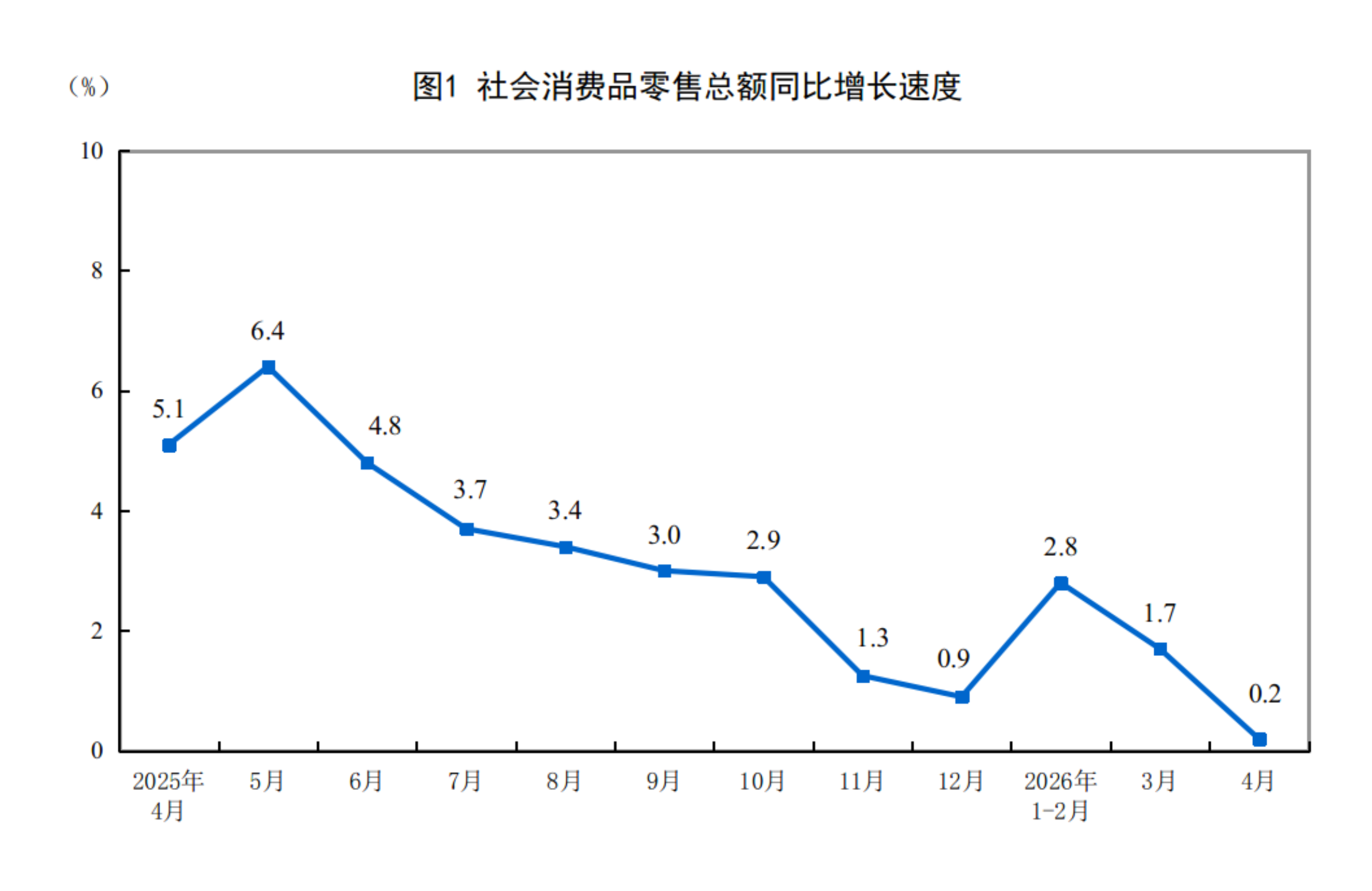
On May 18th, the National Bureau of Statistics released data showing that from January to April 2026, the total retail sales of consumer goods (referred to as "social retail") increased by 1.9% year-on-year. Among them, the year-on-year growth of social zero in April was 0.2%, the lowest since 2023.
In 2022, the year-on-year growth rate of Social Zero experienced negative growth for several months, but in January and February 2023, the growth rate rebounded to 3.5%. From then until December 2025, the growth rate has remained at 2% or above. Entering 2026, the year-on-year growth rate of social zero shows a downward trend (as shown in the figure below).
At the press conference on the day of the data release, Fu Linghui, spokesperson for the National Bureau of Statistics, stated that in April, the growth rate of retail sales of goods slowed down due to factors such as a relatively high base compared to the same period last year. However, based on the overall situation of retail sales of goods and services, the trend of stable growth in consumption has not changed. The growth of retail sales of services has accelerated, and the growth of retail sales of some upgraded goods has been relatively fast, while the development of new consumption has grown stronger.
Zhang Lin, Vice President of Far East Credit Research Institute, stated that the continuous weakening of automobile consumption is the most direct drag on the sustained decline in consumption growth this year. Automobiles have a relatively high weight in the social retail market, with a significant decline in automotive retail sales in April and a significant single drag effect. This trend had already emerged in March and continued in April; Secondly, the post cycle related categories of real estate are generally under pressure. Real estate sales, prices, and new construction continue to fluctuate in the negative range, and the wealth shrinkage effect continues to suppress residential related consumption such as furniture, home appliances, and building materials. These categories all recorded significant year-on-year declines in the first four months; Thirdly, the marginal pull of policies such as trade in has declined. Last year, household appliances and other categories performed well under the pulse of subsidy policies, forming a relatively high base. However, although the policies have continued this year, it is difficult to replicate the short-term stimulus effect of last year in terms of coverage and funding rhythm. Coupled with the high base, the growth rate of durable goods naturally declined.
In addition, Zhang Lin mentioned that the nominal disposable income growth rate of residents in the first quarter was about 4.9%, which is at a relatively low level. Consumer confidence is still running at a low level, marginal propensity to consume has not significantly improved, and residents' willingness to leverage is clearly insufficient. The core constraint of current weak consumption is more reflected in the uncertainty of long-term income capacity and long-term income expectations, which makes residents more cautious in making large-scale consumption decisions.
According to the location of the operating units, there has been a significant difference in the growth trend of urban and rural consumption this year. In January and February 2026, the retail sales of consumer goods in urban areas increased by 2.7% year-on-year, only 0.1 percentage points lower than the national average. In March, it dropped to 1.5%, and in April, it further declined to -0.1%. In contrast, the retail sales of consumer goods in rural areas increased by 2.1% year-on-year in April.
Yuan Yan, Chief Statistician of the Trade and Economic Department of the National Bureau of Statistics, explained in an article that since the beginning of this year, with the continuous improvement of supply and demand adaptation in the rural consumer market, the consumption potential of the rural market has continued to be released. From January to April, the retail sales of consumer goods in rural areas increased by 2.8% year-on-year, with a growth rate 1 percentage point higher than that in urban areas. Various commercial and trade circulation methods have increased their penetration and innovation in county and township markets, continuously stimulating market vitality and potential. The retail sales of consumer goods in counties and townships, including towns and rural areas, account for 39.7% of the total retail sales of consumer goods in society, an increase of 0.3 percentage points from the same period last year.
Under the fluctuation of zero growth rate in the first four months of the year, looking ahead to consumption in 2026, Fu Linghui stated that there are still some constraints to expanding consumption, and residents' consumption ability and willingness need to be further enhanced. Market supply cannot fully meet the needs of residents' consumption upgrading. In the next stage, we need to implement the special action to boost consumption, strengthen stable employment and increase income, continuously expand the supply of high-quality goods and services, improve the consumption environment, better unleash consumption potential, and promote sustained and healthy economic development and improvement of people's livelihoods.
Zhang Liqun, a researcher of the Macroeconomic Research Department of the Development Research Center of the State Council, said that the social sector had a zero year-on-year growth of 0.2% in April, and the national fixed assets investment had a year-on-year decline of 1.6% from January to April, which indicates that the situation of strong supply and weak demand is still further developing, and this issue must be highly valued. Next, it is necessary to initiate large-scale government investment in public goods, which will significantly increase market demand through a significant expansion of government spending.
Zhang Lin stated that in the short term, the pattern of weak consumer recovery and structural differentiation is likely to continue, but the risk of a significant sharp decline is not high. Consumption growth is a slow and lagging variable in economic operation, and it relies more on the improvement of consumption ability and willingness of low - and middle-income groups. Promoting consumption is an important lever for promoting economic structural adjustment, but it is also a major challenge. Currently, service consumption and online new business forms are growing rapidly, but offline bulk optional consumption is continuously under pressure from the dual constraints of real estate and expectations. This structural differentiation indicates that in the process of transforming residents' consumption structure, the policy space relying solely on durable goods subsidies is becoming increasingly limited. On the one hand, it is necessary to accelerate the alleviation of the wealth shrinkage effect caused by the continuous decline in housing prices, and on the other hand, it is necessary to continue to shift the policy focus to the upstream direction of stabilizing employment, increasing income, expanding services, and forming consumption ability and willingness


 WeChat registration or login


 Subscribe