Economic Observer Follow
2026-11-21 14:00

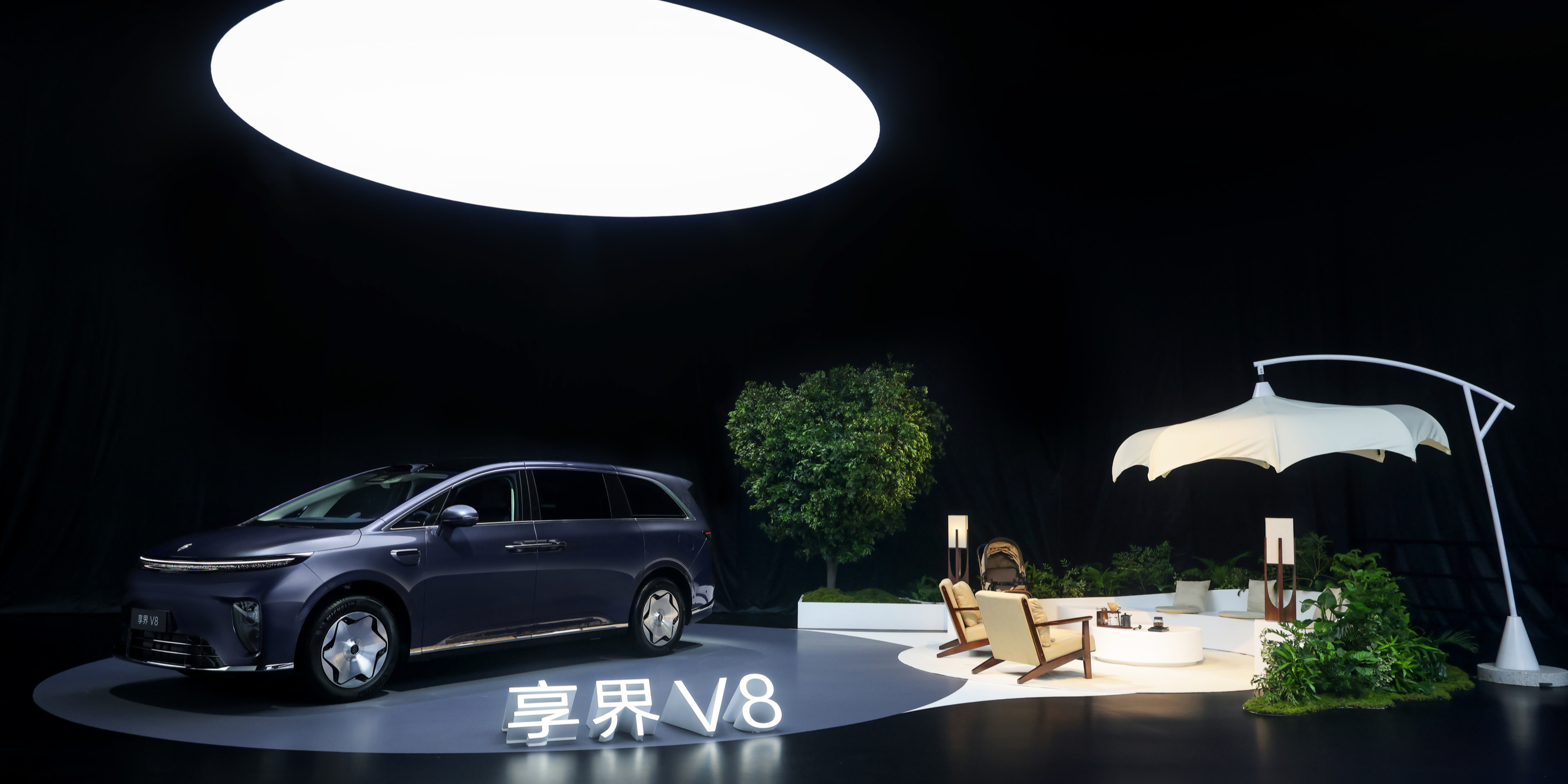
After the arrival of L3 in the future, there will be no need to touch the steering wheel while driving. You can sleep while driving, just don't fall asleep. ”On November 20th, Yu Chengdong, Executive Director of Huawei, Director of the Product Investment Review Committee, and Chairman of Terminal BG, said at the Hongmeng Zhixing Xiangjie V8 press conference.
On the same day, the Xiangjie V8 was officially launched with a suggested retail price of 319800 to 429800 yuan, offering both pure electric and extended range dual power options, positioned as a large family MPV. The Xiangjie V8 also announced the launch of the first 120km/h L3 autonomous driving cross city highway test, which is also the first cross city L3 test project in the MPV category.
The Xiangjie V8 Ultra and Ultra+are equipped with Huawei Qiankun Intelligent Driving ADS 5, using a four laser radar solution with 896 line dual optical path image level LiDAR. The total number of sensors in the vehicle is 38, and the hardware is designed according to the L3 level autonomous driving architecture (L3 function has not yet been commercially opened).
Hongmeng Zhixing is playing the L3 card with the help of Xiangjie, and an important background is that BAIC is one of the first domestic car companies to obtain conditional access to L3.
In December 2025, the Ministry of Industry and Information Technology conditionally granted access to two L3 conditional autonomous driving products, one from Changan Shenlan and the other from BAIC's Arctic Fox Alpha S (L3 version). This means that before the launch of the Xiangjie V8, the BAIC system had already completed the first complete process of L3 product application and admission. The L3 architecture design of Xiangjie V8 can rely on BAIC's accumulated admission experience.
In October 2026, Guo Shougang, Director of the Equipment Industry Department of the Ministry of Industry and Information Technology, stated at the 2026 World Intelligent Connected Vehicle Conference that the second batch of pilot admission work is underway. According to the current pilot operation rules, the first batch of L3 usage scenarios are limited to closed road sections and single lane areas without pedestrian traffic. Ordinary consumers generally need to make an appointment to experience it, rather than activating it directly after purchase.
In July 2026, the mandatory national standard Safety Requirements for auto drive system of Intelligent Connected Vehicles (GB 44721-2026) was approved and issued, which is applicable to M and N vehicles equipped with L3 and L4 auto drive system and is intended to be officially implemented on July 1, 2027.
In other words, when the Xiangjie V8 is delivered to users, it is equipped with a set of hardware redundancy designed for L3 architecture, covering eight dimensions of perception, computing, communication, braking, steering, power distribution, positioning, and interaction with full link redundancy. However, whether L3 functions can truly be "out of hand" in the hands of users depends not only on waiting for the strong standard to be implemented, but also on the entire set of regulations and regulatory rhythms such as subsequent pilot projects and road access. Yu Chengdong's statement of 'being able to sleep' describes the scenario after the full implementation of L3 regulations and supporting systems in the future, rather than the current delivery version capability.
The L3 slot of the Xiangjie V8 is also an upgrade to the cooperation model between Huawei and BAIC. On the day of the press conference, Huawei and BAIC announced the upgrading of their strategic community, increased strategic investment, and the upgrading of their four major systems: technology products, dedicated teams, quality assurance, and service experience. Prior to this, Zhang Jianyong, Chairman of BAIC Group, had led a team to Shenzhen for talks with Huawei founder Ren Zhengfei, and both sides agreed to "continuously increase investment in the Xiangjie brand around user experience".
The MPV market entered by the Xiangjie V8 is not empty. In October 2026, Weipai Gaoshan, Lantu Dreamer, Buick GL8 PHEV, Tengshi D9, and Ideal MEGA will be among the top sellers of new energy MPVs. The Xiangjie V8 aims to compete for home users in the price range of 300000 to 450000 yuan who require both large space and willingness to pay for intelligence.
From the perspective of market performance, the L3 label of Xiangjie V8 is expected to help HarmonyOS establish a technologically advanced user perception in the short term. More noteworthy is whether the L3 function of Xiangjie V8 can be stably delivered in the first batch of open individual user scenarios after the full implementation of L3 related regulations, and whether BAIC, as the main body of experience accumulation in admission, can effectively transfer the pilot operation experience accumulated in the Jihu project to Xiangjie's user service system.



 Subscribe