Economic Observer Follow
2026-11-21 13:59

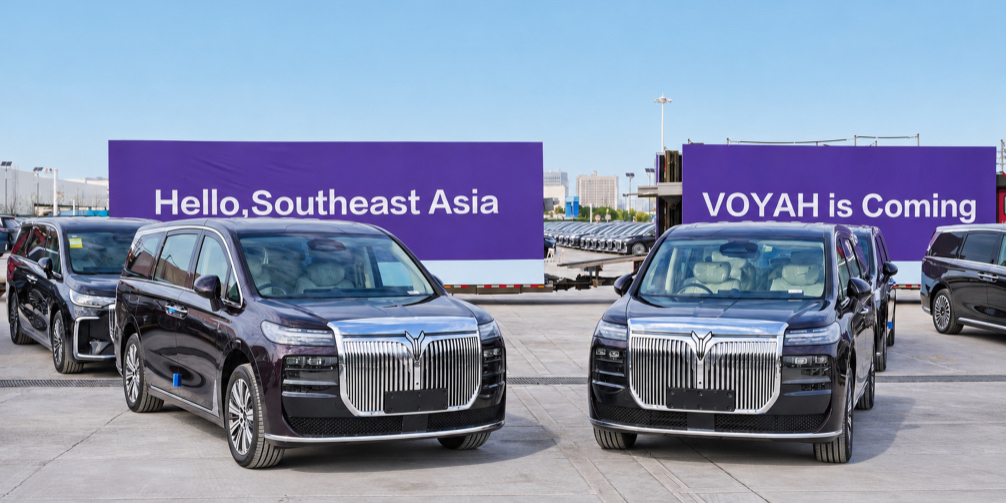
On November 20th, the shipping ceremony for the right-hand drive version of the Qiantai Lantu Dreamer 9 was held at the Lantu Gold Factory in Wuhan. On the same day, the model was launched simultaneously in Thailand and will land in Hong Kong, China in mid December, further expanding the right-hand drive market.
In September of this year, Lantu Dreamer 9 was launched in China and subsequently won 1 billion level overseas orders in Southeast Asia. This batch of Lantu Dreamer 9 right-hand drive version is produced for this order and will be launched in markets such as Thailand, Singapore, and Indonesia in the future.
Lantu Motors stated that MPVs are an important automotive category in the Southeast Asian right-hand drive market. Taking Indonesia as an example, MPVs account for 31% of the local automotive market, with significant market demand and development potential. But in the high-end MPV market, traditional fuel powered models have established a high market threshold based on brand accumulation. With the upgrading of user demand, the existing Japanese products in the local area are no longer able to meet consumers' expectations for intelligent technology, comfortable experience, and diverse travel scenarios. The high-end MPV market is ushering in new opportunities for product experience upgrading and new energy transformation. Chinese brands are growing from market participants to important competitors in the high-end MPV market.
According to a research report by Guohai Securities, MPVs have an annual sales volume of over 500000 units in Southeast Asia, accounting for more than 20% of the region's total automobile sales. Japanese brands have long dominated the market.
The formation of this pattern is the result of localization adaptation by Japanese car companies. Previously, Japanese car companies in Southeast Asia saw the weakness of European and American MPVs being "too large in size and too expensive". In response to the reality of narrow roads, limited purchasing power, and sensitivity to oil prices in the local area, MPVs were "downsized, reduced in size, and lowered in price", giving rise to the category of AUVs (Asian multi-purpose vehicles). Toyota Avanza, Mitsubishi Xpander and other models are essentially cross-border products with "high chassis, seven seats, fuel efficiency, and durability".
The barriers for Japanese car companies in this market are comprehensive. Its localization rate is as high as 98%, and its supply chain, financial solutions, second-hand car residual value system, and dealer network are deeply embedded in various national markets. In 2021, the Japanese market share in the Southeast Asian MPV segment reached 94.0%, almost monopolizing.
However, the market landscape is loosening. At the overall level, the share of Japanese brands in the Southeast Asian automotive market has decreased from 70% in 2021 to 52% in 2025; In the MPV segment market, the Japanese market share decreased from 94.0% to 73.4% during the same period, a five-year decline of over 20 percentage points. However, 73.4% means that the Japanese still hold nearly three-quarters of the MPV market, and the loss of market share mainly occurs in specific price bands and power forms, rather than a global collapse.
The changes mainly occur in the high-end luxury MPV market. By 2025, a total of 6251 high-end new energy MPVs from China, including the Tengshi D9, Jike 009, and Xiaopeng X9, will be registered in Thailand, surpassing the total of 5438 vehicles from Toyota Alphard and Vellfire; Among them, there are 3096 units of Tengshi D9 single model, ranking second in the overall MPV ranking in Thailand. Jike 009 and Xiaopeng X9 also entered the top six, with a total market share of over 31% for the three models.
In the luxury MPV market in Indonesia, the Tengshi D9 sold a total of 6775 units from January to September 2025, far exceeding Toyota Alphard's 1884 units. Its selling price is approximately 950 million Indonesian rupiah (about RMB 347400), significantly lower than Toyota Alphard's 1.6 billion to 1.7 billion Indonesian rupiah (about RMB 585100 to 621600).
The logic of competition between Chinese and Japanese brands is not simply low prices, but a combination of "electrification+intelligent configuration+price advantage over Japanese luxury MPVs". The listing price of Jike 009 in Thailand is about 3 million Thai baht (approximately 590700 yuan), lower than Elfa's about 4.6 million Thai baht (approximately 905700 yuan), but it forms a differentiation in intelligent cockpit and comfort configuration.
From the perspective of product positioning and price range, Lantu Dreamer 9 is entering the high-end new energy MPV market where Tengshi D9 and Jike 009 have already opened up, rather than the mid to low end LMPV (low-priced MPV) market dominated by Japanese brands.
The advantage of choosing to enter the Lantu Dreamer 9 at this time is that the acceptance of electrification among luxury MPV consumers in Southeast Asia is on the rise, and Chinese brands have completed a leap from "zero awareness" to "competing head-on with Alphard and gaining sales advantages" in this niche market. In addition, Lantu has established a certain layout foundation overseas, and Dreamers has entered more than 40 countries including Norway, Finland, the Netherlands, Italy, the United Arab Emirates, Qatar, etc.
However, the absolute size of the high-end MPV segment market in Southeast Asia is limited. The sales scale of three high-end Chinese electric MPVs in Thailand, totaling over 6000 units, is still relatively small compared to the total annual sales of over 500000 MPVs in Southeast Asia. Entering the high-end market can establish brand awareness and profit margins, but it is difficult to achieve economies of scale in the short term.
Even more tricky is that the policy environment in Southeast Asia is shifting from "encouraging imports" to "mandatory localization". Starting from 2027, Thailand will impose a 35% consumption tax on imported electric vehicles that lack local production and component matching; ASEAN countries continue to raise their TKDN (Local Content) requirements. In addition, the existing supply chains in markets such as Indonesia are built around fuel vehicles, and the core components of the three electric and intelligent systems are still highly dependent on imports. The weak local supporting capabilities are structural costs faced by all Chinese brands, including Lantu.
The shipment of 9000 units of Lantu Dreamer is the starting point for its large-scale delivery, but the sustainable share of the right-hand drive market ultimately depends on the pace and depth of its localized production.


 Subscribe