Economic Observer Follow
2026-11-21 13:59

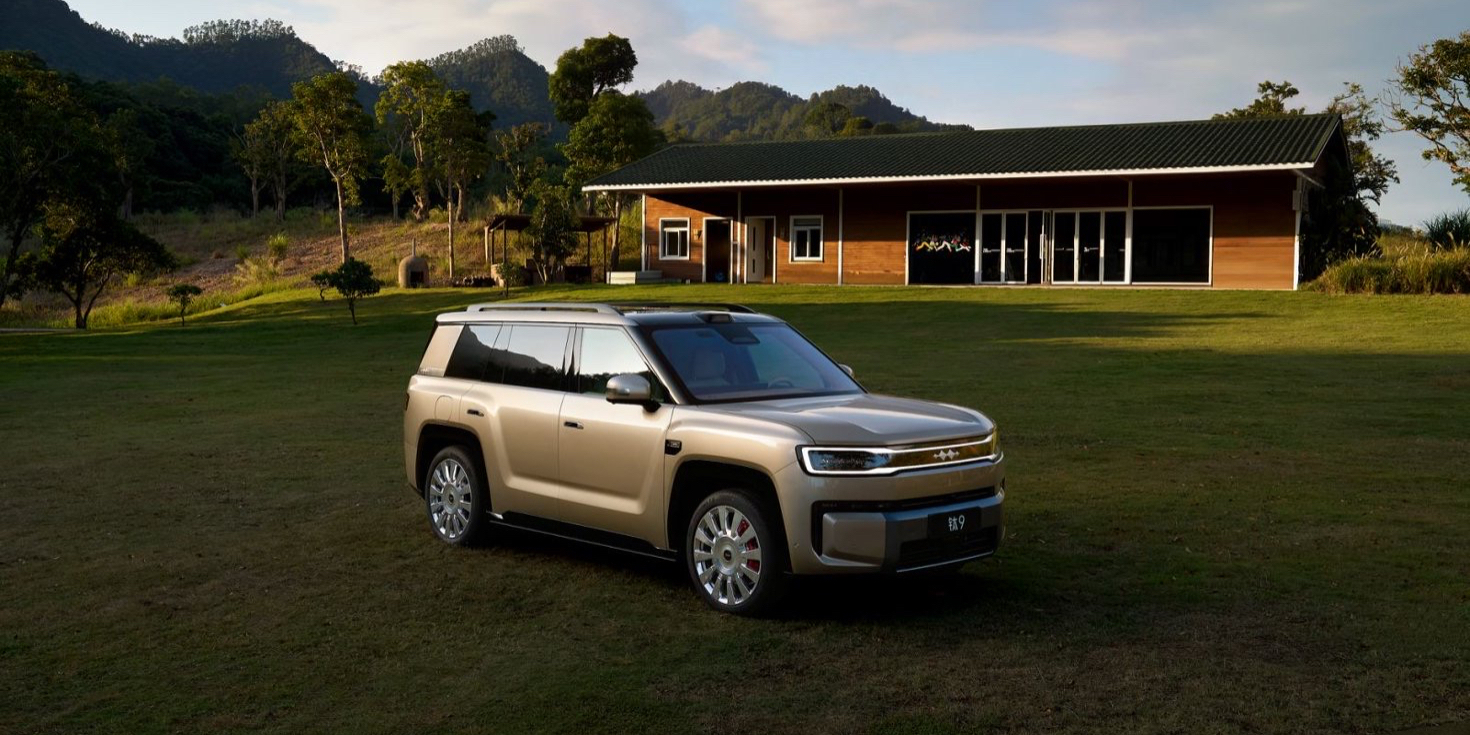
On November 19th, the Equation Leopard Titanium 9 was officially launched, with an official guide price of 279900 to 329900 yuan. As the final model of BYD in 2026, the Titanium 9 is equipped with two new technologies, the "Folding Smart Cabin" and the "DMS Super Hybrid Omnibus Platform".
The core of the "Folding Smart Cabin" is the folding steering wheel for mass-produced vehicles, which breaks the traditional mechanical connection by relying on wire controlled steering and wire controlled braking. The steering wheel can be folded and stored from 0 ° to 180 ° within 10 seconds, supporting "folding while parking in, unfolding while parking out". The high-frequency start stop design has a lifespan of 80000 times. This technology is positioned by BYD as a cabin form reserve for L3 and L4 intelligent driving: when the vehicle is driving, the steering wheel gives up the driver's space, and the cabin switches from the "driver's seat" to the "rest or office seat".
The "DMS Super Hybrid Omnibus Platform" is BYD's horizontal integration of existing hybrid routes. DM-i focuses on energy saving, DM-p focuses on performance, and DMO focuses on off-road. DMS aggregates the advantages of the three on the same platform, attempting to achieve a balance between energy consumption, power, handling, and safety through rear wheel drive vector control, high-speed decoupling of the rear motor, and independent adjustment of 0-100% power on the left and right sides of the rear axle. BYD stated that with the support of DMS, the launch of the Titanium 9 aims to continue expanding diversified vehicle scenarios. The Titanium 9 equipped with this platform has a 0-100 km/h acceleration of 4.8 seconds, a fuel consumption of 6.4 liters per 100 kilometers, a CLTC pure electric range of up to 400 kilometers, and a comprehensive range of 1630 kilometers.
Before the launch of the Titanium 9, Li Yunfei, General Manager of Brand and Public Relations at BYD Group, publicly stated that BYD had "played two technology cards" this year: second-generation blade batteries and flash charging technology, as well as intelligent driving support. The folding smart cabin is the third card of the year.
The first card, the second-generation blade battery and flash charging technology dispel the energy replenishment anxiety of car owners. It compresses the charging time to a level close to that of refueling a gasoline car, with "5 minutes to fully charge and 9 minutes to fully charge". The characteristics of this card are rapid deployment and wide coverage, with multiple models including the Touareg, Tengshi, Fangchengbao, Wangchao, and Haiyangwang being simultaneously equipped throughout the year. As a result, flash charging has transformed from a differentiated configuration to a technological foundation for BYD products.
The second card, intelligent driving, dispels the trust anxiety of car owners. BYD shall bear the corresponding direct economic losses in case of any liability accidents during the compliant use of the city navigation function by users. This is a commitment at the business model level, aimed at addressing the responsibility issue between "usable" and "daring" intelligent driving.
The third card, the folding smart cabin, displays the future cockpit form. Unlike the wide coverage of flash charging, the Foldable Smart Cabin is currently only available on the top of the line "Foldable Smart Cabin Edition" of the Titanium 9. Its significance lies in pre setting physical interfaces for human-machine co driving in the L3/L4 stage.
The logic behind BYD's choice of first car models based on these three cards is that flagship or new series models assume the benchmark function of "technology first car", and then penetrate mainstream models according to the cost curve.
In addition to the above three cards, there are also multiple technologies within BYD's system that have completed their first deployment in 2026. The Tengshi N8 is the first to be equipped with the Yi San Fang Evo and Tengshi Giant Screen Intelligent Cockpit, while integrating the Eye of Heaven 5.0 and Yunnian-A. The second-generation Sea Lion 07 is equipped with the Yunnian-M intelligent magnetorheological vehicle control system for the first time, bringing this technology into the price range of 130000 to 170000 yuan. Smart Ecology 2.0 is the first to be installed in the Equation Leopard Equation S series, achieving modular expansion of the cabin through three standardized interfaces: PIN port, magnetic suction, and thread.
In addition, there are still several technologies in BYD's reserves that are in a 'loaded' state. Their common feature is that technology validation has advanced to the pilot or mass production preparation stage, but is limited by cost, production capacity, or regulatory nodes, and has not yet entered the mainstream market for large-scale release, mainly including semi-solid state batteries and all solid state batteries, self-developed intelligent driving hardware Xuanji A3 chip, next-generation hybrid technology platform DM 6.0, etc.
In terms of batteries, BYD's semi-solid state battery is on the eve of mass production, with an energy density exceeding 300Wh/kg and a goal of pushing pure electric range to over 1000 kilometers. It is planned to be mass-produced in the second half of 2026, and the first batch of models may include the first sedan "Magnesium X" and Han L, as well as the facelift of the U8. The more advanced all solid state batteries have completed vehicle level verification, with a single energy density of 400Wh/kg for sulfide route and a prototype CLTC range of 1218 kilometers. However, the demonstration installation of thousands of units will only be launched in 2027, initially limited to high-end models such as the U9 and Han EV. The official caliber of large-scale popularization points to around 2030.
In terms of self-developed intelligent driving hardware, the Xuanji A3 chip adopts a 4nm process, with a single chip computing power exceeding 700TOPS, and three chips working together can support L3/L4 level computing power requirements. Its first model is aimed at the mass-produced new car of Tengshi brand in 2027. The L3 level autonomous driving regulations are expected to be implemented in July 2027, and the time window overlaps with the boarding rhythm of the Xuanji A3.
In terms of hybrid technology platform, existing information shows that DM 6.0 may be upgraded to a 900V full range high-voltage platform, matched with silicon carbide electronic control, and the engine thermal efficiency target will be further explored. The core change is to shift from rule-based control to AI intelligent energy management. The expected time for mass production is around 2027.
In the market driven by industry competition, BYD's sales scale and profitability support its significant investment in technology, and also enable its technology differentiation competition strategy to continue to deepen. The manifestation of technological differentiation in products gives BYD models a unique experience compared to other competitors, thereby attracting consumers and promoting market sales. This virtuous cycle has already taken shape within BYD.


 Subscribe