2026-11-20 16:46

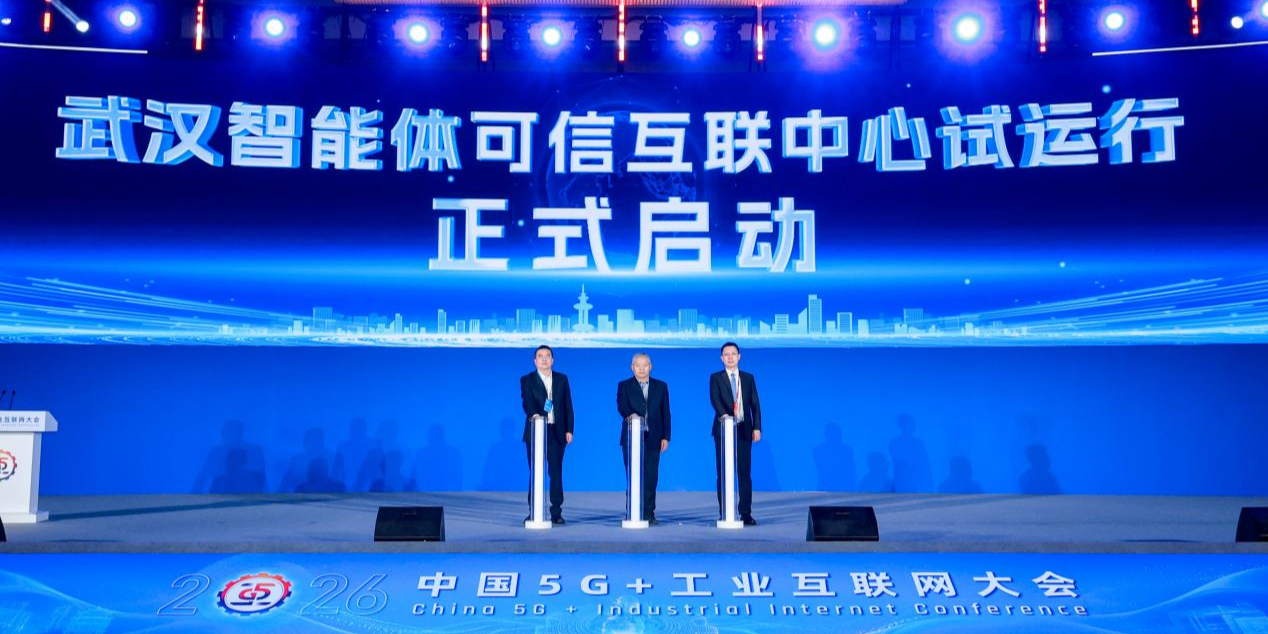
On November 19, at the 2026 China 5G+Industrial Internet Conference, the Wuhan Agent Trusted Internet Center launched its trial operation. This center is based in Hubei and connects the whole country. It is an important node for the layout of intelligent agent identification and identity networks in the central region of China, following the centers in Beijing, Xiamen, and Chongqing. At the event site, He Wei, Deputy Chief Engineer of China Academy of Information and Communications Technology, Zhang Bingxin, member of the Party Group of Wuhan Economic and Information Technology Bureau, and Zhou Bo, Secretary and Director of the Party Group of Wuhan Dongxihu Economic and Technological Innovation Bureau, attended the launching ceremony.
Identification and identity are important foundations for supporting intelligent agent naming, authentication, access, and authorization management. Under the guidance of the Ministry of Industry and Information Technology, the China Academy of Information and Communications Technology is promoting the construction of an intelligent agent identification and identity service network, providing public services such as identification registration, identity verification, addressing resolution, capability discovery, and collaborative verification for various intelligent agents, enhancing the ability of intelligent agents to "find service entrances, see operating entities clearly, trace interaction processes, and trace problems", and reducing the threshold for small and medium-sized enterprises to access and use intelligent services.
The intelligent agent trusted interconnection center is a carrier that provides services to the industry and is implemented locally. Technically, the intelligent agent identification and identity service network, as well as the interconnection center, adopt a fusion route of "intelligent agent+DID+blockchain", supporting multiple DID methods that comply with the W3C DID core specifications, and carrying out protocol adaptation such as MCP, A2A, ANP, etc., supporting identity and authorization verification with digital identity and verifiable credentials, relying on "Spark Chain Network" to achieve identity status management and key record storage and traceability.
It is reported that the Intelligent Agent Trusted Interconnection Center focuses on providing three types of services: first, registration and discovery services, such as intelligent agent identification registration, subject identity information association, capability information registration, and identification status management, supporting the retrieval and discovery of intelligent agents, skills, and related resources; The second is parsing and verification services, which support multiple DID method parsing to achieve identification control, subject identity, and related authorization verification; The third is resource management services, which include accessing and managing local data, computing power, tools, and business services, supporting intelligent agents to call relevant resources within the authorized scope. At the same time, the center can combine operational monitoring and situational awareness technology to provide support for network operation management and risk assessment, promoting the trusted interconnection of intelligent agents in different regions, entities, and technology platforms.
At present, the intelligent agent identification and identity network has been officially launched and opened to the public for access. Beijing, Xiamen, Chongqing, and Wuhan intelligent agent trusted interconnection centers have successively started trial operation, forming a preliminary node layout distributed in North China, East China, Southwest China, and Central China, accumulating practical experience for cross regional networking and collaborative services.
The China Academy of Information and Communications Technology (CAICT) stated that it will take the trial operation of the Wuhan Intelligent Agent Trusted Interconnection Center as a new starting point, and work together with industry stakeholders to promote network node construction, standard specification development, and key scenario applications, further consolidating the identification and identity foundation of intelligent agent trusted interconnection.


 Subscribe