2026-11-19 22:14

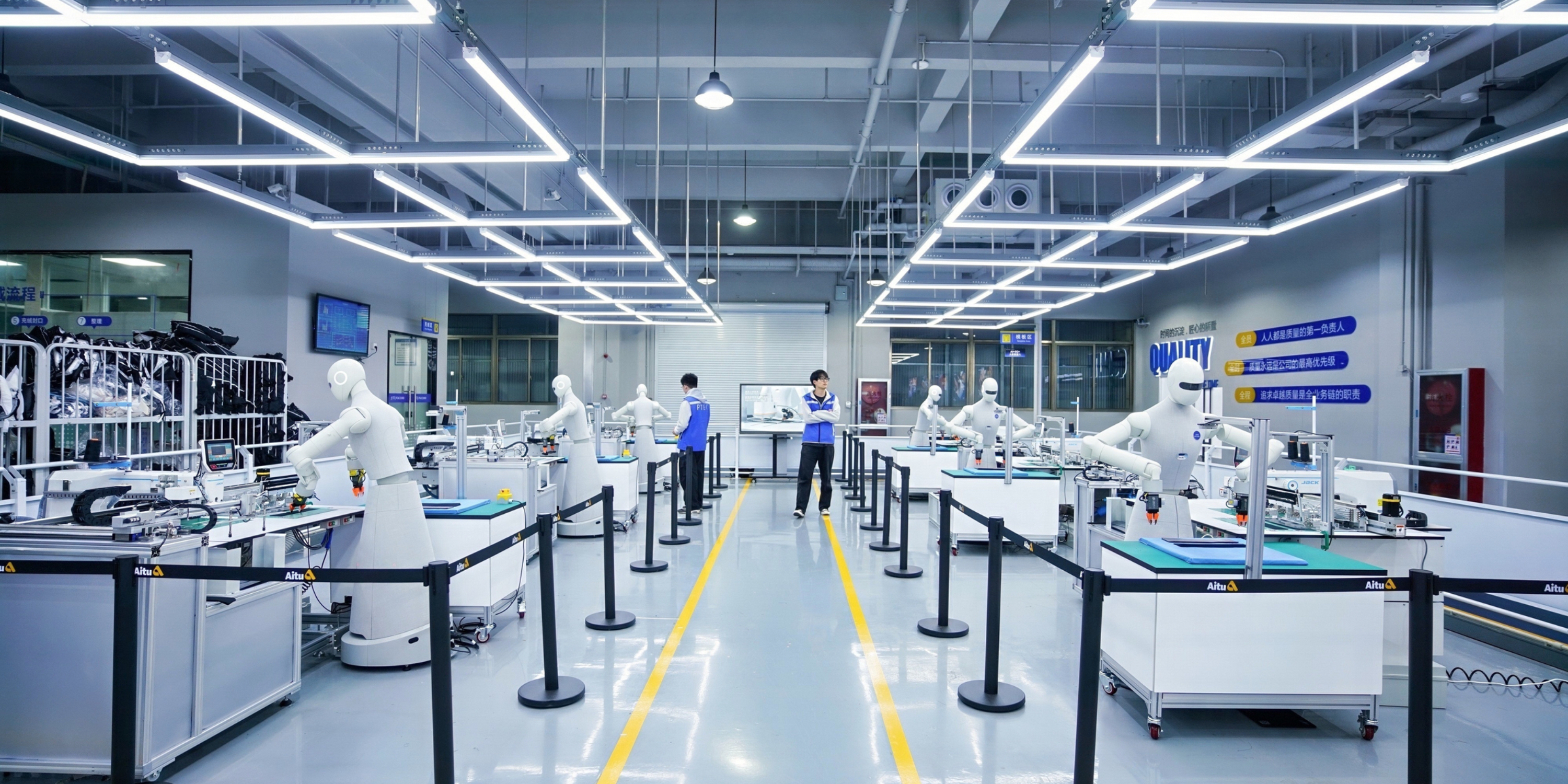
On November 18th, due to the influence of cold air, the temperature in Ningbo dropped to around 10 ℃. But in the factory building of Taiping Bird Excellence Technology Center, due to multiple production lines operating simultaneously, the temperature is at least 5 ℃ -6 ℃ higher than outdoors. Unlike usual, today there are several new robot employees in the factory.
At this moment, the robot is working. On the operating table in front of the robot, there are two stacks of rectangular cutting pieces of different materials placed one on top of the other. It needs to place them on the other operating table on the left side in order for the cutting pieces to be recognized by the automatic sewing machine and sent to the sewing process.
The robot's two hands are two tactile fixtures. It can be seen gripping a thin and light cutting piece, twisting it and placing it on the sewing machine. With the naked eye, there are two red spots on the cutting piece. It is understood that this is a convenient setting for the robot to accurately locate points. Just as the cutting piece was put down, the robot found that the position was not precise. It gently moved the cutting piece to the left with the end of the fixture. After the automatic sewing machine recognizes the cut piece, it is pushed into the automatic sewing process. The robot has already turned around and picked up the second piece of cutting.
The staff explained that this process is the sewing process of the sleeve cutter. Xiu Kefu is a professional term in the clothing industry, commonly known as the "sleeve head" of a shirt.
It is understood that the robot is an intelligent humanoid sewing robot jointly developed by Taiping Bird and Aitu Technology. This is the first robot application in the industry to land on the clothing production line. At present, Taiping Bird has introduced 8 humanoid sewing robots and plans to conduct small-scale validation in its own factory before determining the pace of large-scale production in the future.
Wang Pengyu, Director of Taiping Bird's Excellence Technology Center, stated that currently, robots are capable of completing production processes such as sleeve cuffs, collars, and plackets. It is understood that this type of process belongs to the C-class process in clothing production, with a relatively simple process. Therefore, it is prioritized as a landing verification scenario for humanoid sewing robots. After the improvement of computing power and efficiency in the future, it will gradually expand to the more difficult A-class and B-class complex processes. In clothing production, more than 70% are C-class processes, 20% -30% are B-class processes, and about 10% are A-class processes, such as zipper installation.
The speed at which robots work is not particularly fast. Zhang Hanwen, founder and CEO of Aitu Technology, introduced that currently, the humanoid sewing robot can achieve 50% -70% of manual efficiency. He also stated that the improvement of robot efficiency in the future is a deterministic event. He explained that certainty first comes from the robot itself: the algorithm continues to iterate, and indicators such as the success rate of grasping will continue to improve; Secondly, it comes from the collaboration between robots and sewing equipment. Currently, robots need to wait for the piece to be sewn before grabbing the next piece after grabbing and placing it. In the future, it can be designed as a "swing and sew" mode, which will speed up the process.
It is not easy to develop robots that can work in the clothing processing scene. Zhang Hanwen stated that the first difficulty lies in the variability of clothing fabrics, styles, and techniques, especially in the fashion industry where Taiping Bird operates, where these changes are even more complex; The second difficulty is that the fabric belongs to flexible materials, and the difficulty of grasping is much higher than that of rigid materials.
Since it's difficult, why does Taiping Bird still insist on investing in this area? The answer points to the issue of 'difficult employment'. Wang Pengyu has firsthand experience with this. Many factories are located in remote areas, and the manufacturing assembly lines are relatively dry, resulting in fewer people willing to enter the factory. At the same time, the employment requirements of clothing factories are relatively high, such as sewing requiring hand, foot, and eye coordination, which is more difficult. The pincer attack from both ends has made 'fewer and fewer people' an even more urgent issue.
Structural labor shortage has indeed become a challenge faced by China's clothing industry. According to the "Matching Analysis of Talent Demand in the Textile and Clothing Industry and Professional Setting in Vocational Colleges" data, from 2024 to 2026, there will be a shortage of about 1.1532 million technical and skilled talents in the textile and clothing industry, mainly concentrated in core production positions such as sewing and plate making.
From a technical perspective, Zhang Hanwen makes a judgment on the future of the clothing industry: in about ten years, the vast majority of production processes in garment factories can be independently completed by machines. But he also admitted that as a practitioner in the clothing industry, he does not want workers to completely disappear. He said that nowadays, the clothing manufacturing industry is constantly relocating to Southeast Asia, and what is worth noting is the risk of hollowing out the manufacturing industry in the future. The reason for the layout of robot production capacity lies in this.
The introduction of intelligent robots by Taiping Bird in the Excellence Technology Center is still in the strategic investment stage. The significance of this initiative is that Taiping Bird will first complete verification in its own factory, and then serve as a sample solution to provide reference and inspiration for Taiping Bird's cooperative supply chain factories.
Entering the production workshop of Taiping Bird Excellence Technology Center, you will first be attracted by the intelligent hanging track above your head, as the track covers the ceiling of the entire workshop, and various semi-finished products and cutting pieces are being transported and circulated on it, so that they can be accurately transported to the next process. The intelligent sewing machine with a display screen can record the process, automatically adjust the speed, and collect data on the sewing posture of the lathe operator; Intelligent line changing machine realizes automated line changing; The data collection device worn by the sample maker continuously collects information on the plate making process, accumulating process materials for robot training.
These various digital devices, big and small, are all explorations of Taiping Bird in clothing intelligent manufacturing. According to Taiping Bird, the production of sample clothes has been compressed from a cycle of 7 to 10 days in the past to a fastest of 3 hours. In the first half of 2026, the tracking cycle of Taiping Bird will be compressed to within 30 days.


 Subscribe