Economic Observer Follow
2026-11-19 18:59

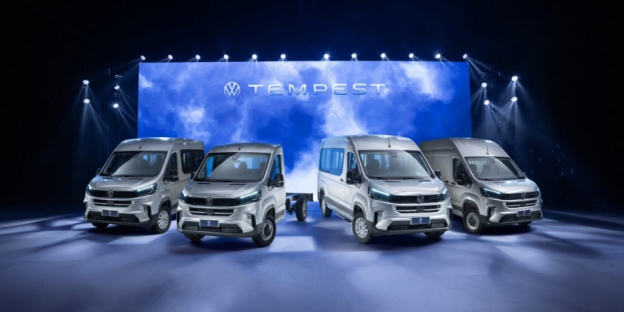
Recently, the largest commercial vehicle exhibition in Latin America, the Brazil International Commercial Vehicle Show, opened in S ã o Paulo. The first light passenger vehicle model Tempest (domestic Maxus V90 light passenger) jointly developed by SAIC Maxus and Volkswagen TRUCK&BUS was officially launched at this exhibition. This model is manufactured by SAIC Maxus Wuxi production base, and the first batch of 500 complete vehicles have been sent to Brazil.
In the cooperation model between the two parties, SAIC Maxus provides platform products that meet the Brazilian market access standards through its own light passenger product research and manufacturing system; Volkswagen TRUCK&BUS relies on its own brand strength to provide user understanding, channel network, and service system for the South American market in cooperation.
At the product level, Tempest has completed targeted development and durability testing for Brazilian regulatory standards, high-temperature climates, complex road conditions, and local fuel characteristics. Volkswagen emphasized that over 250 technological improvements and adjustments were made to over 50 production processes during the development of the new car, with a total of 1.5 million kilometers of testing completed.
SAIC Maxus stated that its light passenger series products have entered multiple developed global markets such as Australia, New Zealand, the United Kingdom, Ireland, and Chile, accumulating solid market reputation and user recognition under different regulatory standards, usage environments, and consumer demands. This has also laid a solid foundation for entering the Brazilian market with global partners.
Outside of Tempest, Volkswagen's new generation Amarok South American version has explicitly stopped using the Ford Ranger platform and instead developed based on the SAIC Maxus StarCraft X platform. It is planned to be put into production at the General Pacheco factory in Argentina in 2027, with a focus on the South American market.
In terms of power, the new Amarok car will fully shift towards electrification, with the top of the line plug-in hybrid version having a combined maximum power of over 470Ps and peak torque of 800N · m, no longer providing diesel power. Volkswagen stated that despite the shared platform, the suspension system, steering calibration, and dynamic driving characteristics of the entire vehicle are still independently tuned by its engineering team. This means that Volkswagen has a deeper involvement in the technology of this pickup truck, and the output of the StarCraft X is the underlying architecture rather than the finished vehicle.
Regarding the cooperation between the two parties, Hou Wenjie, Secretary General of Shanghai Yuce Think Tank, told the Economic Observer that "SAIC Maxus borrowed a ship to go abroad, and the core is to choose 'trade products for channels' in the face of brand recognition barriers
For Volkswagen, the pace of updating its own light passenger car products has slowed down, and there is a gap in the product line. Therefore, it has invested heavily in directly developing a new platform. The DaTong V90 platform has been validated in multiple markets and has a mature supply chain that can compress development cycles and vehicle costs.
In fact, many years ago, SAIC Maxus reached a similar cooperation with General Motors, and its products T70 and V70 entered the Mexican market with the Chevrolet logo.
The origin of the cooperation between SAIC Maxus and General Motors in overseas markets can be traced back to December 2009. At that time, SAIC Group and General Motors established a 50:50 joint venture in Hong Kong to jointly enter the Asia Pacific market. SAIC Group's early overseas business was clearly "walking on two legs", one of which was to cooperate with General Motors and go global through the Chevrolet channel.
Since 2016, General Motors has launched nearly 10 models produced in China in Mexico, including the Baojun 530 rebranded Chevrolet Captiva and the Wuling Hongguang V rebranded Chevrolet Groove.
At the end of 2021, SAIC Maxus' T70 pickup truck was rebranded as Chevrolet S10 Max and exported to Mexico. By 2024, the annual sales of S10 Max have exceeded 20000 units, ranking third on the Mexican pickup truck sales chart. In 2025, the S10 Max will sell 21000 units in Mexico, ranking second among all pickup truck models, only behind the Nissan NP300, with a market share of approximately 7.9%. As of August 2026, the cumulative sales of S10 Max since its launch have reached 85100 units.
After the success of the Chevrolet S10 Max in the Mexican market, in March 2025, SAIC Maxus introduced the V70 rebranded Chevrolet Express Max to the Mexican market. The Express Max only offers a closed door cargo version, equipped with a 2.0T diesel engine and a 6-speed manual transmission, with a starting price of 758100 Mexican pesos (approximately 270000 yuan).
In 2025, 749 units of Express Max were sold in Mexico, and 705 units have been recorded since 2026, bringing the total to 1454 units. At the end of 2025, Chevrolet further added the Express Max EV version.
Wang Guangwei, an expert in marketing and communication at Shandong University and a member of the Huamou Think Tank, stated that SAIC Maxus' joint brand going global is not simply about outsourcing and changing labels. It is a typical strategy for domestic commercial vehicles to use mature overseas brands, channels, and after-sales networks to reduce the cost of trial and error when entering high barrier markets.
SAIC Maxus' decision to borrow a ship to go out to sea is a market test. First, the acceptance of the product in the local market will be verified with foreign brands. If it is successful, it will then wait for the opportunity to import its own MAXUS brand. Of course, the cost is equally obvious, with a portion of profits to be split and products subject to strict quality control from partners. It is difficult to pass on Datong's own brand mentality to end consumers in the short term. ”Wang Guangwei said.
Outside of SAIC Maxus, several Chinese car brands have been "borrowing labels" to sell in overseas markets for many years. For example, some Chery Tiggo series models have been rebranded as Italian DR and entered Europe; Some models of GAC Trumpchi have replaced their Dodge logo and entered the Mexican market, relying on Stellantis channels for sales; Geely has rebranded the Star Yue L as the Renault Koleos, entering the Korean market through the Renault channel.
Hou Wenjie's judgment on this is that "borrowing a ship to go abroad" will become a norm within a certain range, but it will not become the only mainstream path. Self built channels and brands will still be the long-term mainline of top car companies, and the two paths will run parallel rather than replacing each other.
Borrowing a ship to go out to sea is a good 'stepping stone', but it is not the end point. Whether 'borrowing a ship' can be turned into 'shipbuilding', and the local supply chain, customer data, and service capabilities can be accumulated during the cooperation process, will determine whether this type of going out to sea can create long-term value, "said Wang Guangwei.


 Subscribe