Economic Observer Follow
2026-11-18 16:00

There is silence | text
In the movie "The Odyssey," there is a scene where Telemachus travels to Sparta to investigate the whereabouts of his father Odysseus. Upon returning to Menelaus, Helen hears her husband attribute the Trojan War to the face that "once set a thousand ships sail," and only responds lightly, "Or perhaps it's because of your brother's ambition." In Homer's "The Odyssey," Helen's whereabouts and the truth about the Trojan War are indeed interesting puzzles in Greek mythology.
Euripides said in "Helen" that the woman on the walls of Troy was a phantom made of clouds, while the real Helen appeared in Egypt. This statement can at least be traced back to the Sicilian poet Stryclus, whose fragments were recorded by Plato in "Phaedrus". Herodotus also believed that Helen was stranded in Egypt and Paris returned to Troy alone. At the same time, the wise man Gorgias overturned her verdict in "Hymn to Helen", saying that "words are the powerful ruler".
In a sense, the image of Greece is this Helen. Everyone knows Greece, knows Sophocles and Aristotle, knows Hippocrates or Alexander. But perhaps everyone finds it difficult to define the true Greece - because there is never a 'one true' Greece from beginning to end. Greece, like Helen, is both geographical and cultural; It is both a nation and a language. Different histories are always telling and competing for the same Greece. Rodrik Beaton's "3500 Years of Greece" provides a very valuable general knowledge on this basis: who are Greeks, what is Hellenism, and how to rediscover what we call "Greece".
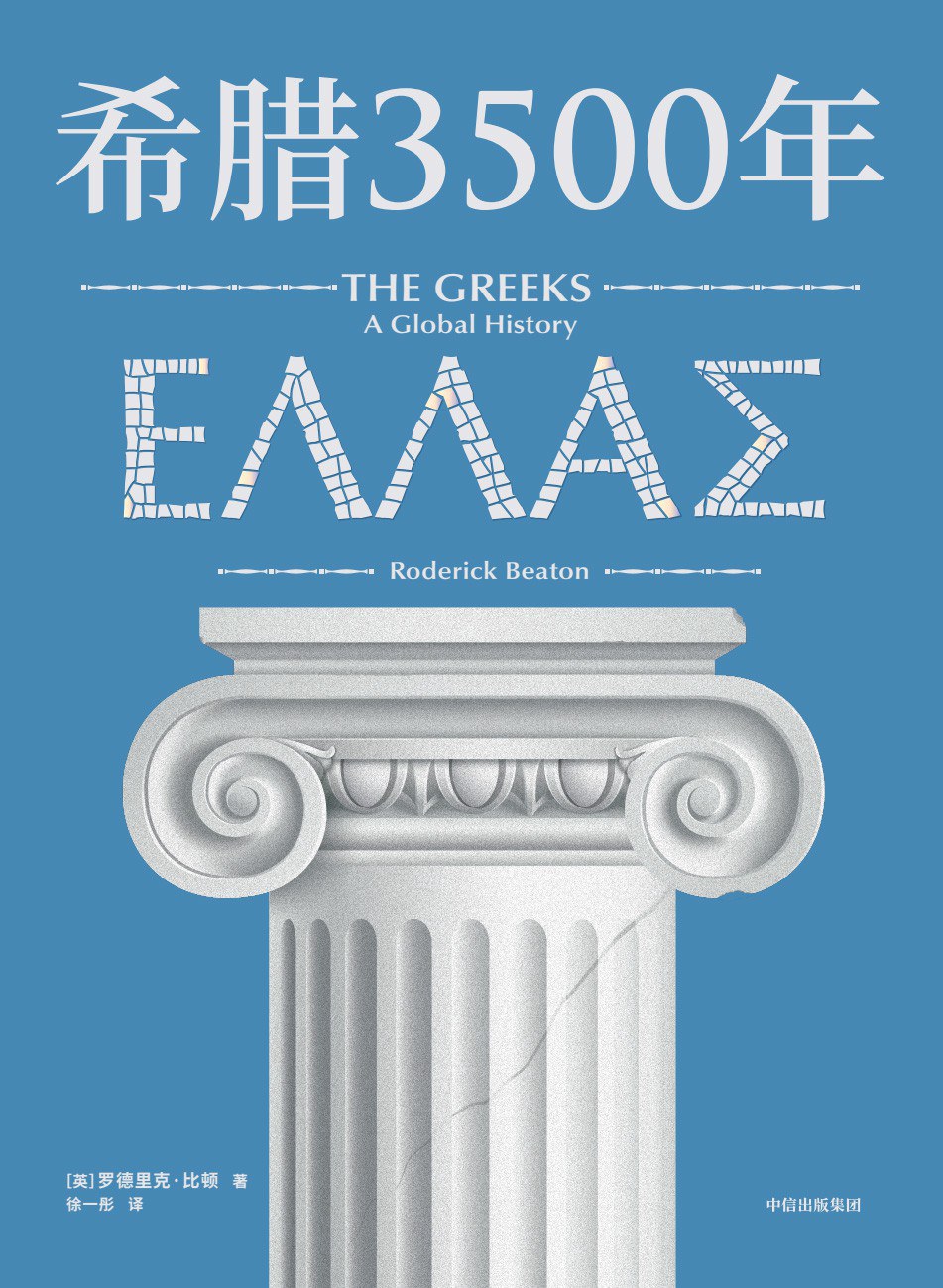
3500 Years of Greece
Written by Roderick Beaton
Translated by Xu Yitong
New Culture | CITIC Publishing Group
April 2023
1
More than a decade before the shining of Greek drama, the earliest history of the Greek region began with palaces on the island of Crete. However, unlike other general histories, Beaton compared it in the context of the entire Mediterranean civilization in the first chapter and emphasized that Greece was originally a 'mixed race'. At that time, Egypt, the Hittites, and the Mesopotamia all had very mature civilizations, while Greece was actually a peripheral world, with the only truly advanced civilization being the Minoan civilization on the island of Crete.
Subsequently, the Mycenaean civilization, a native warrior group in Greece, took over the gradually collapsing Minoan civilization and transformed it into linear script B. Then, Mycenaean also suffered a systematic collapse, with the Greek language group's first attempt to imitate the more developed societies (or civilizations) in the Near East ending in failure. The population sharply declined, trade shrank, and the Greek world degenerated back into many small communities dominated by small-scale farming economies. The 'Dark Ages' have arrived, and even early writing has disappeared. Fortunately, the stories of the auspicious feathers of history have been passed down: Theseus, Minotaur, Troy.
In the late Dark Ages, the Greeks added vowels to the Phoenician script and invented the Greek alphabet. So Homer appeared, and the story and the historical evidence behind it became the Iliad and Odyssey. Although Homer's world is a world assembled through literature, and the standard name for the Greeks we call them today, "Hellenes," has never appeared in the afterlife - "Hellas" was originally a small place in the region of Thessaly in the Iliad and also the homeland of Achilles - this new world in Greek has begun to reclaim that lost heroic era through words.
Therefore, the commonly known rise of Greece actually occurred between the 8th and 6th centuries BC. During this period, the Greeks learned to sail and colonize, and established one colony after another along the long coastlines of the Black Sea, Italy, Sicily, North Africa, France, and Spain. Unlike imperialist colonies, these colonies, known as "homes outside the home," often became "polis" as civic communities: people had to solve problems through discussion, competition, and persuasion. Therefore, political philosophy emerged, tyranny, oligarchy, and democracy began to emerge, and culture, art, and philosophy began to gestate. These Greeks scattered like stars in the sky, but for the first time began to realize that they belonged to some kind of common world.
Next is the Hippo War: Marathon, Thermopylae Pass, and the Battle of Salamis. Biton believed that it was in the face of the enormous' other 'of Persia that a more distinct identity as a' Greek 'began to take shape. We have the familiar 5th century BC: Athens, philosophy, drama, medicine, sculpture... The default "ancient Greece" in our minds today is basically the brilliant civilization of these 100 years.
However, cannibalism immediately began: the Peloponnesian War broke out, and after nearly 30 years of fierce fighting, Athens was defeated, Sparta suffered a tragic victory, Corinth and Thebes took turns, and a northern neighbor became increasingly powerful under the aggregation of Philip II. Then, his son Alexander of Macedon swept across Greece and crossed the Dardanelles to the east, reaching the end of the known world. Thus, city-state politics, as the dominant form of Greek history, came to an end.
However, it was during the period of politically autonomous death that "Greek culture" began to gain a broader life than any city-state. Just as Athens lost its hegemonic position and instead became a cultural center, attracting people from all over the Greek world. The fragmented period of the successor dynasty after Alexander's death also allowed the spread of Greek language and culture far beyond its territory. Greece has finally transformed from a geographical location into a culture: from Alexandria in Egypt to Bactria west of the Pamir, as long as you speak Greek, follow the Greek system, or receive Greek education, you become a 'Greek'.
Even though the Roman Empire rose and destroyed Corinth in 146 BC, effectively controlling Greece, it still remained so. Although Greece was one of the many ethnic groups conquered by the Romans, they increasingly imitated and inherited Greek cultural customs. As Bitton quoted Horace's famous saying: "The conquered Greece, in turn, conquered the rough conqueror." The Greeks lost their political autonomy but began to exert cultural power, turning the eastern part of the empire into a stable Greek speaking world.
However, with Emperor Caracalla issuing an amnesty that expanded citizenship, almost all Greek speaking free citizens became Roman citizens in an instant. Thus, the "Greek" identity that had been condensed since the Greco Persian War underwent a significant change: people who spoke Greek began to identify themselves as "Romans" and continued to do so until the 19th century.
2
At this point, the content of this book is only halfway through. It is not difficult to see that Beaton's approach breaks away from the romantic tradition of mainstream Greek narrative since the Enlightenment. He no longer sees Greece as a beacon of Western civilization or enlightenment, but rather focuses more on how Greece, as a symbol pointing to civilization, can be rewritten, utilized, and reborn in different communities through language, migration, and identity rewriting. In the second half of the war between Byzantium, Osman, and modern Greece, Biton mainly revolves around an important question: how did Greece survive after ancient Greece disappeared?
When Christianity emerged from the Jewish region, faith became a huge variable, and Greek, as the most "international" medium of communication at that time, became the "wheel" of Christianity. Three centuries later, Christianity has gone from the brink of persecution to the state religion. In 330 AD, Emperor Constantine rebuilt the ancient Greek colony of Byzantium and named it Constantinople. The emperor, "Rome," Greek, and Christianity became the new center of the community.
In 626 AD, Constantinople was besieged by Avars, Slavs, and Persians, but miraculously emerged victorious - and throughout the siege, the defenders held high the statue of Mary and wandered around the high walls. Bitton compared it to the Greco Persian War over a thousand years ago and keenly pointed out that just as the Greco Persian War first brought about a sense of unity as Greeks, the Battle of Constantinople also brought them together in an unprecedented way, embracing a new identity as Christians.
So, in the absence of changes in space and language, the framework for explaining the world has quietly undergone a transformation. In the 5th century BC, Athenians offered sacrifices to Athena at the Temple of Parthenon. In 1018 AD, Eastern Roman Emperor Basil II prayed to the Virgin Mary at the Temple of Parthenon to celebrate his triumph. Like Athens in the past, Byzantium began to rise and Constantinople became the "city of the world's longing".
But the community is still on the brink of collapse, and this time, the crisis is a major split within the Christian church. Religious differences gradually transformed into cultural hatred between "Latins" and "Romans". Therefore, when Byzantium faced the threat of the Seljuks and launched a rescue mission to the West, the response of Western Europe was to launch an epic religious war. So, in 1204, during the Fourth Crusade, Constantinople was plundered by Western Christians, and over 600 years later, the Greek speaking Roman world entered an irreversible decline.
At this time, the Greek world was once again divided into different fragments such as Trabzon, Epirus, Nicaea, and surrounded by Italian city states, Balkan countries, and Turkic forces until 1453, when Constantinople fell and Byzantium was conquered by the Ottoman Empire. However, as the Roman Empire was on its deathbed, a new vision of community was proposed. At the beginning of the 15th century, a man named Pluto put forward in Misteras near Sparta: "We are the descendants of ancient Greece, and can be witnessed no matter in language or in cultural and educational traditions." Different from Aesocrates in Plato's era, Pluto believed that "consanguinity" was the first criterion beyond "language" and "education".
So, for the first time, someone took the identity of a "Greek" seriously from a perspective similar to modern nationalism. Although Pluto's ideas seem to have gone unnoticed, and his posthumous works were publicly burned by Eastern Orthodox patriarchs for advocating a return to the polytheistic worship of ancient Greece, the Greek world during this period was still striving for change in its own way. Beaton referred to it as a "hopeful monster," a concept in evolutionary biology that the author used to describe the political and cultural community that continued to emerge in the Greek speaking world after 1204 but may not ultimately take shape.
Another example cited by Beaton is the colony of the Venetian Republic: Crete. The Venetians gradually Hellenized after ruling here from the 13th century onwards; At the same time, the local Greek dialect has also incorporated a large amount of Italian vocabulary. Even since the 16th century, Crete has experienced its own Renaissance: theater, painting, and other arts have exploded, and the famous religious painter El Greco emerged from here.
History repeats itself once again: after losing their country, Greeks once again spread across both the East and West worlds. However, this time, in addition to bringing back money and information, they were also exposed to Enlightenment, the French Revolution, nationalism, and Europe's obsession with classical Greece: in 1764, a man named Winckelmann published "A History of Ancient Art," in which he passionately claimed that ancient Greece was the source of Western civilization, and that its outstanding civilization originated from the perfect climate of the area - even though he had never been to Greece; In 1812, Byron published "Childe Harold's Travels," a work that pondered whether ancient civilization could be reborn and achieved great success. The idea of reviving Greece spread to every corner of England, Europe, and even the newly born United States.
3
In 1821, a group of Greek speakers began a revolution. For over a thousand years, their ancestors referred to themselves as "Romans," but in parliament, this group underwent a very radical and thorough reshaping of their collective identity. They chose 'Hellas', the hometown of Achilles in the Iliad, as their country name near the ancient ruins of the Peloponnese Peninsula, and called themselves' Hellenes'. From 1830 to 1834, under the protection of foreign powers, Greece was founded with its capital in Athens. At that time, Athens was just a dilapidated small town with a population of only ten thousand. The Acropolis had long been abandoned, but in the eyes of any foreigner who had been influenced by classical studies, it must have been the capital of Greece.
However, this emerging nation-state seems less "powerful" under the shadow of ancient Greece that people imagine. On the one hand, the political power and geopolitical value of the Aegean region have undergone earth shaking changes; On the other hand, nationalism has also become a double-edged sword for a modern Greek community: Greece has been trying to achieve the "great ideal" of incorporating Anatolia and its large Greek speaking population into the country. However, after World War I, Türkiye's nationalist army counterattacked and 1.3 million Orthodox Christians were forced to leave. This Greek speaking world, which had lasted since the Bronze Age, almost disappeared within a few years, laying the groundwork for the future north-south division of Cyprus. Once again, a large number of Greeks migrated globally, with their footprints spread throughout Europe and America.
Despite Greece's overall prosperity with its closeness to the West and the end of the Cold War, this finally established nation-state seems unable to fully accommodate "Greece". In 1991, as Yugoslavia began to disintegrate, the "Republic of Macedonia" sparked public outrage: because Macedonia was considered an inseparable part by all Greeks, and now there were independent countries using it as their name, using the pattern of Philip II's tomb as their flag, and statues of Alexander the Great began to appear in the capital.
Although the ethnic groups in the southern Balkans of modern times are indeed far from the Macedonian royal family of the past, and similar topics have even been discussed as early as Athens in Demosthenes, this dispute continued until 2018 when the neighboring country changed its name to "North Macedonia" and was barely resolved.
In addition, modern Greece is also plagued by troubles. In 2004, the Olympics returned to Athens after a hiatus of over a century; A few years later, a debt crisis erupted and the Olympic venues quickly became overgrown with weeds. International aid, street unrest, and the successive downfall of political parties. Fortunately, the national system did not collapse in the end, and the Greek businesses and wealth scattered around the world gradually flowed back in the form of foundations and donations. This country is stumbling, but still moving forward with time.
Therefore, in a sense, the Hellenistic process that has lasted for thousands of years has never completely ended. And as Biton said, for the large number of refugees appearing on the Greek coastline today, "Greece has a significance that goes beyond refugee transit stations". Greece has long become a symbol that transcends geography and integrates identity. Although the old storms have not yet subsided and new storms are still brewing, just like the Mycenaeans crossed islands and oceans three thousand years ago in search of opportunities, Greece is forever emerging. As Biton quoted Kurdish poet Shiva Panahi in the conclusion, "We wanderers, we barefoot, we have no kingdom to rely on." We can always see the Aegean Sea, the "wine red ocean" in Homer's epic.