2026-11-16 20:28


On November 16th, Baidu released its financial report for the third quarter of 2026, with AI business revenue of 13.2 billion yuan, accounting for 53% of Baidu's general business revenue, and having accounted for more than half of it for three consecutive quarters. This quarter, AI cloud infrastructure revenue increased by 94% year-on-year, significantly accelerating from the 50% year-on-year growth rate in the previous quarter.
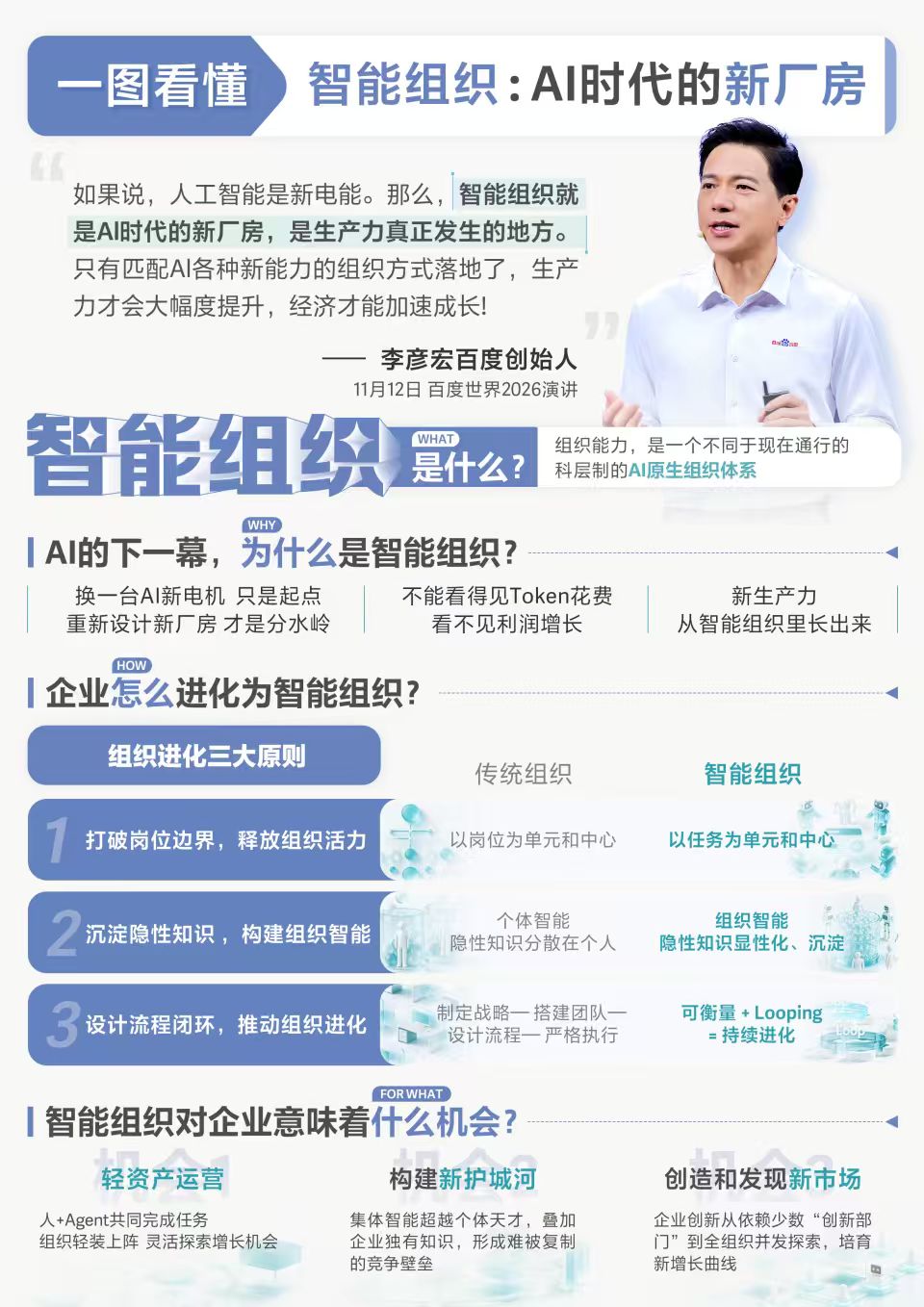
In addition to the financial report, Baidu deserves more attention. This company is promoting AI from personal use to workflow, experience reuse and core R&D, and bringing relevant capabilities to enterprise customers. Robin Lee calls these capabilities intelligent organizational capabilities.
Intelligent organization capability has become the core competition point of the leading Internet companies. ByteDance uses Feishu as the collaborative base and Doubao as the intelligent layer to release the "Doubao Work Partner", allowing intelligent agents to inherit the enterprise work context; Alibaba integrates Qianwen Office and DingTalk to build enterprise level agents and knowledge infrastructure for business flow; Tencent uses WorkBuddy to communicate with enterprise WeChat, allowing intelligent agents to enter existing collaborative networks as "organizational members" and compete for access to enterprise workflows.
Baidu's differentiation lies in its "internal first, external second" approach: after completing its transformation from a functional organization to a task oriented intelligent organization, it encapsulates its internally validated Harness, Skill, and Looping mechanisms into intelligent cloud and AI application products, providing practical organizational intelligence solutions to the outside world. It sells not only model calls or office plugins, but also how to enable agents to enter real business flows and turn implicit experiences into callable assets. A group of corporate clients have restructured their procurement, investment research, and customer service processes based on this, resulting in significant improvements in organizational efficiency.
AI revenue continues to grow in the third quarter
In the third quarter, Baidu's AI business continued to contribute more than half of Baidu's general revenue. AI cloud infrastructure has become an important revenue increment for this quarter.
According to the financial report, Baidu's AI cloud infrastructure revenue in the third quarter was 8.2 billion yuan, a year-on-year increase of 94%. Among them, GPU cloud revenue still increased by 191% year-on-year and 43% month on month, despite a relatively high base in the same period last year.
It is reported that in the third quarter of this year, the revenue related to open source models operated solely on the Baidu Qianfan platform increased more than tenfold. The rise is partly due to the explosive demand for model calls from enterprises. On the other hand, it originates from the improvement of Baidu AI Cloud's enterprise service capability.
Currently, the rental prices of some GPUs in China are rising, and the demand for computing power remains active. According to data released by SMM on October 13th, the monthly rent for 5090 8-card servers in East China increased from 13500 yuan/unit in early September to 16000 yuan/unit on October 10th, an increase of 18.5%. Some securities firms believe that the upward trend in leasing quotes reflects a tight supply and demand for computing power, providing favorable conditions for Baidu GPU Cloud to undertake new demand and contribute more business increment.
Moreover, compared with cloud computing in the past, intelligent cloud mainly serves intelligent agents, providing computing power, models, and operating environments, as well as connecting existing data, tools, and systems of enterprises. Such intelligent clouds are penetrating the underlying resources, IT systems, and even business systems of enterprises like never before. Intelligent agents can flexibly call them, eliminate organizational friction, and efficiently complete tasks.
Baidu has reorganized its intelligent cloud products and services to support customers in better building intelligent agents, completing tasks, and achieving organizational evolution. At present, Baidu AI Cloud has three new service standards: for customers who are "task centric", Baidu AI Cloud organizes computing power, models, data, and security capabilities into a unified infrastructure to support various business tasks; For customers' need to "precipitate tacit knowledge", Baidu AI Cloud helps customers keep and manage the organization's context well, so that the ability of excellent employees and the experience accumulated by the organization become the productivity of sustainable growth of the enterprise; Baidu AI Cloud is helping customers get through the closed-loop of task execution, effect evaluation and feedback optimization for the requirements of customers to "design process closed-loop and promote organizational evolution".
The growth of Baidu's AI business is also related to the increase in AI application revenue. In the third quarter, Baidu's AI application revenue was 2.6 billion yuan. In September, the AI DAU penetration rate of Baidu Wenku and Baidu Netdisk increased by 60.7% year-on-year. The jointly launched library has been fully upgraded, and the global monthly active users have reached 50 million.
According to QuestMobile's third quarter report released on October 20th, the total active user base of Baidu Tuzi reached 9.77 million in September 2026; During the same period, the monthly active user base of AI office reached 142 million, a year-on-year increase of 50.6%, and the demand for AI applications in office scenarios continued to expand. Baidu Tuzi supports cross application and cross file task execution, covering file organization, content generation, and workflow automation. Its official website currently has personal Pro, Max subscriptions, and incremental point packages, forming a product system that charges based on usage intensity. Guotai Haitong Securities has released a research report stating that Baidu's AI application product layout is well-developed and is expected to contribute to increased performance.
Baidu's internal AI capability evolution
Baidu's AI revenue growth in the third quarter is also related to the internal AI transformation within Baidu's organization. Since the beginning of this year, there have been significant changes within Baidu, and a group of AI native organizations are emerging.
In the past six months, Baidu has iterated over 160 times, generating 90% of its code and over half of its external communication materials.
Robin Lee mentioned that only when an enterprise can restructure its organization around AI capabilities can it seize the huge success opportunities given by this era.
In addition to Baidu Tiezi, other departments within Baidu are also becoming AI native organizations. The daily active number of intelligent agents on Baidu has increased from an average of 5000 to 37000 in the past year, a six fold increase. Baidu has built 4300 workspaces and accumulated 20000 company level organizational skills.
The emergence of these AI native organizations can turn an individual's experience into the organizational capability of the entire organization.
Robin Lee said that the biggest difference between organizational intelligence and individual ability is that it will make tacit knowledge explicit. There are many ways of doing things within the company, such as how departments collaborate, make decisions, and negotiate with customers. If this knowledge only exists in the minds of employees and has not been accumulated into something that AI can understand, it will still be just individual abilities, not organizational intelligence. The true organizational intelligence is to make this knowledge explicit and deposited on the company's platform, which can be continuously accumulated, called upon at any time, and available to everyone.
He believes that organizational evolution is not simply about letting everyone do more, but about breaking down job boundaries, accumulating tacit knowledge, and forming reusable loops for every job. The good experiences and methods accumulated by these organizations can be reused by more students and called upon by intelligent agents. This kind of organizational ability cannot be copied, dug up, or bought by others.
Drive other enterprises to evolve together
The transformation of Baidu AI organization is not only happening internally, but also promoting this capability externally, allowing more external enterprises to enhance organizational capabilities through AI and enabling more organizations to enjoy the technological dividends brought by AI.
In order to enable external enterprises and individuals to easily find, purchase, and use trusted model tokens, Baidu has launched a new large model service platform, the Word Element Institute.
Ciyuan is a neutral and trustworthy large model trading platform that connects suppliers and consumers, smoothing the information gap between the two parties. Make trading of keywords as convenient, open, and transparent as trading stocks of listed companies.
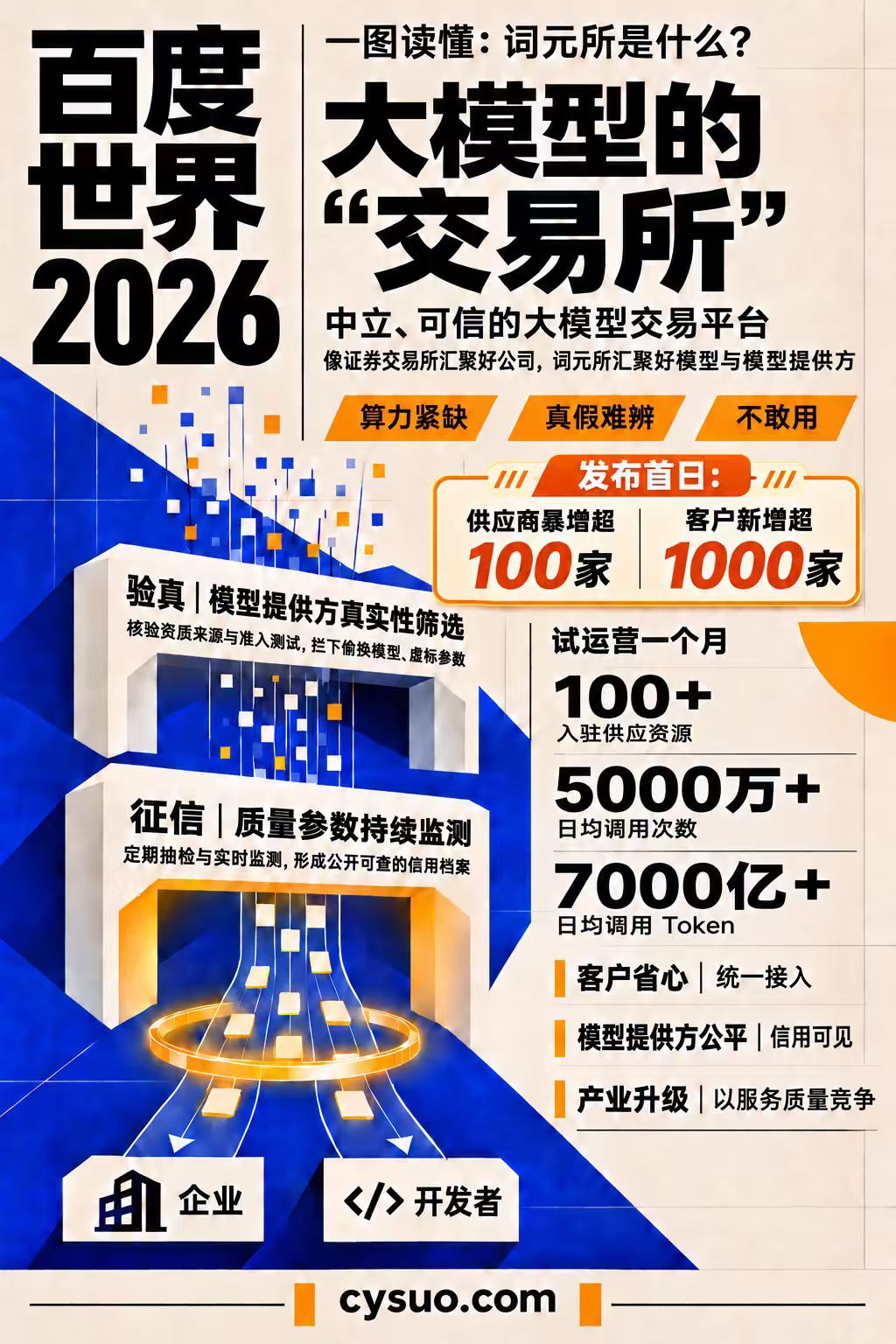
For enterprises, a unified entrance gathers a massive amount of trusted model resources, and they do not need to connect, test, and verify each other one by one. Faster access and more flexible switching have truly lowered the threshold for using large models.
On the first day of Baidu Zhiyuan's release, more than 100 new suppliers have applied to join, and over 1000 new customers have joined. At present, the platform has launched more than 40 models, covering mainstream models and video models such as DeepSeek, Kimi, Zhipu GLM, MiniMax, as well as Baidu's self-developed Wenxin series; The tenants include both model manufacturers and third-party inference service providers.
It is reported that several companies have improved their organizational capabilities through Baidu's various AI services.
A national level specialized and innovative small giant enterprise called Blue Ocean Blackstone has improved organizational efficiency through Baidu's platform. This company has an important task every week, which is raw material procurement. In the past, when making production plans every week, the planning department had to look at sales forecasts, conduct inventory analysis, and provide procurement requirements; The procurement department needs to check prices, analyze trends, formulate strategies, and then place orders in a timely manner to ensure supply.
In the past, companies heavily relied on human experience and manual operations. It is difficult to ensure the accuracy and timeliness of supply and demand matching. Now, Blue Ocean Blackstone has customized three intelligent agents, "demand deduction", "procurement decision-making", and "procurement execution", through Baidu's sub development platform, connecting internal systems such as OA, ERP, and enterprise WeChat. In this way, they can use Baidu to schedule these three intelligent agents and complete the closed-loop procurement task.
Previously, this job required two teams for planning and procurement each week, with 10 people involved and a total of 100 working hours invested. Now, only two people are needed to complete it in less than an hour. Moreover, based on the results of the launch, in addition to saving manpower, the optimization of procurement costs will also bring millions of profits to this enterprise every quarter.
In addition to Baidu Tiezi, multiple companies have also improved their organizational capabilities through libraries. Since its launch three months ago, the capabilities of the Library Enterprise Edition have covered over 600000 organizations, with daily task volume increasing by 9 times compared to the initial launch, and monthly traffic increasing by 4 times. At Nanhua Futures, customer service efficiency has increased by 60%; At Xi Venture Capital, the delivery speed of business has increased by 25%; At Guolian Life Insurance, the investment research team's efficiency has increased by 40%.
No enterprise can only use AI as a tool for personal efficiency improvement. But it is about enabling intelligent agents and digital employees to truly enter the business, into various aspects such as sales, customer service, research and development, and operations. ”Robin Lee believes that new productivity can only grow from AI assembly lines and from intelligent organizations. This is also the direction that Baidu is betting on in the next era.