Economic Observer Follow
2026-11-06 14:15

Yan Huilian | Text
At the beginning of the 20th century, retirement was still a difficult thing to rely on for most American workers. They will continue to work unless their bodies are no longer able to support them. After being forced to "rest", the livelihood of workers can only rely on their families or charity. The Great Depression of 1929 exposed the fragility of this elderly care system and became a serious social problem.
In 1935, the Roosevelt administration passed the Social Security Act, establishing a federal pension insurance system that was jointly paid by employers and employees. After the end of World War II, social security continued to improve, and labor unions fought for corporate pensions through collective bargaining. Some American workers were finally able to rely on public pensions, corporate pensions, and personal savings to live a peaceful life in their later years.
Nowadays, retirement accounts are becoming increasingly popular among Americans, but retirement income may not necessarily be more secure. By 2025, only 14% of workers in private enterprises in the United States will have the opportunity to participate in traditional fixed benefit pension plans, while 70% of workers will have the opportunity to participate in fixed contribution retirement plans. At first glance, retirement accounts are becoming increasingly popular, and workers seem to have more choices. But if we carefully examine their differences, we will find that the changes are not only in the payment methods of pensions, but also in the distribution of responsibilities between enterprises and individuals.
In the past, companies agreed on retirement benefits based on salary and length of service; Nowadays, more and more companies only promise to pay a certain amount to personal accounts. The impact of this transformation on different income earners is also different: high-income earners still have surplus capacity to cope with risks through savings and investments, while low-income earners often find it difficult to maintain their daily expenses. Allowing them to save for retirement decades from now is even more of a luxury.
Why is the pension fund untrustworthy?
The name Studbeck may seem unfamiliar to many people today, but it was once a well-known vehicle manufacturer in the United States. In 1852, the Studbeck brothers opened a blacksmith shop in South Bend, Indiana, and started by manufacturing horse drawn carriages. During the Civil War, it supplied vehicles to the northern army and later developed into one of the world's largest carriage manufacturers. After the arrival of the automotive era, this company successfully transformed and continued to gallop on the roads of the United States. However, in 1963, this enterprise with a history of over a hundred years closed its car factory in South Bend.
For many workers, losing their jobs is not the worst news. They found that the company they had worked for for decades had not saved enough money to redeem their pension. According to the provisions of the pension plan, people who have retired or meet the retirement conditions can receive all benefits; Some employees under the age of 60, even after working for 40 years, can only receive about 15% of the value of their pension; Employees under the age of 40 will receive nothing.
Has the company not previously contributed to the pension fund? This is obviously impossible. Stuttgart Beck established a pension plan with the union as early as 1950, but this system allows companies to spread the pension liabilities formed by past years of service over the next few decades. As long as the company continues to operate, it can gradually replenish funds to the pension fund in the coming decades.
Unfortunately, the company's business situation did not develop as expected. In 1958, Studbeck was in a very difficult situation and even avoided bankruptcy through debt restructuring. But in the autumn of that year, the company launched a compact car called "Lark", which unexpectedly gained market popularity. In 1959 alone, Lark's sales exceeded 138000 units, more than double the company's car sales the previous year.
This has changed the situation of labor management negotiations. In 1959, the trade union took the opportunity to fight for an increase in pension benefits, and the company agreed to their request, but the additional condition was to extend the payment deadline. But the market situation quickly changed, and in the autumn of 1959, General Motors, Ford, and Chrysler successively launched their own compact cars.
By the end of 1960, there were already 11 American made compact cars competing in the US market, and Studbeck lacked the strong distribution network of the three major automotive giants, quickly losing its advantage. The South Bend factory produced approximately 154000 cars in 1959, which decreased to 106000 in 1960 and further dropped to 79000 in 1961, causing the automotive business to fall back into losses. In 1959 negotiations, both parties were still considering payment arrangements for the next 30 years; Just four years later, the company decided to close the South Bend factory.
Seeing the retirement benefits earned after decades of hard work turn into a bubble, workers and unions naturally refuse to give up. But they soon realized that the company may not necessarily be responsible for this money. The pension agreement signed initially only required Studbeck to make regular contributions to the fund, but did not require it to make up for the entire pension when the fund was insufficient. As long as the company fulfills its agreed payment obligations, even if it ultimately cannot fulfill the employee's retirement benefits, it does not necessarily constitute a breach of contract. At that time, federal law neither required companies to raise pension funds according to later established standards nor provided pension termination insurance, making it difficult for workers to recover losses based on their original contracts, no matter how indignant they were.
The Studbeck incident exposed the loopholes in the corporate pension system to the public and also promoted pension reform in the United States. Trade unions and legislators are gradually realizing that relying solely on agreements between companies and employees is not enough to guarantee retirement benefits decades later. In 1967, New York State Senator Jacob Javits proposed a pension reform bill. After years of debate, in 1974, President Ford signed the Employee Retirement Income Security Act, which required companies to raise and manage pensions according to stricter standards and establish pension benefit guarantee companies. When eligible pension plans terminate due to insufficient funds, the institution will continue to pay employee benefits within the statutory limit.
For workers, receiving pension protection is a good thing. But for companies that need to bear long-term liabilities, it is not a benefit. This has even sparked a debate in the academic community: Yale Law School professor John Lambern believes that the 1974 law, while aimed at protecting workers, increased the costs of contributions, insurance, and management for businesses, ultimately leading many to withdraw from traditional pension systems.
Alicia Munnell of the Boston College Retirement Research Center believes that attributing the decline of pension funds to this law is too crude. The intensification of global competition, the decline of union power, and changes in the employment structure in the United States have also affected the willingness of companies to provide pensions. There is serious disagreement among scholars on whether the law affects the aging of traditional pensions. But there is a contradiction that no one questions - workers hope that the company's retirement commitments are more fully protected, while companies increasingly hope to alleviate this unpredictable long-term burden.
Traditional pension funds originally had their own business logic. After the war, large manufacturing companies in the United States needed to cultivate and retain skilled workers, with pension benefits linked to length of service, which could attract employees to stay for a long time. For enterprises, this helps to stabilize the workforce; For workers, long-term service to a company also means an additional guarantee for their later life. But in the 1970s and 1980s, the American manufacturing industry faced more intense competition, and the employment status of large unionized enterprises gradually declined. Emerging industries no longer commonly adopted this long-term employment model. The system originally used to retain employees is increasingly seen by more and more companies as a cost that needs to be recalculated.
Therefore, it seems difficult to attribute the decline of traditional pensions to the bankruptcy of a single enterprise or the enactment of a certain law. The enterprise organization, labor relations, and business environment that it once relied on are all undergoing changes, and its exit is not an accident.
How can a pension be converted into a savings account?
In 1978, a new retirement savings method emerged in the United States. No one expected that it would gradually replace traditional pensions. At that time, the US tax law added Section 401 (k), which allowed employees to deposit a portion of their salary into a retirement account and temporarily not pay personal income tax on this income. They would pay the tax when they received it in the future. Two years later, welfare consultant Ted Benner discovered that companies could use this provision to allow employees to take a portion of their salary and deposit it into a retirement account that enjoys tax benefits. He immediately recommended this idea to the client, but was rejected. Later, other companies began to try, and 401 (k) gradually became popular.
The initial interest in 401 (k) was mainly from companies that wanted to provide additional savings channels for managers and executives. These people usually already have pensions and surplus money to make further arrangements for retirement life. But with the decline of traditional pensions, this plan, originally designed for those with surplus savings, has gradually become the primary retirement arrangement for many ordinary employees.
Some companies are gradually realizing that a 401 (k) can alleviate their retirement burden. According to traditional pension plans, the amount of money employees receive each month after retirement is usually determined by their salary and length of service, and companies need to continuously raise funds to fulfill this commitment. If there is a shortfall in the pension fund, additional contributions may be required. 401 (k) changed this approach. Employees deposit a sum of money from their salary every month, and the company can also make additional payments according to the agreement. Afterwards, the money will be deposited into personal accounts and the employees will bear the corresponding investment risks. The company will no longer be responsible for how much money can be accumulated decades later and how much money can be spent each month after retirement.
This also brings convenience to workers: traditional pensions are usually tied to long-term job relationships, and when employees change jobs, they may lose some benefits because they cannot meet the eligibility criteria for pension. Assets already belonging to employees in the 401 (k) account can be retained or transferred according to regulations. For young people with frequent job changes, they no longer have to worry about whether they need to stay in the same company for a long time just for a future pension.
The development of 401 (k) coincided with the prosperity of the US stock market. In the 1980s and 1990s, the stock market continued to rise, and more and more employees began to purchase stocks and funds through retirement accounts. Deposit a sum of money from your salary every month, and as your account balance increases year by year, personal investment seems to provide another possibility for arranging your later life. In 1990, the active participants of the 401 (k) plan in the United States had reached 19 million; By 1995, this number had increased to 28 million people, exceeding the number of people participating in traditional private enterprise pension plans at that time.
There are also different approaches for enterprises to withdraw from the traditional pension system. Some companies have stopped providing pensions to new employees and instead established 401 (k) accounts; Others freeze their original plans, retaining the benefits accumulated by employees before, but no longer allowing them to increase their pension by continuing to work. In this way, companies can still fulfill their past commitments while gradually reducing the retirement liabilities they will need to bear in the future.
Sears, which used to be spread throughout the United States, also provided traditional pensions for its employees. In 2005, the company decided to freeze the pension plan, and the pension accumulated by employees' past work was still retained. However, from then on, continuing to work at Sears could not increase this benefit. In 2018, Sears filed for bankruptcy, and the following year, the American Pension Benefit Guarantee Corporation took over its two pension plans, involving approximately 90000 employees and retirees.
Sears' employees have an additional layer of protection compared to the Studbeck workers of the past, as the United States has established a pension insurance system, and the guarantee agency is expected to be able to guarantee the vast majority of their accumulated benefits. But insurance can only protect the pension that has already been earned in the past, and cannot compensate for the potential increase in benefits after the plan is frozen. Sears did not go bankrupt until 2018, but employee pensions stopped increasing as early as 2005.
From Studbeck to Sears, the corporate pension system has undergone over half a century of reform. There are problems in the traditional pension system, and 401 (k) is not perfect either. The Internet foam burst in 2000 and the financial crisis in 2008 made investors experience severe market fluctuations. Young employees still have time to wait for the market to recover, while workers nearing retirement may have to postpone their retirement as a result.
Even if the investment goes smoothly, the money in the account may not be enough for a lifetime. Traditional pension usually pays lifelong benefits on a monthly basis, while 401 (k) requires retirees to arrange their own expenses. No one knows how many more years they can live: spending too quickly may exhaust their savings in their later years; Being too frugal may also prevent one from enjoying the present life due to concerns about the future.
The author of 'Old and Unrested', Girarducci, believes that retirement security should not only depend on how much assets workers have accumulated, but also on whether this money can sustain them for the rest of their lives. 401 (k) places more responsibility on individuals, making it particularly difficult for workers with limited income to bear the risks involved. For low-income individuals, when their retirement savings are insufficient to cover their living expenses, they have to continue working to make a living.
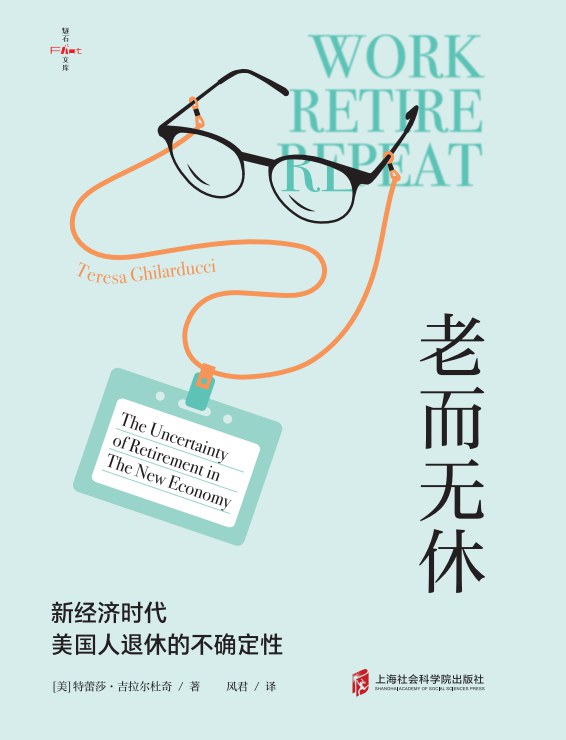
Old Without Rest
Written by Theresa Girarducci
Feng Jun | Translation
Shanghai Academy of Social Sciences Press
May 2026
Who has the freedom to retire?
Earning a few more years' salary, spending less savings, and waiting until there is enough money in the account before retiring sounds like a reasonable solution. But for those who have been engaged in physical labor for a long time, they may already be troubled by occupational injuries and health problems before reaching retirement age. Even if their bodies can still support them, companies may not be willing to continue hiring them. According to a survey conducted by the Pew Research Center in 2024, among working adults aged 65 and above in the United States, 17% are primarily driven by economic needs, while 56% have both the motivation to enjoy their work and the motivation to rely on their salary.
This situation also affects the employment benefits of the elderly. There is a concept in economics called retention wage, which refers to the minimum wage that workers are willing to accept for a job. Low income individuals do not have many options in the market, and even if they work hard and earn meager wages, as long as they can afford their living expenses, they may accept it. The insufficient pension weakens the ability of workers to leave their jobs and also weakens their bargaining power when they stay in the labor market.
This is also the reason why American labor unions fought for pensions back then. In 1950, labor songwriter Joe Glazer wrote "Too Old to Work", which tells the story of workers who have worked for the company for many years but have no way to make a living in old age. At that time, the union hoped to use pensions to prevent workers from having to wait until their bodies were completely broken before being forced to leave the factory.
In Girarducci's view, retirement has a common historical background with weekends off, paid leave, and daily working hours regulations. She believes that in addition to wages, labor income also includes time not required to work. The gap in retirement security among workers is also reflected in the difference in how much time they can have in their later years.
401 (k) creates this gap before retirement. Retirement accounts require decades of continuous contributions, but life is difficult to have decades of smoothness. When unemployed, divorced, or suffering from illness, people with other assets may be able to temporarily stop saving; People with limited savings can only withdraw their retirement benefits in advance. What is withdrawn is not only a sum of money in front of us, but also the potential returns that this money may generate in the coming decades. Research has found that low-income families are more likely to use their retirement accounts after experiencing life shocks, and an immediate crisis may weaken their retirement readiness years later.
Personal accounts have also changed the direction in which people pursue responsibility. Stuttgart Beck's pension cannot be redeemed, and the problem points to the company's financing obligations and legal protection; When the personal account balance is insufficient, people tend to point the finger at the workers, questioning why they didn't save money earlier and didn't choose the right fund. Savings and investments certainly require personal judgment, and adults should be responsible for them, but financial knowledge cannot resist the reality of low income and sudden unemployment. When the salary is only enough to sustain daily life, saving is first a matter of whether there is surplus money, and then how to improve investment levels.
Government tax incentives may not necessarily help those who need pension security the most. 401 (k) allows workers to deposit a portion of their pre tax salary into an account and pay taxes upon retirement. But the higher the income, the more surplus savings there is usually, and the more likely it is to receive more current tax benefits. The risks borne by individual accounts may also be transmitted to the entire economy through consumption. During the economic recession in the United States, a stable pension helps maintain daily consumption; Families with significantly reduced investment accounts may cut expenses and postpone retirement. If similar choices occur on a large scale, the sales and employment of enterprises will be further impacted.
Girarducci believes that the risk allocation of the pension system is also related to the economy's ability to withstand recession. How to improve this situation? Girarducci and collaborators proposed the establishment of a guaranteed retirement account: jointly paid by employers and workers, covering part-time workers and freelancers, reducing the burden on low-income earners with refundable tax credits, controlling costs through centralized investment, and providing lifetime pensions after retirement.
But there are still many practical problems with this reform plan: low-income earners may not have the capacity to continue paying, financial subsidies require stable sources of funding, and investment losses must also be borne by someone. How to reasonably share costs among different groups and ensure the fulfillment of pension commitments decades later still needs to be tested in reality.
The profound aspect of 'Old without Rest' is that it allows us to see the life behind retirement accounts. Unemployment, illness, and market fluctuations can all change a person's savings for decades, and aging does not wait for their financial situation to improve. As retirement becomes increasingly dependent on personal planning, people seem to have to be fully prepared for the life they have not yet experienced. Life never happens according to plan.