Economic Observer Follow
2026-11-06 12:27


Among young Chinese writers, Sauer's figure is somewhat unusual, and his works are sometimes difficult to classify. His new novel "The Lingering World" focuses on four independent yet secretly interconnected stories, focusing on Southeast Asian Chinese merchants, Dan people, Vietnamese refugees, and Shenzhen migrant workers, questioning the individual's belonging in the midst of mobility.
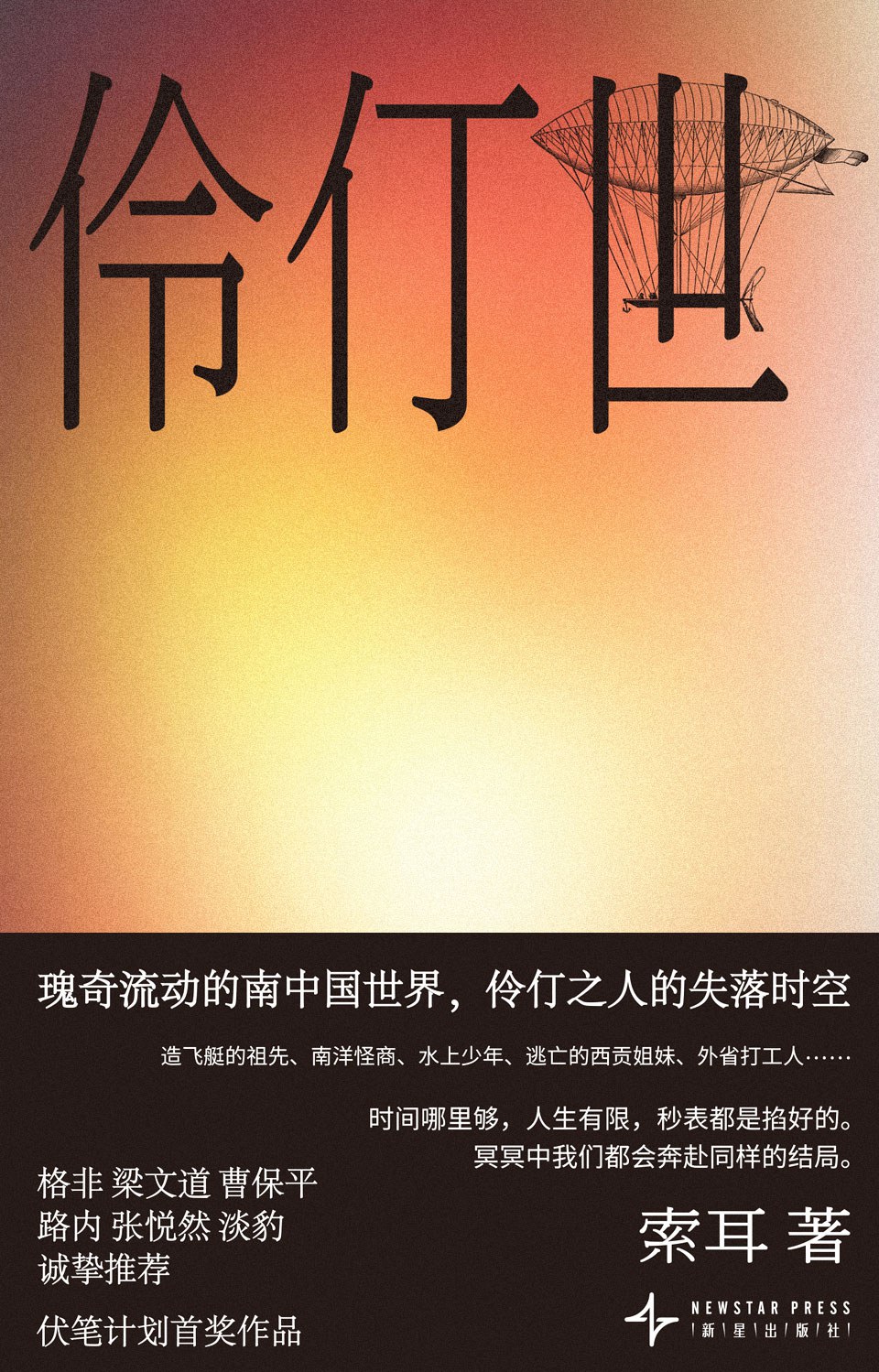
The Lingering World
Suo'er | Written
New Classic Culture | New Star Publishing House
March 2026
The novel adopts a blend of Minnan dialect, Cantonese, Hubei dialect, and Mandarin, and draws on the surreal image of the "guava airship" to wrap up the entire piece. Inspired by symphonic music, the structure attempts to present the discrete scene of the 20th century in a polyphonic manner.
Tracing Sauer's writing career, he combines literary experimentation, local storytelling, and exotic legends. Through years of practicing writing, he has been able to navigate between reality and imagination with greater ease.
On the occasion of the release of his new book, we had a chat with him.
I chiseled several holes in the back of this giant beast in the 20th century
Economic Observer: The characters in your writing, whether they are Nanyang Chinese businessmen, Dan people, Vietnamese refugees, or Shenzhen workers, are all asking 'Where do I belong'. How does this questioning resonate with your own growth experience? From the "southernmost tip of Chinese Mainland" to Guangzhou, Wuhan, Beijing, and back to the south, does this geographical drift make you have special sympathy for these "Lingding" lives?
Sauer:Maybe it is. Geographic migration brings freshness and discomfort, and one needs to adjust oneself and change one's "tentacles" in order to embed oneself in a new place. Human beings are not a single entity, but a complex state that constantly accumulates. People are actually not that difficult to change. But often the feeling is that after spending a lot of time with a place, just establishing some connections, you have to say goodbye and turn to another place. There are always some regrets emotionally.
But on the other hand, we are probably all strangers, and even if we return to the place where we were born and raised, it is not the hometown we remember. Many times, it just goes with the flow.
Economic Observer: The main chapters of "Lingdingshi" use a mixture of different language systems: Minnan dialect, Shui Shang Ren dialect, Cantonese, Hubei dialect, and Mandarin. But dialect writing faces a dilemma, as readers who are too "rustic" cannot understand it, and those who are too "plain" lose their flavor. What is your specific operational strategy when you are trying to strike this balance?
Sauer:It's really difficult. The dialect here is of course a transformed language, a product of mixing with standard written language. After writing, repeatedly modify and adjust the dialect concentration to a balanced position. But the so-called 'balance' is also a fallacy, everything depends on subjectivity. What I am seeking is actually a level that locals may find strange but still acceptable when reading, while outsiders may not understand it at first but can guess it based on the context.
In fact, I gradually realized that dialect writing is not about how many authentic words appear inside, but about its internal rhythm. There is that rhythm, even if it is completely replaced with Mandarin, it will still be there. I also found that there is a high degree of similarity between classical Chinese and dialects. Dialects themselves retain many ancient words and phrases, so I also use classical Chinese as a glue between dialects and standard languages.
In addition, I will also try to choose dialects that are close to the standard language when choosing different expression paths. For example, in Cantonese, the expression "why" is often expressed as "dianjie", but using "dianjie" obviously confuses Mandarin readers, so I would rephrase it as "hejie". Similarly, there are also "return" and "turn around". I use "return" instead of "flip" to make it easier to understand.
Economic Observer: There is no traditional long causal chain between the four stories, you are more like juxtaposing several celestial bodies on the same orbit. You also mentioned that this structure was inspired by symphonies, with four chapters corresponding to different tonality of each movement. This structure poses a challenge to readers' reading habits. When readers expect a coherent narrative like a 'long river novel', why do you choose such a counter expectation structure? How does this structure serve the theme of the 'lonely world' itself?
Sauer:This structure was actually determined almost from the beginning, without any doubt. The stories of the four main chapters, including the characters, their time and era, are all representative of the mobile history of the 20th century in my opinion. Because the time span of the novel is relatively large, and I don't want to write traditional long river novels, so I started with 'small'. The 1920s, 1930s, 1950s, 1970s, 1990s - it's a bit like I chiseled a few holes in the back of this giant beast in the 20th century, and from inside, it seems like I could also get a glimpse of its complex internal organs.
This structure is of course anti centric, and different styles are intentionally used to distinguish between chapters, which actually conforms to a certain "southernness" - "southernness" itself is also loose, complex, and polyphonic, making it impossible to have its internal "same voice" and pour it together.
Economic Observer: The novel begins and ends with the surreal image of "pomegranate airship", which is very charming and carries a certain utopian imagination. What do you want to express most about choosing it as the structural image of the entire book?
Sauer:Actually, many times it's just an intuition. The airship is a "Chinese boat" designed by Xie Wangtai. When I saw its design, I felt that it had a very strong steampunk feeling, which was very touching, so I wrote it down. Later on, its airbags were gradually replaced by the guava (we call it pomegranate or chicken poop fruit) that I ate when I was a child. The two are grafted together in this way, both local and wandering.
In the story, the pomegranate airship is something passed down from generation to generation through word of mouth. It may seem surreal, but in reality, fantasy is not much weaker than this. Even if you look back at history, one hundred or two hundred years ago, you will find that what seems incredible now may have been done by someone back then.
For example, I recently learned an interesting story that happened in Shanghai in 1936. The president of the Commercial Freemasonry Union at that time, on his birthday, flew away with his wife in a newly made French hot air balloon and went missing. At that time, the hot air balloon ignited, the gathering before departure, and the hot air balloon flying in the sky all left recorded images. Later, a contemporary artist also created works based on this. I think it's amazing to see this. The couple in the photo have a relaxed expression, and when they board the hot air balloon, it feels like they're attending an after party. It's very ordinary, and they don't feel like it's a formal matter at all, nor do they realize their future destiny. But they just disappeared like this.
The dispersion in history is accompanied by geographical migration
Economic Observer: You say you are a person who "tries to perceive the environment through smell and footsteps", so this book has conducted a lot of field research. Do you think this specific experience injects something different into the novel?
Sauer:This kind of 'field' is probably embedding oneself into the specific environment depicted in the pen. This way, I will feel closer to the object of writing. I have not personally experienced the vast majority of the history written in the book, and many of the objects in the book are also strangers to me. First, break free from one's original identity and cognition before entering them. Look at what they see, think what they think.
Besides the mind, other parts of the body also need to participate in this process. I would also call it a calibration, just like as a land person, I always had unrealistic imaginations about water people before chatting and interacting with them. Actually, that was imposed on them by me. What are their own thoughts? How many of their ideas were influenced and assimilated by terrestrial societies after they landed? These things gradually became clear after coming into contact with them.
But then again, what is the so-called 'truth'? Imaginative reality is also important. This kind of calibration is more about protecting a solid fact, but for those facts that are at the intersection of light and dark and have a lot of room for expansion, I will respect the initial imagination more. So calibration is also a form of recalibration.
Economic Observer: You said that you are "naturally not very interested in the overall, unified things, and care about more subtle things, as well as things that are different from the larger system". The novel 'Lingdingshi' depicts people outside of these 'big systems' - Chinese merchants, Dan people, returned overseas Chinese, and migrant workers. When did this attention to the dispersed begin?
Sauer:This tendency may have started very early. If I were to pay more specific attention to these people, it was after returning from my trip to Malaysia in 2019 that I became curious and asked a series of questions, searched for information, walked and collected materials on the ground, and gradually gained a better understanding of them.
The dispersion in history, accompanied by geographical migration, often stems from a survival instinct and is passive, like pieces of meat thrown away with centrifugal force; They take root in different places and gradually establish their own subjectivity, at which point they have more choices, either to return, stay, integrate, or break away. Their existence provides a perspective beyond the continent, which I think is precious - that is, besides being squeezed into a solid continent, they can still live in the form of scattered islands.
Economic Observer: You have proposed an interesting concept, 'the realm of mobility'. This territory transcends borders, languages, and time. For you, is' South 'not just a geographical location, but also a way of viewing the world? What are the core features of this approach?
Sauer:The term 'South' that we often refer to has both localized narrowness and the danger of expanding its scope, leading it to become void. So I want to use another word to summarize the space we are talking about.
'Flow' means that all relationships and positions are in flux, rather than a constant relative 'south' or 'north'. It is indeed a way of viewing the world, not a center periphery narrative, but an acknowledgement that the world is inherently "non centered" or "polycentric"; Those exiled people, those moss like creatures, even if you look at them or not, they still exist.
They are geographically dispersed, with natural barriers, but also interconnected in a mysterious way, like a network of hyphae. For example, people who make a living from water not only have sea dwellers, but also river dwellers, lake dwellers, and pearl dwellers, which exist in both the south and north; It is better than those Zomia who evade rule, not only in the southwestern mountainous areas or Southeast Asia, but also spanning all the mountains and caves that can escape the world on land.
Economic Observer: The book blends reality and fiction, with historical figures such as Yu Dafu and Kang Youwei coexisting with fictional characters. You mentioned that Kang Youwei's "Unfulfilled Journey to Brazil" was also one of the creative inspirations. What principles do you follow when dealing with the boundary between historical truth and fictional fiction? Where is the fictional ethical bottom line?
Sauer:This question is very interesting. It's hard to say what specific principles and bottom lines are. My own feeling is that those so-called solid facts (history) have already marked the rough outline, just like drawing something, with the head and tail already drawn. What I need to do is fill in the middle body, and there can be many paths in it, which is the fictional space.
What novels aim to magnify is that kind of 'private' aspect, and I don't care about big things. If it's about writing about people, I focus on their human side, rather than the abstract, voluntary, and emotionally charged parts. Speaking of which, it's actually about creating that layer of 'illusory reality'. It's very consistent in the text and looks real, but it won't impersonate historical materials or disguise itself as a documentary memoir. For me, writing is not about deliberately thinking about this, but more about self-awareness.
An instinctive inertia makes us give up entanglement with complexity
Economic Observer: You have described your early creative pursuit of "the coexistence of heterogeneous beauty and aesthetics", and attempted literary experiments in "Non kinship and Non kinship". In 'Lingdingshi', the experimental nature seems no longer as significant as in the previous work. How do you view the "heterogeneity" and "experimentation" in contemporary literature, and how do you reflect them in your own works?
Sauer:Although I say so, I am actually very wary of things like "heterogeneity" and "experimentation". Many works that are touted or self proclaimed as heterogeneous are actually just clich é s. I have seen this situation many times before.
Heterogeneity is more like a vision and inclination, not necessarily a result, its path can be infinitely extended. I certainly strive to pursue heterogeneity, but in fact, true novelty or heterogeneity is very rare. Moreover, heterogeneity is often relative. In the literary ecology of China, some works may seem heterogeneous, but on a global scale, they are merely a repetition, imitation, or reference.
Deliberate heterogeneity is not advisable, it is essential to express oneself truthfully. No matter what form or method it is, it ultimately needs to reach that level of authenticity. Once the true self is expressed, it cannot be replicated.
Economic Observer: When it comes to the experimental nature of Chinese literature, readers may be most familiar with the avant-garde literature of the 1980s. However, as major avant-garde writers turn to realism, the experimental nature of contemporary Chinese literature seems to be less mentioned and praised. What do you think is the difference between the so-called "experiment" and "heterogeneity" in today's literature and the 1980s?
Sauer:Like 'experiment' and 'heterogeneity', I am also very cautious about the word 'pioneer', even more cautious. It is a sealed heritage belonging to a certain period, and its imitation and intensity also block the passage of intergenerational extension.
To be honest, the previous words were actually good words (or at least neutral), but today they have a strange sense of disconnection and have become some kind of rough labels. When literary forms and evaluation criteria become singular, even a slight strangeness can appear detached, fragmented, and difficult to understand. Many times, I feel that our literary ecology is like an isolated island, as if it is not connected to the world.
If you look at literary works from a subtle, continuous, and global perspective, you will find that there is never any "experiment," "pioneer," or "heterogeneity," only good or bad. A certain style that you consider experimental or heterogeneous is just a small tributary of the river of styles. There's nothing to be surprised about. What looks like a problem is not actually a problem.
I certainly believe that today's literary attempts are more diverse and complex than before, but some may not appear in our field of vision, and even if some do, we may not be able to discover their goodness. What's the solution? Leave it to time.
Economic Observer: You once said, 'Writers need to have good language skills first, and then they need to have a good understanding of their imagination. Unfortunately, in today's society, the demand for accuracy and vividness in language has been weakened.' In the era of short videos and AI, language seems to be being replaced by information. What is the significance of a contemporary writer insisting on good language?
Sauer:Language is the first sign of an author (work). I think the meaning may be guarding this complexity, and I don't think language can truly be replaced. Many times we give up voluntarily. An instinctual inertia makes us give up entanglement with complexity.
This process is step-by-step, giving up a little today, giving up a little tomorrow, and at a certain moment, it seems like everything has become a huge problem. Persisting in language is actually just the most basic job, which is to bite firmly from the beginning and not loosen.
Economic Observer: Looking back at your starting point in reading and writing, which writers have had the deepest impact on you? How did they shape your literary perspective?
Sauer:My earliest attempt at writing should have started with a poor imitation of "street vendor literature" in my childhood, such as Cen Karen's "Happiness Flower" and Qiong Yao's "Colorful Clouds in the Sky", as well as Jin Yong's martial arts novels. Later, when I was in high school, I read Su Tong's "Cavalry" and was surprised to find that the novel could be written in this way. So I also tried to write one and was encouraged by my Chinese teacher at the time, feeling flattered.
Didn't we talk about the topic of "avant-garde" earlier? So Su Tong's novels are a kind of enlightenment for me, and "avant-garde literature" may still have some imprints on me. Afterwards, I will continue writing and reading, gradually engaging in self-education in literature. Actually, many writers have influenced and nourished me. This list can be very long, but if I had to choose the 'most', I would definitely choose Thomas Bernhard.
For a period of time, I was addicted to the exaggeration, satire, repetition, musicality, and toxic emotional power in his works, but in fact, his influence on me has far exceeded the level of text and works. Sometimes I can't help but wonder: Is it also because the environment is too protective of a writer who has been angry, independent, and critical (including self-criticism) for decades? But anyway, get closer to him.
Economic Observer: Currently, you are a full-time writer. Do you think you can make a living by writing? Do you have the idea of looking for a new job?
Sauer:I don't have much confidence, so I'm just taking one step at a time. Look at how long you struggle with reality and material desires, and if you can't stand it, you'll go find it.
Economic Observer: In addition to the Southeast Asian countries mentioned in "Ling Ding Shi", you have also traveled to the United States, Europe, and other places. How has this experience affected your writing and life?
Sauer:I mainly have experience in some resident projects. The residence is neither permanent nor travel, its duration is neither long nor short, just right. These experiences have indeed broadened my horizons. When communicating with people from different regions, I find that their views and understandings of the same thing are so different. We may even get caught up in debates. I often have some surprises in my mind, such as "Oh, I didn't have to do that" or "There's this solution", which is a bit like walking on a narrow road and suddenly realizing that there are actually many forks in front of me.
On the other hand, we share the same sensitivity, vulnerability, joy, and sadness, and can share them safely without reservation, because we know that we have come from faraway places to gather here and will eventually part ways. We all have a human side, with the greatest common divisor, as if we are not much different from each other. It also gives me a vague illusion: no matter where I go, it seems like I'm still walking on the familiar path of my hometown.
During this process, sometimes an emotional connection is established, which is irreplaceable. For example, I used to rarely listen to and find it difficult to enter soul music. I always felt that it was far away from me, but after going to Detroit, I realized that such music should indeed grow in such a place. I even feel that the roots of this music are floating in the air of this city. Later, whenever I listened to such music, it seemed to immediately connect me to that distant land. It's quite amazing, isn't it? It's like there's a USB flash drive inserted into the host. I hope to have more and more USB ports.
Economic Observer: Finally, let's recommend a recently published new book for the readers of Economic Observer!
Sauer:I recommend two books.
One book is "The Paper Road" by Erik Muegler, an anthropology professor at the University of Michigan. The description of the landscape is very interesting: the landscape is not only a natural ecology, but also a social network constructed by British botanists. The book also contains many clues about eyes, perception, mysticism, interactions between Western botanists and locals, and so on. The author's narration has both charm and rhythm, giving a feeling of being narrated in detail.
The other one is Yang Xiao's' Another Country '. When reading this book, I feel that the author is a true 'global citizen'. Inquire and reflect like shadows following in one's footsteps. Although it is about Germany in the past 20th century, the past is the present, and time and space are not broken, but a continuous fabric. I can also feel that the author has a tendency to lay their own literary trajectory (or rather, 'ambition', or rather, this tendency has already been completed), which is amorphous and quite free.


 Subscribe