Economic Observer Follow
2026-11-05 22:16

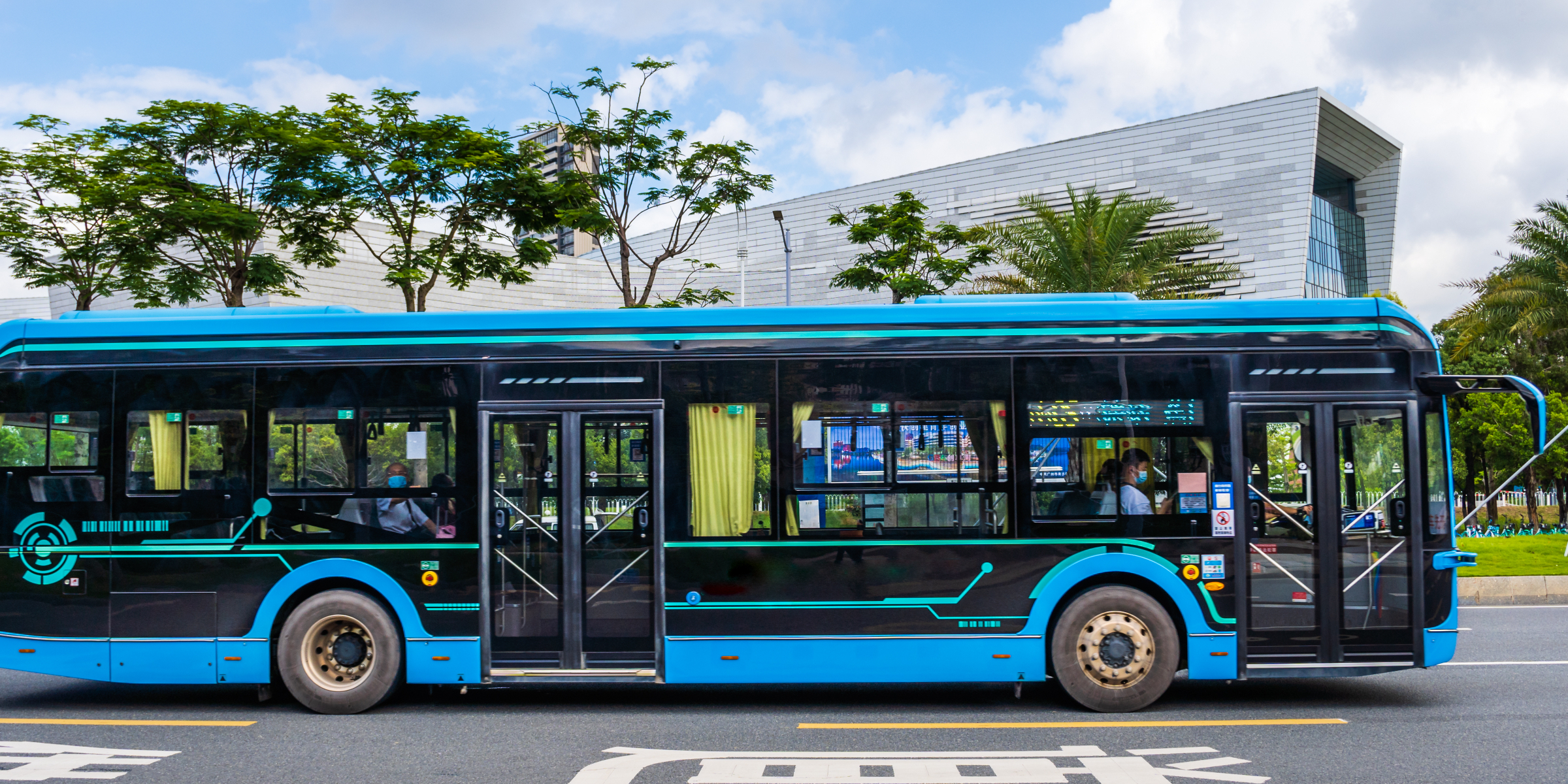
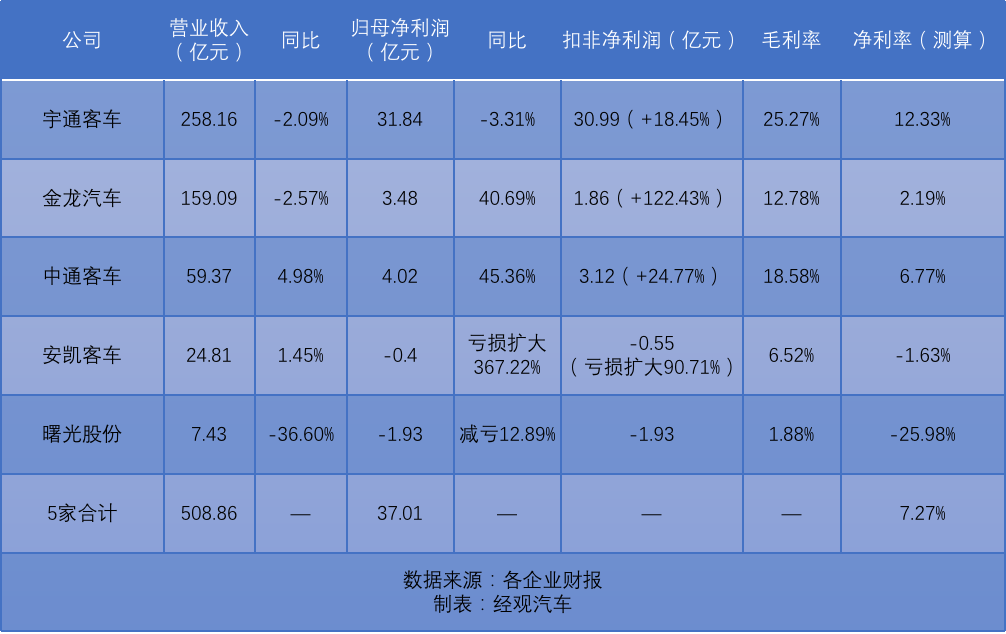
Domestic bus listed companies will gradually disclose their third quarter reports for 2026. According to the Economic Observer, the five listed bus companies achieved a total revenue of 50.886 billion yuan and a net profit attributable to shareholders of 3.701 billion yuan in the first three quarters, with a net profit margin of 7.27%, higher than the overall profit margin of 3.3% in the automotive industry from January to September. The overall profit of the bus industry is better than expected, but there is obvious differentiation among enterprises: some have both decreased revenue and profit, some have increased revenue without increasing profit, and some have decreased revenue but increased profit. Only Zhongtong Bus has achieved a simultaneous increase in revenue, profit, and cash flow; Yutong Bus contributed 3.184 billion yuan in net profit attributable to the parent company, accounting for 86% of the total profit of the five companies, and the industry's profits are highly concentrated.
In the first three quarters of this year, the bus industry as a whole maintained stable growth. According to data from the China Association of Automobile Manufacturers, the sales volume of passenger cars from January to September was 433000, an increase of 6.4%, but almost all of the increase came from light passenger cars: the sales volume of light passenger cars was 351000, an increase of 8.1%; There were only 82000 large and medium-sized buses, a decrease of 0.5%. According to data from the China Bus Statistics Information Network, 27 key enterprises have sold a total of 87000 buses over 6 meters, a decrease of 2.18%; In September, sales of 11000 vehicles per month decreased by 13.41%, making it the worst performing month of the year. This means that the growth of sales in the bus industry cannot be simply equated with an "overall recovery", and the focus of demand is shifting from centralized transportation dominated by large and medium-sized passengers in the past to lighter transportation that is more dispersed, flexible, and closer to end use scenarios.
Currently, the passenger flow of domestic public transportation continues to be under pressure. In the first three quarters of this year, the urban passenger traffic was 79.28 billion, an increase of 2.5%, but the number of public buses and trams was about 26.52 billion, a decrease of 2.4%, and the passenger flow was diverted by taxis and subways. By 2025, the national public transportation passenger volume will reach 36.566 billion, a year-on-year decrease of 5.5%, which is only 52.86% of 2019. Even if the subsidy for the renewal of new energy public transportation continues in 2026, the sales volume of buses from January to September will still decrease by 3.8%, and the monthly year-on-year decline in September will be 15.2%.
The only clear increase is overseas: from January to September 2026, 44194 large and medium-sized buses over 7 meters were exported, a year-on-year increase of 8.17%; 15984 new energy buses were exported, a year-on-year increase of 26.98%, with a growth rate of about 7.6 times that of the domestic new energy bus growth rate of 3.53%. Export has become a key variable supporting the profits of bus companies and has also amplified the differentiation between enterprises.
In addition, BYD, Foton Motor, Dongfeng Motor, and others also have bus businesses, but buses are not their main business. They are more responsible for strategic functions such as new energy technology going global and brand trust building. Among them, BYD produced and sold 4540 buses from January to September, an increase of 22.5%; Overseas new energy buses exported 3930 units, an increase of 17.3%, ranking first in the industry with a share of 24.6%, accounting for 86% of exportsFoton Motor sold a total of 35000 large, medium, and light buses in the first nine months, ranking among the top players in the bus industry, but only accounting for 14.9% of the company's total sales. Dongfeng Motor Corporation has sold a total of 1989 vehicles, a year-on-year decrease of 48.5%.
Yutong dominates, while Jinlong and Zhongtong see profit growth
Yutong Bus is still the industry leader. In the first three quarters, its revenue was 25.816 billion yuan, a decrease of 2.09%; The net profit attributable to the parent company was 3.184 billion yuan, a decrease of 3.31%. This is mainly due to the decline in its market sales, with Yutong buses selling 31000 units in the first three quarters, a decrease of 7.83%. However, excluding the impact of non recurring gains and losses of 676 million yuan in the same period last year, Yutong Bus had a non recurring net profit of 3.099 billion yuan in the first three quarters, a year-on-year increase of 18.45%. This indicates that its main business has increased its single vehicle profitability despite a contraction in sales volume. Data shows that its gross profit margin for the first three quarters reached 25.27%, the highest in the industry.
Export is an important source of profit increase for Yutong Bus. Data shows that in the first half of 2026, Yutong exported 6850 vehicles, a year-on-year increase of 13.8%, with exports accounting for about 34%; During the same period, domestic sales reached 13000 units, a year-on-year decrease of 13.4%. This year, Yutong Bus did not disclose its profits in overseas markets separately, but data for 2025 shows that Yutong's overseas gross profit margin is 10.53 percentage points higher than that in China. However, Yutong experienced a temporary slowdown in exports in the third quarter, with 3928 vehicles exported, a year-on-year decrease of 16.81%. Among them, the export of new energy was about 1000 vehicles, a year-on-year decrease of 23.95%. At the same time, as domestic market sales decline, how to maintain export advantages while stabilizing domestic demand will be Yutong's next challenge.
Golden Dragon Motors' revenue for the first three quarters was 15.909 billion yuan, a decrease of 2.57%; Net profit attributable to the parent company was 348 million yuan, an increase of 40.69%; Deducting non net profit of 186 million yuan, an increase of 122.43%; The gross profit margin is 12.78%. Jinlong Automobile stated that the increase in net profit is mainly due to the optimization of product structure, cost reduction and efficiency improvement, and refined management, as well as the improvement of operational quality and efficiency. However, in the third quarter, revenue decreased by 19.62% and net profit attributable to shareholders decreased by 45.24%. Jinlong Automobile explained that this was mainly due to factors such as a year-on-year decrease in operating revenue and changes in product sales structure. In terms of sales, Jinlong Automobile sold 36000 units from January to September, an increase of 2.34%; In September, 4137 vehicles were sold, a year-on-year decrease of 15.16%. The proportion of exports has exceeded half, and overseas markets have become the core growth engine of Jinlong Automobile.According to the 2026 interim report, Jinlong Automobile exported 17800 passenger cars in the first half of the year, accounting for approximately 74.5% of the total sales of 23900 vehicles.
Zhongtong Bus is the only company among the five that has achieved a simultaneous increase in revenue, profit, and cash flow. Its revenue for the first three quarters was 5.937 billion yuan, an increase of 4.98%; Net profit attributable to the parent company was 402 million yuan, an increase of 45.36%; The gross profit margin was 18.58%, an increase of 1.46 percentage points, second only to Yutong Bus; The net operating cash flow was 1.685 billion yuan, an increase of 274.85%. In terms of sales, Zhongtong Bus sold a total of 11200 vehicles in the first three quarters, a year-on-year increase of 24.41%. Among them, 11000 vehicles were sold for buses over 6 meters, with a market share of 12.68%, ranking second in the industry. The export performance was equally impressive, with 6446 large and medium-sized buses over 7 meters exported in the first three quarters, a year-on-year increase of 28.56%, and an export market share of 14.59%.
Ankai Bus and Shuguang Shares are under pressure
Ankai Bus increased revenue but not profits in the first three quarters, resulting in an expansion of losses. In the first three quarters, Ankai Bus had a revenue of 2.481 billion yuan, an increase of 1.45%; The net profit attributable to the parent company changed from profit to loss, with a loss of 40.45 million yuan, and the loss increased by 367.22% year-on-year; Deducting non loss of 54.99 million yuan, an increase of 90.71% year-on-year. The gross profit margin was only 6.52%, a year-on-year decrease of 1.49 percentage points; The gross profit margin for the third quarter was only 2.97%, a year-on-year decrease of 4.3 percentage points. Ankai Bus sold a total of 6193 vehicles in the first 9 months, a year-on-year increase of 1.66%. Among them, the cumulative sales of large passenger vehicles were 1789, a year-on-year decrease of 45.16%, medium-sized passenger vehicles were 3364, a year-on-year increase of 80.96%, and light passenger vehicles were 1040, a year-on-year increase of 7.11%.
According to the financial report, Ankai Bus's financial expenses increased by 161.71% year-on-year from -9778000 yuan in the same period last year to 6.034 million yuan, mainly due to exchange losses. Ankai Bus has a relatively high proportion of exports. Data from the first half of this year shows that its export revenue accounted for as high as 53.77% in 2025, but declined in the first half of this year, reaching 49.97%. At the same time, the export gross profit margin decreased by 3.83 percentage points to 6.10%. In terms of expenses, the proportion of raw material costs to operating costs is as high as 88%, management expenses increased by 18.15% year-on-year, and the proportion of three expenses to revenue increased to 6.76%, further compressing profit margins under the background of slight revenue growth.
The pressure on Shuguang Shares is even greater. The main operating revenue for the first three quarters was 743 million yuan, a year-on-year decrease of 36.6%; The net profit attributable to the parent company was a loss of 193 million yuan, with a deduction of non net profit loss of 193 million yuan. Shuguang Group stated in its financial report that the decrease in operating revenue was mainly due to the intensification of internal competition in the automotive market, the impact of overseas geopolitical conflicts on the execution of some orders, the acceleration of customer iteration leading to a decline in demand for old products, the failure of new products to fill the sales gap, and the sales of 400 incomplete vehicles during the same period. Shuguang Group's main operating revenue for the third quarter was 238 million yuan, a year-on-year decrease of 22.5%; The net profit attributable to the parent company was a loss of 66.2082 million yuan, with a gross profit margin of only 1.88%, ranking last in the industry. Shuguang Group's cumulative sales from January to September were 671 vehicles, a year-on-year decrease of 45.93%. Huanghai Bus is one of the core brands under Shuguang Group, but the operating pressure is obvious this year. Based on the design production capacity in 2025, the utilization rate of vehicle production capacity in the first nine months was only 1.61%.
Although the performance of listed bus companies varies, they face similar external new opportunities. At present, the bus industry has fully entered the stage of stock game and accelerated its development towards electrification and intelligence. The subsidy for updating old vehicles continues to be implemented, and the demand for new energy buses over 6 meters is strong, which is an important increment in the industry. At the same time, the recovery of the tourism market is driving the demand for tourist buses, which is attracting passengers to return. Whoever can seize these new opportunities will be the key to winning the future.
At the same time, Chinese buses have high cost-effectiveness and mature new energy technologies. Orders in regions such as the Middle East, Latin America, and the Commonwealth of Independent States have grown significantly, and exports have become the second growth pole. Some companies have seized export opportunities and maintained high profits and gross profit margins despite declining sales. However, it is worth noting that with the increase in the overseas base of passenger cars, the growth rate has slowed down. How to accelerate the overseas expansion while avoiding geopolitical and exchange risks has become a common issue for passenger car companies.
Challenges also exist. The profit model of the bus industry has shifted from the past "subsidy+bus volume" to more market-oriented competition, and sustained profitability in China is not easy. In terms of net profit per bicycle in the first three quarters, Yutong had the highest, at 102900 yuan; Zhongtong is 35900 yuan; Jinlong is only 9800 yuan; Ankai even suffered a loss of 6500 yuan per bike. The profit of the bus industry is still high, but the profit gap between enterprises has widened.

Old players looking for an exit, new brands looking for an entrance: Two companies in the CIIE will join the framework
From exhibits to proposals, the answers to the nine year "full-time students" admission to the CIIE from two companies
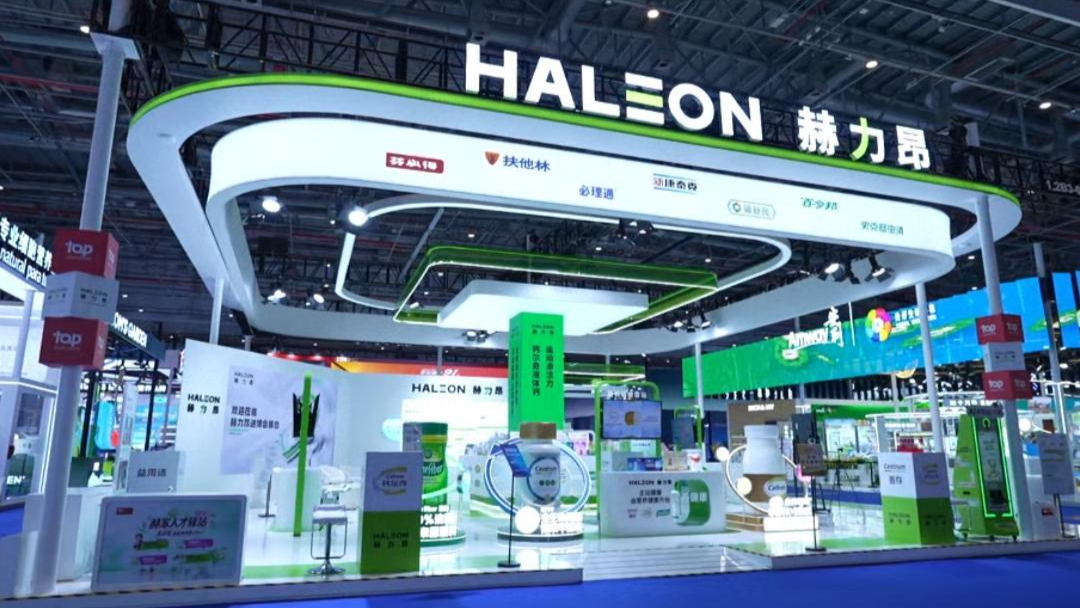
CIIE Entry Time | CIIE Full Diligent Student Heliang, turning the booth into a health station this year


 Subscribe