Economic Observer Follow
2026-11-02 16:19


Today, I was delighted to hear about the publication of Professor Jin Manlou's masterpiece "Where Did Money Go in the Qing Dynasty: The Dilemma of Primitiveism and the Background of Qing Government Finance". I read it for the first time and found it very beneficial.
The finance of the Qing Dynasty is a hot topic in the study of Qing history. Currently, the main views of the academic community on the finance of the Qing Dynasty can be classified into the following categories:
One is the theory of "financial transformation in the late Qing Dynasty". It should be said that the Qing Dynasty's finance can be divided into two stages based on the Opium War or the Taiping Heavenly Kingdom: the "fixed budget fiscal system based on income and expenditure" and the "local expansion, increased commercial taxes, and transition to borrowing and budgeting fiscal system". The focus is on how the traditional fiscal system gradually transformed into modern finance during the modern crisis.
The second is the perspective of "fiscal state" and "national finance". In recent years, research has increasingly focused on the relationship between fiscal capacity and national capacity. Scholars have pointed out that the early and mid Qing Dynasty was a system of "centralization but low taxation", which ensured central control but resulted in a dual deficiency in the country's ability to absorb resources and social responsiveness, leading to a "low-level governance balance". Another study used the concept of "dual track finance" to depict the coexistence of formal central finance and informal local finance, arguing that this structure hinders the expansion of fiscal capacity and modernization transformation.
The third is the comparative fiscal history from the perspective of the "Great Divergence". Placing the Qing Dynasty's finance in a global comparison and questioning why China failed to give birth to a fiscal state and financial revolution like modern Europe did.
This new work by Jin Manlou has a simple yet sharp problem awareness: how could a dynasty that had tens of millions of taels of silver in its treasury during the Kangxi and Qianlong periods fall into a financial crisis of "no increase is allowed" just a few decades later? His answer does not appeal to the monarch's personal confusion, nor is it just a coincidence of external shocks, but instead focuses on a deep institutional logic - "primitivism".
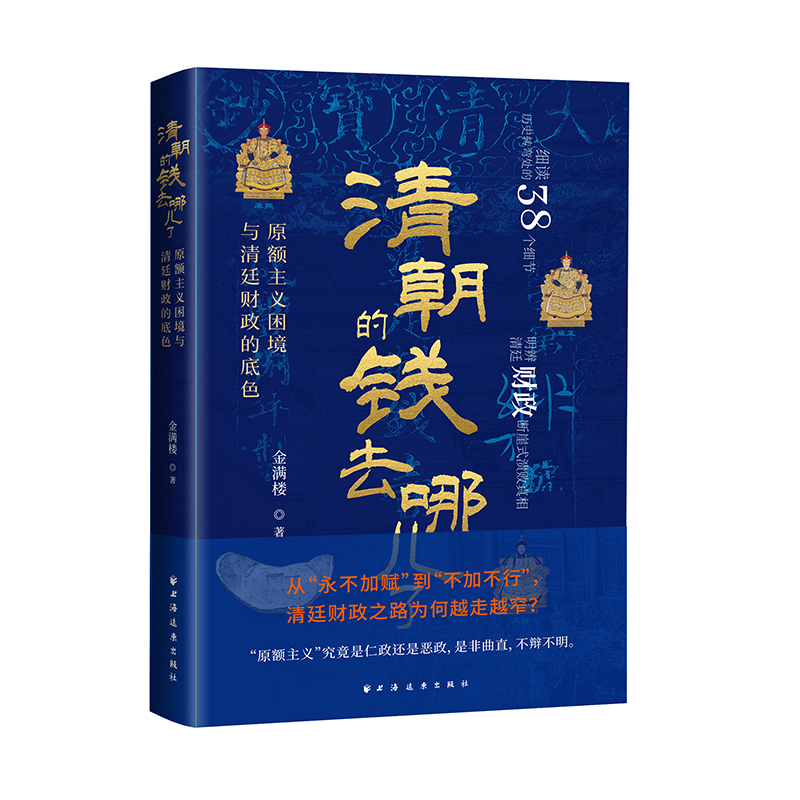
The concept of "primitivism" was proposed by Japanese scholar Shigeki Iwai in his book "Research on the History of Modern Chinese Finance" to depict the structural characteristics of Ming and Qing finance: the "positive quota" in the system was fixed within a rigid range as much as possible, while the constantly expanding administrative demand in actual operation could only be filled by "additional additions" beyond the positive quota, forming a complementary but distorted relationship between the two. Jin Manlou had previously written an article introducing the theory of Shigeki Iwai, summarizing this logic as "the more one tries to maintain good governance, the more rampant the evil governance outside of regular finance becomes. In this book, he did not just focus on the transfer of concepts, but transformed the core concepts analyzed by Shigeki Iwai into a specific narrative of the decline path of the Qing Dynasty, elevating "primitivism" from a concept describing fiscal structure to a key to understanding the governance dilemma of a dynasty.
Afterwards, Jin Manlou followed the logic of "primitivism" and pointed out that the lack of institutional funding in local areas is the structural soil for the continuous growth of "bad rules" and additional levies. The additional levies under various pretexts such as fire consumption, floating income, Lijin, and so on, are not accidental occurrences beyond the normal amount, but the inevitable result of the inability of the national tax system to solve financial problems. However, the Qing court was neither able to cancel this nor willing to publicly acknowledge it, and could only maintain a superficial narrative of benevolent governance with the attitude of "never adding taxes".
Furthermore, this book elevates' primitivism 'from a financial and technical issue to an explanation of political domination order. The reason why Zheng'e is immovable is superficially due to adhering to the ancestral system, but deeply related to the ideological foundation of the legitimacy of the dynasty: "light corv é e and low taxes" are seen as a symbol of benevolent governance, and any public increase in taxes will shake the narrative of "winning the hearts of the people". So a paradox arises: the more one boasts of "no additional burden", the heavier the additional factual burden becomes; The more the dignity of maintaining a positive amount is maintained, the greater the imbalance of additional levies, ultimately pressing down on the bottom tier small households who lack bargaining power. Thus, the book reveals the deep-seated contradiction in the financial background of the Qing Dynasty - the rupture between the commitment to good governance and the ability to govern. The principle of primitivism has gone beyond the original level of tax collection and management, and has become a key approach to understanding how the Qing Dynasty's state intended to implement "benevolent governance" but turned it into "evil governance".
From the perspective of narrative content, the book discusses the issues of Li Jin, customs duties, indemnities, and foreign debt in the late Qing Dynasty from the concept of "never adding taxes", covering a wide range of aspects and delving deeply into the problems. It is not easy for ordinary readers to read and understand. Starting from specific aspects such as the ecology of official services, grassroots governance, and financial trends, Jinmanlou explains how additional levies operate, how local governments maintain operations beyond their regular quotas, how the central government is financially sidelined by local governments, and so on. This completes the transformation that a work aimed at a wider range of readers should have, giving a more vibrant narrative to an analytical tool that was originally limited to a professional field.
Ultimately, the greatest value of the book "Where Did the Money of the Qing Dynasty Go?" lies in its use of "primitivism" as an analytical pivot, transcending the superficial narrative of "not enough money to spend" in the Qing Dynasty and extending to the contradiction between institutional rigidity and governance capacity. When a dynasty regards' no taxation 'as a talisman of legitimacy, but is unable to keep up with the changes of the times in its fiscal system, it will inevitably fall behind the times and bear a heavy cost as a result.