Economic Observer Follow
2026-10-12 13:07

Talk about Jiongcheng | Article
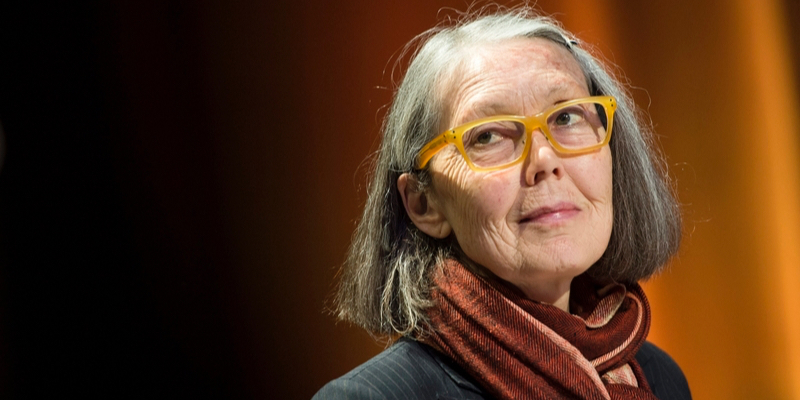
On October 8, 2026, Canadian poet Anne Carson was awarded the Nobel Prize in Literature for her bold and creative works that, in a playful dialogue with classical tradition, created new forms for contemporary literature. This poet, who is highly creative in language and can be compared to John Ashbury and Jeffrey Hill in the eyes of Harold Bloom, demonstrates an atypical attitude towards poetry writing. He does not need to be an "unrecognized legislator" like Romantic poets, nor does he need to follow in the footsteps of the Confessions and view poetry as an unfinished healing.
There is no altar set up for poets in contemporary society, and poets do not need to search for some kind of heroic and isolated sacrifice for language on their own. But language ages and wears away day by day, like meat and bones constantly simmering in a boiling pot, gradually fading away their blood color. The job of a poet, like Carson did, is to read, translate, and write day after day, to bring the world back to a book full of gaps and imperfections, rather than back to AI generated lengthy corpora.
The most unusual aspect of these poems is that, despite being in a postmodern context, they stubbornly return to the classical origins of Western literature. Although they may seem fragmented and personalized, they are still appropriately refined and ultimately reach the sublime in Langinus' writing: "great ideas, strong emotions, specific rhetorical devices, noble language, and solemn word arrangements
The bitterness and sweetness of love
Carson wrote poetry with the expertise of a classicist, but rarely turned the text into a maze of Minotaur, filled with various obscure puzzles. The college poetry produced in bulk under the influence of T.S. Eliot, due to its excessive emphasis on intellectual puzzles, slid from eloquence to closure and ultimately became a game of words.
Her works often begin with her reading and translation of classical texts. At first, as a classicist, she delved into the nuances of words, trying to find the context lost in the waves of the Aegean Sea two thousand years ago. When she discovered that the hard shell of ancient Greek could never be broken by the light and everyday modern English, and the fragmented form of the text meant that the translation would face multiple contextual losses, she began to rewrite it.
The works formed in this way, on the surface, are like modernist classics such as Ulysses and The Sound and the Fury, sinking mythological narratives into contemporary contexts to achieve a certain irony of the modernity of capitalist cities. However, in reality, Carson is more of a soul stirring work, and the poet seems to have finally returned to his priestly identity, retrieving some classical dust from the mundane air of contemporary times.
The foundation of this writing posture that calls for the return of classical literature to contemporary times is deeply rooted in her classical studies. Carson's poetry and scholarship are not two parallel lines, but two sides of the same coin. The issues she deals with in classical studies, such as how desires operate and how language carries love and loss, are crucial themes in her poetry. Her first critical work, "The Bitterness and Sweetness of Desire," published in 1986, can be seen as a key to understanding all of her creations.
The book explores eros as a state of simultaneously experiencing pleasure and pain, and uses the word "glukupikron" (bittersweet) created by Sappho as the best example. The 130th fragment of Sappho reads: "Eros once again in limestone loosener, which I/Sweetbiter, impossible to fight off, feature cooking up. (Carson translation) "glukupikron" compresses the Greek words "sweet" (gluku) and "bitter" (pikron) into the same word, refusing to separate the two into successive feelings. Carson's argument is that the essence of desire is not either happiness or pain, but a paradoxical state where the two occur simultaneously and permeate each other.
She further examined how the triangular structure of desire appeared in the works of Sappho, ancient Greek novelists, and Plato. In the 31st fragment of Sappho, the lover witnesses the beloved conversing with a third person, and the various parts of the body - tongue, skin, eyes, ears - disintegrate into independent fragments one by one. The self is no longer unified, but falls apart under the impact of desire.
The role of this' third party 'is at the core of Carson's desire triangle theory. In the afterlife of Sappho, the man sitting across from the beloved, listening to her sweet laughter, is not a rival in love, but a structural void: his presence makes the beloved aware of a position they cannot occupy, igniting desire while being perpetually postponed.
In Plato's writings, desire shifts from the body to truth, but the structure of desire itself remains unchanged. It is always a movement born of scarcity, a hunger that constructs itself around "absence". At the end of this monograph, Carson imagines a city without desire, where the flight of love is no longer possible, desire is no longer the movement that can move the heart of longing, and it can no longer 'open a story in the soul'. In a city without desire, philosophy itself no longer exists, because "exploring the difference between the known and the unknown is a very dangerous proposition," but the love for truth can make thinkers transcend fear.
The Bitterness and Sweetness of Desire thus established the tone for Carson's entire writing thereafter, that desire is not a state that can be possessed or fulfilled, but a grammar, a structure that places the subject in eternal delay. She repeatedly returned to this topic in her later poetry and translations. In 'If Not, Winter', she uses square brackets to mark every missing word in the remains of Sappho, making 'absence' itself the object of reading. In "The Red Autobiography," she kept the desires of Cleon revolving around an unreachable Hercules. Just like Derrida's concept of delay, desire constantly postpones its own completion and spreads differences.
Contemporary interpretation of Ge L ü weng's fragments
The Bitter Sweetness of Desire holds great significance for Carson.
As a poet, she is not a niche, and her popularity in North American popular culture mainly relies on the continued popularity of this critical work. Critic John Dajata wrote in an article published in the Boston Review of Books in 2000 that "The Bitterness and Sweetness of Desire" "first shocked the classical academic community as a Greek academic work; then, it shocked the non fiction literary community as a brilliant return to the lyrical essays created by writers such as Seneca, Montaigne, and Emerson; and finally, it was not until the 1990s, when it was republished under the name of" literature "and redesigned for a completely new readership, that it finally shocked the poet.
The publication of "The Red Autobiography" in 1998 further won Carson a large readership. Dagata mentioned that at the time of his writing, "The Red Autobiography" had already sold over 25000 copies in the United States alone, which was quite a good achievement for a poetry collection. But Carson was never a professional poet who could be dissolved into the commercialized literary system. She never lingered on the explosive effect of individual rhetoric in the textual layers, but worked like a visual artist, focusing on the presentation of the book itself as a whole. The form of the book itself has been requisitioned as a certain structure, and collage books like 'Night' are even close to art books. And 'The Red Autobiography' imitates the style of academic monographs, including two introductions, three appendices, and a fictional interview with the author of the original text, Stryklos, in addition to the main body and ending.

Red's Autobiography: The Beauty of Husband: Selected Poems by Anne Carson
Written by Anne Carson from Canada
Huang Qian | Translation
Yilin Press
January 2021
This poet, who lived in 650 BC, even had a direct conversation with Baudrillard in Carson's writings. He invented a more personal adjective rhetorical device, which differed from Homer's formulaic approach of "fixing every real system in the world to its most desirable features for the sake of epic consumption". Subsequently, Carson borrowed Baudrillard's statement that "consumption is not a passion for material things, but a passion for symbols," and regarded the complex adjective "silver white like the roots of a river" in Strathclyde as a passion for material things themselves, while Homer's singing was seen as a consumption of epic poetry. So, beneath the calm surface of this symbol, Stryklos was born. Stryklos anxiously studied this surface
As an academic introduction, this piece "Red Meat: What Has Stryklos Changed?" has a poetic style that flows like magma. What is important is not academic rigor, but the subversion of poetic principles over logical principles. Concepts and ideas seem to be pieced together as rhetorical devices here, rubbing against each other and leading to an open-ended conclusion with one seemingly plausible conclusion after another. Carson invites us to view the remaining parts of Stryklos' "The Tales of the Clavier" as "fragments of narrative poetry, lyrical poetry, lecture notes, and meat scraps" encapsulated in a dark box. All she did was shake the box, let the fragments fall, and record them.
But in reality, what she did was far more than that, even far more than rewriting, but repairing all the fragments and piecing them together into a new story of classical bone and contemporary flesh.
In Greek mythology, Cleon was the three giants defeated in Hercules' tenth achievement. He was a monster located at the end of the world, situated on the island of Eretia, with three bodies and three lives. Carson's character, Ge Lv Weng, is a boy with red wings who constantly runs away and wanders due to sexual exploitation in his childhood. Hercules is no longer a demigod, but a homosexual lover with Creon during his youth. There is no war between the two, only desire, loss, and separation.
The formal experiment of 'The Red Autobiography' serves its theme of love and desire. Carson interweaves the main text and endnotes, translation and criticism, poetry and prose, allowing the story of Graham to be constantly interrupted, commented upon, translated, and rewritten within the framework of academic books.
This kind of text arrangement itself is a simulation of the constantly postponed desire. Each chapter of a poetic novel is a brand new beginning, like poetry repeatedly trying to break free from the shell of prose, attempting to return to pure metaphorical language but failing. The language fragments remaining here are mixed with academic vocabulary, daily slang, the most poetic insights ("The spirit rules alone in secret, the body achieves nothing"), and the most ordinary dialogues ("Don't scratch it, the rebel will infect you, let it heal on its own"). Therefore, language itself constitutes the toughest reality.
Readers will never be able to fully touch upon Ge Lv Weng through it at once. Every time they approach, they will be interrupted by new annotations or translations, and by another sublimation or sudden decline in style. Carson is not asking readers to search for a buried truth, but to experience the delay of desire among fragments. This is precisely the unfolding of the triangular structure she discussed in "The Bitterness and Sweetness of Desire" at the formal level of the book: the "third party" - annotations, translations, and fictional interviews - forever lies between the reader and the hero, and desires are constantly ignited and postponed in the text.
One of the many facts in the world
Despite her long-standing reputation, Carson still insists on leaving only one line of uncut introductory text in her poetry collection: "Born in Canada, made a living teaching ancient Greek." Regarding her personal life, Carson claims that it is just one of many facts in the world, and her use of her own life in her works is not fundamentally different from the use of references to the Greeks.
The publication of 'The Beauty of Husband' in 2001 demonstrated Carson's decisiveness and precision in using his personal life. The poetry collection comes from her first failed marriage more than 20 years ago, but it does not extensively use real letter texts to satisfy the public's voyeuristic desire for public figures, as Robert Lowell did in his later work "The Dolphin" which also wrote about personal marital changes. The details of 'The Beauty of a Husband' are extremely precise, but this is on a literary scale rather than a biographical scale. The relentless pursuit of precision leads the text to the rhythm of tango dance steps, with lines of varying lengths, as if the dancer keeps moving forward and then back, and as if the couple alternates between disillusionment, sadness, joy, and separation.
Unlike the single perspective of "Dolphin" that seems to look out from an airplane window, "Husband's Beauty" portrays the tension and interaction between two desire subjects. Husband is the object of observation and reflection, yet he never remains silent. The poetry collection does not self vulgarize into a discussion of right and wrong in a marital crisis, but instead pays tribute to John Keats' philosophy that 'beauty is truth, truth is beauty'. Each unit of the poetry collection begins with a quote from Keats, which connects the entire book like beads, while summarizing the emotions, metaphors, and themes of each chapter.
This is not to forcefully give this vulgar marriage story cultural and aesthetic depth, but to lay down personal experiences from many years ago on a page and test them on an eternal scale. As a result, the specific male and female protagonists are simplified into husband and wife, becoming two subjects struggling in unattainable desires.
The poem "VII But in order to pay tribute to the smooth and sacred truth, to pay tribute to the lives of those who are with the gods, we must (along with Plato) dance and lie about the tragic and arduous lives of the masses" in the poetry collection may condense Carson's most typical creative technique, starting with a whole theoretical opening:
Myth is a rich paradigm,
A two-sided proposition,
Allow the operator to live a dual life, both intentionally and unintentionally.
Therefore, throughout history, people have believed that poets are all liars.
And from the true lies of poetry
Slowly revealing a problem.
What truly connects things and words?
Afterwards, there is a sudden descent towards everyday facts: "Everything my husband says is a lie." We see a series of different forms of lying: "He lies when he doesn't need to lie. He lies when he's out of place. He lies when they know he's lying. He lies when they're heartbroken.
As Carson wrote in another short poem, 'Spring opens like a blade,' every time she uses fragments, they suddenly fall and open a hole in the air with their uncompromising sharpness. The world has not healed, but light drips from somewhere and becomes poetry itself. Perhaps this is the metaphor of beauty and truth in Keats' writing: the poet extracts the true human condition from the most mundane and ordinary materials, and turns it into a simple and irreparable spoken language, while still retaining that little bit of roughness that tickles people, making the language itself echo for a long time.