Economic Observer Follow
2026-09-30 12:26

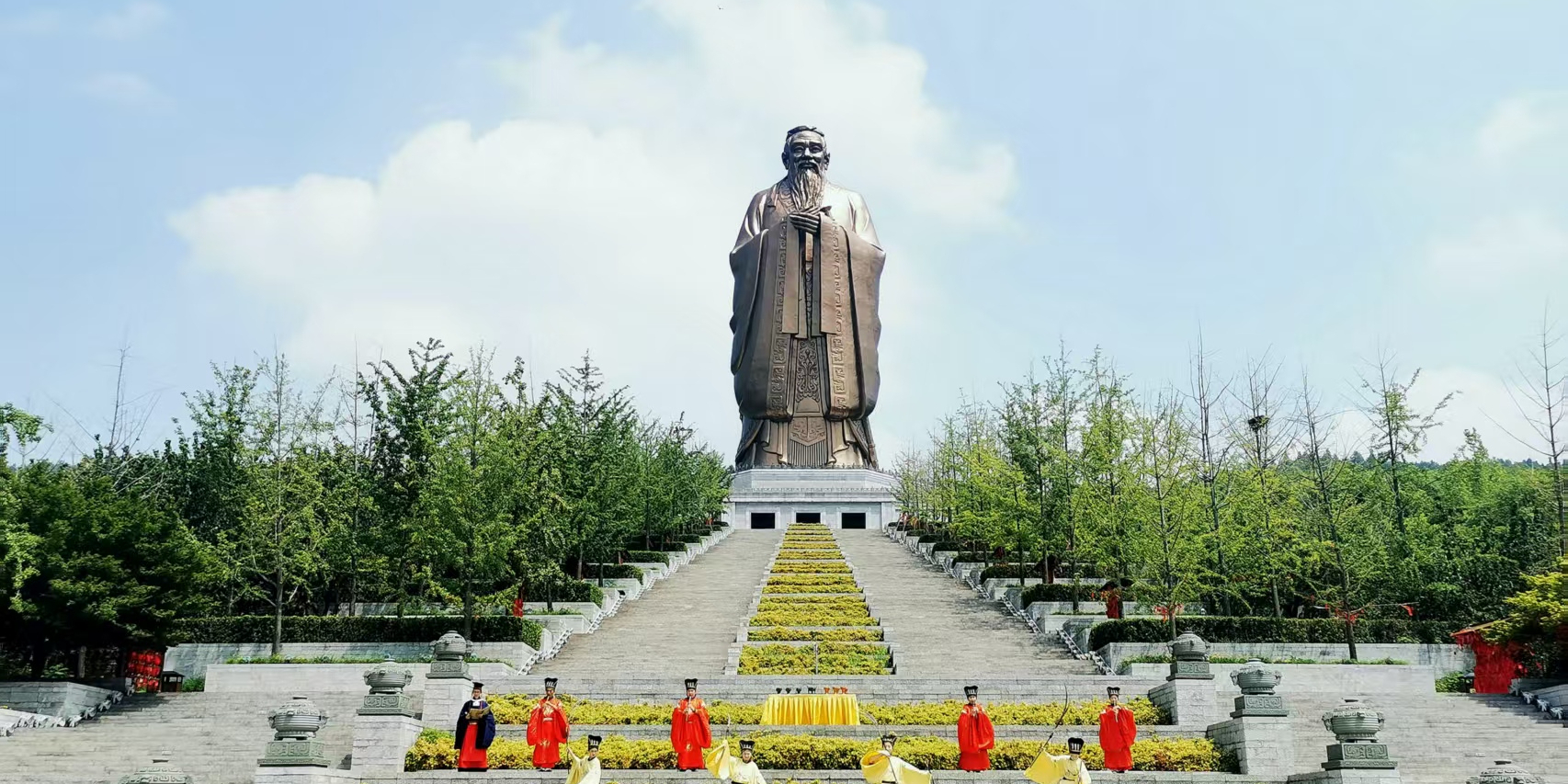
On the morning of September 28, 2026, in the Ming Dynasty ancient city of Qufu, Shandong Province, a group of ritual students dressed in Hanfu held incense altars and walked slowly forward. Guests from home and abroad walked along the millennium old road into the Confucian Temple, jointly commemorating the 2577th anniversary of Confucius' birth to the sound of ancient music.
On that day, the 2026 China International Confucius Culture Festival officially kicked off. On September 28-29, the 12th Nishan World Civilization Forum was held simultaneously. More than 340 guest scholars from 49 countries and regions gathered in Nishan, with "Civilization, Order, and Axiom" as the core topic, to seek a cultural answer from the East for the turbulent and changing world in the birthplace of Confucianism.
From festivals to platforms for cultural dialogue
On the morning of September 28th, the opening ceremony of the 2026 China International Confucius Culture Festival was held at the Confucius Institute in Qufu, located at the foot of Mount Ni.
Nishan is an important birthplace of Confucianism and a crucial platform for promoting dialogue among world civilizations. More than 2500 years ago, Confucius was born here, constructing the value core of Chinese civilization with "benevolence, righteousness, propriety, wisdom, and trustworthiness", and interpreting the Chinese nation's thinking on order and justice with "harmony in diversity" and "the world is for all". For thousands of years, these ideas and concepts have provided Eastern wisdom for humanity to handle the relationships between different civilizations.
The opening ceremony of the Confucius Culture Festival in 2026 will be held for the first time at the Confucius Institute. The changes in this venue are a microcosm of the festival's continuous expansion into academic depth and international perspectives over the past forty years.
In 1984, the first commemoration of Confucius' birthday was held in Qufu, and at that time, the activities were more focused on reviewing and sorting out traditional culture in the local academic community; Afterwards, the event gradually upgraded to the China International Confucius Culture Festival, growing from a local festival to an important platform for cultural exchange between China and the world.
Nowadays, the Confucius Culture Festival is deeply integrated with the Nishan World Civilization Forum, connecting festival resources, academic resources, and international communication resources, allowing ordinary tourists to touch the warmth of traditional culture while visiting Confucian temples, listening to folk music, and visiting cultural temple fairs. It also allows scholars from around the world to find resonance points for cultural exchange and mutual learning through ideological collisions.
The 2026 Nishan World Civilization Forum will be held in Qufu from the afternoon of September 28th to 29th. This forum focuses on the theme of "Civilization, Order, and Axiom", closely following the pulse of the times and responding to the world's questions. The voices of different cultural backgrounds have formed a lively atmosphere of dialogue at the foot of Mount Ni.
Sosyara, Central Committee member of the Cambodian People's Party, Vice Chairman of the Central Foreign Affairs Committee, and Chairman of the National Assembly Foreign Affairs Committee, stated in his speech that "civilization, order, and justice" are not three independent issues. Civilization endows humanity with identity and wisdom, order provides conditions for peaceful coexistence, and justice maintains this order. The world has entered an unprecedented era where technological change, deep interdependence, and significant prosperity coexist, accompanied by profound uncertainty and multiple intertwined crises.The Nishan Forum provides us with a platform to transform the grand principles of civilization, order, and justice into meaningful dialogue, and explore how to work together to create a common future for humanity.
In his speech, Pakistani Senate Chairman Yusuf Raza Gilani stated, "I have always believed that a great civilization can transcend time, space, and borders, and engage in dialogue with all humanity. Confucius is such a wise man who transcends time and space. Harmony in diversity, mutual respect. May Confucius' wisdom continue to inspire us that the most enduring bridge is not only built with bricks and steel, but also forged with knowledge, friendship, and human hearts
Chen Lai, a senior professor of humanities at Tsinghua University and director of the academic committee of the Nishan World Civilization Forum, believes that both cultural exchange, mutual learning, and dialogue should "transcend cultural barriers with cultural exchange, transcend cultural conflicts with cultural mutual learning, and transcend cultural superiority with cultural inclusiveness" to handle various mutual relationships. These "three excesses" correspond to the three main issues that need to be addressed in cultural exchange and mutual learning, namely cultural barriers, cultural conflicts, and cultural superiority. They represent that China has formed a complete system of "cultural exchange and mutual learning", which has universal significance for the whole world.
Jin Minqing, director of the Institute of Contemporary China Studies, put forward three propositions: to safeguard the diversity of civilizations and build a solid foundation for human coexistence. Building a new order of civilization and exploring effective solutions for global governance. Pursuing the principles of civilization and illuminating the right path for humanity to move forward. Jin Minqing called for abandoning the theories of civilization superiority and civilization conflict, promoting the common values of all mankind, and working together to build a community with a shared future for mankind.
Exploring the direction of AI with the wisdom of Confucius
The most hotly discussed topic at this year's Nishan World Civilization Forum, both inside and outside the venue, is undoubtedly the specially designed sub topic of "Artificial Intelligence and World Harmony".
When algorithms begin to deeply participate in human production and life, when large models constantly reshape the path of knowledge production and information dissemination, the rapid iteration of technology not only brings efficiency improvements, but also exacerbates cultural barriers due to algorithmic biases, widens the development gap due to digital divide, and blurs the boundaries of technological ethics, leading to a crisis of trust and a series of new challenges.
This year's Nishan Forum has set up a special seminar on artificial intelligence, hoping to use humanistic wisdom to constrain the rapid development of technology in this era of rapid technological progress. Many attending scholars have mentioned that these challenges cannot be solved solely by technical logic, and the Eastern civilization perspective provided by the Nishan Forum may contribute unique value orientation to global AI governance.
Xue Lan, a senior professor of humanities at Tsinghua University, proposed in her keynote speech "The Current Situation and Opportunities of Global Governance of Artificial Intelligence" that global artificial intelligence governance is no longer a debate on whether to govern or not, but a game of "who defines rules and how to enforce them". The current global governance of artificial intelligence is entering an important period of institutional construction opportunities, but it is facing structural contradictions such as fragmented governance and divergent positions of major powers. He suggested implementing a new type of multilateral cooperation platform, leveraging the important role of major country coordination, bridging the digital divide through inclusive cooperation, and rejecting the development direction of AI monopolized by a single culture to jointly build a bottom line for security governance.
Edmund Mokala, the representative of UNESCO in Ghana, believes that the Confucian concepts of "benevolence" and "righteousness" can be embedded in the design origins of AI. Algorithms are good at calculating pros and cons, but they are difficult to distinguish right from wrong independently. At the beginning of technology research and development, public welfare should be given top priority, avoiding algorithms serving the interests of minority groups, using moral constraints to constrain technology, and making AI move towards universal fairness.
Professor Wang Bo, a liberal arts professor at Peking University, starts from the traditional Chinese civilization of the mind and nature, and proposes that in the discussion of the relationship between humans and machines, the emotional, mental, and ethical dimensions that the Confucian tradition of the mind and nature focuses on have important reference value. Although technology is developing rapidly, people with flesh and blood and genuine emotions possess traits that machines cannot replace. Humans should adhere to humanistic values to guide the development of technology.
According to Frantiszek Shkverda, an assistant professor at Bratislava University of Economics, artificial intelligence can be both a good servant and a bad servant. At present, we are witnessing its duality. On the one hand, artificial intelligence is being abused for military purposes and economic crimes; On the other hand, we also see its positive value in the fields of industry, healthcare, education, and entertainment. He believes that the call to shape artificial intelligence with classical civilization wisdom is in the right direction. The Five Constants and related ethical concepts advocated by Confucianism, combined with a planned economy and responsible social policies, ultimately lead to the ideal of Great Harmony, which can turn artificial intelligence into a transformative tool for promoting civilization progress.
Confucius' advocacy of "harmony in diversity" and "world unity" has become the core keywords for forum guests to explore global AI governance. From a deeper perspective, AI not only brings about technological changes, but also reshapes the order of civilization. Humanity is standing at a historical juncture: allowing technology to expand in disorder and falling into competition and confrontation; Or should we lead technology with humanities and pursue common development for all mankind? The ideal of Confucius' "Great Harmony of the World" is not to pursue uniformity, but to appreciate each other's beauty and coexist harmoniously, which may coincide with the goal of artificial intelligence developing towards goodness.
On September 29th, the two-day 2026 Nishan World Civilization Forum came to an end in Qufu. At the closing ceremony of the forum, the attending representatives reached the "2026 Nishan World Civilization Forum Consensus" (hereinafter referred to as the "Consensus").
The Consensus points out that the diversity of human civilization is a fundamental characteristic of the world and a source of human progress. Every civilization in the world has its own value, without distinction of superiority or inferiority, and enjoys the right and space to inherit and develop on an equal basis. We hope to uphold the concept of "harmony in diversity", advocate for the exchange of civilizations to surpass cultural barriers, mutual learning to surpass cultural conflicts, and inclusiveness to surpass cultural superiority, jointly safeguard the resilience of civilizations, promote equal treatment and mutual tolerance among different civilizations, and learn from each other's strengths and weaknesses. The Consensus also points out that in the face of global challenges such as climate change and technological ethics, no country can develop alone and be self-sufficient. Only by adhering to mutual benefit and win-win, abandoning confrontational games, and transforming mutual learning of civilizations, joint construction of order, and protection of justice into concrete actions, can we overcome difficulties and achieve steady progress.
Xilinx officially announced that Wanjie has joined the Mercedes Benz and BMW supercharging camp, with over 600 stations directly connected
OPPO Find X10 tops sales on the standard version track

Technology Show | iQOO16 is now available for sale, under the name of Standard Edition, to meet the requirements of Pro Max product strength


 Subscribe