2026-08-24 16:12


On August 18th, Hilton Group (NYSE: HLT) announced a strategic partnership with Bank of Communications and Mastercard to launch two co branded credit cards in the Chinese market. In January 2026, the group's operational scale in China exceeded 1000, and this cooperation is considered a new milestone in the construction of its customer loyalty program "Hilton Honors Club" ecosystem in China.
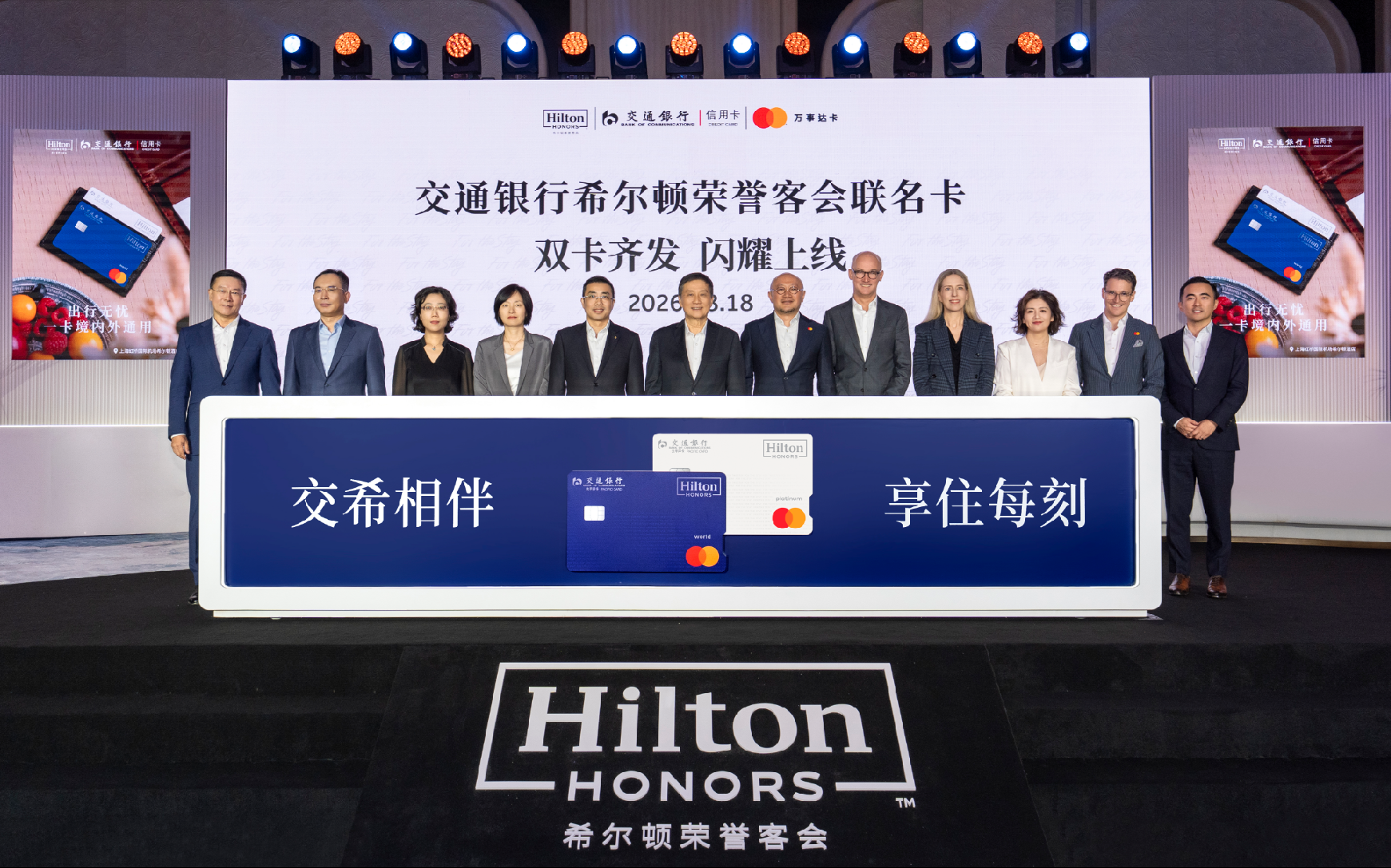
The Bank of Communications and Mastercard, which cooperate with it, are both financial enterprises with huge growth potential in China. The former is creating scenario based consumption for food, accommodation, and transportation around the cultural and tourism ecology, hoping to build a financial consumption chain that covers all areas and scenarios. The latter is the world's second-largest bank card clearing organization and payment technology company that connects over 210 countries and regions worldwide. The co branded card cooperation launched for the first time in the Chinese market will focus on expanding the growth space of lifestyle in the Chinese market. Although cooperation has symbolic significance at their respective stages of development.
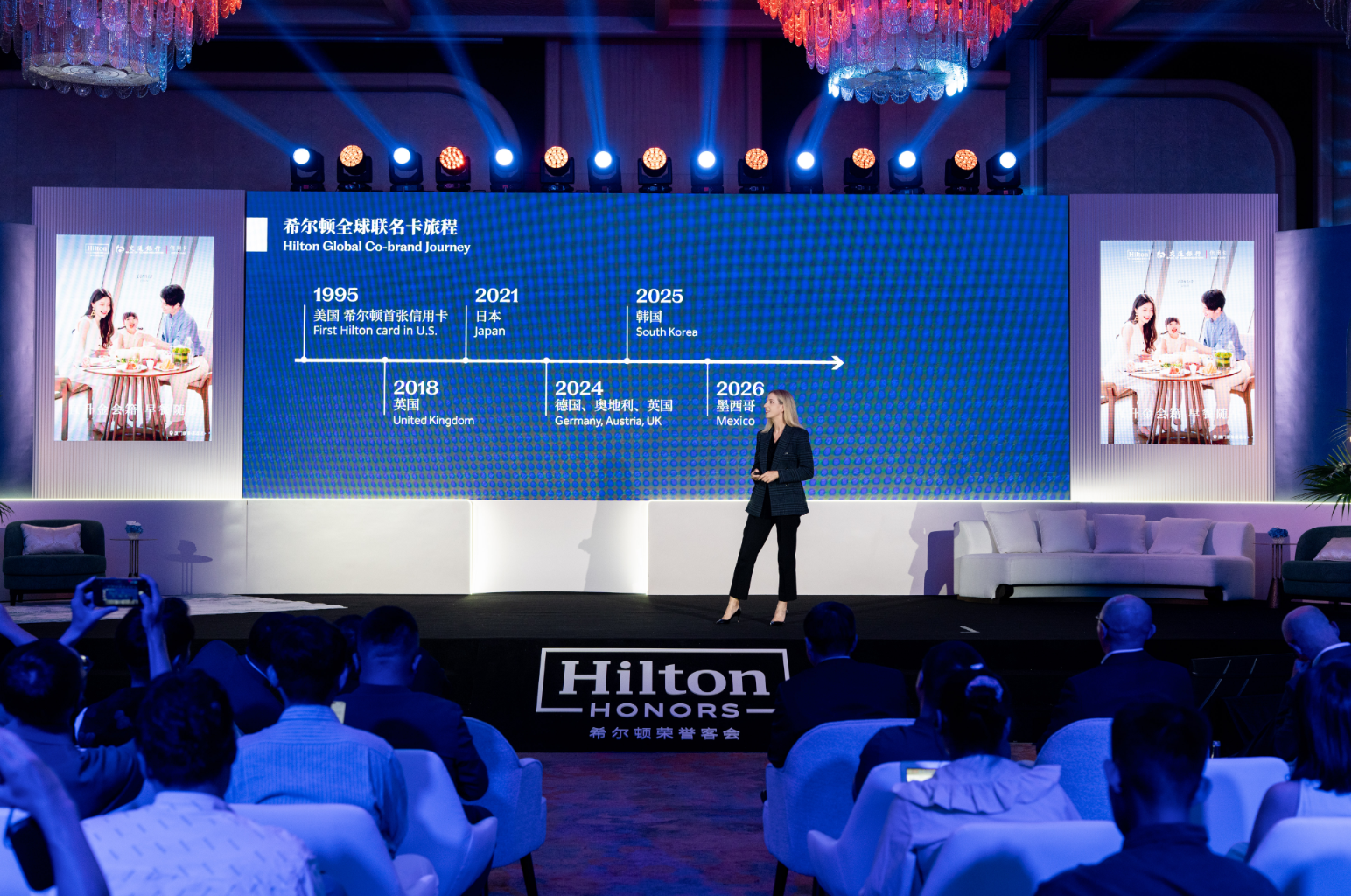
The first co branded card of Hilton Group began in 1995 and currently covers countries such as the United States, Japan, South Korea, the United Kingdom, Germany, Austria, and Mexico. The Japanese market launched co branded credit cards earlier, and the proportion of new members joining Hilton Honors through credit cards increased from 30% to 50%. Germany is a relatively new market to launch this product in 2024, with card members showing a consumption amount or quantity four to five times higher than non card members of Hilton Honors.
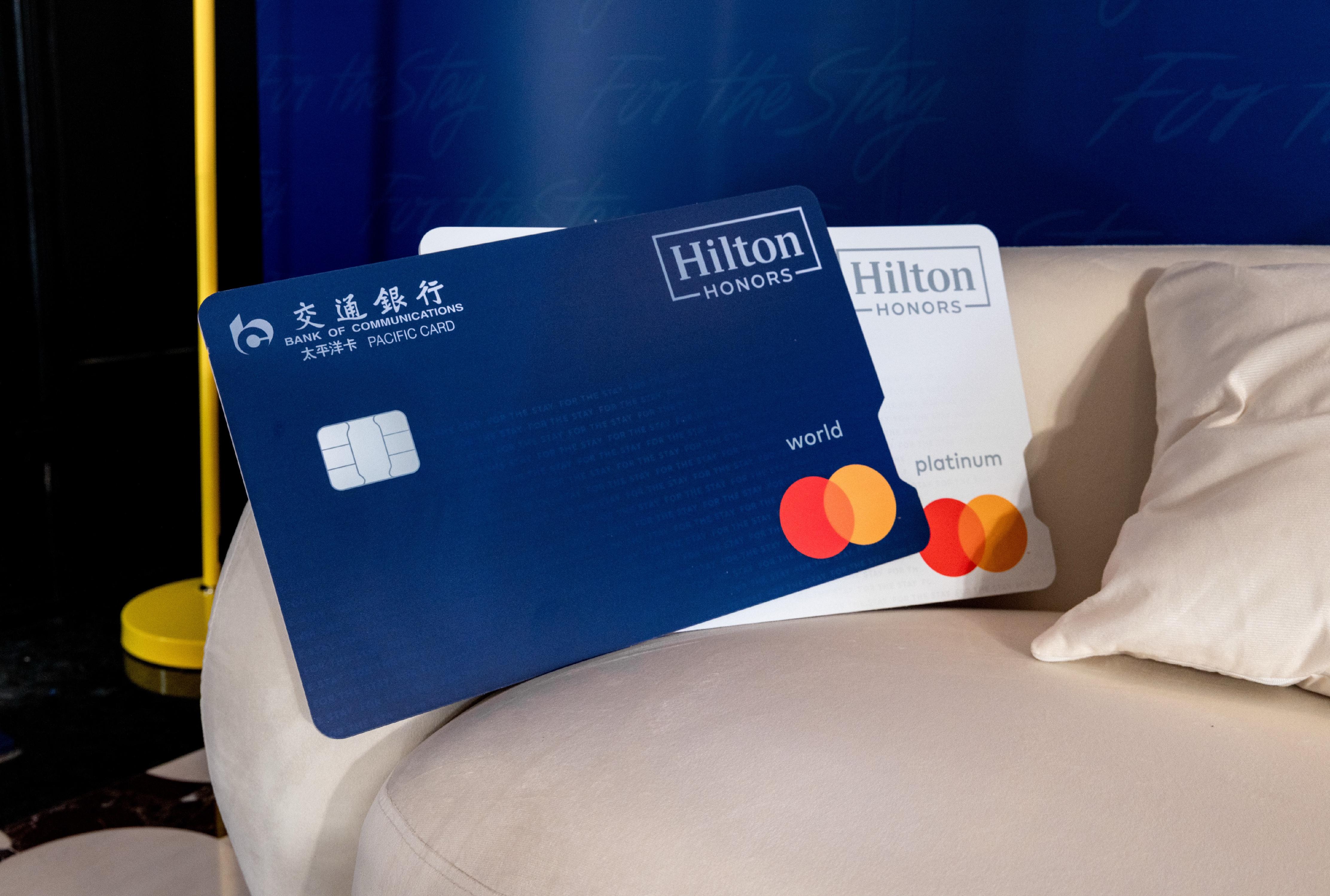
According to the new service content, cardholders can accumulate Hilton Honors points by using co branded credit cards for daily consumption, achieving "consumption equals points". Enjoy double points when spending in hotels under the Hilton Group, accelerating the redemption of free room nights, room upgrades, and more at Hilton Group's more than 9400 hotels worldwide. By connecting daily consumption scenarios with the membership points system, cardholders can quickly advance to elite membership benefits.
For the three parties involved in the cooperation, the launch of a joint credit card is not a one-time marketing choice. Instead, it abandons traditional models and takes three years to refine, blending the financial scene of local life with the consumption chain of domestic and foreign travel through an internationally renowned hotel brand.
Huang Jie, Senior Vice President of Business Development for Hilton Group in Greater China and Mongolia, said in an interview, "With the continuous expansion of Hilton Group's hotel layout in China, there are currently about 290 destinations available for consumers to choose from nationwide. With the large number of Hilton Honors members, customer acquisition is no longer the primary goal. Providing them with more platforms to interact with the brand and expand more consumption scenarios is the important reason for choosing to launch this card at this time
Our goal has always been to provide members with more flexibility, richer choices, and superior value experiences. Chinese consumers' demand for converting daily consumption into travel rewards is growing day by day. Whether on the go or in daily consumption scenarios, the value of the UnionPay card can be realized. "She said," Whether it is cross-border or ecological cooperation, we do not cooperate just because of a brand or a fresh opportunity, but hope to find like-minded brands and partners who can create value for members in the long run. This is very important

In July, the State Council issued a reply on the "15th Five Year Plan for Expanding Consumption", agreeing in principle to the "15th Five Year Plan for Expanding Consumption" (referred to as the "Plan"). The Plan proposes to develop cultural and tourism consumption. Expand the supply of high-quality culture and tourism consumption, and deepen the integrated development of "cultural tourism+hundred industries" and "hundred industries+cultural tourism". By improving the experiential consumer market and industry standard system, we aim to cultivate new industries and sectors. Cultivate experiential consumption. Focusing on consumer experience, cultivate new forms, models, and scenarios of consumption. As an important area of consumer experience, cultural and tourism consumption is shifting from a single scenario to an interconnected ecosystem.
At the same time, consumers are becoming more rational and willing to pay higher premiums for products and services that bring emotional value. The "2025 China Outbound Tourist Satisfaction Research Report" released by the China Tourism Research Institute shows that in 2025, Chinese citizens will travel abroad about 148 million times, with outbound tourism consumption of nearly 160 billion US dollars, with a year-on-year growth rate of over 20%. With the wealth of experience in outbound tourism, Chinese tourists have slowed down their pace and are willing to pay for a better life, discovering more "small and refined, small and beautiful, small and warm" living scenes and experiencing them in depth. Bringing profound and multi-faceted changes to industries such as cultural and tourism consumption.
He Bo, Secretary of the Party Committee and General Manager of the Pacific Credit Card Center of Bank of Communications, said, "With the strategic deployment of 'promoting consumption and expanding domestic demand', Bank of Communications Credit Card has always been committed to stimulating consumption vitality with higher quality financial services. This cooperation, on the one hand, helps users unleash more value potential in daily consumption and enjoy a more diverse global travel experience. On the other hand, relying on financial flow to empower offline physical merchants such as hotels and restaurants, continues to activate the growth momentum of service consumption
Dr., Executive Vice President of Mastercard Asia PacificPeter Robejsek believes that collaboration among three parties is not only about joint products, but also about empowering offline consumption scenarios and expanding the global user ecosystem. This collaboration with Hilton Group and Bank of Communications not only creates a hotel co branded card product for its new "China Mastercard" card, which has the widest coverage both domestically and internationally and smooth online and offline use, but also builds a payment carrier for the development of domestic and cross-border tourism industries. Chang Qing, global executive vice president of MasterCard and president of Greater China, said, "This new co branded card also marks the first release of Touch Card for visually impaired people in the Chinese Mainland market, highlighting the joint commitment and unremitting practice of Hilton Group, Bank of Communications and MasterCard in fulfilling corporate social responsibility and enabling inclusive growth. ”
The Chinese market, as an important growth market for Hilton globally, contains enormous opportunities in its business landscape. But the entry of the Chinese market into Hilton's global international co branded card business is not just a simple replication of global products. Heather Laverne, Vice President of International Co branded Cards and Financial Cooperation at Hilton Group, said, "Considering Hilton's growing hotel layout in China, we hope to have more Hilton Honors members stay at these hotels - which is important for both us and hotel owners
This is not only a product designed for the Chinese market, but also a product jointly created with Chinese consumers, "said Heather Laverne. In fact, by working together, the advantages of global travel, global payments, and Chinese financial products can be combined. Cardholders are no longer facing isolated brands or services. Through the combination of consumption, scenarios, and experiences, the value obtained in different contexts does not simply come from a certain product itself, but from a set of life scenarios that can be repeatedly called upon, making the product always embedded in it.
Previously, according to a special demand survey conducted by Hilton Group on 2000 Hilton Honors members, nearly 80% of respondents stated that they value hotel membership and elite membership recognition; More than 60% of respondents believe that earning points is one of the most attractive benefits of co branded credit cards; Nearly 70% of respondents agree that substantial hotel benefits and membership benefits can enhance the stay experience; In addition, nearly 90% of the respondents showed interest in the concept of high-end credit card products tested in the survey. These insights further help Hilton gain a deeper understanding of consumers' core needs and directly shape Hilton's product strategy. Heather Laverne said, "This research result has prompted us to adjust our global design concept for credit cards. From a global perspective, users have a strong demand for 'daily consumption can accumulate points', but the demand for providing more direct value is particularly prominent in the Chinese market. Therefore, we have partnered with Bank of Communications and Mastercard to promote products that truly meet the needs of Chinese consumers to the Chinese market. For example, cardholders can choose a reward based on their consumption level every quarter, which is unprecedented in our global scope
A stable customer source structure is crucial for hotel revenue. But in Hilton Group's view, consumer stays are not one-time purchases, but a continuous interaction between lifestyle, experience economy, and hotels. Consumers not only interact with the brand by repeatedly using the hotel's services, but also help the brand provide new value. Consumers are not just buyers, but also creators of these values.




 Subscribe