Economic Observer Follow
2026-08-22 09:59


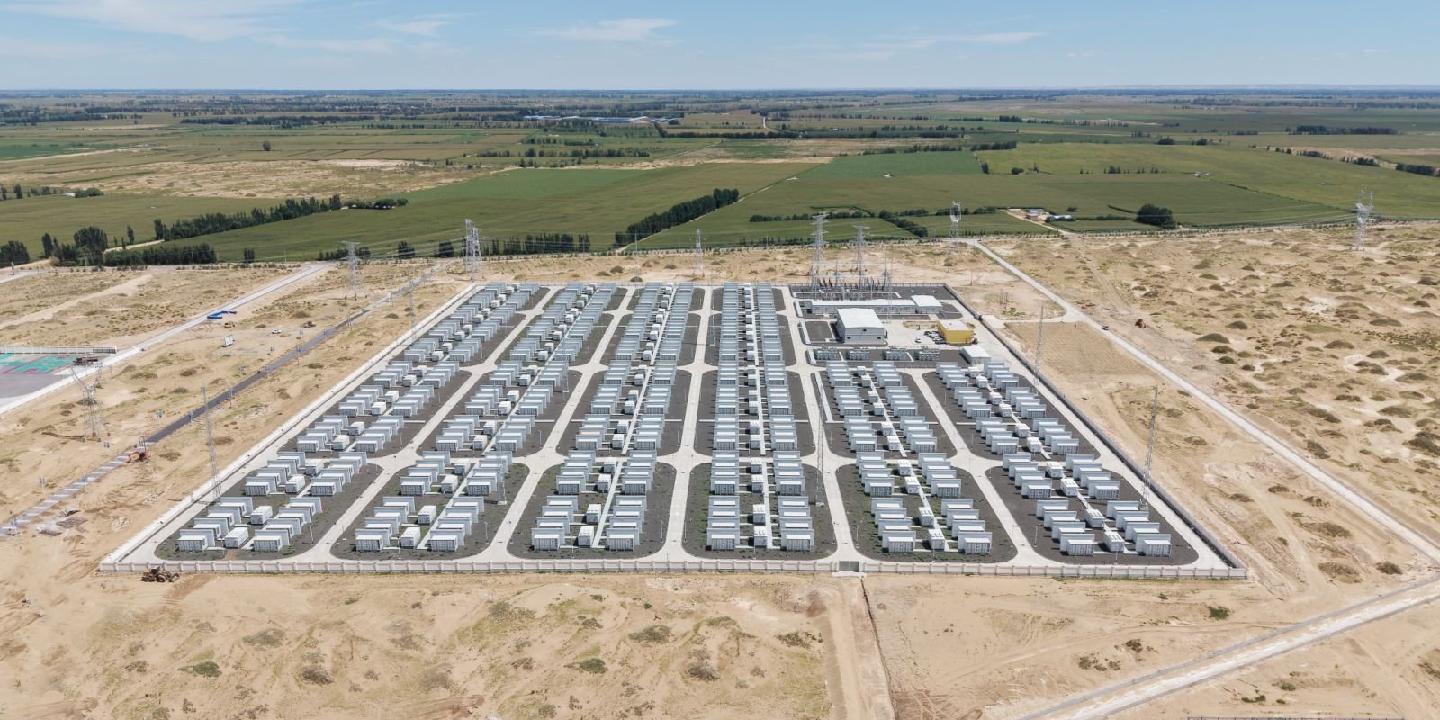
By the end of 2025, almost all of Qidian Energy's business backbone will arrive at the Taiyaoxin Energy Storage Power Station in the western desert of Bayannur City.
The project is surrounded by deserts, with only a few high-voltage power poles, energy storage cabinets, and rudimentary two-story container houses in the artificial landscape. The team's goal is to complete the "three charging and three discharging" test of a 500MW/2000MWh energy storage power station before 2026.
Behind this rush to install is the pursuit of independent energy storage investors in Inner Mongolia over the past two years.
By 2025, Inner Mongolia's new energy storage capacity will increase by about 10.03 million kilowatts, ranking second in the country, only 200000 kilowatts less than the first place Xinjiang, and its cumulative installed capacity will be the largest in the country. In March of this year, the Inner Mongolia Autonomous Region Energy Bureau issued the "List of the First Batch of Independent New Energy Storage Construction Projects in 2026", with a scale of 8.15GW/32.6GWh; In May, the second batch of the list added 22 items, totaling 5.55GW/22.2GWh. The planned construction scale in 2026 may even exceed the cumulative installed capacity scale before.
The investment boom began with a compensation policy for discharged electricity.
In March 2025, the Inner Mongolia Autonomous Region Energy Bureau issued the "Notice on Accelerating the Construction of New Energy Storage" (hereinafter referred to as the "Notice"), which stipulates that the maximum compensation standard for the discharge of independent new energy storage power stations in 2025 is 0.35 yuan/kWh, with a guarantee period of 10 years. The notice directly ignited the investment enthusiasm of energy storage investors in Inner Mongolia.
According to data from the Inner Mongolia Autonomous Region Energy Bureau, out of the 42 independent energy storage power stations that received compensation before February this year, 11 projects will be completed and put into operation before November 10, 2025, and will receive compensation ranging from 0.335 yuan/kWh to 0.35 yuan/kWh; 30 projects will be completed and put into operation before November 10th to December 31st, 2025, with a discharge compensation standard of 0.3 yuan/kWh to 0.35 yuan/kWh; One project will be completed and put into operation from January 1 to January 26, 2026, with a discharge compensation standard of 0.28 yuan/kWh.
The reporter learned that the current bottom line for project returns for energy storage investors is roughly 4.5% or more for state-owned enterprises and 5.5% or more for market-oriented funds. Xu Xiaodong, Deputy General Manager of Huanghe Industry and General Manager of Huanghe Capital, stated that the return rate of energy storage power stations completed and compensated in Inner Mongolia by 2025 can exceed 10%.
But by 2026, the compensation standard has been reduced to 0.28 yuan/degree.
If the compensation price introduced in September this year can be maintained above 0.22 yuan/kWh, the Inner Mongolia market will still be profitable. Last year it was a must invest, and next year it will be a 'can invest or not invest' decision. Investors need to rely on a more supportive economic benefit model to decide whether or not to enter the market, "said Wang Yangjun, Assistant General Manager of Qidian Energy and General Manager of the Engineering Center.
Grab in front of the window
'Fast' and 'large capacity' are Wang Yangjun's most intuitive feelings about the current independent energy storage market in Inner Mongolia.
The landing of an energy storage power station usually involves multiple stages such as preliminary research and site selection, project registration, grid access approval and technical demonstration, engineering design and equipment bidding, civil construction and equipment installation, system integration and grid acceptance, and grid connection delivery.
A lot of time is spent on the process of handling procedures in the early and middle stages. Only in the early stage of site selection, a GW level energy storage power station requires hundreds of acres of vacant land, and a series of practical issues need to be implemented one by one, including land attributes, surrounding gathering station resources, available access intervals, and whether the intervals can be locked after the project is completed.
Just finding land could take up two months, "said Wang Yangjun.
These external links are difficult to compress, and the policy timeline cannot be changed. The compression space left for the project mainly focuses on the construction and equipment installation links.
The Taiyaoxin 2GWh energy storage power station under the responsibility of Wang Yangjun will enter the site in September 2025, complete construction and "three charging and three discharging" in three months, and achieve grid connection by the end of December.
Mengxi's "three charging and three discharging" is an important test before the local energy storage power station is connected to the grid and put into operation, and it is also one of the strictest tests in the industry, requiring independent energy storage power stations to control the power deviation of each charging and discharging within a certain range.
A new energy storage power station will face the risk of battery consistency, and the actual output power will be stuck within the required range; newly installed box type substations may also have problems, and once disconnected, it will lead to test failure. Many newly connected power stations find it difficult to meet the 'three charging and three discharging' requirements at once, "a professional technical personnel of an energy storage power station told reporters.
The Inner Mongolia Autonomous Region Energy Bureau announced in September that the compensation standard for 2026 is 0.28 yuan/kWh, and the owner's mandatory requirement is to connect to the grid before 2026. Once the project is delayed and connected to the grid, the project will lose several billion yuan in profits, and the owner will be held responsible, "said Wang Yangjun.
Fast "can only be achieved during construction, and cannot be achieved in other stages, so construction is becoming increasingly" convoluted ".
In terms of products, different from the traditional on-site scattered assembly, step-by-step debugging, and process separation mode of energy storage projects, all products of the project are integrated in the factory, rigorously tested and pre debugged at the factory, achieving "factory prefabrication, on-site quick installation"; At the project site, a lightweight construction plan using pipe piles and steel platforms will be adopted instead of traditional cement infrastructure. During the construction process, a multi process parallel tackling mode is adopted, and a special tackling team is established to coordinate and control the entire process, taking into account construction speed, engineering quality, and safety production. Wang Yangjun gave an example.
In his opinion, the rapid implementation of large-scale energy storage power plants requires two factors: firstly, choosing a technology route that is suitable for fast delivery, and secondly, equipment manufacturers must have sufficient delivery capabilities.
How to reduce the slope of compensation
The reason why Inner Mongolia has become an investment hotspot for independent energy storage is not only due to high compensation, but also closely related to local new energy resources, power grid structure, and electricity price fluctuations.
Inner Mongolia has abundant wind and solar resources, and the scale of new energy installation continues to grow. For the power system, new energy generation has volatility: when wind and solar power are generated, electricity is concentrated in the market; During peak load periods, the output of new energy may not be able to meet the demand synchronously.
According to the reporter's understanding, the "Zhanxin" industry development plan formulated by relevant departments in Inner Mongolia hopes to utilize abundant wind, solar and green power resources to develop industries such as computing power centers. The level and stability of electricity prices are one of the reference indicators. The relevant departments believe that although Inner Mongolia can provide a lower level of electricity prices nationwide, significant price fluctuations are not conducive to the stable operation of industrial enterprises that require continuous production. Therefore, independent energy storage is considered an important regulatory resource for smoothing fluctuations.
High compensation has attracted a large amount of capital, but with the rapid growth of independent energy storage scale, compensation itself has also formed new costs.
According to the Notice, the compensation cost for independent energy storage is allocated on a monthly basis by the generator units (stations) according to rules such as installed capacity.
According to the reporter's understanding, due to the compensation cost for independent energy storage, the settlement average price of new energy and thermal power in the Mengxi market has been affected to some extent. Some power plants bear a relatively high proportion of shared costs to revenue when their monthly power generation is relatively low. Some power generation companies are also calling for a reduction in this burden.
A journalist specializing in energy storage investment stated that by 2025, Inner Mongolia will provide a compensation of 0.35 yuan per kilowatt hour, which clearly has the effect of attracting investors to invest in the construction of energy storage power stations. With the increasing number of independent energy storage systems and the improvement of power system regulation capabilities, overall electricity price fluctuations will decrease, and compensation efforts will gradually decrease.
At the same time, the charging and discharging behavior of independent energy storage is also beginning to be subject to more constraints.
In February of this year, the Energy Bureau of Inner Mongolia Autonomous Region released the "Revised Edition of the Inner Mongolia Electricity Multilateral Trading Market Rules System 2026 (Draft for Comments)", which stipulates that when independent energy storage participates in the electricity spot market without quoting, the maximum daily full capacity charging frequency is 1.5 times.
The aforementioned energy storage investment direction reporter stated that as long as there are still significant price fluctuations in the Inner Mongolia electricity spot market, the capacity value of independent energy storage will not disappear.
Xu Xiaodong stated that Document No. 114 (Notice on Improving the Capacity Pricing Mechanism on the Power Generation Side) for the first time clarifies the value of new energy storage capacity at the national level, requiring the inclusion of independent new energy storage on the grid side in the capacity pricing mechanism on the power generation side, and the implementation of corresponding standards after conversion based on reliable capacity. This also means that the current "compensation based on discharge capacity" model in the Mengxi region may gradually shift towards "compensation based on capacity" in the future.
From grabbing projects to grabbing nodes
The current revenue of independent energy storage power stations in Inner Mongolia mainly comes from two parts: compensation and participation in the electricity market, with a relatively high proportion of compensation fees. In the future, there may also be an increase in revenue from frequency regulation auxiliary services.
Xu Xiaodong stated that in the future, frequency regulation auxiliary services may also become a new source of revenue, as the frequency regulation performance of different power stations varies, and operational capabilities will further affect revenue.
But with the increasing number of energy storage stations, the difficulty of participating in the electricity market is also increasing.
Wang Suitao, Deputy General Manager of Xi'an Qidian Cloud Carbon Technology Co., Ltd., stated that the Mengxi market adopts the form of quoting quantity without quoting for independent energy storage power stations. Energy storage power stations participating in the market need to declare their daily output curve one day in advance, but they do not know the complete operation of other energy storage power stations when making decisions and actual operations, which is a certain degree of "black box" operation.
The independent energy storage power station currently operated by Wang Suitao's team ranks in the top 10% of regional revenue. A single charge and discharge of a GW level energy storage power station is equivalent to one million kilowatt hours of electricity, calculated at a price difference of 0.1 yuan per kilowatt hour, which is 100000 yuan. Improper operation may result in daily losses of millions of yuan. Owners attach great importance to the ability of electricity trading. ”Wang Suitao said.
Zhao Weiliang, the power operation manager of Singularity Energy, said that the entry of energy storage stations into the market is essentially buying electricity from the grid to charge at low prices and selling electricity to the grid to discharge at high prices. But energy storage stations themselves can also change market prices.
If a large number of energy storage stations charge collectively at the same time, it will increase the electricity price during that period; If the discharge is concentrated, it will also lower the electricity price. All participants want to charge at the lowest price and discharge at the highest price, which may in turn change the originally predicted peak and valley prices.
According to the reporter's understanding, there has been a situation in the Mengxi market where a large number of energy storage power stations collectively choose to charge at noon, resulting in a significant increase in prices during the originally low price period.
In this situation, where the power station is built is becoming increasingly important.
Zhao Weiliang stated that if calculated on a daily basis, it is not uncommon to see a difference of several hundred thousand yuan in revenue between good and poor power plants. In the long run, even if the equipment and operational capabilities are close, different nodes may still experience significant differences in revenue. Inner Mongolia energy storage power stations enter the market in the form of quoting without quoting, and the power grid congestion is obvious, so there is a large difference in node electricity prices, gradually forming a construction model dominated by node electricity prices. Nodes with greater fluctuations in daily spot electricity prices have greater arbitrage space, "said Wang Suitao.
Inner Mongolia, especially the western region of Inner Mongolia, has a large installed capacity of new energy and obvious grid constraints, resulting in significant differences in electricity prices among different regions.
As of September 2025, the installed capacity of new energy in the Hubaoxi region is approximately 44585MW, with wind and solar accounting for 45.83% and 46.63% respectively; The installed capacity of new energy in the Hubaodong area is about 24500MW, with wind and solar accounting for 73.26% and 21.38% respectively. The differences in new energy structure, load scale, and power grid transmission capacity in different regions collectively result in differences in node prices.
Zhao Weiliang gave an example that when there are many photovoltaic power stations near a certain node, the noon rush of new energy may lower the electricity price, while the evening peak price may rise, forming a large difference in charging and discharging electricity prices. But if the proportion of wind power nearby is high, the transmission capacity of the power grid is limited during strong wind weather, and even if energy storage is desired to be discharged, it may be subject to scheduling constraints.
Therefore, selecting a location for an energy storage power station is no longer simply about finding a piece of land that can be connected to the power grid.
Zhao Weiliang stated that before investing in the construction of an energy storage power station in Mengxi, it is necessary to repeatedly discuss the situation of a certain node with the power grid dispatch and design institute. The selection of nodes should not only consider the current power supply and demand, but also assess the surrounding new energy installed capacity, load growth, and grid changes in the next 10-15 years. The logic is the same, but each node needs to calculate with data, "Zhao Weiliang said.
Xu Xiaodong summarized that the selection of independent energy storage sites in Mengxi mainly considers three factors: first, the intensity of new energy, nodes with high penetration rates of new energy, and the possibility of lower prices during low price periods, with greater opportunities for peak valley arbitrage; The second issue is the blockage of the grid structure, where the price fluctuations of some nodes with limited cross-sections are greater, but scheduling constraints also need to be considered; The third factor is the distance from the load center. Nodes closer to the load center have higher electricity demand at night, and may have better conditions for participating in auxiliary services such as frequency regulation in the future.
As compensation decreases, energy storage capacity increases, and participation in the electricity spot market varies, project scale itself begins to affect returns.
For investors, this means that Inner Mongolia's independent energy storage is gradually transforming from a business that mainly calculates compensation standards to a business that requires simultaneous calculation of compensation, nodes, electricity prices, and operational capabilities.



 Subscribe