Economic Observer Follow
2026-08-21 22:31


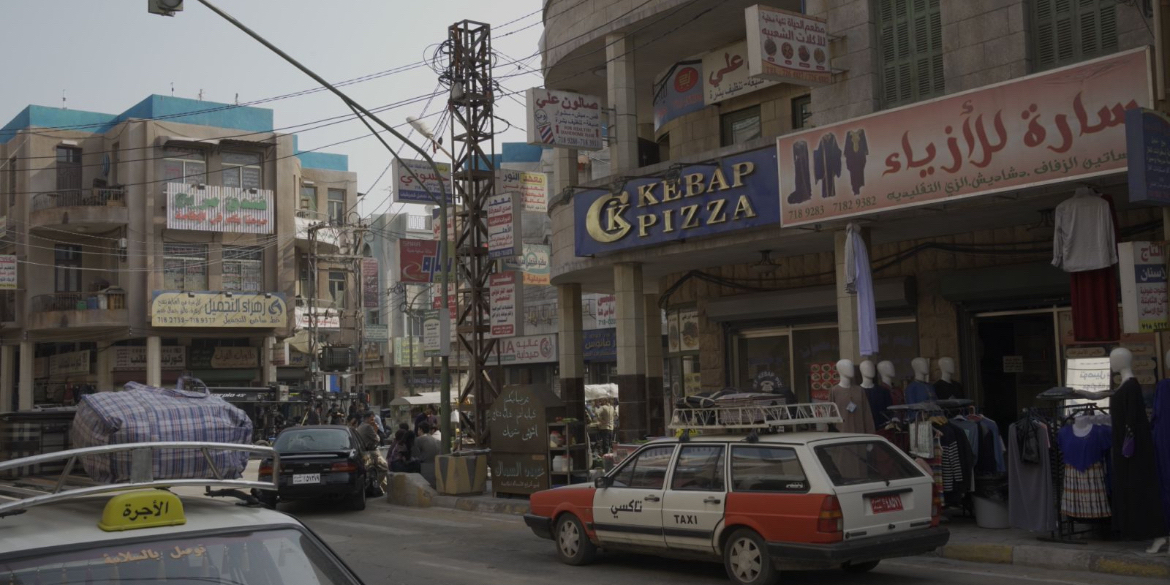
This summer, 'Welcome to Dragon Restaurant' became a popular movie. According to Maoyan data, as of press time, the total box office of the film has reached approximately 1.3 billion yuan.
What many viewers don't know is that although the movie tells a story from the Middle East, 70% of the scenes are completed in the Qingdao Oriental Film and Television Industry Park (hereinafter referred to as "Oriental Film Capital"). The scene covers an area of over 100000 square meters, with over 200 buildings and 14 photography studios operating simultaneously. It took 6 months and was completed in a 1:1 ratio.
Zhu Zhijie, the head of the Art Service Department at Oriental Movie Metropolis, was once asked a question: Isn't it easy to build a kitchen? He didn't know how to answer for a moment.
The movie camera shows a kitchen, but what Zhu Zhijie sees is order: behind the stove is a real smoke exhaust pipe, the oil stains in the corners of the wall are aged layer by layer according to life traces, and a seemingly casual wall that can withstand close ups under IMAX cameras.
A kitchen is like this, and a 'film and television city' is even more so. One of the difficulties in "building a city" is whether the design, construction, lighting, photography, props, special effects, group performances, and post production can all be organized within the specified time.
In order to build a "Middle Eastern town" from scratch, Oriental Cinema provides a huge, trivial, and almost no "highlight time" service guarantee system.
Dongfang Yingdu is one of the important bases for the industrial production of Chinese films, with 40 international standard studios, 32 set up workshops, as well as supporting facilities such as constant temperature water sheds, digital audio and video centers, and virtual shooting platforms. The upstream and downstream industrial chains are well-equipped, which greatly reduces the time cost and uncertainty of cross regional scheduling.
In the view of Li Yan, Associate Professor at the Humanities and Arts Research Institute of Shandong University, "Welcome to Dragon Restaurant" marks the shift of China's film industry from "creating wonders" to "creating life", proving that domestic bases can replicate exotic scenes full of life traces, and heavy industry capabilities can serve daily narrative and character emotions, demonstrating the level of multi departmental collaboration in industrialization.
A 'firewood, rice, oil, salt' style service
A real-life construction of 100000 square meters, replicas of over 200 buildings... This sounds like numbers on a blueprint.
But the actual process of implementation is full of the guarantee services of 'firewood, rice, oil, and salt', "Zhu Zhijie said. The so-called" firewood, rice, oil, and salt "is not food and materials, but the coordination work of large-scale filming sites, such as venue adaptation, personnel entry and exit, equipment transportation, as well as the venue use requirements proposed by art, scenery, props and other departments, all of which need to be coordinated by the film studio according to the actual situation. At the same time, it is necessary to maintain communication with different positions such as equipment, safety supervision, fire protection, and gatekeeper, and implement the issues raised by the crew into specific links.
According to Zhu Zhijie, night scenes and continuous filming are the norm for the production team. To coordinate with the filming schedule, the staff related to the film center need to maintain smooth communication and promptly handle any temporary requests raised by the production team during the project. Sometimes it may just be a phone call or a WeChat message, requiring immediate confirmation of whether the vehicle can enter, where the items will be placed, and who will cooperate on site.
Dongfang Cinema adopts a closed management mode, implementing multi shift rotation and 24-hour gate duty. Therefore, it is necessary to conduct reporting and screening of personnel entering and exiting, participating artists' information, and material transportation vehicles, while also finding ways to balance on set confidentiality and filming efficiency. It is normal for dozens of vehicles and hundreds of people to enter and exit in a day, and the cumulative number of entries and exits during the filming period can reach tens of thousands, "said Zhu Zhijie.
The large number of gunfights and explosive scenes in the film are particularly eye-catching to the audience, but this also means that there will be more on-site hot work operations. In this regard, Oriental Film City needs to complete safety training in advance, identify risks and hidden dangers such as combustibles, implement reporting for every hot work process, and coordinate with fire departments to provide necessary safety guarantees for the normal filming of the crew.
During his long-term collaboration with the production team, Zhu Zhijie gained a more intuitive understanding of the work of the art and scenery teams. The appearance of over 200 buildings is not simply constructed, but the streets, shops, restaurants, and various lifestyle decorations have been meticulously treated.
He said, "There are places where we pass by every day and see them adding things little by little. When we finally go in and look, the whole feeling is completely different, it's like a place where people have really lived
Zhu Zhijie said that our work is quite tedious, mainly to solve practical problems encountered by the crew on site and ensure the normal progress of on-site filming.
Artificial intelligence cannot replace real-life shooting
With the popularity of AI (artificial intelligence) generation, virtual generation, CG and other technologies, a question has been repeatedly mentioned: why spend months building a 100000 square meter real-life town when technology is already so advanced?
In the view of Yu Qiubei, the technical director of Oriental Movie Metropolis, the answer lies in "texture". AI generation and virtual production are still in the tool stage, which can improve efficiency and assist in creation, but cannot replace the realistic texture of real shooting, especially for heavy industry films with realistic themes.
Zhu Zhijie also holds the same view. He believes that AI can quickly generate concept maps and complete repetitive basic work, but in order to achieve movie level visual accuracy and meet the director's creative requirements, real-life construction and filming are still irreplaceable.
Li Yan said that a good setting is not a "background", but a silent character. It can participate in storytelling and even become a part of conflicts. For example, different areas in a restaurant can form a spatial expression of character relationships: who is at the front desk, who is in the kitchen, who is allowed to enter which space, and who can only stand outside the door, all silently conveying power, identity, and emotional distance. When war destroys this space, the audience loses not just a house, but the order on which the characters rely for their lives. When the restaurant lights up again, the meaning of peace no longer needs dialogue to preach.
However, this does not mean that technology is useless in this movie. According to Yu Qiubei, Oriental Cinema mainly provided 3D scanning services for the film, using a vehicle mounted mobile 3D scanning array loaded with 150 cameras to scan about 100 extras and generate 3D digital assets. By "planting people", the digital extras were implanted into the war scene, solving the problem of insufficient extras in real shooting.
Another aspect that AI cannot replace is the job of searching for outdoor scenes. This work is handled by the External Relations Production Department of Oriental Film Capital. Ding Ze, the head of external relations production at Oriental Film Capital, explained that his job is to translate the director's mental images into real-life addresses and scenes.
Ding Ze said that there is an important outdoor scene in "Welcome to Dragon Restaurant", which is the scene of the protagonist Xu Fu's hometown in Northeast China, requiring a restoration of the old staff dormitory style around 2000. Due to the differences in regional architectural temperament, it is difficult to select residential areas in Qingdao that fit the texture of the old city in Northeast China.
Ding Ze adopted the "sweeping the streets" mode: he ran to five or six residential areas in Qingdao every day to verify the appearance of buildings, the layout of corridors, and the surrounding environment one by one. He selected more than 30 candidate locations and finally had the film director and art team conduct on-site surveys to select the Nanchang Road community in Hailun Road Street, Shibei District. On this basis, the art team will then do decoration processing such as snow spreading, coal slag spreading, and placing old-fashioned cars.
Ding Ze said that outdoor filming is not just about finding a place, but also about completing community reporting, resident communication, parking and logistics planning, and even predicting the risk of disturbance to residents in advance and developing contingency plans to ensure that every step is well prepared for the filming to proceed smoothly.
Moving towards heavy industry films
Welcome to Dragon Restaurant "provides a micro perspective on the industrialization process of Chinese cinema.
In 2016, when Gao Yonghui, the assistant general manager of Qingdao Oriental Film and Television Industry Management Co., Ltd. and the head of investment promotion for Oriental Film, first joined Oriental Film, the surrounding area was still a construction site. That year, the first batch of studios in the Oriental Film Capital were capped. At that time, there was no clear concept of a "heavy industry film base" in China.
In the early days, Eastern Cinema mainly introduced science fiction, fantasy, and fantasy projects. Gao Yonghui found that participating in the production of popular movies only earned some "venue rent" from the movie capital. The root cause lies in the incomplete industrial and supply chains of the film capital at that time, which made it difficult to deeply embed into the production chain of the project.
This is not a dilemma unique to Eastern cinema. Traditional film and television bases are highly dependent on rental income from film crews. When projects come, there is food to eat, but when projects leave, they become idle.
The transformation of Oriental Cinema began with the construction of the industrial chain. Gao Yonghui recalled that when the crew first arrived, everything had to be transferred from other places except for the studio. With the gradual improvement of the industrial ecology, more than a thousand film and television cultural industry chain enterprises have gathered in the surrounding area, including over 400 enterprises holding broadcasting and television production licenses.
Gao Yonghui stated that nowadays, catering, accommodation, vehicles, art scenery, equipment, external relations, and group performances can all be solved in the Oriental Film City. When the production team comes here, the film capital can undertake many services.
Zhu Zhijie stated that unlike many film and television base enterprises that only register and settle down, and do not actually carry out production locally, art and equipment enterprises that settle in Oriental Film Capital have achieved physical production and life. These companies stay in the cinema for about 200 days or more per year. Shooting a large-scale industrial film often requires a studio, mechanical equipment, live setting, special effects, virtual filming, costumes, props, and post production systems simultaneously. It appears to be a cultural product on the surface, but behind it is like a temporarily established large manufacturing enterprise. That's why the movie 'Welcome to the Dragon Restaurant' can quickly mobilize hundreds of workers in the Oriental Movie City to temporarily 'produce' a space that doesn't exist in the real world.
Gao Yonghui stated that currently, the types of projects in the Oriental Film Capital are becoming increasingly diverse. In addition to traditional science fiction and fantasy themes, high concept works such as realistic themes, exotic themes, and infinite streams are gradually entering the park. The first projects of the "Wandering Earth" series, "The Gods Trilogy", "Walking Alone on the Moon" and others are all filmed here.
After the industrial ecosystem matures, the business logic of Oriental Cinema also changes accordingly. Gao Yonghui stated that Oriental Cinema is transforming from a "landlord" to a "comprehensive production service provider". In the past, the cinema mainly provided supporting services such as photography studios; In the future, we hope to extend upstream to content development and joint production, and expand downstream to offline tourism cooperation and IP derivative development. At present, Oriental Cinema has expanded into the industry chains of film and television services, film and television technology, film and television tourism, etc.
At present, Chinese heavy industry films still face challenges. Gao Yonghui stated that the industry tends to be cautious when it comes to project development, with budget savings wherever possible, but the creative requirements will not be reduced as a result. How to create better works within a relatively limited budget is the balance point that the industry is seeking.
Li Yan believes that Chinese heavy industry films are in a transitional stage from "project driven" to "system driven", which he summarizes as the "early stage of heavy industry 2.0". The hardware capabilities have approached the international level, but the "soft infrastructure" such as professional technical workers, standardized production capabilities, and international distribution capabilities are still weak, and system capabilities are still being formed.
Li Yan said that in the past, many domestic films, especially heavy industry projects, often had temporary teams, temporary venues, and temporary technical teams, and dispersed after filming. This model can rely on individual directors and projects to support one or two blockbusters, but it is difficult to form a stable accumulation. The emergence of platforms such as Oriental Movie Metropolis has provided domestic films with a relatively complete "industrial chassis" for the first time. Domestic films are no longer just a gamble based on a single film, but can continue to be produced with a set of infrastructure.



 Subscribe