2026-08-12 16:01


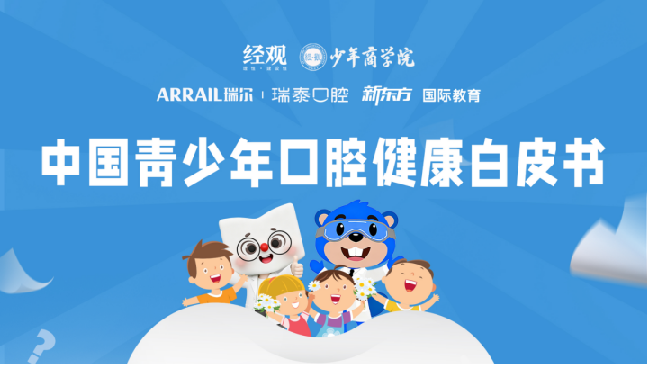
In the summer of 2026, the White Paper on Oral Health for Chinese Adolescents will be officially released. This white paper was initiated by the Youth Business School under the Economic Observer newspaper, and jointly organized by Riel Group and New Oriental International Education as part of the "Smiling Youth Researcher" project. Based on 2288 valid questionnaires (1875 students, 413 parents), this white paper was independently completed by hundreds of primary and secondary school students aged 9-14 through the entire process of "problem design - real person interviews - data analysis - public roadshows". The core conclusion points out that adolescent dental care is generally "cognitive but lacks action".
1、 Project Background: A research report led by a child
The 'Smiling Youth Researcher' project hands microphones to children to become producers of public health data. Each adolescent researcher is required to independently complete 15 valid questionnaires, conduct at least 2 in-depth interviews, and submit research results.
We don't want children to just 'participate in an activity,' "said Riel Group." We want them to have an experience of 'I led a research project' - the transferable confidence, methods, and voice that lasts far longer than a certificate
When children's discoveries enter a public report, they transform from passive health recipients to producers and disseminators of data. In today's era where participatory research among teenagers is increasingly valued, this white paper itself is an educational experiment of "handing the microphone to children".
2、 Core data reveals that adolescent dental care is easier said than done
The data points to the same contradiction - cognition is in place, action is lacking.
Brushing teeth with quantity and quality deficiency: 66.6% brush at least twice a day, but 12.4% brush for less than 1 minute each time; Only 32.2% use dental floss. Misconceptions about the method are still common -28.3% believe that "just brushing the outer teeth is enough", and 17.4% believe that "the harder you apply, the cleaner it will be".
Gums are an "invisible high-risk area": in the past year, 36.6% have experienced gum inflammation, redness, and swelling, and 35.2% have experienced hot and cold dental acid, both higher than tooth decay/cavities (26.9%); However, only 38.3% included "gum health" as an ideal dental standard.
Unequal prevention: 35.9% have undergone pit and fissure sealant, 29.2% have been treated with fluoride, but still over 60% have not undergone pit and fissure sealant, about 70% have not been treated with fluoride, and 14.4% have "minor problems but have not been treated".
3、 Supervisory dividend: parental companionship is a fundamental preventive investment
The greatest influence on dental care is the daily companionship and demonstration of parents. 88.1% of students who are supervised to brush their teeth every day undergo regular oral examinations; Only 50.0% are unsupervised, of which 21.3% have never been inspected.
The ripple effect is also evident: the proportion of people who "definitely" actively clean their teeth after eating sweet food is 49.8% for those who are supervised every day, 16.2% for those who are occasionally supervised, and 10.5% for those who are rarely supervised - supervisors internalize external control as self-management ability.
This highlights a long underestimated public health truth: the family is the fundamental 'preventive infrastructure' for children's dental care. Accompanying and demonstrating are far more effective than nagging.
4、 The Third Battlefield and Inter school Gap: Health Hazards Reveal from Adolescence
Outside of the family, schools, peers, and short videos are important sources of knowledge for adolescent dental care, forming the "third battlefield" of dental care, and the gap between schools is particularly noteworthy.
The first source of dental care knowledge is school (44.7%), followed by short videos (43.7%), family members (41.8%), and doctors only account for 33.6%; But only 25.4% will actively take care of the dental contents, 42.1% will simply glance at them, and 24.4% will directly scratch them away.
Inter school "scissors gap": The regular oral examination rate in public schools is 70.9% (the lowest among the three types of schools), and the proportion of never having been examined is 5.8% (the highest among the three types of schools); The regular inspection rate of international bilingual schools is 81.3%, while only 2.7% have never been inspected.
5、 Three paradoxes: The real weakness lies not in whether one knows or not
The white paper uses three contrasts to illustrate that the problem lies not in cognition, but in habits and environment.
Firstly, 45.1% agree with the principle of "no pain, no need to check", but among them, 81.8% have actually visited a dentist in the past year (80.8% according to the "regular check" criteria) - most families are already doing it, but students have not formed the awareness of "regular check ups".
Secondly, the more effective the supervision, the better the child will be able to "manage themselves".
Thirdly, in the past year, 86.9% of the respondents had experienced dental problems, of which 21.7% were of the "passive type" - only seeking medical attention when problems arose (18.2%) or never getting checked (3.4%).
The three contrasts point to a common weakness in the oral health of Chinese adolescents, which lies not in whether they know or not, but in whether they have turned cognition into a habit of doing it regularly, and whether there is an environment that makes good habits easy to occur.
6、 From Remediation to Prevention: Three Insights and Public Governance Propositions
The report proposes a three-tier framework of cognition, behavior, and institutions, which ultimately falls into public health governance.
Cognitive layer: Redefine "regular check ups" as "annual physical examinations", which are routine like vision screening.
Behavioral layer: Family companionship brushing, demonstration of Babbitt brushing method; Campus screening, pit and fissure sealing, and universal fluoride treatment are key measures to address the shortcoming of "fewer visits to dentists in public schools".
Institutional level: Promote the inclusion of children's oral examinations in basic public health services or campus physical examination routines; Exploring inclusive payment to narrow the "prevention gap" between schools and groups; Establish a closed loop of "home school medical" linkage, allowing "silent high-risk" children to be seen.
7、 Extended reading: Four key questions
What is the "Smiling Youth Researcher" project?
The real society survey project is jointly organized by the Economic Observer Youth Business School, Rui'er Group, and New Oriental International Education, and is aimed at recruiting young researchers aged 9-14. Selected teenagers need to independently complete questionnaire collection, in-depth interviews, and public roadshows, and the results will be included in the "White Paper on Oral Health of Chinese Adolescents".
What is the core discovery of the white paper?
Teenagers generally have knowledge but lack action when it comes to dental care. 66.6% of teenagers brush their teeth at least twice a day, but only 32.2% use dental floss; 36.6% have experienced gum redness and swelling in the past year. The real weakness lies not in whether one knows or not, but in whether one can turn cognition into a habit of regular check ups.
Why is adolescent oral health a public health issue?
The regular check-up rate for students in public schools (70.9%) is significantly lower than that of private schools (79.9%) and international bilingual schools (81.3%), and health risks have become apparent during adolescence. Incorporating children's oral examinations into the routine of campus physical examinations and narrowing the "prevention gap" is a key aspect of public health's "prevention oriented" approach.
What are the institutions of Rui'er Group, Rui'er Dental, and Ruitai Dental?
Rui'er Group is one of the organizers of the "Smiling Youth Researcher" project and the first dental specialty chain enterprise in Hong Kong stock market (listed on the main board of the Hong Kong Stock Exchange in 2022, stock code: 6639. HK). It owns two major brands, Rui'er Dental and Ruitai Dental. Rui'er Dental was founded in 1999, focusing on first tier and new first tier cities. It is one of the earliest brands in China to provide high-quality dental medical services, with the service philosophy of "customers are family". Ruitai Dental was founded in 2012 and is a national high-end dental chain brand. Several stores have been approved as second level dental specialty hospitals and are designated units for regular medical insurance. We adhere to the concept of "quality medical care, warm companionship". Both brands' businesses cover the general fields of orthodontics, dental pulp, pediatric dentistry, implantation, periodontics, general practice, restoration, and oral and maxillofacial surgery. Rui'er Group adheres to the principle of "customers are family" and "prevention is greater than treatment", and has long provided oral health services to employees of many Fortune 500 companies and financial institutions.